Building Instagram DM Automation: From Product Idea to Scalable System
Building a system to convert Instagram comments into instant DMs
Building Instagram DM Automation: From Product Idea to Scalable System
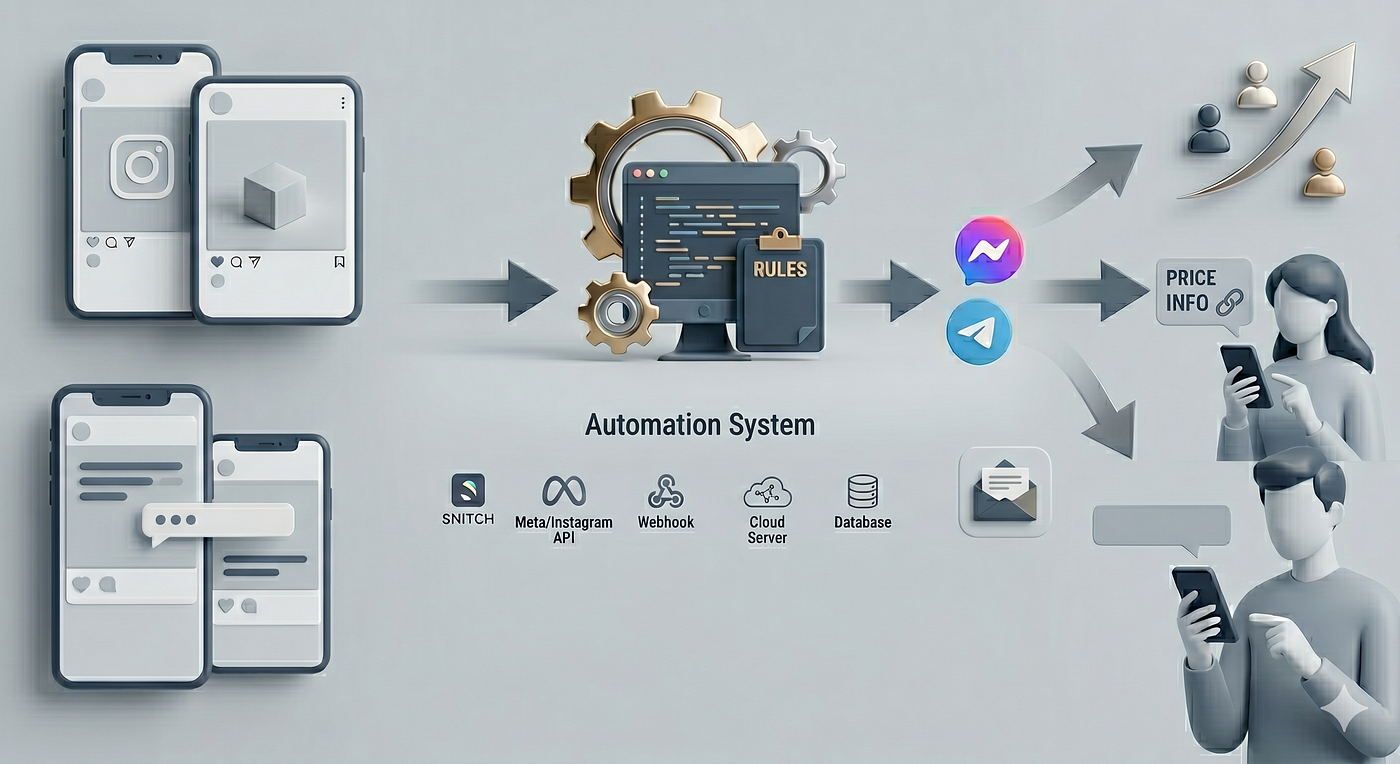
At **SNITCH**, we noticed a simple gap: users actively comment on Instagram posts (“price?”, “link?”), but manually responding was making it slow and inconsistent.
We decided to build an automated system to solve this. When a user comments on a post, the system matches it against configured rules and instantly triggers a relevant DM.
This blog walks through how we built it, starting from the product thinking, then diving into the technical architecture.
The Product Vision
Before jumping into tech, we defined the product clearly.
Problem: Users frequently comment with inquiries like “price?”, “link”, or “details pls”. Manually replying or sending DMs in response is slow, inconsistent, and doesn’t scale as engagement grows.
Solution: We designed a system where each Instagram post (media) can have its own set of automation rules. Every rule consists of defined keywords — such as “price”, “buy”, or “link” — along with a corresponding DM template that can include text, links, or even media. When a user’s comment matches one of these keywords, the system automatically triggers a DM, with an option to also post a reply to the comment.
System Architecture
At its core, the system follows an event-driven architecture where incoming Instagram events are processed asynchronously. When a user comments on a post, Meta sends a webhook event to our backend. That event is ingested, validated, and passed through a rule engine that determines whether a response should be triggered. If a match is found, a job is pushed to a queue, which is later consumed by workers responsible for sending DMs via the Instagram Messaging API.
This separation between ingestion, decision-making, and execution ensures that each component can scale independently. It also allows us to keep webhook response times low while handling spikes in traffic reliably.
High-level flow:
- Instagram → Webhook → Ingestion Service
- Rule Engine → Queue
- Worker → Instagram Messaging API
- Logging → Analytics DB

Meta API Integration and Constraints
Integrating with Instagram required working with the Instagram Graph API for reading comments and the Messaging API for sending DMs. While the APIs themselves are well-documented, the real challenge was meeting Meta’s compliance requirements. Messaging is tightly controlled, and only user-initiated interactions are allowed.
To get production access, we went through Meta’s App Review process. The key to approval was clearly demonstrating:
- User-triggered interaction (comment → DM)
- No spam or unsolicited messaging
- Clear product value for the user
On the implementation side:
- All API calls use retry + exponential backoff
- Access tokens are securely stored and rotated
- Webhook signatures are validated for authenticity
API Integration, Webhooks & Reliability
Once API access was in place, the focus shifted to reliably handling real-time events from Instagram.
Webhook delivery is not guaranteed to be exactly-once or in order — events can be duplicated, delayed, or arrive out of sequence. To handle this, we validate webhook signatures, acknowledge requests immediately, and offload processing asynchronously to keep latency low and avoid timeouts.
Idempotency is enforced using comment_id, ensuring duplicate events don’t trigger multiple actions. We also guard against race conditions during concurrent processing using unique constraints and atomic operations, so only one execution path succeeds.
The system does not rely on event ordering. Each event is processed independently using payload data, which keeps the pipeline resilient even when events arrive out of order.
Rules, Data Model & Matching
The system is rule-driven. Each Instagram post has a set of rules that define which comments should trigger a response and what that response should be. To keep the system fast and flexible, we store keywords and DM configurations directly with the rule. This avoids complex joins and ensures that rule evaluation remains a single, fast lookup.
When a comment is received, we first narrow down the scope by fetching rules only for that specific post. The comment is normalized before matching, and then simple strategies like exact and partial matching are applied. While basic, this approach works well for most real-world cases and keeps latency low.
To handle scale, frequently used rules are cached in memory, reducing database load. The system is intentionally designed to stay simple, with room to evolve into more advanced matching techniques if needed.
Queue, Workers & DM Delivery
A queue sits at the heart of the system to decouple real-time ingestion from DM execution. This ensures that webhook responses remain fast while allowing the system to process messages reliably in the background.
Each job pushed to the queue contains all the information needed to send a DM, which makes workers stateless and easy to scale. Workers consume these jobs, construct the appropriate message, and call the Instagram API.
Failures are handled carefully. Temporary issues trigger retries with backoff, while permanent failures are logged and skipped. This ensures that one bad event does not block the system. Rate limiting is also enforced at this layer to stay within API constraints during high traffic.
Observability, Scaling & Safety
Observability plays a key role in operating the system. Every important event — from rule matching to DM delivery — is logged. This allows us to monitor success rates, understand failures, and identify which keywords or campaigns perform best.
The architecture naturally supports scaling. Workers can be added as load increases, and the queue absorbs sudden traffic spikes. Caching reduces pressure on the database, and the overall system remains responsive even during high engagement.
Security and compliance are built in from the start. Webhook authenticity is verified, tokens are stored securely, and messaging strictly follows user-triggered interactions to comply with platform policies.
Conclusion
Instagram DM Automation shows how a simple idea can evolve into a scalable system. By combining event-driven design, a rule-based approach, and strong observability, we built a system that responds instantly to user intent while remaining reliable under load.
If you’re building something similar, the key is to keep the system simple, asynchronous, and observable. That combination is what turns automation into a real growth engine.
메타데이터
- post_id
- f6a67d6971a9
- slug
- building-instagram-dm-automation-from-product-idea-to-scalable-system-f6a67d6971a9
- url
- https://threads.snitch.com/building-instagram-dm-automation-from-product-idea-to-scalable-system-f6a67d6971a9
- canonical_url
- https://threads.snitch.com/building-instagram-dm-automation-from-product-idea-to-scalable-system-f6a67d6971a9
- author_url
- https://medium.com/@snitchthreads
- status
- ok
- fetched_at
- 2026-06-12 18:14:10