I Asked a CTO What Makes a Good AI Pitch. He Told Me How to Sell Against Myself.
His sharpest idea was that proof should scale with the blast radius. The riskier the system, the more credentials he needs before he’ll…

Roller coaster car, Atlantic City, New Jersey (1978) photography in high resolution by John Margolies. Original from the Library of Congress.
I Asked a CTO What Makes a Good AI Pitch. He Told Me How to Sell Against Myself.
I talked to a CTO of a large business and asked, “What’s it like being in your position now that there is AI?”
Their business has a number of products across different parts of the organisation and so they get pitched 2–3 new products everyday.
Not a Medium member? Keep reading for free by clicking **here**.
First observation — 99% of things are just the same old stuff with AI slapped on it.
The key example they used here was workday.com
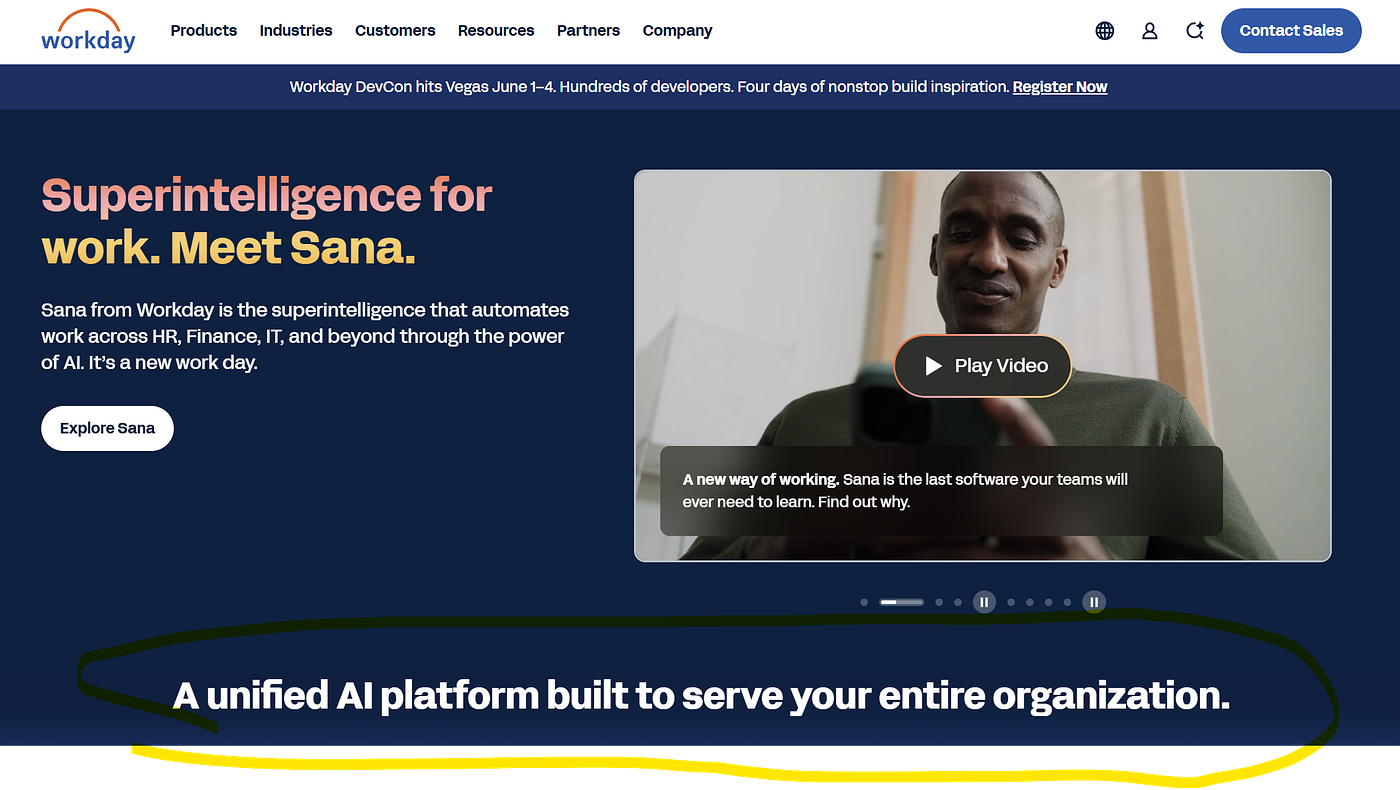
Workday is an HR & Finance system but it markets itself as a “unified AI platform built to serve your entire organisation.”
From the CTOs perspective, this gets old really quick and actually distracts from the buying process. When everyone is leading with “AI first” or “AI native” you basically have to wait for the real pitch after they get the AI out of the way.
They were finding that this most often comes from legacy based SAAS companies.
So I asked, “If someone were pitching you, what should they say?” He gave me three things.
The first was clarity.
Speak to the facts of what you do and how you help. Drop the exaggeration entirely. If AI sits at the genuine centre of your product, say so plainly and then prove it. If it’s a thin layer over something conventional, he can tell that quickly, especially as everyone else is saying the same thing.
What struck me was how he framed exaggeration. He doesn’t read it as ambition, but rather as a tell. A company that oversells the AI is usually a company that’s nervous about the substance underneath. The pitch that respects his time states the capability in plain English and lets him do the judging.
One thing I liked that he said, “Even after 100s of pitches, I’m still perfectly capable of being impressed, I just wants to arrive there myself without the hype”
The second was originality.
So much of what he hears is identical that it has become, in his words, “quite boring listening to that over and over again.”
He had a phrase for what he likes the best, Principles-first products. He describes this as when someone has taken the raw technology, started from what it can genuinely do at a fundamental level, and built upward from there to a use case nobody else had reached.
That’s a real act of engineering and imagination. It’s a different exercise altogether from taking last quarter’s roadmap and threading AI through the existing features.
The distinction matters because it tells him something about the team. A first-principles product is evidence that the people behind it actually understand the technology, rather than understanding the marketing of the technology.
I can’t always verify the claims in the room, but I can read the shape of the thinking.
Original work has a texture to it. It answers questions he didn’t know he had. I really liked this one and it reminds me of this book The Challenger Sale.
It implies a team that went away, sat with the problem, and came back with something that could only have come from genuine work. A buyer who sees a hundred decks a month can feel that texture in the first few minutes.
The third was track record, and this was the most interesting part of the whole conversation.
He’d noticed something. There are more companies like mine pitching him now than there used to be. The big tech firms and the Big Four are still around, but alongside them there’s a new layer. Smaller AI agencies, typically but not always younger people. Lean teams who’ve picked up the latest tools fast and are moving quickly. He’s watching this shift happen in real time, and he’s worked out how to think about their credibility.
He doesn’t want track record for its own sake. He wants to know which capabilities actually require it.
I thought this part was quite cool and should be encouraging if you are a startup.
Here’s the logic he walked me through. Sell him an enterprise finance system and he’ll demand a wall of credentials, reference customers, audited deployments, etc. The reason is simple, the downside of getting that wrong is enormous. It touches money, compliance, and systems that cannot fall over. As a result, “The proof has to be proportionate to the blast radius”.
But here was the cool part, if you bring him a genuinely new concept, an innovative product, something experimental at the edge of what he’s doing, then the credentials matter far less. The risk is contained, the cost of trying it and being wrong is small, and the upside is precisely the novelty he’s buying. In that area a long track record can even work against you, because it tends to come with the baggage of how things have always been done.
So the rule he applies is that the proof you need scales with the cost of being wrong.
According to him, this is the part most young teams get backwards. They turn up to pitch an innovative product and spend half their time apologising for being small, padding the deck with logos and borrowed credibility, trying to look like a firm three times their size. They’re answering a credibility question the buyer wasn’t asking. He doesn’t want you to be big! He wants you because you are different to the big companies.
A young team with a sharp, original idea, pitched into the right risk category, is in a far stronger position than they realise. Their job is to read which game they’re in and play that one well.
Putting this into practice
What these three add up to is a single pattern. Clarity, originality, and proof matched to the stakes, all ask the seller to do more work upfront and claim less on the slide deck. They reward substance and punish performance. Every one of them is harder than the alternative, which is exactly why the market is so full of the alternative. What I mean by that, deep work takes time, and that is why it is rare.
But also, be encouraged! Don’t try to copy the big guys and girls out there, just be yourself. If you are small, then play to your strengths, pitch innovative products that are relatively low risk so that you can get some runs on the board.
If you want to work on a higher ‘blast radius’ product, then be prepared to take a long time building up track record, you can’t rush that.
Before you go
Subscribe to my free Substack newsletter because you get the following:
- A brand-new article for executives on Sunday that’s only posted on Substack.
- Links to every Medium post I’ve written in the past week
- Book recommendations every week for you to spend your Audible credits on
메타데이터
- post_id
- f6b1595ffaec
- slug
- i-asked-a-cto-what-makes-a-good-ai-pitch-he-told-me-how-to-sell-against-myself-f6b1595ffaec
- url
- https://medium.com/realworld-ai-use-cases/i-asked-a-cto-what-makes-a-good-ai-pitch-he-told-me-how-to-sell-against-myself-f6b1595ffaec
- canonical_url
- https://medium.com/realworld-ai-use-cases/i-asked-a-cto-what-makes-a-good-ai-pitch-he-told-me-how-to-sell-against-myself-f6b1595ffaec
- author_url
- https://medium.com/@chrisdunlop_37984
- status
- ok
- fetched_at
- 2026-06-15 20:49:13