A Cannon and A Crown in the Park: Kacha Bagh, Chandni Chowk, Delhi
Nestled in a corner of the oval-shaped Kacha Bagh park near Chandni Chowk metro station are a cannon and a large metal ‘cap.’ Both look…
A Cannon and A Crown in the Park: Kacha Bagh, Chandni Chowk, Delhi
Nestled in a corner of the oval-shaped Kacha Bagh park near Chandni Chowk metro station are a cannon and a large metal ‘cap.’ Both look oddly out of place in their surroundings.
(Originally published on RetroDelhi.com)
The first time I stumbled upon these two fascinating objects was in 2017. After stepping out of the Chandni Chowk metro station, I took a walk through Kachcha (Kacha) Bagh Park on my way to Chandni Chowk.
Nestled in a corner of the oval-shaped park are a cannon and a large metal ‘cap.’ Both are mounted on red, concrete platforms, looking oddly out of place in their surroundings.
Were they unearthed here and simply installed on-site?
Cannon and Crown: Kacha Bagh, Chandni Chowk, Delhi (February 2024)
The bigger question is: why are they here? And when were they placed in this park? Unfortunately, there are no clear answers.
Despite exhaustive research, I couldn’t find any mention of these objects online.
The Cannon
The cannon, in particular, is captivating. Determining its age, origin, and maker would require an expert in historical weaponry. However, one thing is clear: it does not belong to the British period.
Its fading inscriptions, written in either Persian or Arabic, add a layer of mystery — there’s not a single word in English.
The cannon has faded markings in what appears to be Persian or Arabic script
For comparison, the two cannons displayed outside the Lahori Gate of the Red Fort are unmistakably British. Their design and markings leave no doubt about their origin.
This cannon, however, tells a different story. Its design suggests it may be Indian-made, adding to its historical enigma.
Could it have been part of the Mughal military arsenal? Or perhaps a weapon used by the Sepoys during their revolt against the British in 1857? There’s no plaque or explanation here to provide any answers.
The Crown
The second object initially left me puzzled. At first glance, I assumed it was somehow connected to the cannon. It’s a large metal cap topped with a ball and a cross. After considerable research, I discovered it to be a replica of a crown.
The large metal cap appears to be a crown from the British Raj (February 2024)
But what kind of crown? Upon closer inspection, it bears a striking resemblance to Queen Victoria’s crown — a relic of the British Raj.
The original crown was much smaller, featuring a silver frame set with 1,187 brilliant-cut and rose-cut diamonds. Commissioned by Queen Victoria in 1870, it was crafted by the Crown Jewellers, R.S. Garrard & Co.
The original, small crown holds a fascinating history.
After the death of her husband, Prince Albert, in 1861, Queen Victoria went into deep mourning, retreating from public life and wearing black for the next 40 years, until her death in 1901.
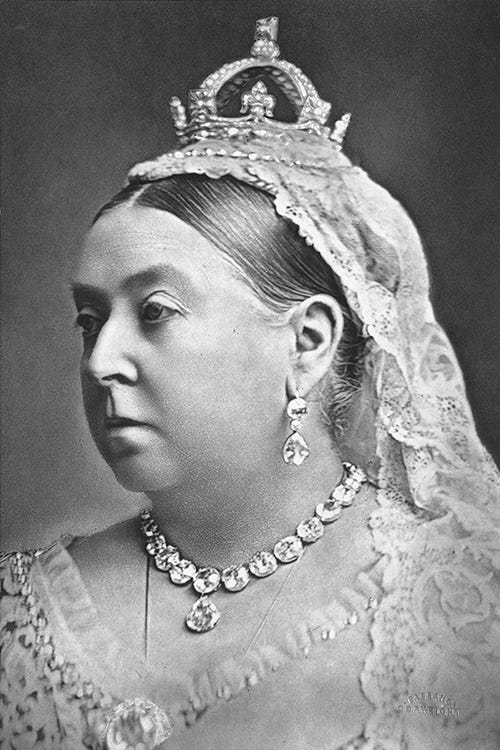
Queen Victoria wearing her small diamond crown (Source: Wikimedia Commons)
Queen Victoria refused to wear the imposing Imperial State Crown, opting instead for the much smaller, lighter crown that could be worn over her mourning attire — commonly known as “widow’s weeds.”
In 1877, *Queen Victoria was proclaimed the Empress of India*, and her crown became a symbol of her dominion over the subcontinent. The proclamation was made by the Viceroy of India, Lord Lytton, at the Imperial Assemblage in Delhi, attended by Indian princes and dignitaries.
While the event was carefully orchestrated by Lytton, local princely states held their own celebrations to mark Victoria’s new title.
Could the large replica crown have been part of the grand 1877 celebration? Was it commissioned by Lord Lytton or the British government, intended to stand as a public symbol of the British monarch’s omnipresence and supposed beneficence?
Or was it perhaps a flagpole finial — an ornamental piece placed atop a flagpole from which the Union Jack once flew?
The crown with an orb topped by a cross, a symbol of royalty (February 2024)
The crown is adorned with an orb (ball) topped by a cross, known as a globus cruciger (Latin for “cross-bearing orb”), a symbol of royal authority and divine power. This iconic element has long been associated with monarchies.
In fact, during the coronation of King Charles III in 2023, the globus cruciger is a prominent feature of the Royal Crown he wore.
Better in a Museum
Why these two relics of the past — a cannon and a crown — have been installed here specifically remains a mystery.
And if only they could speak, they would undoubtedly share stories so rich and vivid that we’d be compelled to pause, listen, and reflect, even amidst the chaos of our busy lives.
In my opinion they should be in a museum, where they can be preserved and protected from the elements.


메타데이터
- post_id
- f6b51ee22add
- slug
- a-cannon-and-a-crown-in-the-park-kacha-bagh-chandni-chowk-delhi-f6b51ee22add
- url
- https://medium.com/@hemant-arya/a-cannon-and-a-crown-in-the-park-kacha-bagh-chandni-chowk-delhi-f6b51ee22add
- canonical_url
- https://medium.com/@hemant-arya/a-cannon-and-a-crown-in-the-park-kacha-bagh-chandni-chowk-delhi-f6b51ee22add
- author_url
- https://medium.com/@hemant-arya
- status
- ok
- fetched_at
- 2026-07-13 14:59:43