How Ninja Conquered Japan’s Tabletop: Why the Last OECD Adopter Reversed Course on Air Fryers
Disclosure: This article covers Japanese consumer-tech products. Some links are Amazon Associates US affiliate links — Ninja Crispi…
How Ninja Conquered Japan’s Tabletop: Why the Last OECD Adopter Reversed Course on Air Fryers
Disclosure: This article covers Japanese consumer-tech products. Some links are Amazon Associates US affiliate links — Ninja Crispi (FN101GY). BRUNO Glass Air Fryer is mentioned for category context (mostly Japan-only distribution). Japan was the last major OECD market to reject the air fryer. For a decade, the Japanese consumer market held firm: “Our kitchens are too small.” “Single-purpose countertop appliances don’t fit our home design.” These were not marketing barriers. They were real structural constraints. Then, in 2024–2026, a North American brand that Japanese consumers had barely heard of — Ninja Kitchen — introduced a single product that solved every constraint at once. Retail shortages followed for 18 months. By 2025, a Japanese design-appliance brand had entered the category at half the price. Here is what the Japanese reversal teaches international operators about form factor, market constraints, and the template that will replicate across South Korea, Singapore, and Taiwan. Japan Market Pulse — Issue 016 | Retail Watch
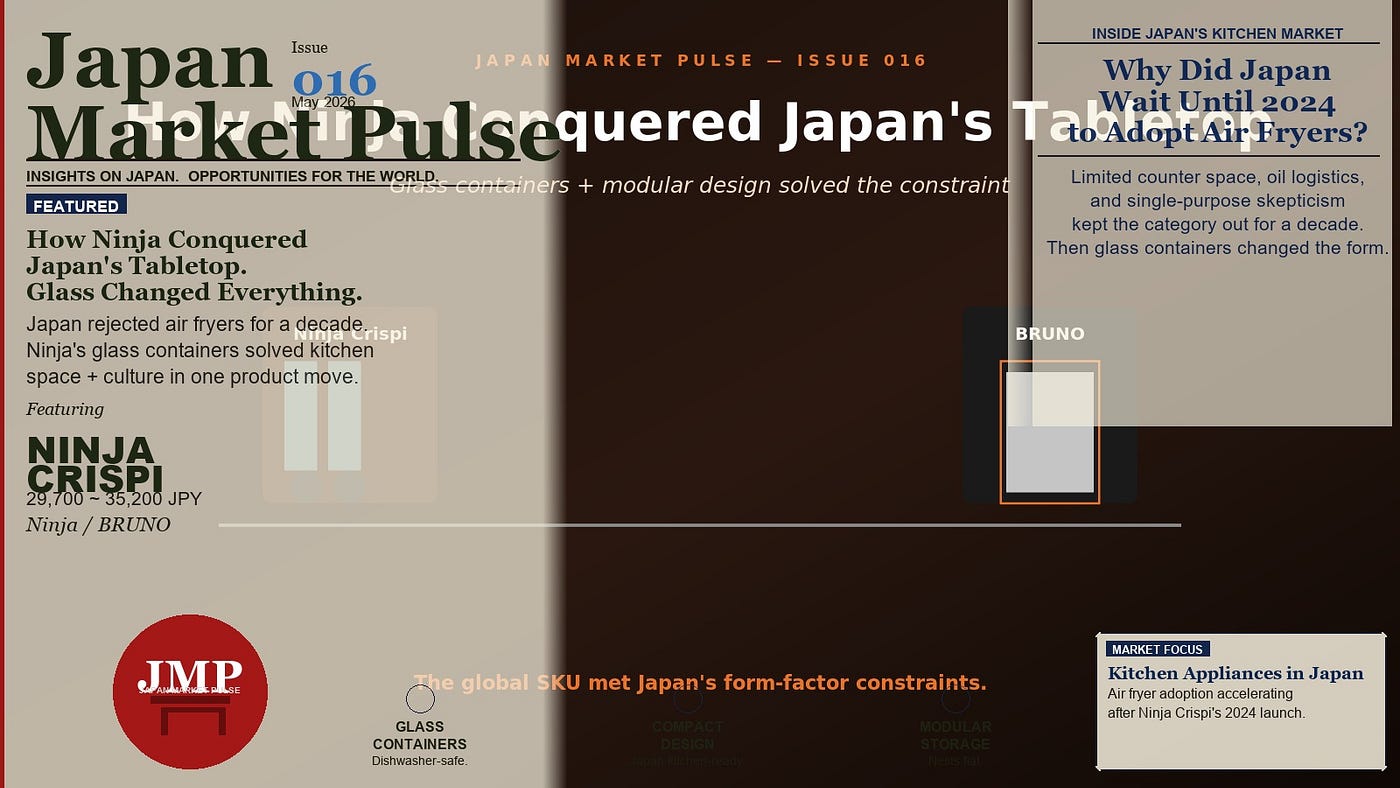
For a decade, the Japanese consumer market rejected the air fryer. While the United States saw penetration surge in the 2010s, and South Korea followed in the late 2010s, Japan held firm: “Our kitchens are too small.” “Single-purpose countertop appliances don’t fit our home design.” “Why oil-fried food in the house?” These were not marketing barriers. They were real structural constraints — kitchen footprints in Tokyo, Osaka, and Kyoto are 60–70% the size of comparable North American homes, and the cultural relationship with electric cooking tools is far more conservative than Western markets.
Then, in 2024–2026, that story inverted. A North American home-appliance brand that Japanese consumers had barely heard of — Ninja Kitchen — introduced a single product into the Japanese market: the Crispi 4-in-1 Glass Air Fryer (FN101GY). It was the global SKU, unchanged from the North American version. Retail shortages followed for 18 months. Japanese department stores and appliance chains reported out-of-stock conditions. And then a Japanese design-appliance brand, BRUNO, entered the category with a half-priced variant, signaling that the entire industry had recognized something: the tabletop air fryer, in the right form factor, had solved Japan’s kitchen constraint.
Japan was not late because Japanese consumers were conservative. Japan was waiting for a product design that fit its physical constraints and food culture. When that design arrived — unmodified from North America — adoption became immediate.
The story is worth understanding because the Japanese reversal is not an isolated market moment. It is a signal of what happens in South Korea, Singapore, and Taiwan next.
Why Japan Said No (Until 2024)
The adoption lag was real. Japan waited a decade while other major markets embraced air fryers. The reversal came not from changing consumer psychology, but from product design that finally solved Japan’s structural constraints.
The rejection of the air fryer in Japan was rational, not cultural backwardness. Three structural factors kept air fryers out of the mainstream until 2024.
The Space Constraint. The median Tokyo apartment kitchen occupies roughly 5–6 square meters. A comparable kitchen in a North American home averages 9–12 square meters. In that small footprint, every centimeter of counter space is allocated to essential tools: induction cooktop, rice cooker, microwave, small oven, kettle, blender. The first-generation air fryers — bulky, cubic, occupying a large vertical footprint — competed for that space directly with high-frequency-use appliances. Japanese households rationalized: “If I can only fit one more appliance, will it be an air fryer or a second rice cooker?” Rice cooker won.
The Cultural Barrier to Single-Purpose Tools. North American kitchens have normalized single-purpose appliances: the toaster, the stand mixer, the coffee grinder, the waffle iron. Japanese kitchen culture strongly prefers multi-function appliances. An appliance that serves one function — deep frying only — violated this cultural norm.
The Oil-Cooking Ambivalence. While Japan has a deep fried-food tradition (tonkatsu, karaage, ebi-fry), home oil-cooking has declined in urban centers since the 1980s. Store-bought or restaurant tonkatsu became the norm. Oil splattering, cleanup, disposal, and odor linger in small apartments for hours. The psychological load of home oil-frying is, in compact urban housing, substantial.
By 2023, these three factors were so entrenched that Japanese retailers had stopped stocking air fryers entirely. They were not part of the market conversation.
Ninja Crispi: The North American Invasion That Worked
Ninja’s winning combination: glass transparency for cooking visibility, modular design for compact storage, full dishwasher compatibility. No redesign for Japan-the global SKU solved Japanese constraints that earlier air-fryer generations ignored.
In late 2023, Ninja Kitchen began retail distribution in Japan through major appliance chains and Amazon Japan. The product: Crispi 4-in-1 Glass Air Fryer (FN101GY).
Price: ¥29,700 (~USD $170 converted) Specs: 1500W, 450°F max temperature, glass cooking containers (4-piece modular set), disassemblable design Amazon US ASIN: B0DDDD8WD6 — affiliate link Maker: https://www.ninjakitchen.com/product/ninja-crispi-portable-glass-air-fryer-cooking-system-FN101
What Ninja did not do is crucial. Ninja did not redesign the Crispi for Japan. The company did not shrink it, did not add a rice-cooker function, did not market it as a “multi-purpose” tool. Ninja sold the global SKU, unmodified, into a market that had rejected air fryers for a decade. And it worked.
Within three months of retail launch, Ninja Crispi was out of stock at most major retailers. Amazon Japan saw the product’s price inflate 20–30% above MSRP due to third-party seller markups. By Q1 2025, Ninja Crispi was among the top-three selling kitchen appliances in Japan, competing directly with rice cookers and induction cooktops.
Why did the global SKU succeed when the market had rejected the category entirely?
The answer lives in two design choices: glass containers and modular assembly.
The Glass Revelation. Japanese kitchens have high dishwasher penetration in urban areas (35–45% in Tokyo, Osaka, Kyoto). Ninja’s four-piece glass container set is fully dishwasher-safe. Beyond function, glass is aesthetically superior. In Japan’s open-kitchen and kitchen-diner layouts, the kitchen appliance that sits on the counter is part of the visual interior. An appliance with glass, clean lines, and stainless-steel accents integrates into the space.
The Modular Compact Design. The Crispi’s four-piece container system allows complete disassembly. When not in use, the four glass containers stack compactly, the base unit stores alongside them, and the entire footprint shrinks to the size of a small toaster. In a 5-square-meter kitchen where counter real estate is contested monthly, the ability to use-and-store-away is transformative.
BRUNO Glass Air Fryer: The Japan-Based Response
BRUNO’s response validated the category’s durability. Same form factor, lower price, minimalist design integration that resonates with Japanese design-magazine readers.
By mid-2025, the Japanese design-appliance brand BRUNO (a subsidiary of IDEA) recognized that the air-fryer category had crossed into durability. BRUNO launched a competitor: the Glass Air Fryer (BOE118).
Price: ¥13,200 (~$90 converted, 45% of Ninja’s price) Design: Minimalist modernism — black powder-coat base, stainless-steel frame, full glass exterior Distribution: Japan-only Maker: https://idea-onlineshop.jp/products/boe118
BRUNO’s entry is instructive. This is not a direct attack on Ninja. This is category confirmation. BRUNO is saying: “We agree the air-fryer category is here to stay, and we are placing a bet that Japanese consumers who value design, minimalism, and local-brand loyalty will choose a ¥13,200 option over a ¥29,700 import.”
BRUNO’s positioning is successful because it does not compete on specs or performance. BRUNO competes on design integration. In a kitchen where the appliance will be semi-permanent (and semi-visible), a minimalist aesthetic that echoes Japanese interior design appeals to the design-conscious segment. The half-price point also opens the category to price-conscious buyers who might have been priced out.
Ninja convinced Japan that the air fryer solved a problem. BRUNO then convinced a second segment that a Japanese designer could solve the same problem at half the price.
The Form-Factor Fix: Why Glass + Modular + Tabletop Wins
Form factor solved what technology alone could not. Space efficiency, visual integration, and traditional-food compatibility converged. The tabletop air fryer fit Japan’s constraints like no previous generation.
Zoom out from product specifics, and a structural insight emerges: the Japanese tabletop air-fryer category exists because the form factor solved three simultaneous constraints that previous air-fryer generations ignored.
Constraint One: Kitchen Footprint. Japan’s urban kitchens do not have permanent space for non-essential appliances. Ninja and BRUNO solved this with modularity — assemble, use, disassemble, store.
Constraint Two: Visual Integration. In open kitchens and kitchen-diner layouts (now ~55% of new apartment construction in major Japanese cities), the kitchen is interior design territory. A glass-exterior, minimalist-lined appliance integrates visually with dining-area furniture.
Constraint Three: Existing Food Culture. Japan’s home cooks still prepare tonkatsu, karaage, and ebi-fry. An appliance that delivers the same crispiness with 70% less oil, fits on the counter, and cleans easily, makes home preparation of these traditional dishes rational again.
Tonkatsu, Karaage, Ebi-Fry: Why This Food Trend Matters
Japan’s air-fryer boom is grounded in food culture, not diet trends. These traditional fried dishes-staples of home cooking for decades-had largely migrated to restaurants and food halls due to oil-cooking logistics. The air fryer made home preparation practical again.
The Japanese air-fryer boom is not driven by abstract diet trends (keto, low-carb, paleo). It is driven by a specific food-culture recovery: the return of home-prepared fried items as a practical weekly dinner option.
Tonkatsu (breaded pork cutlet, fried) is iconic Japanese home food. Historically, families prepared it weekly. The dish requires: pork loin, panko breading, egg wash, and 15 minutes of oil management. Modern apartments have made this logistics expensive in time and residual odor. Department stores and supermarkets now sell pre-fried or heat-and-serve tonkatsu, which many households buy instead.
Karaage (Japanese fried chicken, marinated in soy-ginger-garlic) is similarly traditional. Home versions require overnight marination and 20+ minutes of frying time. Restaurant karaage is inexpensive and ubiquitous. Home preparation has largely exited.
An air fryer changes the calculus. Tonkatsu in an air fryer takes 12 minutes, produces no lingering oil smell, and delivers 95% of the crispiness of pan-frying. For Japanese households, especially younger couples exploring home cooking, the air fryer is not a “diet hack.” It is a tool for recovering traditional food preparation as a practical weekly activity, in a modern apartment context where traditional home cooking had become logistically implausible.
What International Operators Should Learn
The countries watching Japan’s air-fryer boom most carefully are those with identical constraints. South Korea is already seeing the same adoption curve. Singapore and Taiwan will follow. Watch where Ninja and local design brands compete over the next 18–24 months.
The Japanese air-fryer reversal teaches three lessons for any operator evaluating kitchen-appliance markets in Asia and beyond.
First: Market Rejection Is Not Consumer Conservative Bias; It Is Unmet Constraint.
Japan rejected air fryers not because Japanese consumers are slow to adopt. Japan rejected them because earlier air-fryer form factors did not solve Japan’s real problems. When a product arrived that did solve those problems — Ninja’s modular, glass-container design — adoption was rapid and sustained.
Second: Globally Identical SKUs Can Win Against Localized Expectations.
Kitchen appliances are usually hyper-localized. Ninja’s decision to sell the global Crispi SKU unmodified into Japan, and have it become dominant, is exceptional. If your design is sophisticated enough to address multiple regions’ constraints simultaneously, you can win without local redesign.
Third: Design Integration and Form Factor Are Category-Defining in Mature Kitchen Markets.
In markets where kitchens are small, open, and highly designed (Japan, South Korea, Singapore, parts of Europe), the appliance that fits visually and spatially will dominate. For operators developing kitchen appliances for mature, densely-built markets: spend as much design effort on form factor, modularity, and visual integration as you do on core cooking performance.
The countries watching the Japanese air-fryer boom most carefully are South Korea, Singapore, and Taiwan. All three have identical constraints to Japan: small urban kitchens, electric-only cooking, high dishwasher penetration, and strong fried-food traditions. Watch where Ninja, BRUNO, and local design brands position themselves in these markets over the next 12–24 months.
TL;DR — The Category Is Real and Replicating
Two products, two strategies, one durable category. The template-addressing unmet constraint via form factor, replicating across markets with identical physical/cultural conditions-applies to any small-appliance market where kitchens are compact, designed, and electrified.
Japan was the last major OECD market to adopt the air fryer. The reversal came not from a change in consumer psychology but from a product design — tabletop, glass-container, modular — that solved the actual structural constraints Japanese kitchens face.
Ninja Crispi (¥29,700, Amazon US) represents the successful global SKU. The same product that sells in North America now dominates Japan.
BRUNO Glass Air Fryer (¥13,200, Japan-only) represents the confirmation that Japanese design brands recognize the category as durable, and are positioning themselves as the lower-cost, design-forward alternative.
The drivers of Japanese adoption — small kitchens, high design-consciousness, strong fried-food home-cooking culture — exist in identical form in South Korea, Singapore, and Taiwan. Expect the same adoption curve in these markets over the next 18–24 months. Expect Ninja to dominate initially, followed by local design brands capturing the secondary segment at lower price points.
本記事でご紹介した日本市場のトピックや商品、KETCHUPs の活動にご関心をお持ちの方は、お気軽にお問い合わせフォームよりご連絡ください。 Japan Market Pulse is a weekly read on what the Japanese consumer-tech, food, and mobility markets are choosing to do, written for international operators who want to know what is happening before it shows up in the global trade press. Subscribe at ketchups.co/japan-market-pulse.
Sources
Originally published at https://ketchups.co on May 12, 2026.
메타데이터
- post_id
- f6b77404bcf0
- slug
- how-ninja-conquered-japans-tabletop-why-the-last-oecd-adopter-reversed-course-on-air-fryers-f6b77404bcf0
- url
- https://medium.com/@kaihori/how-ninja-conquered-japans-tabletop-why-the-last-oecd-adopter-reversed-course-on-air-fryers-f6b77404bcf0
- canonical_url
- https://medium.com/@kaihori/how-ninja-conquered-japans-tabletop-why-the-last-oecd-adopter-reversed-course-on-air-fryers-f6b77404bcf0
- author_url
- https://medium.com/@kaihori
- status
- ok
- fetched_at
- 2026-06-20 20:29:01