Amdocs Is Cutting 3,000 Jobs. The Real Story Isn’t the Layoffs.
When a $5B enterprise software company names AI as the explicit reason for cutting 10% of its workforce, something structural is happening.
Amdocs Is Cutting 3,000 Jobs. The Real Story Isn’t the Layoffs.
When a $5B enterprise software company names AI as the explicit reason for cutting 10% of its workforce, something structural is happening.
Headlines read: Amdocs to lay off 3,000 employees. Readers move on.
That’s the wrong reaction. Because what’s actually happening at Amdocs isn’t a cost-cutting story. It’s a signal about how enterprise software companies are being forced to rewire themselves and most aren’t moving fast enough.
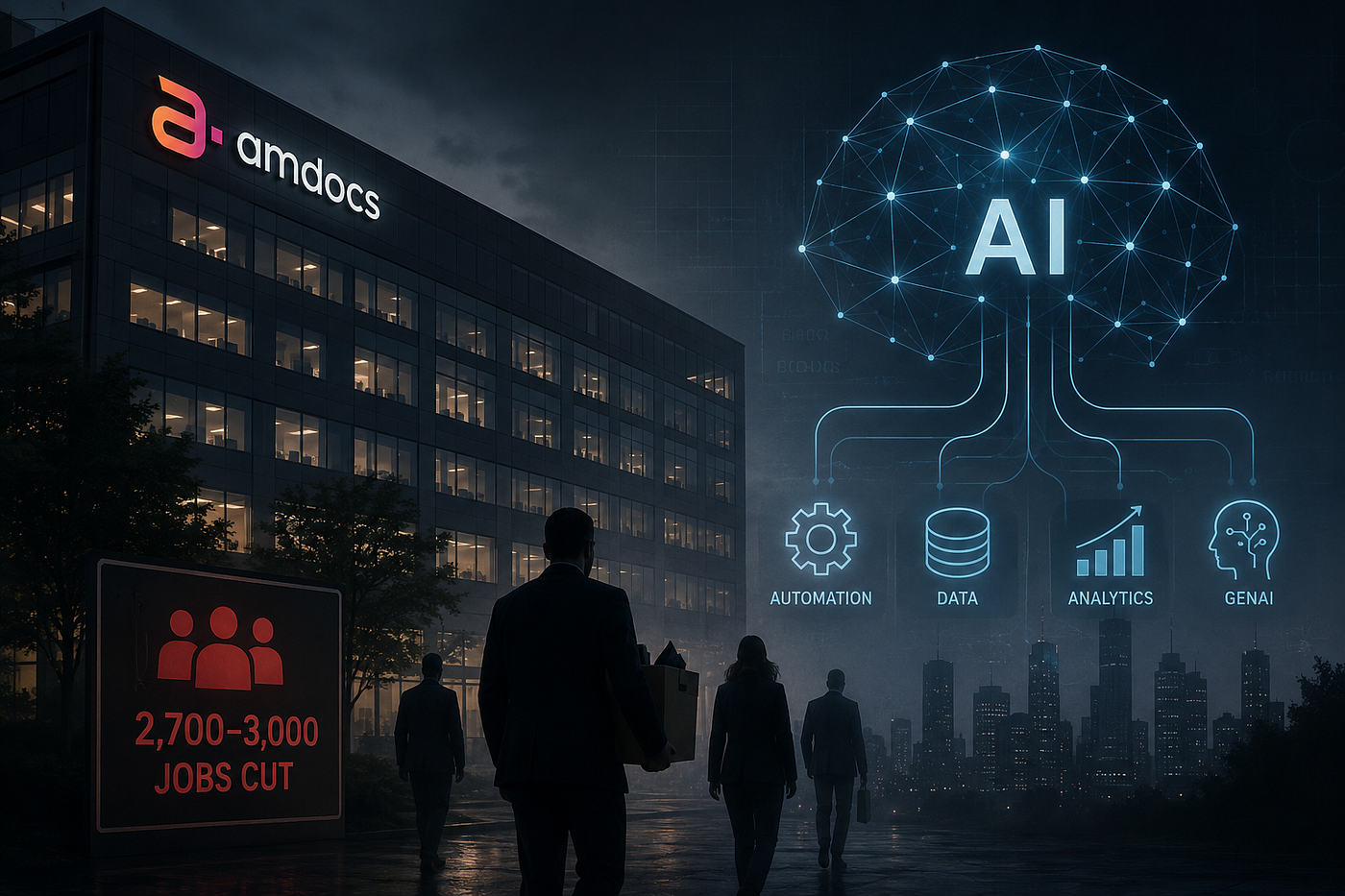
Ai Generated Image
What’s Actually Happening
Amdocs builds billing, customer management, and BSS/OSS systems for telecom carriers. Think AT&T, T-Mobile, and similar global operators. It’s high-customization, high-labor, deeply embedded software the kind that takes years to replace.
And yet the company is eliminating roughly 10% of its 29,000-person workforce. Not because business is collapsing Q2 fiscal 2026 revenue came in at $1.17 billion, up 3.9% year-over-year. The cuts are tied directly to a company-wide AI reorganization, including the creation of a dedicated GenAI & Data division that consolidates product, engineering, strategy, and go-to-market under one unit.
New CEO Shimie Hortig, who took over in March 2026, has been explicit: AI is being integrated “deeply into the DNA of the company.” That’s not PR language. It’s an architectural decision and it has workforce consequences.
This Isn’t Year One
Here’s the number that deserves more attention: 7,000+.
That’s the cumulative headcount reduction at Amdocs across 2023, 2024, and 2026 if this round hits its upper estimate.
Year      Cuts       Label
──────────────────────────────────────
2023      ~2,700     Restructuring
2024      ~1,500     Operational
2026      2,700–3,000  AI-driven reorganization
──────────────────────────────────────
Total     ~7,000+    Three rounds, one direction
The first two rounds weren’t publicly branded as AI-driven. This one is. That labeling shift matters more than people realize.
The Architectural Shift Underneath
What Amdocs is building isn’t just a smaller team. It’s a different operating model. The GenAI & Data division represents a consolidation pattern emerging across enterprise software:
BEFORE (Traditional Enterprise Software Org)
   ─────────────────────────────────────────────
  Product    Engineering    Professional     Support
  Teams         Teams         Services       Teams
     │              │              │            │
     └──────────────┴──────────────┴────────────┘
                         │
                   Per-customer
                   customization
                   (labor-heavy)

AFTER (AI-Reorganized Org)
─────────────────────────────────────────────
           ┌──────────────────────┐
           │   GenAI & Data       │
           │   Division           │
           │  (Strategy + Eng     │
           │   + GTM unified)     │
           └──────────┬───────────┘
                      │
           ┌──────────▼───────────┐
           │  AI-augmented        │
           │  delivery layer      │
           │  (automates repeat   │
           │   customization work)│
           └──────────────────────┘
The bet: AI handles the repetitive customization and support work that previously required large implementation teams. Fewer humans, higher margins, faster delivery cycles.
Why Telecom BSS/OSS Is Actually Hard to Automate
Here’s the tension nobody’s discussing. Amdocs doesn’t build generic SaaS. Telecom billing and OSS systems are notoriously complex carrier-specific business rules, legacy integrations, regulatory requirements that vary by country, contracts that run for years.
A rough mental model of what AI can and can’t touch here:
# Work AI can absorb quickly
automatable = [
    "Ticket triage and routing",
    "Standard configuration tasks",
    "Test case generation",
    "Documentation and reporting",
    "Code review for repetitive patterns",
]

# Work that still needs domain expertise
human_required = [
    "Novel carrier integrations",
    "Regulatory compliance for new markets",
    "Contract-level customization decisions",
    "Incident management on live carrier systems",
    "Architecture decisions for 10-year-old OSS stacks",
]
The risk: if Amdocs cuts too deep into the second list while the AI tooling is still maturing, they face capability gaps at contract renewals in 2026 and 2027. Carriers like AT&T don’t have patience for service disruptions on billing systems.
What This Normalizes
Amdocs is now one of the largest enterprise software companies to formally label a workforce reduction as AI-era restructuring. That label “AI-era restructuring” is new language, and it will spread.
When a company of this scale points to AI as the structural driver of headcount reduction (not a downturn, not a merger, not poor performance), it gives other enterprise software executives a template. Expect more companies to use this framing over the next 18 months.
The precedent isn’t just about jobs. It’s about how enterprise software delivery is being repriced. If AI-augmented teams can deliver what 29,000-person organizations used to deliver, the cost basis of the entire industry shifts.
What To Watch
Three indicators that will tell whether this restructuring is working or backfiring:
1. Contract renewal rates with major carriers. If AT&T or Deutsche Telekom quietly move to a competitor’s BSS stack in 2027, the capability gap hypothesis wins.
2. Revenue per employee trend. If revenue holds while headcount drops, the AI-efficiency thesis has legs. If revenue also drops, the cuts were just margin preservation.
3. Whether the GenAI division ships products or becomes an internal cost center. A dedicated AI division that only reduces headcount internally isn’t a product bet , it’s an operations bet. The former is more valuable long-term.
The Uncomfortable Truth
Three thousand jobs is a human story first. People with mortgages, families, years of specialized domain knowledge that matters and shouldn’t get lost in the architecture diagrams.
But zooming out: this is what technology-driven displacement looks like in enterprise software. It’s not robots replacing assembly lines. It’s AI absorbing the middle layers of knowledge work the ticket triagers, the configurers, the repetitive implementation tasks in a company that most people have never heard of but whose software touches every major carrier on the planet.
This isn’t an isolated event. It’s a preview.
Sources: The Jerusalem Post, ValueTheMarkets, Commstrader, AI Weekly, Layoffs.fyi
메타데이터
- post_id
- f6bbecb626d6
- slug
- amdocs-is-cutting-3-000-jobs-the-real-story-isnt-the-layoffs-f6bbecb626d6
- url
- https://medium.com/@kanishks772/amdocs-is-cutting-3-000-jobs-the-real-story-isnt-the-layoffs-f6bbecb626d6
- canonical_url
- https://medium.com/@kanishks772/amdocs-is-cutting-3-000-jobs-the-real-story-isnt-the-layoffs-f6bbecb626d6
- author_url
- https://medium.com/@kanishks772
- status
- ok
- fetched_at
- 2026-07-09 17:12:49