Why Did Gold Prices Drop Despite the War?
Why did gold prices fail to surge despite escalating war in 2026? The traditional “War = Gold Rally” formula is broken. This article…
Why Did Gold Prices Drop Despite the War? The True Cause of the ‘Safe Haven Paradox’ in the 2026 Gold Market
Why did gold prices fail to surge despite escalating war in 2026? The traditional “War = Gold Rally” formula is broken. This article analyzes the ‘Safe Haven Paradox,’ explaining how high interest rates, a strong US dollar, and yielding Treasury bonds suppressed gold prices, proving that modern gold valuation is dictated by macroeconomics, not just geopolitics.
Table of Contents
- Why Was the “War Equals Surging Gold” Formula Broken?
- Summary of the Gold Price Flow in Early 2026
- What is the Safe Haven Paradox?
- The First Variable Suppressing Gold Prices: High Interest Rates
- The Second Variable Suppressing Gold Prices: A Strong Dollar
- Conclusion
1. Why Was the “War Equals Surging Gold” Formula Broken?
Gold has long been globally recognized as the ultimate safe-haven asset. Whenever uncertainties such as war, financial crises, inflation, or fiat currency debasement amplify, gold is the very first asset that comes to investors’ minds. Therefore, the vast majority of people naturally assumed that as military tensions escalated in the Middle East and the possibility of a direct conflict between the US and Iran expanded, the price of gold would inevitably skyrocket.
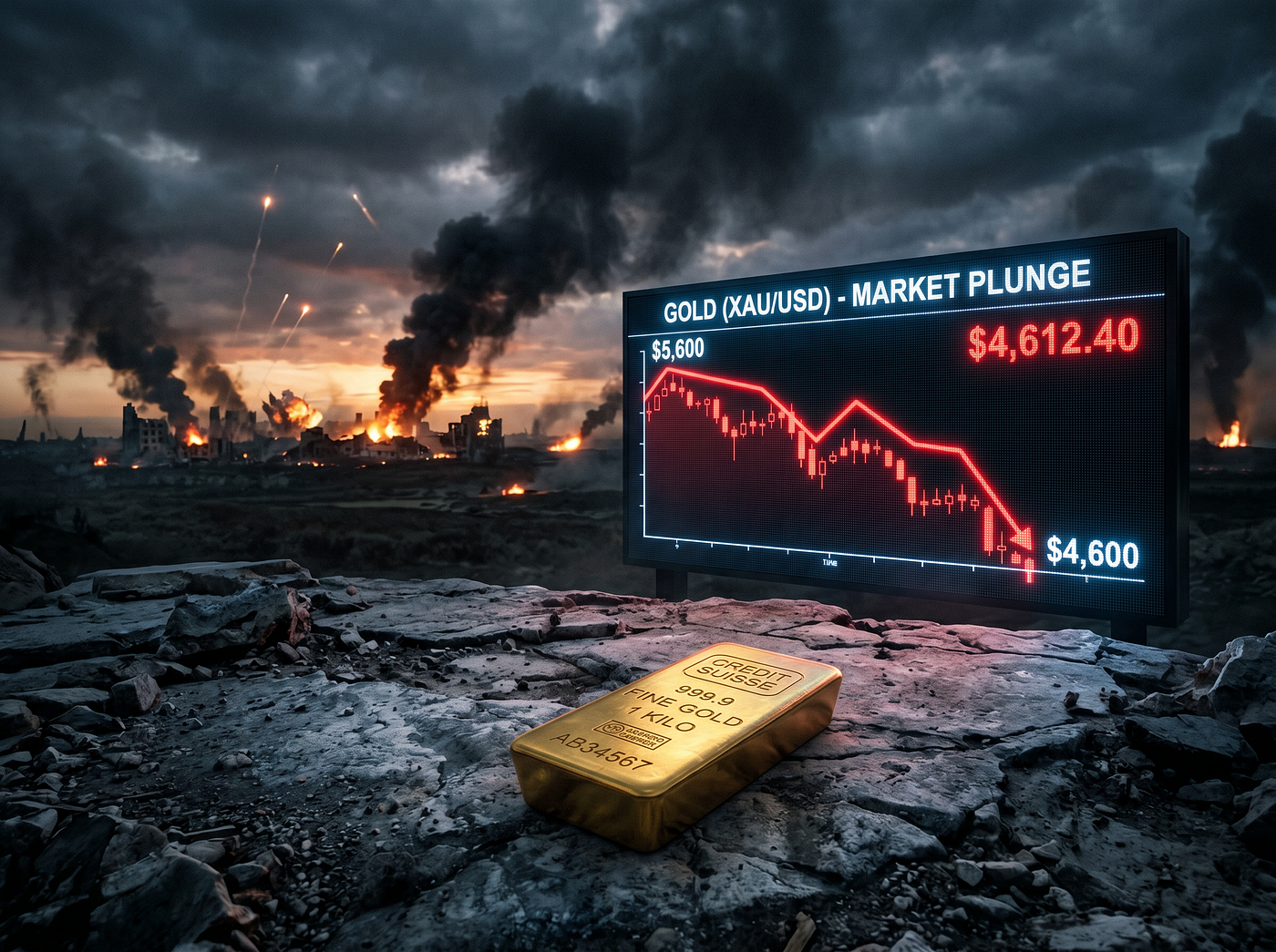
However, in the gold market of early 2026, this historical formula operated completely contrary to expectations. Despite the amplification of severe geopolitical risks — and the emergence of classic safe-haven catalysts like tensions in the Strait of Hormuz and surging crude oil prices — the price of gold failed to rally strongly. Instead, after recording an unprecedented historical high surpassing $5,500 per ounce in January 2026, it retreated to approximately $4,600 by late April, consolidating within a frustrating box range.
This phenomenon cannot be simply interpreted as “Gold has lost its role as a safe haven.” Rather, it is far more accurate to acknowledge that the modern gold market has entered a vastly more complex price-determination structure than in the past. The price of gold is no longer moved solely by the single geopolitical variable of war. It is simultaneously reflecting US interest rates, the strength of the dollar, Treasury yields, ETF capital flows, the need for institutional liquidity, and the pace of Central Bank accumulation.
In Part 1 of this series, we will first address the most fundamental question. Why did the price of gold fail to rise significantly despite the escalation of war and uncertainty? And what are the precise reasons why gold could not defend the $5,000 threshold and was pushed down near $4,600? The absolute core of this issue is not the “Betrayal of a Safe Haven,” but rather a fundamental “Shift in the Competition Among Safe Havens.”

2. Summary of the Gold Price Flow in Early 2026
1) Entering a $4,600 Box Range After Peaking at $5,600 per Ounce
By early 2026, the price of gold had already surged to an exceptionally high level. Driven by a complex amalgamation of geopolitical anxiety, inflation fears, sustained long-term accumulation by central banks, and growing distrust in the fiat dollar system, gold forcefully entered the territory of all-time highs. At certain points, the price surged past $5,500, approaching the $5,600 mark, leading market analysts to declare the commencement of a massive new long-term supercycle for gold.
However, the crucial point to remember is that gold did not start its ascent from a low price point when the war news broke. Massive expectations were already fully ‘priced in’ to the market. Because Middle Eastern risks, inflation hedging demands, and central bank buying expectations were already baked into the valuation, the actual room for additional upward movement was far more restricted than anticipated.
The fact that gold dropped back toward $4,600 after its peak does not imply that gold’s intrinsic value evaporated. Rather, a price that had risen too rapidly was simply undergoing a necessary correction in the face of harsh macroeconomic realities: unyielding interest rates and a dominant dollar. The most dangerous moment in any investment market is when overwhelmingly positive news is released, yet the price fails to rise further. If the price already reflects maximum expectations, new catalysts yield limited upside and instead provide the perfect excuse for massive profit-taking selloffs.
The 2026 gold market perfectly exhibited this dynamic. War and uncertainty were undeniably bullish catalysts for gold, but the market was simultaneously fixated on vastly stronger macroeconomic variables: high interest rates and a strong dollar.
2) Why Gold Was Suppressed Despite US-Iran Tensions, Hormuz Risks, and Surging Oil Prices
Generally, when Middle East war risks escalate, immense upward pressure is exerted on the price of gold. Because the Strait of Hormuz is the absolute critical artery for global crude oil transportation, tensions in this region immediately translate to surging energy prices and severe inflation fears. Theoretically, this environment is immensely positive for gold. Gold is universally recognized as the ultimate asset for defending against currency devaluation and rising consumer prices.
However, in the 2026 market, surging oil prices — instead of propelling gold higher — actually acted as heavy shackles suppressing its ascent. The underlying reason is brutally simple. A violent spike in oil prices directly stimulates inflation. If inflation reignites, the US Federal Reserve fundamentally cannot lower interest rates. The moment the expectation of interest rate cuts vanishes, a massive burden is placed entirely on gold.
Gold is a non-yielding asset; it generates zero interest. Conversely, US Treasuries and dollar-denominated short-term financial instruments provide highly attractive, guaranteed interest yields in a high-rate environment. From an investor’s perspective, even if the prospect of war is terrifying, they must coldly calculate: Should I hold gold, which offers zero yield, or should I hold US Treasuries or dollar assets, which offer absolute safety combined with guaranteed interest? In the market of early 2026, the latter emerged as the overwhelmingly superior choice.
Ultimately, while the war itself was a bullish catalyst for gold, the inflation fears generated by that war actively destroyed expectations for interest rate cuts. Consequently, gold completely failed to capture the full ‘war premium.’ This is the absolute first key to deciphering the 2026 gold market.
3) The Background Behind the Short-Lived ‘War Premium’
A ‘War Premium’ is the inflated price added when the market actively anticipates the absolute worst-case scenario. As the probability of scenarios like full-scale total war, the collapse of global energy supply chains, logistical paralysis, and catastrophic financial market shocks expand, the premium attached to gold multiplies. However, this premium is never permanent. The exact moment the market assesses that “the absolute worst can be avoided,” this premium evaporates instantaneously.
In early April 2026, as expectations for a temporary ceasefire between the US and Iran emerged, the market rapidly shifted its weight from the expansion of war toward the possibility of diplomatic negotiation. As the probability of a Strait of Hormuz blockade plummeted, oil prices crashed, and the appetite for risk-on assets partially recovered, the massive pools of defensive capital parked in gold immediately began to migrate elsewhere.
The critical lesson here is that gold is absolutely not an asset that reacts exclusively to war headlines. While gold can surge violently when fear amplifies, it can face equally violent corrections the moment that fear subsides. Particularly if a massive number of investors were already holding gold near its absolute peak, news of a ceasefire or negotiation acts as the ultimate justification for aggressive profit-taking.
Because of this specific dynamic, the price of gold completely failed to decisively break and hold the $5,000 barrier, even though the underlying risk of war had not been fully eliminated. The market ceased asking, “Will the war continue?” and began intensely asking, “How will this war impact interest rates and the dollar?”

3. What is the Safe Haven Paradox?
1) Gold is a Safe Haven, But It is Not an Asset That Always Goes Up
Declaring gold a safe-haven asset absolutely does not mean it will blindly appreciate during every crisis. Over the long term, gold impeccably defends against the debasement of fiat currency and functions as the ultimate alternative store of value when distrust in the legacy financial system peaks. However, its short-term price action fluctuates in a vastly more complex manner.
When a systemic crisis occurs, investors aggressively reduce their exposure to risk-on assets and increase their allocation to safe havens. However, multiple categories of safe havens exist. Gold, the US Dollar, US Treasuries, short-term cash deposits, Money Market Funds (MMFs), and even physical commodities like crude oil can all be selected as safe havens or defensive assets under specific macroeconomic conditions. Therefore, a crisis occurring does not guarantee that all fleeing capital will blindly funnel solely into gold.
The phenomenon observed in the 2026 gold market is precisely this intense “Competition Among Safe Havens.” While institutional investors thoroughly acknowledged the unshakeable stability of gold, they simultaneously evaluated the high-yielding US Dollar and US Treasuries as far more attractive options. In essence, gold was safe, but the dollar was both safe and highly profitable. This crucial discrepancy is exactly what capped gold’s upward trajectory.
2) Why the Dollar and Treasuries Were Chosen Over Gold During the Crisis
When war erupts and financial instability explodes, the absolute first thing institutions require is highly liquid cash assets. As volatility spikes, institutional investors violently reduce their overall positions, prepare for cascading margin calls, and aggressively maximize their cash reserves. In these precise moments, the universally preferred asset is the US Dollar. This is because the dollar remains the undisputed bedrock currency for global settlements and debt repayment.
US Treasury bonds also serve as a formidable alternative. Treasuries form the deepest, most highly liquid bond market on the planet, and in a high-interest-rate environment, they perfectly provide absolute stability combined with attractive yields. No matter how safe gold may be, its inherent weakness of providing zero interest is an undeniable mathematical reality.
Therefore, when a geopolitical crisis erupts while US interest rates remain elevated — exactly as they did in 2026 — global capital is violently split between gold and the dollar. In the low-interest-rate eras of the past, gold’s lack of yield was not a heavily scrutinized weakness. However, in an era of sustained high interest rates, the opportunity cost (the forgone interest) of holding gold becomes massive. This is the absolute core pressure suppressing gold prices.
Furthermore, as the dollar strengthens, gold becomes exponentially more expensive for any investor utilizing a currency other than the dollar. Investors attempting to purchase gold using the Korean Won, Euro, Chinese Yuan, or Japanese Yen must bear a significantly higher financial burden solely due to the strength of the dollar. This acts as a massive headwind, severely dulling global physical gold demand.
3) The Limitations of the “Gold Price Rally Formula” That Investors Easily Miss
The vast majority of retail investors blindly memorize a dangerously simple formula: “War = Rising Gold Prices.” Of course, this formula is not entirely false. A war will undeniably stimulate safe-haven demand for gold. However, in the unforgiving reality of global financial markets, this formula does not always operate flawlessly.
The actual formula dictating the price of gold is vastly more intricate. When a war breaks out, safe-haven demand initially spikes. But simultaneously, oil prices surge, heavily stimulating broad inflation. As inflation solidifies, central banks find it structurally impossible to lower interest rates. If high interest rates are maintained, the opportunity cost of holding non-yielding gold skyrockets. As the dollar strengthens, gold becomes mathematically more expensive globally, which can trigger massive profit-taking and forced leverage liquidations across ETF and futures markets.
In summary, while war itself is a catalyst for rising gold prices, the macroeconomic consequences generated by that war can actually become powerful catalysts for crashing gold prices. The 2026 gold market serves as the ultimate, stark example vividly demonstrating this exact paradox.
4. The First Variable Suppressing Gold Prices: High Interest Rates
1) Gold is an Asset Devoid of Interest and Dividends
The greatest defining characteristic of gold is that it possesses intrinsic physical value. Gold does not rely directly on the quarterly earnings of a specific corporation or the sovereign credit rating of a specific nation. Therefore, when the global financial system trembles, it is universally valued as a completely independent, uncensorable store of value.
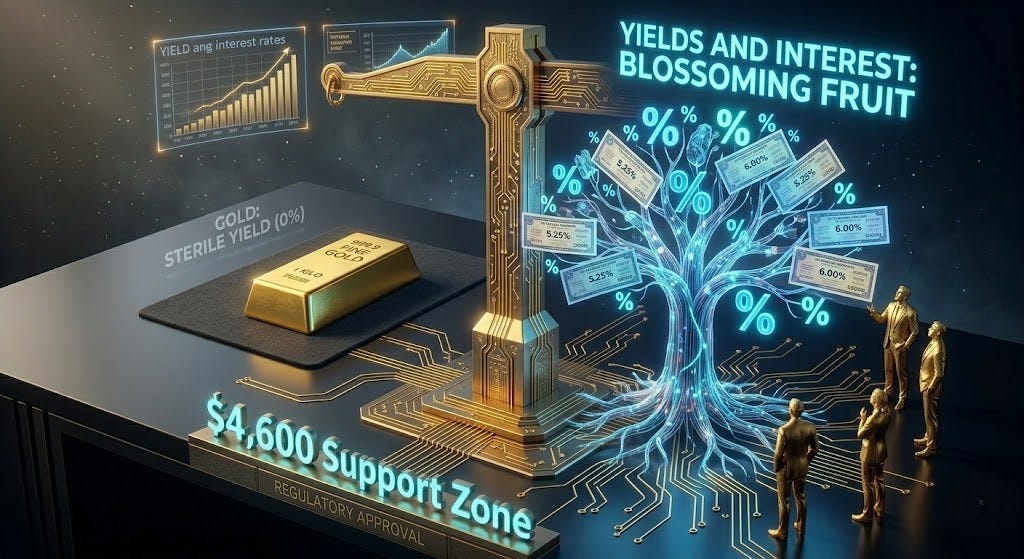
However, gold also possesses a glaring, undeniable weakness. Gold pays zero interest. It issues zero dividends. Merely holding it generates absolutely zero cash flow. If the spot price of gold does not appreciate, the investor realizes absolutely zero profit.
Conversely, in a sustained high-interest-rate environment, US Treasuries, fixed deposits, Money Market Funds (MMFs), and dollar-denominated short-term instruments provide remarkably high, guaranteed interest yields. At this juncture, sophisticated institutional investors do not merely seek ‘safety’; they actively prioritize “assets that provide safety while simultaneously generating yield.” Consequently, the relative attractiveness of gold plummets drastically.
The absolute core of the 2026 gold price correction lies exactly here. It is not that the intrinsic value of gold itself weakened; rather, the fundamental attractiveness of the competing safe-haven assets became overwhelmingly superior.
2) The Structure Where Rising Real Interest Rates Amplify the Opportunity Cost of Holding Gold
When analyzing the price of gold, one of the most critical macroeconomic concepts to grasp is ‘Real Interest Rates.’ The real interest rate is calculated by subtracting the rate of inflation from the nominal interest rate. Simply put, it is the actual, purchasing-power-adjusted yield an investor earns when lending money or holding a bond.
When real interest rates are low or negative, gold has an incredibly easy path to explosive strength. Because holding cash results in a loss of purchasing power, and holding bonds yields negative real returns, gold instantly emerges as the premier alternative to defend against the debasement of currency.
Conversely, when real interest rates rise, a massive burden is placed on gold. Investors must forfeit the lucrative interest yields they could have easily earned while choosing to hold barren gold. This is the exact definition of the ‘Opportunity Cost’ of holding gold.
In early 2026, the market was heavily pricing in the possibility of aggressive interest rate cuts by the Federal Reserve. However, as war-driven oil price surges and inflation fears intensified, the environment violently shifted, making it structurally impossible for the Fed to lower rates easily. As the market’s anticipated rate-cut scenario collapsed, the price of gold was immediately subjected to crushing downward pressure.
3) The Paradox Where War-Driven Oil Spikes Actually Crushed Rate Cut Expectations
War is traditionally a phenomenal catalyst for gold. However, when a war violently pushes up the price of oil, the macroeconomic narrative becomes exceptionally convoluted. Oil prices exert a massive, cascading impact on general inflation. When energy prices surge, transportation costs, manufacturing costs, food prices, and ultimate consumer prices are all sequentially impacted.
From the perspective of a central bank, a violent spike in oil prices directly signifies the reignition of systemic inflation. If inflation solidifies, it becomes functionally impossible to lower interest rates. Prematurely lowering rates in that environment would only hyper-stimulate inflation further.
Ultimately, while the war successfully generated positive safe-haven demand for gold, it simultaneously — and far more powerfully — increased the probability of a prolonged, high-interest-rate regime by the Federal Reserve. The global gold market chose to price in the latter factor far more aggressively. Therefore, despite the overwhelmingly bullish catalyst of war, the price of gold completely failed to rise as anticipated.
This is the absolute most critical paradox of the 2026 gold market. The war did not pull the price of gold up; rather, the inflation fears generated by the war crushed the expectations for interest rate cuts, which ultimately suffocated the price of gold.
5. The Second Variable Suppressing Gold Prices: A Strong Dollar
1) The Structure Where a Strong Dollar Makes Gold More Expensive
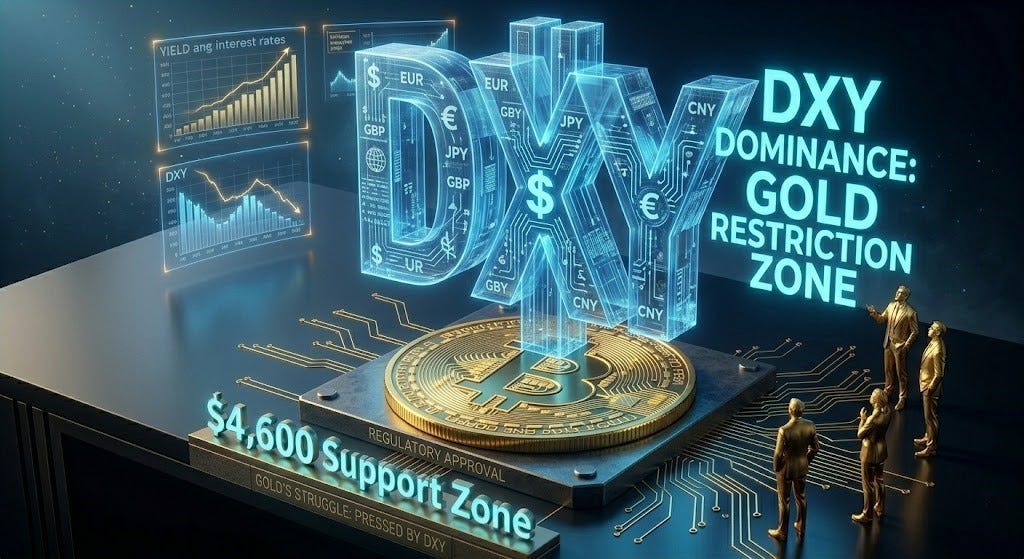
The international spot price of gold is exclusively denominated in US Dollars. Therefore, an undeniable mathematical reality exists: when the dollar strengthens, gold becomes relatively more expensive for any investor located outside the United States. For example, if the value of the dollar surges, the price of gold in Korean Won feels significantly more expensive, even if the international spot price of gold remains completely stagnant.
This structural reality directly and severely impacts global physical gold demand. Investors in massive gold-consuming nations like China, India, South Korea, and the European Union must ultimately convert their local fiat currencies into dollar-denominated prices to purchase gold. If the dollar is strong, the cost of acquiring gold skyrockets, severely contracting both physical retail demand and institutional investment demand globally.
In early 2026, amidst escalating geopolitical crises, the dollar was once again overwhelmingly selected as the premier global safe-haven asset. As the specter of war expanded, institutional investors scrambled to secure the dollar, recognizing it as the absolute center of global settlements and debt obligations. A massive, global “Flight to the Dollar” had commenced.
2) Why the ‘Flight to the Dollar’ Was Stronger Than the ‘Flight to Gold’
In past historical crises, the massive flow of capital rushing into gold was undeniably powerful. However, in the modern financial market, the dollar frequently operates as a vastly more powerful safe haven. The reason is simple: the dollar is not merely an asset; it is the absolute foundational currency of the entire global financial operating system.
In international trade, crude oil settlements, corporate debt obligations, sovereign foreign exchange reserves, and the collateral systems of global financial institutions, the dollar holds an absolute, monopolistic position. When a crisis magnifies, corporations and massive financial institutions scramble desperately to secure dollar liquidity to prevent catastrophic default. During this chaotic process, the demand for the dollar can surge vastly faster and harder than the demand for gold.
Furthermore, dollar assets actively provide yield. US short-term bills or Treasury bonds provide absolute stability coupled with highly attractive interest yields in a high-rate environment. Conversely, gold only generates profit if the investor relies on pure price appreciation. Therefore, in a sustained high-interest-rate environment, the dollar and Treasuries are naturally evaluated by institutions as vastly superior, more attractive safe-haven assets than gold.
3) The Rise of US Treasuries as the “Yield-Bearing Safe Haven”
Gold’s primary competitor is absolutely not Bitcoin. Rather, the single most formidable competitor to gold in 2026 was the United States Treasury bond. US Treasuries are the ultimate traditional safe-haven asset, yet they simultaneously provide guaranteed interest. Particularly in an environment where interest rates are elevated, the bond yield itself acts as a massive, gravitational pull for global investment capital.
Gold incurs heavy logistical storage costs, yields zero interest, and is subjected to significant price volatility. In stark contrast, short-term US Treasuries provide incredibly stable, guaranteed interest yields. From the perspective of a massive institutional portfolio manager navigating a macro crisis, it is mathematically far more rational to migrate capital into dollar-denominated short-term bonds or cash equivalents rather than irrationally overweighting an allocation to barren gold.
This is the ultimate macroeconomic background that decisively blocked gold from breaking the $5,000 threshold. It was absolutely not a loss of trust in gold itself; rather, the underlying conditions of the safe-haven assets competing against gold simply became vastly superior. As global defensive capital fractured and dispersed across Gold, the Dollar, and US Treasuries within the safe-haven sector, the unchecked, monopolistic rally of gold was structurally terminated.

6. Conclusion
1) The Drop in Gold Prices is Not a Collapse of Safe Haven Value, but a Shift in the Valuation Structure
The fact that gold prices failed to surge massively despite the war in 2026, and instead chopped around the $4,600 level, absolutely does not mean that gold’s status as a premier safe-haven asset has collapsed. On the contrary, because gold remains an exceptionally critical safe haven, massive amounts of institutional capital paid close attention, and the price had already been driven to historic highs.
The real issue began after that peak. The price of gold had already aggressively priced in a massive amount of geopolitical anxiety, and it required a vastly stronger catalyst to justify any further upward expansion. However, the market was simultaneously bombarded by a perfect storm of downward pressures: high interest rates, a surging dollar, highly attractive US Treasury yields, massive capital outflows from Gold ETFs, and the desperate need for institutional liquidity.
Therefore, this current correction in gold prices must absolutely not be viewed as a “Failure of Gold,” but rather as a profound “Shift in the Method of Gold Price Determination.” We have definitively entered an era where it is impossible to blindly predict a gold rally based on a single war headline, as retail investors did in the past.
2) Why Future Gold Investors Must Watch Interest Rates and the Dollar Before War Headlines
When analyzing the gold market moving forward, the most critical variables are no longer simple geopolitical war headlines. Of course, geopolitical tension will always impact the price of gold. However, for that impact to be structurally sustained, the macroeconomic flows of interest rates and the dollar must perfectly align.
For the price of gold to roar back into a powerful, sustained rally, several strict macroeconomic conditions must be met.
① First, the expectations for Federal Reserve interest rate cuts must definitively revive.
② Second, the relentless strength of the US dollar must be broken.
③ Third, US Treasury yields must decline, directly reducing the massive opportunity cost of holding gold.
④ Fourth, massive institutional capital and ETF flows must actively rotate back into the physical gold market.
Conversely, even if the war rages on relentlessly, if surging oil prices continue to stimulate inflation — and as a direct result, the Federal Reserve maintains a grueling high-interest-rate regime — the price of gold will remain pinned under immense downward pressure. Therefore, the 2026 gold market absolutely must not be viewed through the simplistic lens of “War = Rising Gold.” It must be analyzed through the sophisticated macroeconomic lens of “How will this war impact global interest rates and the strength of the US Dollar?”
In conclusion, gold is absolutely not a dead asset. However, it has evolved into an asset that demands a vastly more sophisticated and rigorous macroeconomic analysis than in the past. While gold undeniably remains a vital asset for hedging against inflation and systemic financial instability, its velocity of ascent will remain structurally constrained as long as the crushing combination of high interest rates and a strong dollar persists.
In Part 1 of this series, we thoroughly examined the core macroeconomic background explaining why gold prices failed to surge despite the war. In the upcoming Part 2, we will execute a deep dive into the highly specific supply and demand factors that caused the collapse of the $5,000 threshold. We will focus our rigorous analysis on the massive selloffs in Gold ETFs, the forced liquidation of institutional leverage, the drastic slowdown in central bank accumulation, and the fierce resistance from physical retail demand in key markets like China and India.
GoldPriceForecast2026, #SafeHavenParadox, #MacroEconomics, #FedPolicy, #StrongDollar, #GeopoliticalRisk, #OpportunityCost, #TreasuryYields, #InflationHedging, #KoreaGabrielBlog
[Official CrypWorld Channels]
- Website: crypworld.io
- Whitepaper: Read Whitepaper
Community:
- Telegram Channel: Join Here
- Medium: Follow us
- Twitter (X): @Crypworld_CWG
- Instargram: https://www.instagram.com/crypworld_official/
- Blog: koreagabriel.blog
메타데이터
- post_id
- f6d742bb2365
- slug
- why-did-gold-prices-drop-despite-the-war-f6d742bb2365
- url
- https://medium.com/@crypworld/why-did-gold-prices-drop-despite-the-war-f6d742bb2365
- canonical_url
- https://medium.com/@crypworld/why-did-gold-prices-drop-despite-the-war-f6d742bb2365
- author_url
- https://medium.com/@crypworld
- status
- ok
- fetched_at
- 2026-06-09 15:37:30