Freud and Masochism (Part 3)
Repression (Die Verdrängung) 1915
Freud and Masochism (Part 3)
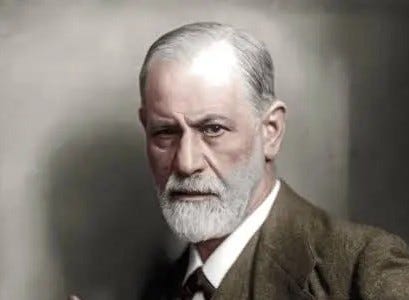
Repression (Die Verdrängung) 1915
<Introduction> The question “What is the mind?” has been a persistent philosophical problem from Aristotle’s time down to the present. However, the very form of the question “What is X?” already presupposes the Idea and is therefore a Platonic question. Nietzsche overturned Platonism by giving priority to the question “Who?” Deleuze radicalized this move, expanding it into the full set of questions: “Who, when, where, what, why, and how?” Once we cease to presuppose the Idea, it becomes obvious that the latter set of questions is far more important and realistic.
In business, concrete facts are valued more highly than Ideas; hence the emphasis on the 5W1H framework is only natural. It should be noted, however, that the “What” of the 5W1H refers to the concrete object or target of an action — one element among the constituents of a situation. By contrast, the “What” in “What is X?” inherits the Latin quid and corresponds to the English quiddity. It is a meta-level “What” that underpins the entire 5W1H framework; that is why it becomes an Idea. However, without the existence of the Idea, the question of “what” as quiddity merely breeds confusion and becomes unnecessary.
For example, the question “What is Keynesianism?” may give the appearance of thought while in fact thinking nothing. The question “Who is a Keynesian?” is far more concrete: it designates those who seek to stimulate the economy by transferring the assets of rentiers and pensioners to investors and corporate managers through inflationary policy.
Although the transition was abrupt, Freud likewise treated the psychic apparatus as an economic apparatus.
Returning to the main thread: Freud, I believe, reformulated the question “What is the mind?” into the 5W1H format. Let us therefore think in those terms.
The mind is an apparatus that seeks pleasure (what) through the drives (who), in childhood (when), within the body (where), for the sake of the organism’s survival (why), by representing the drives through substitutes (how).
At the time of his 1915 paper the fundamental concept of the death drive had not yet appeared, and the above formulation may at first appear to contradict it. Yet Freud consistently maintained, from beginning to end, that the subject is the drive, that the drive is active, and that it knows neither time nor negation. Consequently, it is self-evident that the sexual drive, as a drive for the preservation of the species, transcends the individual; through the ultimate quiescence that is death-as-pleasure, the death of the individual achieves the continuation of life as a species. Sadism and masochism, of course, deviate from this aim, but such deviation arises precisely because the drives are represented by substitutes within the psychic apparatus.
The same holds for the self-preservative drives. Even when an individual encounters something (such as a food additive) that actually threatens self-preservation, the stimulus of appetite can still be quelled, and pleasure can still be obtained. Freud located the cause of this divergence between the aim of the drive (quiescence of stimulus = pleasure) and its purpose (preservation of life) in the prolonged period of human childhood (The Ego and the Id, 1923).
Because the various drives (oral, anal, genital, etc.) differ in their realizability, the pressure (intensity) of those drives that are difficult to realize is transcribed as libido onto the psychic representatives of the drives within the apparatus. This libido then circulates freely and is cathected to more easily realizable drives, thereby achieving partial, phantasmatic satisfaction. In other words, unlike animals whose drive aim and purpose coincide, humans — precisely because they possess a highly developed brain — allow the pressure of the drives to circulate freely in the form of representatives during the immature phase of childhood.
This primitive conception is now being corroborated by contemporary neuroscience. Even in adults, the free circulation characteristic of childhood reappears in dreams during sleep. Carhart-Harris and Friston (2010), for example, describe states in which the default mode network (DMN) is relatively disinhibited (dreaming, early psychosis, psychedelic states, REM sleep) as states of “high free energy,” in which subcortical activity (amygdala, hippocampus, hypothalamus) predominates and energy moves freely.
Freud’s thesis is often linked to Bolk’s theory of fetalization; Lacan also makes the connection. Bolk’s Das Problem der Menschwerdung (1926), however, appeared three years after Freud’s 1923 paper, so Freud’s account must be recognized as highly original. In any case, the proper evaluation of Freud is that his thesis provides the foundation upon which anatomical and neuroscientific findings have subsequently been able to build.
<Main Discussion>
The preceding introduction has been lengthy, but the present paper, although based on Freud’s clinical observations, contains no case presentations; instead, it develops and explains abstract concepts abstractly. For an outsider like myself, it is therefore difficult to grasp. In order to obtain a clear overview of what is being discussed and why, I have summarized the presuppositions of “repression” in the introduction above.
In short, repression is the mechanism by which the various drives are reorganized into more realizable drives for the purpose of preserving life. Yet precisely because these are representatives of the drives, the mechanism can deviate from its purpose and achieve the aim of the drives in phantasy.
Repression is frequently associated with prohibition or morality. A careful reading of the paper, however, shows that prohibition and morality are not negations of the drives but rather reorganizations that render the aim of the drives realizable. The drives are active; they are never negated.
Turning to the text itself, Freud states at the outset that one of the vicissitudes of the drive is that it “may encounter obstacles which seek to render it ineffective” (sie auf Widerstände stößt, welche sie unwirksam machen wollen). Although Freud’s own writing moves fluidly from one point to another, patient reading reveals that these obstacles (Widerstände) are not the drives themselves but external stimuli. For Freud explicitly states that “a drive satisfaction is always pleasurable” (eine Triebbefriedigung ist immer lustvoll). If the drive (internal stimulus) is itself pleasurable, then the obstacle that seeks to render it ineffective must be an external stimulus.
Some commentaries treat this resistance as a force of the unconscious, but within the context of this paper it is an external stimulus. In my view, no force that resists the drives exists within Freud’s unconscious, because the unconscious follows the pleasure principle. Such interpretations are pseudo-interpretations that have not read the text. Repression is in fact the work of consciousness, which follows the reality principle in harmonizing external stimuli with the drives.
That is to say: although every drive is pleasurable, when the realization of a drive’s aim would produce an external stimulus that is unpleasurable, consciousness represses that drive in accordance with the reality principle. For example, rape realizes the aim of the sexual drive, but even a first offense carries the external stimulus of a prison sentence of roughly twenty years with no possibility of parole. Consciousness therefore represses the drive under the reality principle and redirects it toward other realizable drives such as consumption of pornography or fantasy. This is not a negation of the sexual drive but a reorganization into a form of the sexual drive that is compatible with external stimuli.
Freud discusses “primal repression” (Urverdrängung). Contrary to the literal sense of the term, it is less a repression of the drive than a leaving of the drive to itself. The passage is important, so I quote it at length:
Wir haben also Grund, eine Urverdrängung anzunehmen, eine erste Phase der Verdrängung, die darin besteht, daß der psychischen (Vorstellungs-)Repräsentanz des Triebes die Übernahme ins Bewußte versagt wird. Mit dieser ist eine Fixierung gegeben; die betreffende Repräsentanz bleibt von da an unveränderlich bestehen und der Trieb an sie gebunden.
“We therefore have grounds for assuming the existence of a primal repression, a first phase of repression, which consists in the fact that the psychical (ideational) representative of the drive is denied entry into consciousness. With this, a fixation is established; the representative in question persists unaltered from that point onward, and the drive remains bound to it.”
Primal repression, then, refuses to admit the drive into consciousness and leaves it to the world of the unconscious. The fact that the fixation (Fixierung) persists without temporal change is one of the characteristics of the unconscious that Freud emphasizes.
We must pay careful attention to Freud’s distinctive use of the term Repräsentanz (representative). In ordinary usage the word suggests idea, imagination, showing, introduction, or presentation (from Oxford German dictionary) — all of which imply a re-presentation before consciousness. For Freud, however, the representative is a substitute for the drive within the psychic apparatus. Since the psychic apparatus comprises consciousness, the unconscious, and the preconscious, there are also unconscious representatives. Consequently, the representative that is denied access to consciousness is an unconscious representative, and it is for this reason that the drive remains timelessly bound to it. To mistake this for a conscious representative renders the text incomprehensible.
Although Freud calls the unconscious the primary process and consciousness the secondary process, this distinction does not treat them as substantial opposites. Both are parts of the same psychic apparatus whose common purpose is life preservation. The difference lies solely in the fact that the unconscious follows the pleasure principle while consciousness modifies the pleasure principle in accordance with the reality principle.
Freud’s unconscious must therefore be distinguished from the Romantic conception of the unconscious (mysterious, sacred, oracular, infinite). It is not disorderly; it possesses its own grammar — the grammar of the primary process (displacement, condensation, symbolization, etc.). This differs from the grammar of the secondary process (law of contradiction, judgment, inhibition, etc.), but the difference is simply that between the free circulation of libido under the pleasure principle and the binding of libido as a modification imposed by the reality principle.
From the standpoint of consciousness (secondary process), the unconscious (primary process) is a process that realizes the same purpose (survival) by different means. It possesses its own grammar — the grammar of free circulation. For this reason, the unconscious appears to consciousness as though it were another person. Freud showed that the interference of the unconscious in parapraxes is never the intrusion of disorder but follows a logic governed by the grammar of the primary process. To consciousness it appears as an intervention with the purpose of realizing a drive on the part of another personality.
Why, then, does Freud discuss “primal repression” — which amounts to a leaving of the drive to itself — in a paper whose theme is repression?
He does so in order to show how the psychic representatives of the drives in the unconscious come to appear in consciousness. They appear when they conform to the reality principle; it is conscious censorship that judges whether they do so. As noted earlier, when the various drives are represented within the psychic apparatus, their objects and aims undergo multiple transformations through the free circulation of libido. Only those transformations that conscious censorship judges to be compatible with the reality principle are allowed to appear in consciousness. Thus, out of the innumerable transformations of the original drive, the derivative most easily admitted to consciousness is the one that appears.
For example, when one has a painful dream, the dream is a drive that has been rendered compatible with the reality principle and is therefore accompanied by feelings of guilt. Yet it is merely a peripheral fragment, after innumerable transformations, of an originally pleasurable drive; only this fragment has passed conscious censorship. Once it has become conscious, guilt arises. The unconscious representative of the drive itself, however, contains no guilt whatsoever. The unconscious knows only innocent pleasure, as is only natural under the dominion of the pleasure principle.
The following passage from the text provides textual support for this reading:
… daß die Triebrepräsentanz sich ungestörter und reichhaltiger entwickelt, wenn sie durch die Verdrängung dem bewußten Einfluß entzogen ist. Sie wuchert dann sozusagen im Dunkeln und findet extreme Ausdrucksformen, solche Abkömmlinge des Verdrängten zu produzieren, die infolge ihrer Entfernung oder Entstellung die Zensur des Bewußten passieren können.
“…that the representative of the drive develops more freely and more richly when it has been withdrawn from conscious influence through repression. It then proliferates, so to speak, in the dark, and finds extreme forms of expression, producing such derivatives of the repressed as, owing to their remoteness or distortion, are able to pass the censorship of consciousness.”
Freud does not explain why the original repressed representative of the drive undergoes innumerable transformations, nor why some of these transformations are able to pass the censorship of consciousness. This raises the question as to whether the unconscious— which should not be governed by the reality principle — is nevertheless transforming itself, at least partially and contingently, in accordance with the reality principle.
To clarify this point — which is also important for understanding the Wolf Man case in the latter half of the paper — it is necessary to organize Freud’s terminology once more.
Freud’s libido is not itself a representative within the psychic apparatus. Libido designates the state in which the energy of the drive’s pressure (intensity) is cathected to the psychic representative of the drive. Libido is therefore a mediating concept that links the body (the drive as internal stimulus) and the mind (the representative of the drive). The pleasure of the drive itself follows the physiological sequence of stimulus intensification → climax → quiescence. Libido, by contrast, is the cathexis of psychic energy to the representative of the drive; pleasure arises through the representative and is therefore phantasmatic pleasure. It differs from physiological pleasure in the following respects:
- Seeking physiological pleasure by realizing the phantasy in reality.
- Substituting physiological pleasure with its representation within phantasy.
- Discharging the tension cathected to the representative in a dream.
- Discharging it through a symptom.
- Converting undischarged tension into anxiety.
What is cathexis (Besetzung)? For psychic energy to be cathected to a representative of the drive means not only to desire (love) the object that is the representative, but also for that object to acquire meaning by having the direction of the drive concentrated upon it. Proust describes how Albertine, initially inconspicuous among a group of young girls, gradually becomes a meaningful object; this is precisely the process in which the energy of the drive is directed toward the representative “Albertine,” thereby conferring meaning upon her. Consequently, any object can become a representative of the drive if the energy of the drive changes direction.
The drive itself possesses an object as one of its four components, but that object is the actual means of discharging the drive and must be distinguished from the representative of the drive. When one is hungry, for example, some food becomes the object of the drive and eating becomes the aim of quiescence. Once this is specified as “curry and rice,” it becomes a representative of the drive based on past memory. Further representations such as “going to a curry restaurant” or “cooking it oneself” become aims of phantasmatic quiescence of the drive. Realizing the phantasy in action converts phantasmatic pleasure into physiological pleasure. Alternatively, by representing the object in ever greater detail within phantasy alone, one can partially discharge the tension cathected to the representative.
What is the quota of affect? In the latter half of the paper Freud introduces the concept of the quota of affect. Although Freud himself does not clearly distinguish it from libido, a consistent reading of his logic requires, in my view, that the two be conceptually distinguished. The quota of affect is the quantitative representative, within the psychic apparatus, of the pressure (intensity) of the drive. Freud thus posits two kinds of representatives within the psychic apparatus: the representative of the drive and the quota of affect.
The quota of affect is therefore not psychic energy itself but its quantitative representation. Although I dislike analogies, one may be useful for clarity. The quota of affect is like money. Money can be exchanged for various commodities; it is the quantitative representation of commodity value. If the quota of affect is money, then libido is the state in which money is used to exchange commodities — in other words, the act of allocating or investing money in commodities. Freud regarded the psychic apparatus as an economic activity, and cathexis also carries the meaning of investment.
From this perspective, the object of the drive is the means of obtaining physiological pleasure, while the object as representative of the drive is the means of obtaining phantasmatic pleasure. For example, the physiological object that quells the tension of the penis is the vaginal mucosa, whereas the object as representative of the drive is the woman as constituted by past memory. As a genital drive resulting from the organization of component drives, it extends beyond the vagina to the woman’s entire body and becomes a multilayered object entangled with past human relationships and cultural elements.
Having taken this long detour, we can now answer the original question: why does the original repressed representative of the drive undergo innumerable transformations? Within the psychic apparatus, in addition to the representative of the drive, there exists the quota of affect, which represents the pressure of the drive. Unlike the physiological dimension, this is a representative of the drive; metaphorically speaking, it is not an actual investment but a plan for investment. If the plan cannot be executed, the target of investment — the object — can be changed. In other words, the total quantity of libido available for investment is managed and allocated to realizable objects. This is why the objects that serve as representatives of the drive undergo innumerable transformations.
If there were only one possible target of investment — in other words, if there were only one drive — such transformation would be impossible. But the drives are divided into two major classes (self-preservative drives and sexual drives) and further subdivided (feeding drive, oral drive, anal drive, genital drive, etc.). Consequently, there are innumerable possible targets for the investment of the quota of affect (the quantity of excitation). The total quantity can be invested in a plan that is satisfactory overall by changing the targets — that is, the objects.
Since this is a mechanism internal to the psychic apparatus, the objects may be either conscious or unconscious representatives. The reorganization of these targets of investment occurs at the unconscious level and is therefore distinct from the repression subsequently exercised by consciousness after primal repression.
What, then, is repression by consciousness? Freud states that all repression is failed repression. Successful repression would leave no consciousness that repression has occurred. Failed repression means that consciousness has blocked an unacceptable unconscious drive, yet instead of remaining forever unconscious (as in primal repression), it has appeared in consciousness in the form of some symptom.
Because the quota of affect is, like the representative of the drive, a substitute, it undergoes vicissitudes analogous to those of the representative. Freud regards the vicissitudes of the quota of affect as far more important than those of the representative (i.e., changes of object). Repression occurs because, for consciousness operating under the reality principle, a given drive produces an unpleasurable external stimulus (e.g., rape produces the external stimulus of imprisonment). Consciousness represses the drive in order to avoid this unpleasure. Therefore, changing the quota of affect (pleasure/unpleasure) is more important than changing the object that is the representative of the drive.
Although repression is a defense against unpleasure, when it itself produces unpleasure, Freud judges that repression to have “failed.” In the latter half of the paper Freud presents the Wolf Man’s case of anxiety hysteria as an example of failed repression.
For a long time I could not understand the significance of this case. Only after organizing Freud’s concepts on this occasion did its meaning become clear to me.
It is a famous conclusion of Freud’s that love is accompanied by hate — that affect is ambivalent. This is not the same mechanism as the reversal of sadism into masochism discussed in the previous post. The reversal of loving is being loved, not hating. Loving means cathecting libido from the sexual drive to an object; hating belongs to a different drive, namely, the self-preservative one. Unconditional love poses a threat to self-preservation; therefore, the cathexis of libido to the object is withdrawn. This withdrawal is hatred.
This is not self-abandonment through self-sacrifice for the sake of love. Self-sacrifice does not threaten self-identity because it is the self that is abandoned. Hatred arises because self-identity is threatened by love — specifically, by the possibility of rejection by the other. When one has invested one’s own existence in the other, that existence is threatened. And so long as the other is human, this possibility always exists. Hence love is always accompanied by some degree of hatred, however much its intensity may vary.
However, people who actually love their lovers, parents, or children may not feel this intuitively. After all, it is normal to disregard gains and losses when it comes to those one loves. Let me use the investment metaphor once again. To love someone is like investing all one’s assets in that person. This corresponds to the cathexis of libido onto the object. If that person goes bankrupt due to circumstances beyond their control, one can resign oneself to it. This is self-sacrifice. But if the investment goes bad because of a change of heart on that person’s part, is it not only human to want to recover the full amount in order to protect oneself? This withdrawal of libido corresponds to hatred. Those who insist that there is not a speck of hatred in their love are bullish investors. The more bullish they are, the more they tend to panic at the slightest change of heart from their investment target. It is the vicissitude of the drive, which transcends your subjective feelings.
In the Wolf Man’s case, having witnessed (or believing he had witnessed) his parents’ intercourse led him to cathect passive homosexuality to his father. At the same time, this cathexis constituted a threat to self-preservation in the form of castration anxiety. Consequently, the homosexual cathexis to the father could no longer be maintained, and the object was displaced from the father onto the wolf through substitute formation. This does not mean that he loved the wolf. Since love and anxiety had originally coexisted, the anxiety and terror directed at the wolf functioned to reduce the libidinal cathexis that had originally been directed toward the father. In other words, the anxiety directed at the wolf served as a defense against the resurgence of his love for his father.
This substitute formation as repression is a failure because, although the object was changed, the unpleasure of anxiety was not eliminated. Repression is a means of avoiding unpleasure, but in this case it did not succeed. In the Wolf Man’s case, anxiety concerning self-preservation was greater than usual, and therefore the anxiety directed at the wolf manifested as a clinical symptom.
The reason anxiety was not eliminated is that the object and the quota of affect had become separated. Even when the target of investment (the object of cathexis) is changed at the level of the representative of the drive, the total amount invested (the quota of affect) remains unchanged.
If this is the case, there is only one therapeutic method: to reunite the object and the quota of affect. This is achieved by having the Wolf Man re-experience the original scene together with the accompanying affect, thereby enabling him to re-recognize the relation between object and affect. This was Freud’s therapeutic approach.
However, although it was a fundamental principle that the drive is active and pleasurable, in this case the self-preservative drive has turned into hatred. It is unclear whether Freud overlooked this contradiction or deliberately chose not to mention it. This contradiction would later be resolved by the introduction of the death drive. At the time of the 1915 paper, however, one can only conclude that, in the process by which the self-preservative drive pursues pleasure, the conscious ego comes to harbor hatred toward the father. In the Wolf Man’s case, this would mean that he had become conscious of his hatred toward the father. At the very least, he was conscious of castration anxiety; it is therefore possible, in my view, to interpret this anxiety as having been transformed into hatred arising from anxiety over the collapse of self-identity.
This paper does not directly address masochism. Nevertheless, it is important because it presents a theoretical framework of several concepts that will be indispensable for understanding the masochism discussed in subsequent papers.
메타데이터
- post_id
- f6daf439ba6f
- slug
- freud-and-masochism-part-3-f6daf439ba6f
- url
- https://medium.com/@yamasaki241/freud-and-masochism-part-3-f6daf439ba6f
- canonical_url
- https://medium.com/@yamasaki241/freud-and-masochism-part-3-f6daf439ba6f
- author_url
- https://medium.com/@yamasaki241
- status
- ok
- fetched_at
- 2026-06-09 15:37:30