Why Did Earth’s Ice Ages Change About a Million Years Ago?
Scientists may have found a clue in the Arctic Ocean
THE OLD CLIMATE
Why Did Earth’s Ice Ages Change About a Million Years Ago?
Scientists may have found a clue in the Arctic Ocean
Image from CANVA
When people think about what controls Earth’s climate, they usually think about the atmosphere.
Carbon dioxide, clouds. Volcanoes, perhaps even asteroid impacts. But few people think about the shape of the continents.
Yet some of the largest climate changes in Earth’s history happened because the oceans found a new route to flow.
Imagine standing on a rocky coastline and watching the tide move in and out. It is easy to think of the ocean as a giant connected body of water. But from a climate perspective, the exact pathways that water can take matter enormously. Open a new connection between two seas, and ocean currents can change. Close one, and the consequences can ripple across the planet.
Geologists have known this for decades.
The formation of the Isthmus of Panama about three million years ago changed the exchange of water between the Atlantic and Pacific Oceans. The opening and closing of gateways around Antarctica helped shape the currents that surround the continent today. Again and again, Earth’s climate history has shown that geography matters.
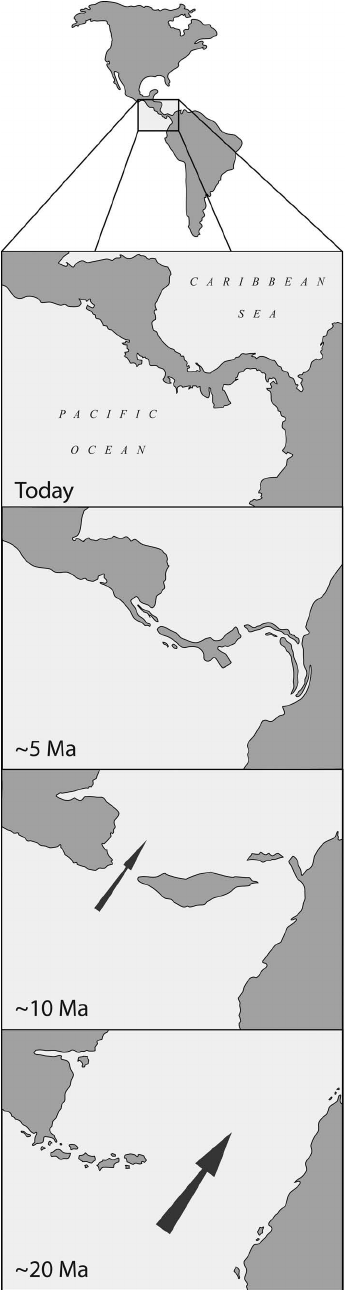
Formation of the Isthmus of Panama during the last 20 million years (Ma ϭ million years ago). Arrows indicate direction of principal water flow through the Central American Seaway — Robertson et al., 2009
The reason is straightforward: oceans move heat around the planet.
Warm water carries heat from the tropics toward the poles. Cold water returns toward lower latitudes. This constant movement helps determine where rain falls, where ice forms, and how much carbon dioxide the ocean can store. Change the routes available to ocean currents, and the climate system responds.
This idea sits at the center of a long-standing mystery in climate science.
About one million years ago, Earth’s ice ages changed.
For much of the early Pleistocene, ice sheets expanded and retreated roughly every 41,000 years. Then the rhythm shifted. Ice ages became longer, larger, and more intense. Instead of following a 41,000-year pattern, the climate system began producing glacial cycles that lasted closer to 100,000 years.
Scientists call this interval the Mid-Pleistocene Transition.
For decades, researchers have tried to understand what caused it. The challenge is that the orbital cycles that influence Earth’s climate did not undergo any dramatic change at that time. Something within the Earth system appears to have altered the way the planet responded to those cycles.
Many ideas have been proposed. Some focus on the growth of larger ice sheets, while others emphasize long-term declines in atmospheric carbon dioxide or examine changes in ocean circulation.
A new study published in* Communications Earth & Environment *adds another piece to the puzzle, and once again the story begins with geography.
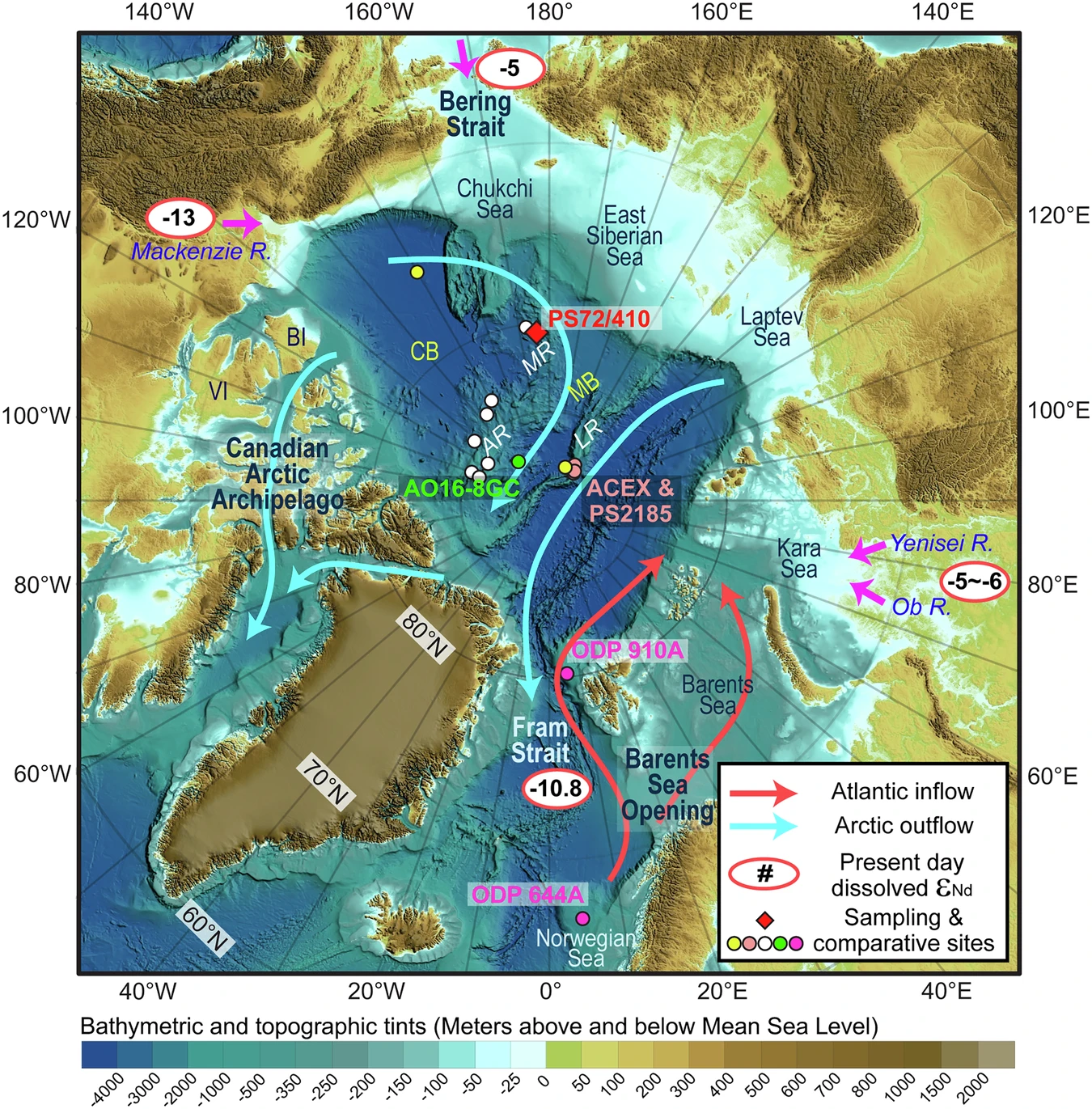
Locations of the studied site PS72/410 and reference records in the Arctic Ocean — Jang et al., 2026
The researchers focused on the Arctic Ocean. Today, Atlantic water enters the Arctic through two main routes. One of them is the Fram Strait, located between Greenland and Svalbard. The other is the Barents Sea region north of Scandinavia and Russia.
But this was not always the case. During the early stages of Northern Hemisphere glaciation, much of the Barents region was shallower and more restricted. Over hundreds of thousands of years, repeated advances of ice sheets eroded enormous amounts of sediment from the landscape. Eventually, this erosion transformed the region into a broader marine gateway.
In simple terms, the Arctic gained a larger connection to the Atlantic.
To investigate whether this mattered, the researchers analyzed sediments recovered from the Arctic Ocean. These sediments contain chemical signatures that act like fingerprints of past water masses. By examining changes in neodymium isotopes through time, they reconstructed how strongly Atlantic waters influenced the Arctic Ocean during the last two million years.
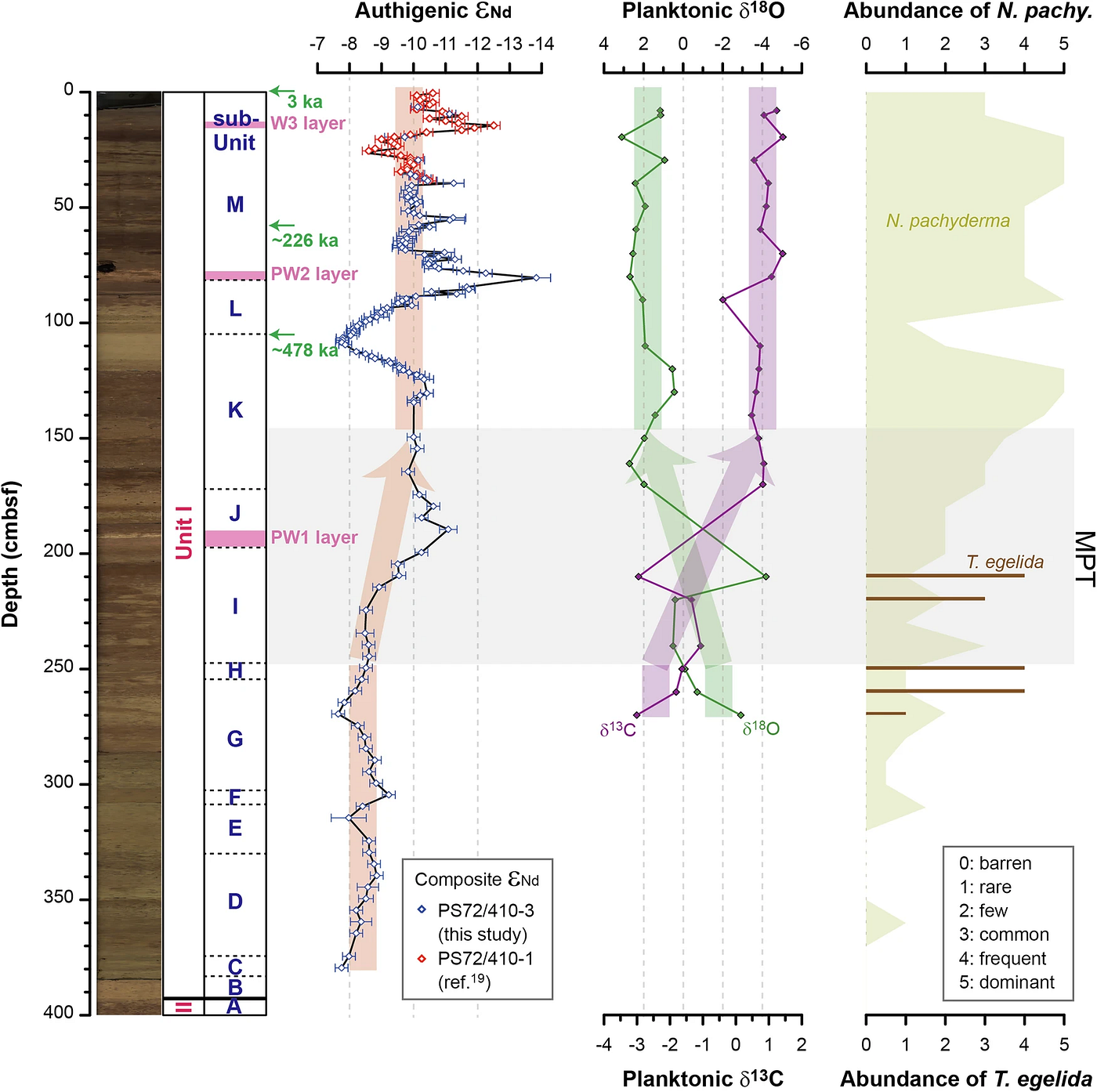
Records from site PS72/410, including core imagery, lithological units, composite authigenic εNd values (with error bars representing 2 SD), planktonic δ18O and δ13C data, and species abundance of N. pachyderma sin. and T. egelida — Jang et al., 2026
Their results suggest that Atlantic influence increased across the Mid-Pleistocene Transition.
That finding is important because ocean circulation is not just about moving water. It is also about moving heat, freshwater, and carbon.
The authors propose that a more open Arctic-Atlantic connection allowed greater exchange between the two oceans. Increased export of freshwater from the Arctic may have altered circulation patterns in the North Atlantic, changing how efficiently carbon was stored in the deep ocean. Because the ocean holds much more carbon than the atmosphere, even relatively small changes in how that carbon is exchanged can influence atmospheric carbon dioxide levels over long periods of time.
Independent records show that atmospheric carbon dioxide levels during glacial periods declined across the Mid-Pleistocene Transition, while larger ice sheets became more common. The new study suggests that changes in Arctic geography may have contributed to the chain of events that made those changes possible.
It is important to emphasize that this study does not solve the mystery of the Mid-Pleistocene Transition on its own. Climate systems are complex, and major transitions rarely have a single cause. Ice sheets, ocean circulation, carbon cycling, and orbital variations were all interacting with one another.
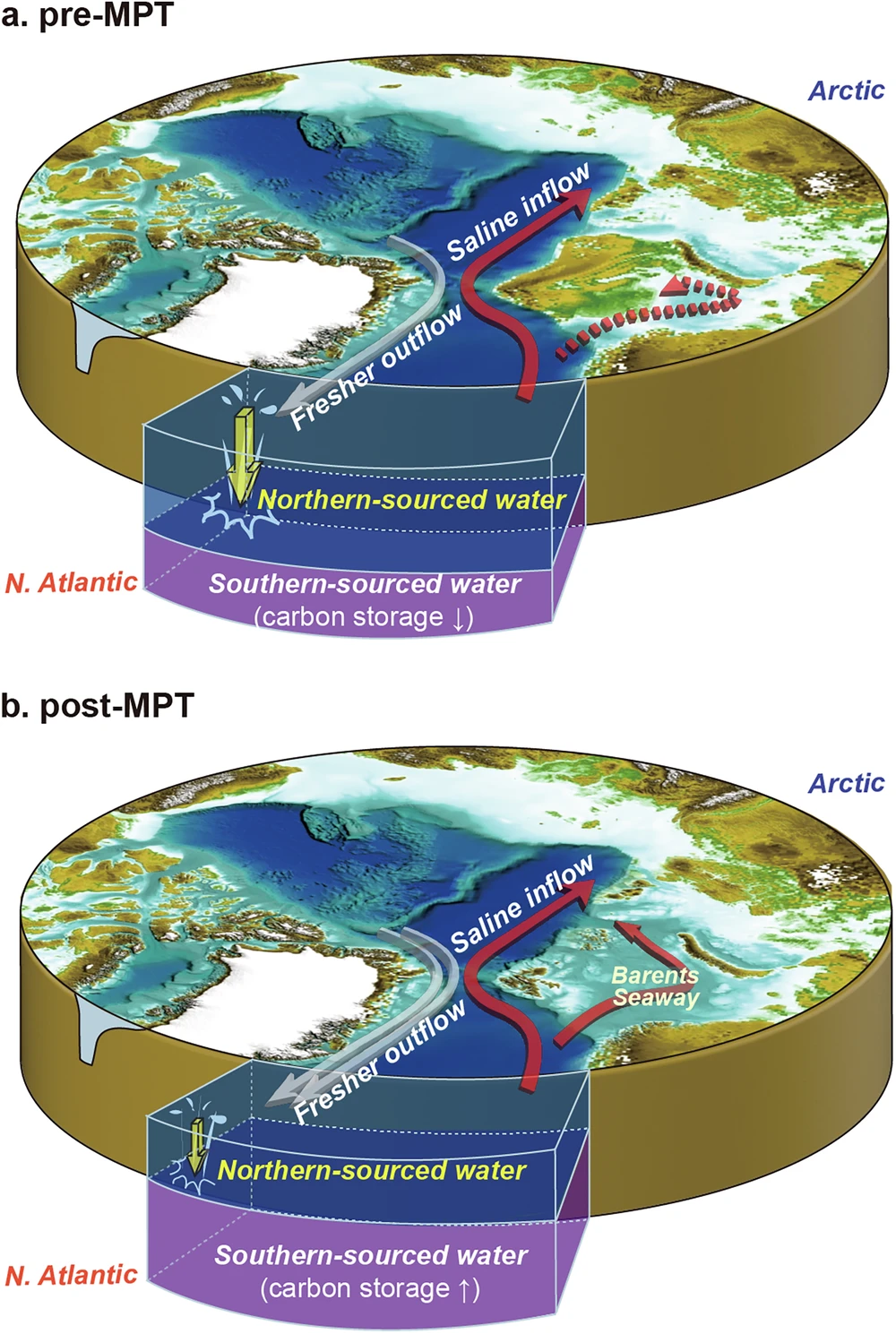
Conceptual model of glacial ocean circulation between the Arctic and North Atlantic oceans across the Mid-Pleistocene Transition (MPT). a before the MPT and b after the MPT. The progressive opening of the Barents Seaway across the MPT enabled vigorous outflow of fresh Arctic water into the North Atlantic, facilitating the expansion of carbon-rich southern-sourced deep waters. This oceanographic reorganization enhanced carbon sequestration, contributing to lower glacial pCO2 levels after the MPT. The reconstructed geomorphology of the Eurasian Arctic region at ~2.0 Ma was used to represent pre-MPT conditions when the Barents Seaway remained closed — Jang et al., 2026
What makes the study interesting is not that it provides a final answer, but that it highlights a factor that can be easy to overlook. The climate system does not operate only in the atmosphere. The shape of the seafloor, the depth of an ocean gateway, and whether a current can pass through a particular region matter.
A change that seems local on a map can influence processes occurring thousands of kilometers away.
That lesson extends far beyond this particular study. When scientists reconstruct ancient climates, they often begin with geography. Before asking how warm the planet was or how large the ice sheets became, they ask a simpler question: what did Earth look like?
The answer helps determine where ocean currents flowed, where heat accumulated, and how the climate system behaved. The new study offers another reminder that geography is not merely the backdrop for climate history. It is one of the forces that helps write the story.
Follow for more stories in Paleontology, Ecology, Conservation, and Climate Change!
메타데이터
- post_id
- f6e22e1873d6
- slug
- why-did-earths-ice-ages-change-about-a-million-years-ago-f6e22e1873d6
- url
- https://medium.com/the-new-climate/why-did-earths-ice-ages-change-about-a-million-years-ago-f6e22e1873d6
- canonical_url
- https://medium.com/the-new-climate/why-did-earths-ice-ages-change-about-a-million-years-ago-f6e22e1873d6
- author_url
- https://medium.com/@silvia-pineda-munoz-phd
- status
- ok
- fetched_at
- 2026-06-20 20:29:01