The mysterious Olmec civilization
Deep within the dense jungles of present-day Mexico, a civilization emerged millennia ago, shrouded in mystery and fascination. The Olmec…
The mysterious Olmec civilization
Deep within the dense jungles of present-day Mexico, a civilization emerged millennia ago, shrouded in mystery and fascination. The Olmec civilization thrived along the Mexican Gulf Coast from approximately 1400 BCE to 400 BCE. It is frequently referred to as the “Mother Culture” of Mesoamerica. Despite being one of the earliest complex societies in the region, much of the Olmec’s legacy remains shrouded in enigma, leaving scholars and historians intrigued by their achievements and unanswered questions.
Via National Geographic
This ancient civilization was born in the Olmec heartland, which included what are now the states of Tabasco and Veracruz. Here, amid the fertile floodplains of the region’s rivers, the Olmec established their urban centers, the most notable being La Venta, San Lorenzo, and Tres Zapotes. These cities, characterized by their monumental architecture and sophisticated infrastructure, served as hubs of political, religious, and economic activity.
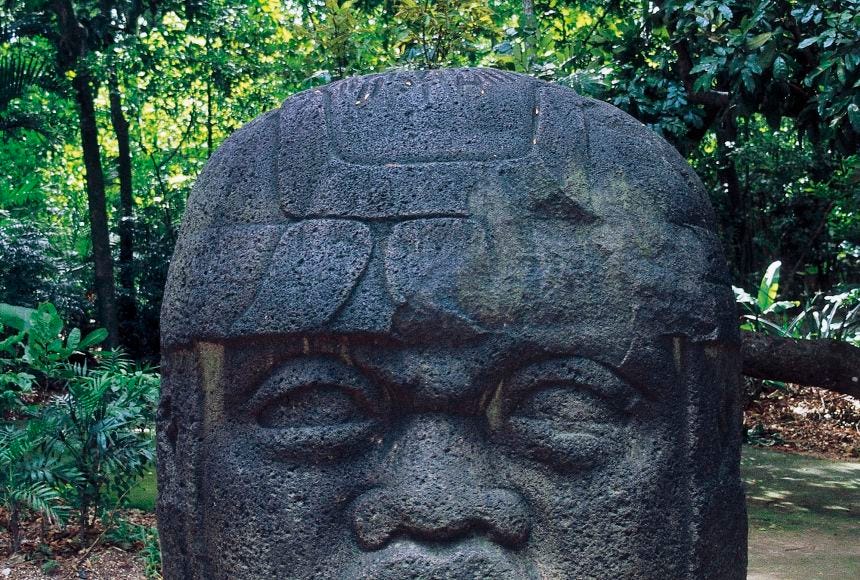
At the heart of Olmec society was their remarkable artistic and cultural legacy. The Olmec are perhaps best known for their colossal stone heads, carved from volcanic basalt, which depict imposing human faces adorned with distinctive features such as flattened noses, prominent lips, and almond-shaped eyes. These monumental sculptures, some standing over nine feet tall and weighing several tons, attest to the Olmec’s mastery of stone carving and their reverence for powerful individuals, possibly rulers or deities.
Beyond the iconic stone heads, the Olmec left behind a wealth of artistic treasures, including intricate jade figurines, ceramic vessels, and elaborate stonework. Their art often featured motifs such as jaguars, serpents, and mythical creatures, reflecting their complex cosmology and religious beliefs. Scholars believe that these artistic motifs held symbolic significance, possibly representing deities, ancestors, or mythological narratives central to Olmec religion and worldview.
One of the enduring mysteries surrounding the Olmec civilization is the question of their origins and influence. While they are widely recognized as the first complex society in Mesoamerica, the sources of their cultural and technological achievements remain a subject of debate among scholars. Some theories suggest that the Olmec developed in isolation, indigenous to the region and drawing inspiration from their surroundings. Others propose that they were influenced by external sources, possibly through trade networks or cultural diffusion from other civilizations.
The Olmec’s influence extended far beyond their heartland, leaving a lasting imprint on subsequent Mesoamerican cultures. Their distinctive artistic style, religious iconography, and architectural techniques would later influence civilizations such as the Maya, Zapotec, and Aztec. The spread of Olmec cultural elements, sometimes referred to as the “Olmec Horizon,” facilitated the exchange of ideas and technologies across Mesoamerica, laying the foundation for the region’s rich cultural tapestry.
The Olmec civilization’s demise is still a mystery, despite their artistic achievements. Around 400 BCE, the once-thriving urban centers of San Lorenzo and La Venta were abandoned, marking the end of the Olmec’s hegemony in the region. The reasons for their decline are the subject of speculation, with theories ranging from environmental degradation to social unrest or external invasion. Historians are forced to piece together hints from ancient writings and archeological evidence in order to piece together the precise circumstances behind the fall of the Olmec civilization.
In recent decades, archaeological discoveries have shed new light on the Olmec civilization, offering fresh insights into their way of life and cultural achievements. Excavations at sites such as San Lorenzo and La Venta have uncovered intricate architectural complexes, ceremonial centers, and evidence of advanced agricultural practices. Through the study of Olmec artifacts and monuments, researchers continue to unravel the complexities of this ancient civilization, piecing together the puzzle of their origins, achievements, and ultimate demise.
Today, the legacy of the Olmec civilization endures as a testament to the ingenuity and creativity of ancient Mesoamerican peoples. Their artistic achievements, technological innovations, and cultural legacy continue to inspire fascination and admiration, fueling ongoing research and exploration into one of the most enigmatic civilizations of antiquity. As archaeologists delve deeper into the mysteries of the Olmec, they unlock new insights into the rich tapestry of human history and the enduring legacy of ancient cultures.
메타데이터
- post_id
- f6e6d0b68c8f
- slug
- the-mysterious-olmec-civilization-f6e6d0b68c8f
- url
- https://medium.com/@allLATAM/the-mysterious-olmec-civilization-f6e6d0b68c8f
- canonical_url
- https://medium.com/@allLATAM/the-mysterious-olmec-civilization-f6e6d0b68c8f
- author_url
- https://medium.com/@allLATAM
- status
- ok
- fetched_at
- 2026-06-28 04:42:08