A Modern, Definition of AI Agents and Agentic Systems
A disciplined framework for defining, constraining, and scaling autonomous AI agents in enterprise environments.
A Modern, Definition of AI Agents and Agentic Systems
A disciplined framework for defining, constraining, and scaling autonomous AI agents in enterprise environments.
Artificial Intelligence is undergoing a structural shift. What began as autonomous software entities in the 1990s has evolved into LLM‑powered, tool‑using, multi‑agent systems capable of reasoning, planning, and acting with increasing sophistication. As enterprises adopt agentic architectures, the need for a clear, formal, and architecture‑grade definition of what an AI agent is — and how an agentic system emerges — has become essential.
This article synthesizes the classical Multi‑Agent Systems (MAS) literature, the modern LLM era, and the definitions published by leading industry LLM providers to establish a unified, authoritative understanding of AI agents.
1. Classical Foundations: What Early Research Considered an “Agent”
The most influential early definition comes from Jennings, Sycara, and Wooldridge (1998), who describe an agent as:
“A computer system that is situated in some environment, and that is capable of autonomous action in this environment in order to meet its design objectives.”
Across foundational works (Jennings et al., Nwana, Wooldridge, Russell & Norvig), four core properties consistently define an agent:
Autonomy: The agent operates without direct human intervention and maintains control over its internal state. Situatedness: It exists within an environment — physical, digital, or simulated — and can perceive it. Reactivity: It responds to environmental changes in a timely manner. Proactiveness (Goal‑Directed Behavior): It does not merely react; it takes initiative to achieve goals.
These four pillars formed the de‑facto standard for agent research from 1996–2005.
2. The Evolution: From Classical Agents → Chatbots → LLM Agents
The Chatbot Interlude (2005–2023)
Chatbots dominated AI interaction for nearly two decades. They improved natural language understanding and user engagement but remained fundamentally reactive — waiting for user prompts, lacking autonomy, and unable to pursue multi‑step goals.
“Chatbots could simulate conversation… but their actions were limited to textual exchanges within predefined boundaries.”
Modern LLM Agents (2023–2026)
LLM agents represent a decisive shift. They combine:
LLM‑powered reasoning Tool and API execution Memory and context windows Multi‑step planning Autonomous task initiation
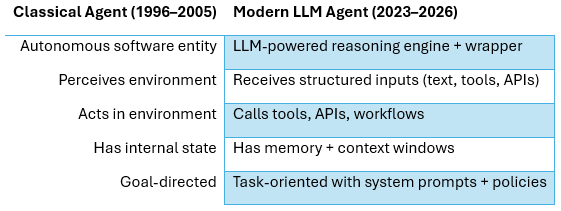
Comparing Agents
- How Industry Leaders Define “Agents” Today
Across IBM, Google, Microsoft, AWS, OpenAI, and others, a consistent pattern emerges in their definition of agents:
LLM‑centric reasoning Tool and API execution Workflow orchestration Memory and context persistence Autonomy within governed boundaries Multi‑agent collaboration
Even though terminology varies, the architectural essence is converging. Below table show a provider Agent Definition and Key Characteristics

Providers with agent framework and how they define an Agent.
4. A Unified, Architecture‑Grade Definition of an AI Agent
Synthesizing classical MAS research and modern industry frameworks, we arrive at a precise definition: An AI agent is an autonomous software entity with a defined identity, role, capabilities, constraints, and decision‑making logic, which uses an LLM as its reasoning engine and interacts with tools, data, or external systems to achieve a goal. This definition is intentionally architectural: it emphasizes identity, boundaries, capabilities, and controlled interaction — elements required for enterprise‑grade deployment.
Now, with the definition of an agent firmly established, we can now articulate the boundary principles that allow agents to operate safely within an enterprise ecosystem. Much like object‑oriented design enforces single‑purpose classes and clear interfaces, agent design demands disciplined segregation of duties, constrained capabilities, and explicit governance. These principles transform agents from ad‑hoc LLM constructs into dependable components of a larger, controlled system.
5. The Five Boundary Principles of Agent Design
These five principles distinguish robust, governable agents from loosely defined LLM wrappers. They form the architectural backbone that ensures safety, modularity, predictability, and enterprise‑grade compliance. Without these boundaries, agent behavior becomes opaque, untestable, and potentially unsafe — making large‑scale deployment impossible
a. One Agent = One Purpose: *Each agent must have a single, clearly defined role. This prevents capability creep, simplifies testing, and ensures predictable behavior. From a security standpoint, it limits privilege escalation and reduces blast radius. b. *Capabilities Are Isolated: Agents receive only the tools and APIs required for their specific function. This enforces least privilege, prevents cross‑domain interference, and maintains clean separation of concerns. c. Data Minimization: Agents are provided only the minimum data necessary to perform their task. This reduces exposure, prevents unintended inference, and aligns with privacy and OWASP GenAI Top‑10 requirements. d. Execution Constraints: Agents operate within strict boundaries — rate limits, stop conditions, escalation paths, and tool‑use rules. These constraints prevent runaway loops, over‑execution, and uncontrolled autonomy. e. Observability: Every agent must emit identity‑linked telemetry: inputs, outputs, tool calls, and decisions. This enables debugging, auditability, anomaly detection, and real‑time governance.
Once agents are defined as autonomous entities with identity, purpose, tools, and boundaries, the next abstraction naturally forms an agentic System.
6. Agentic Systems Emerge
An agentic system is a coordinated architecture in which multiple autonomous agents — each with a defined identity, role, capabilities, constraints, and decision‑making logic — work together, either concurrently or sequentially, to achieve complex goals through reasoning, tool use, and controlled interaction with their environment.
In such systems:
A Controller Agent applies global guardrails and tracks outcomes. A Router Agent classifies tasks and enforces routing policies. A Planner Agent decomposes goals into steps and manages dependencies. Worker Agents execute single‑purpose tasks with minimal permissions. Observability spans the entire system, providing telemetry, traces, and audit trails.

Agentic System key components
Just as the 12‑Factor methodology brought operational discipline to cloud‑native applications, agentic systems require an equivalent rigor. Each agent must behave as an independently deployable, observable, and governable unit — cleanly separated in purpose, state, and execution boundaries. This ensures that the overall system remains composable, resilient, and evolvable, rather than collapsing into a monolithic LLM workflow with hidden coupling and unpredictable behavior.
Conclusion
AI agents are no longer abstract academic constructs — they are becoming the foundational building blocks of modern enterprise automation. By grounding agent definitions in classical MAS theory, aligning them with contemporary LLM capabilities, and enforcing boundary‑driven architectural principles, organizations can build agentic systems that are:
Predictable Governable Secure Composable Scalable
As the industry moves toward increasingly autonomous systems, clarity in definitions and rigor in design will determine which organizations build safe, reliable, production‑grade agentic platforms — and which do not.
메타데이터
- post_id
- f6e7aa37efef
- slug
- a-modern-definition-of-ai-agents-and-agentic-systems-f6e7aa37efef
- url
- https://medium.com/@jitendraparande/a-modern-definition-of-ai-agents-and-agentic-systems-f6e7aa37efef
- canonical_url
- https://medium.com/@jitendraparande/a-modern-definition-of-ai-agents-and-agentic-systems-f6e7aa37efef
- author_url
- https://medium.com/@jitendraparande
- status
- ok
- fetched_at
- 2026-06-09 14:34:10




