If Diplomacy Was Still Alive, Why Did War Begin?
Two days before the missiles flew, talks had ended with signs of progress. That timeline still needs an answer.
If Diplomacy Was Still Alive, Why Did War Begin?
Two days before the missiles flew, talks had ended with signs of progress. That timeline still needs an answer.
On February 26, diplomacy was still alive — not barely, and not only as theater. Indirect U.S.–Iran talks had just ended in Geneva without a deal, but Omani mediators said significant progress had been made, and technical talks were expected to continue in Vienna the following week. Two days later, on February 28, missiles were flying.

Now, as Washington moves back toward talks that resemble the diplomatic track already open before the escalation, the question is no longer only how the war ends — but why it was allowed to begin.
That question matters because war is almost always sold as the final option. The last resort. The terrible necessity. The thing leaders choose only after every channel has gone silent, every compromise has failed, and every diplomatic door has been locked from the other side.
But what if the door was still open?
What if the talks had not collapsed?
What if the next diplomatic step was not dead, but waiting?
Then the public question changes. It is no longer only whether diplomacy can return, but why it had to return through fire.
And if diplomacy was still alive, the public deserves to know who made the choice to interrupt it, who advised that choice, who defended it, and what exactly the war was supposed to achieve.
The Road Back to the Same Table
The emerging picture is hard to ignore. After the escalation, after the missiles, after the threats, after the pressure around the Strait of Hormuz, Washington appears to be moving back toward the same kind of negotiation that had not fully collapsed before the war intensified.
Many of the same unresolved issues remain near the center of the talks: Iran’s nuclear file, sanctions relief, frozen assets, maritime traffic, regional security, and the long-term status of the Strait. Current reporting points toward a possible framework involving a cessation of hostilities, partial economic relief, reopening or securing passage through the Strait, and another negotiating window to settle nuclear questions and other unresolved details.
So what did the war solve?
If the nuclear question, the Strait of Hormuz, sanctions relief, frozen assets, and regional security all still have to be settled through negotiation, then escalation did not settle them. It only delayed the return to the table.
That is the uncomfortable truth at the center of this moment: the war may have taken the long, destructive road back to where diplomacy had already begun.
Of course, the defenders of escalation will say pressure worked. They will argue that force created leverage, that missiles forced movement, that Iran would never have negotiated seriously without the threat of pain.
But that argument only works if the outcome is clearly better than what was already available before the escalation.
If Washington is now returning to roughly the same diplomatic track that existed before February 28, then the logic collapses.
You do not get to burn the bridge, walk through the smoke, rebuild the same bridge, and call that strategy.
You call that failure.
The Voices Around the President
A familiar range of coercive tools was tried: sanctions, threats, military pressure, escalation, blockade tactics, and the belief that enough force would finally break the other side.
Yet the result was not surrender.
It was not a clean victory.
It was not a transformed region.
It was the same unresolved argument, reopened after the damage.
That raises the question the administration does not want to answer:
Who was the president listening to?
Was he listening to the diplomats who still believed the track had a chance?
Was he listening to regional partners warning that a wider war would endanger the region and the global economy?
Was he listening to allies who would have to live with the consequences?
Or was he listening to the familiar voices who always believe the next strike will be the decisive one, the next sanction will be the breaking point, the next escalation will finally produce obedience?
The pattern is familiar: Iraq, Afghanistan, Libya. Each time, force was presented as a shortcut. Each time, the shortcut became a trap.
The promise is always the same: quick, controlled, safer, decisive.
And then the bill arrives.
Not to the people who wrote the speeches. Not to the officials who gave the interviews. Not to the hawks who demanded escalation from television studios and think tanks.
The bill arrives at the homes of ordinary people.
At the gas pump.
In the grocery aisle.
Inside household budgets already stretched thin.
“A Very Small Price”
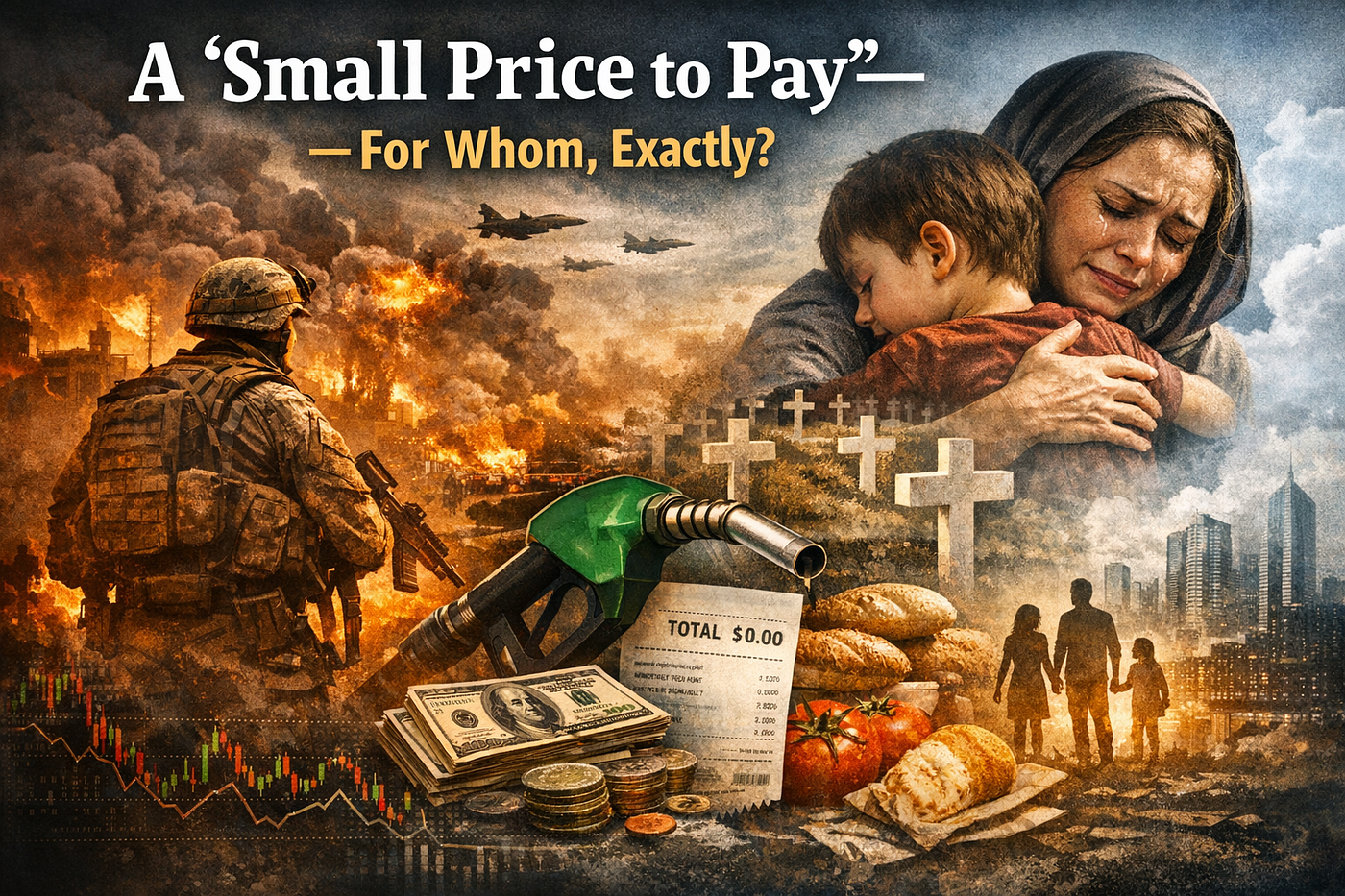
President Trump defended rising gas prices as “a very small price to pay” for the Iran war.
But prices are never abstract to the people paying them.
Energy costs do not stay at the refinery. They move through trucking, shipping, food production, heating, and almost every corner of daily life.
A rise in fuel prices becomes a rise in grocery bills.
A rise in transportation costs becomes a rise in almost everything.
So when a president calls that “a very small price,” the question is: small for whom?
Small for the family choosing between filling the tank and buying a full cart of groceries?
Small for the worker whose commute suddenly costs more?
Small for the small business watching delivery costs climb?
Small for the elderly person living on a fixed income?
War always has two languages.
There is the language of leaders, where costs are temporary, acceptable, strategic, necessary.
And then there is the language of the people who actually live with those costs, where every increase has a name, a face, and a consequence.
That is why the return to diplomacy cannot be treated as a simple success story.
Yes, talks are better than missiles.
Yes, a deal is better than escalation.
Yes, any serious path away from a wider war should be welcomed.
But peace cannot become a public relations strategy for avoiding accountability.
The Question That Still Has to Be Answered
If diplomacy was still alive on February 26, then the public deserves to know why war was allowed to begin on February 28.
If the talks had not collapsed, what changed in those two days?
If technical discussions were expected to continue, who decided escalation could not wait?
If the issues now being negotiated were negotiable then, why were missiles allowed to fly?
And if the final result is a deal that resembles the path already open before the escalation, then leaders must answer for the damage done in between.
They must answer for the lives put at risk.
They must answer for the instability unleashed.
They must answer for the allies left guessing.
They must answer for the region pushed closer to disaster.
And they must answer for every family asked to absorb higher gas prices and grocery bills while being told by the president that the pain was “a very small price to pay.”
Because that is not a strategy.
That is an insult.
The price of war is never small to the people who pay it.
And a war that ends where diplomacy began must answer for everything it burned in between.
메타데이터
- post_id
- f6eb67a1f1b7
- slug
- if-diplomacy-was-still-alive-why-did-war-begin-f6eb67a1f1b7
- url
- https://medium.com/systemic-reckonings/if-diplomacy-was-still-alive-why-did-war-begin-f6eb67a1f1b7
- canonical_url
- https://medium.com/systemic-reckonings/if-diplomacy-was-still-alive-why-did-war-begin-f6eb67a1f1b7
- author_url
- https://medium.com/@peter.schulenberg
- status
- ok
- fetched_at
- 2026-06-14 11:28:49