Teachers! Here is what AI cannot do
Prelude
Teachers! Here is what AI cannot do
Prelude
Something significant has shifted in the landscape of knowledge. AI tools can now retrieve, synthesise, explain, and present information across almost every domain of human learning — often faster, more thoroughly, and with greater patience than any human teacher. For teachers whose primary self-understanding has been as transmitters of content, this is a genuinely disorienting moment. If a student can ask an AI to explain photosynthesis, parse a poem, solve a differential equation, or summarise a century of historical scholarship, what exactly is the teacher’s role?
The honest answer is that knowledge transfer was never the whole job — and it was arguably never the most important part. It was simply the most visible part, the most measurable part, and the easiest part to mistake for the entirety of teaching. What AI cannot do, at least not with any genuine pertinence or relevance to the person sitting in front of you, is read a student’s state: to perceive that this particular student, on this particular day, is not failing because they lack information but because they cannot see the standard they are being measured against — or because they can see it perfectly well and have no idea how to reach it. These are different problems. They require different responses. And they require a human being who is paying attention.
The teacher’s irreplaceable contribution lies not in what they know, but in what they can discern and do in relationship — specifically, in their capacity to inhabit two distinct roles that no information system, however sophisticated, can perform with human precision. The first is the role of the referee: the holder of standards, the deliverer of honest and situated verdicts, the person who tells a student clearly where their work stands and why. The second is the role of the coach: the developer of persons, the reader of emotional and motivational states, the builder of method and confidence from exactly where a student actually stands. Both roles require something AI presently cannot supply: the capacity to be genuinely present to the specificity of another human being, to read what is not said, and to respond not with the statistically appropriate answer but with the precisely right one.
This is not a comfortable reassurance that teachers need not worry about AI. It is a sharper challenge: to give up the parts of the job that AI can do better, and to invest fully in the parts it cannot touch. The teacher who clings to knowledge delivery as their core identity will find that ground increasingly contested. The teacher who develops genuine fluency in diagnosing student need — who can calibrate, moment by moment, whether a student requires the clarity of a referee or the attentiveness of a coach, and who can move between those registers with skill — is doing something that no model, however large, can replicate in any meaningful timeframe. That is not a small thing. It is, in fact, the whole thing.
The Referee and the Coach
Two roles every teacher plays — and how to know which one a student needs
Every teacher inhabits these two roles simultaneously, whether they know it or not. The distinction matters because students, at different moments and in different conditions, need radically different things from those who teach them. A student who does not know the standard needs a referee. A student who knows the standard but cannot reach it needs a coach. Conflating the two — offering warm encouragement when someone needs an honest verdict, or delivering a cold judgment when someone needs developmental support — is one of the most common and consequential errors in teaching practice.
The referee doesn’t need to know the student. The coach cannot function without knowing the student.
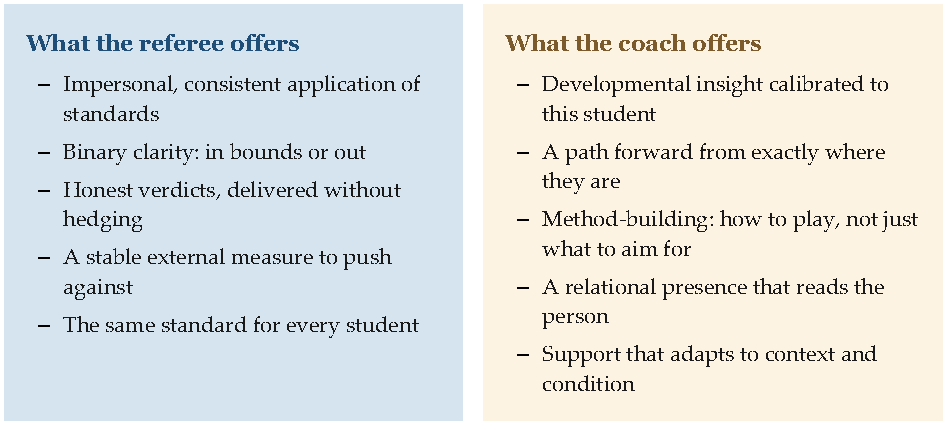
I. What Each Role Offers
The referee’s gift is clarity. To hold a standard impersonally, to apply it consistently, and to communicate the result without softening or hedging is an act of respect toward the student. It says: I take you seriously enough to tell you the truth. The referee does not adjust the standard based on how hard someone tried, how much they want it, or how upset they might be. The rules apply because the rules apply. This can feel clinical, even cold. But for a student who has been given vague, hedged, or falsely encouraging feedback, the referee’s clarity is a form of relief. To finally know where one stands is to have something solid to push against.
The coach’s gift is development. To see where a student actually is — not where they should be, not where they say they are, but where they genuinely stand in their understanding and capability — and to construct a path forward from that precise point, is a different kind of intelligence altogether. The coach is not context-blind. The coach cannot be. To coach well, one must know the person: their prior knowledge, their anxiety patterns, their relationship to failure, their motivation architecture. Coaching is inherently relational. It is soft in the best sense of the word: pliable, responsive, human.
II. What Students Need in Different Scenarios
The diagnostic question is not which role is better. Both are essential. The question is: which does this student need right now, in this moment, given what they are experiencing? The answer is almost never obvious from the surface.
When students need the referee
A student who does not know what “good” looks like is in a referee-deficit situation. They may have worked hard, they may have genuine ability, but without a clear standard they are navigating blind. Vague feedback — “needs more depth,” “be more analytical” — without an exemplar or explicit criterion is a failure of the referee function. These students need the standard made visible: show them what excellence looks like, decode the rubric, tell them precisely where their work fell short and why. Done with care, this is not harsh. It is the most useful thing a teacher can offer.
Similarly, a student who challenges a grade is making a referee request. They are questioning the application of the standard. The right response is to be the referee: walk through the criteria, show where the work did and did not meet them, be specific. Deflecting into coaching at this moment — “what do you think you could have done differently?” — reads as avoidance. The student asked for a verdict. Give it.
When students need the coach
A student who understands the standard but cannot execute it is in a coach-deficit situation. Consider the student who freezes in exams despite knowing the material, or the writer who cannot get words on the page despite having something to say. More criteria will not help them. They need method: strategies, rehearsal, reframing. They need someone to sit with them in the difficulty, diagnose the specific point of breakdown, and build a concrete path through it. The coaching function here is almost entirely about process — how to play, not what to aim for.
A student whose performance drops suddenly — late submissions, below-standard work, absence from engagement — is almost never failing because the standard became unclear. Something has changed. The coach function is to find out what. The referee’s job here is to stay in the background while the coach discovers what happened to the person. Standards can be re-engaged once the person is back in the room.
When students need both, in sequence
Many situations call for a calibrated blend of both functions, delivered in the right order. A student who says “everyone else understands this and I don’t” needs the referee to confirm where they actually stand relative to the standard — which often defuses the social anxiety driving the comparison — and then needs the coach to address the method. A first-generation student arriving without the hidden curriculum of academic culture needs a moderate referee presence to clarify what is actually expected (which is often less alarming than they fear), and heavy coaching to make the implicit explicit and lower the social cost of not knowing.
III. How Teachers Can Diagnose Student Need
Diagnosis is the hardest part. Most students arrive unable to articulate what kind of support they need. They know they are struggling; they do not always know why, or what would help. The teacher’s task is to read the signals beneath the surface request.
The most important diagnostic move is to listen for the implicit question underneath the spoken one. Students rarely present their actual need directly. They present a symptom — a complaint, a behaviour, a silence — and the teacher must read backwards from that to the underlying deficit.

Beyond listening, teachers can train themselves to read two categories of signals: verbal and behavioural.
Verbal signals
Referee signals tend to be outcome-oriented. Students ask about marks, grades, pass thresholds, comparisons with peers, or whether something is “right.” They want a verdict. They are asking: where do I stand? The word “just” is often a tell: “I just want to know if it’s good enough.” The “just” signals that they are not looking for a coaching conversation; they want the simplest possible honest answer.
Coach signals tend to be process-oriented. Students say they don’t know where to start, that they’ve tried everything without success, that they understand it but can’t show it. They use words like “stuck,” “frustrated,” “confused.” They are asking: how do I get there? The presence of emotional vocabulary — “I feel like I’m failing,” “I don’t belong here” — is almost always a coach signal, even when it is wrapped in a question about grades.
Behavioural signals
Silence is the most misread signal in teaching. A student who goes quiet in office hours, avoids eye contact, or gives one-word answers is not necessarily a referee case — not someone who needs a clearer standard. More often, they are a coach case: something about the environment feels unsafe, the cost of not-knowing feels too high, or they have not been given the vocabulary to ask for what they need. The right move is to lower the barrier, not raise the standard.
Sudden performance drops in previously capable students are almost never standard-related. Something changed in the person, not in their knowledge. Treating a performance drop as a referee problem — reminding the student of consequences, reiterating expectations — typically makes things worse. The coach must find out what happened before anything else can be addressed.
Overconfidence paired with poor output is the reverse case: a student who believes their work is stronger than it is. This is a referee deficit — they have not had honest external feedback. The temptation to soften the feedback to preserve the relationship is understandable but misguided. Students who have not been told the truth about their work eventually encounter a context that will tell them without care. A teacher who delivers the honest verdict with warmth and specificity is doing something genuinely valuable.
IV. The Practice of Switching Registers
Knowing the theory is not enough. The practical challenge is to switch registers fluidly within a single interaction — to move from referee to coach and back again as the student’s need shifts, without losing coherence or trust.
The most effective technique is to name the shift. When a teacher says, “Let me put on my referee hat for a moment and tell you exactly where this sits against the criteria,” two things happen: the teacher gets a clean transition cue, and the student understands that what follows is the clinical function, not a personal judgment. When the teacher then says, “Now — how are you feeling about this, and what would help you move forward?” the student understands that the register has changed. Over time, students who experience this pattern learn to ask for what they need. They begin to say, explicitly: “Can you just tell me if this is good enough?” or “I don’t need the grade right now — I need help figuring out my approach.” That is a significant metacognitive development.
The deepest insight is this: most teachers have a dominant default. Those who lean toward the referee tend to fill ambiguity with criteria; those who lean toward the coach tend to fill it with questions. Neither default is wrong. But the students who need the other register — the ones who need method when they are getting verdicts, or clarity when they are getting warmth — are not failing to respond to good teaching. They are receiving the right teaching for the wrong student, in the wrong moment.
The goal is not balance. The goal is precision — the right register, for the right student, at the right moment.
A teacher who can diagnose student state accurately, hold two distinct functional registers fluently, and switch between them deliberately is doing something that no rubric, no curriculum framework, and no assessment policy can do. They are reading the person in front of them and responding to what is actually there. That is, in the end, what teaching at its best has always been.
If you are a teacher, try this self-diagnosis tool and calibrate your classroom register: https://anilkchalla.github.io/referee-coach/
메타데이터
- post_id
- f6f7a0dd7fcd
- slug
- teachers-here-is-what-ai-cannot-do-f6f7a0dd7fcd
- url
- https://medium.com/@anilkumarchalla/teachers-here-is-what-ai-cannot-do-f6f7a0dd7fcd
- canonical_url
- https://medium.com/@anilkumarchalla/teachers-here-is-what-ai-cannot-do-f6f7a0dd7fcd
- author_url
- https://medium.com/@anilkumarchalla
- status
- ok
- fetched_at
- 2026-07-07 18:25:49




