Now Is a Good Time in America to Read The Odyssey
In the summer of 1963, I was four years old.
Now Is a Good Time in America to Read The Odyssey
In the summer of 1963, I was four years old.
My father, mother, brother and I drove cross country in a second-hand Buick station wagon to Claremont, California. My father had a job waiting for him as professor of comparative literature at what is now Claremont McKenna College, where he would spend his entire career.
Along the way, he told us the stories of The Odyssey, by Homer, the blind Greek poet. It’s about the Greek warrior/king Odysseus as he strives to make it home to his family after ten years fighting the Trojan War and another ten years waylaid by one obstacle after another.
Listening from the back seat of the car, I was mesmerized by the one-eyed cyclops, blinded by the man named “Nobody” and his men, who tied themselves under the monster’s sheep. And the intoxicating sirens and the beeswax in the ears of Odysseus’s men.
At the time, I couldn’t remember the hero’s name. As we drove through Arizona and New Mexico, I kept begging him to again tell the stories of “the man who begins with O.”
Those stories are all I remember about the trip.
As it happens, now is a good time in America to read The Odyssey.
A movie version comes out next month. Plus, the themes are timeless, and relevant to today:
Boys become men by struggling, striving, going through difficulties. That community is always under threat and necessary to defend, as without it we are lost in a wilderness of selfishness and brutality.
A year or so ago, I embarked on reading or re-reading classic books: The Grapes of Wrath, Moby Dick, Huckleberry Finn, A Tale of Two Cities, and Homer’s The Iliad.
Not long ago, rummaging through the book bins at my Goodwill Outlet, I found a copy of Robert Fagles’ translation of The Odyssey and set to.
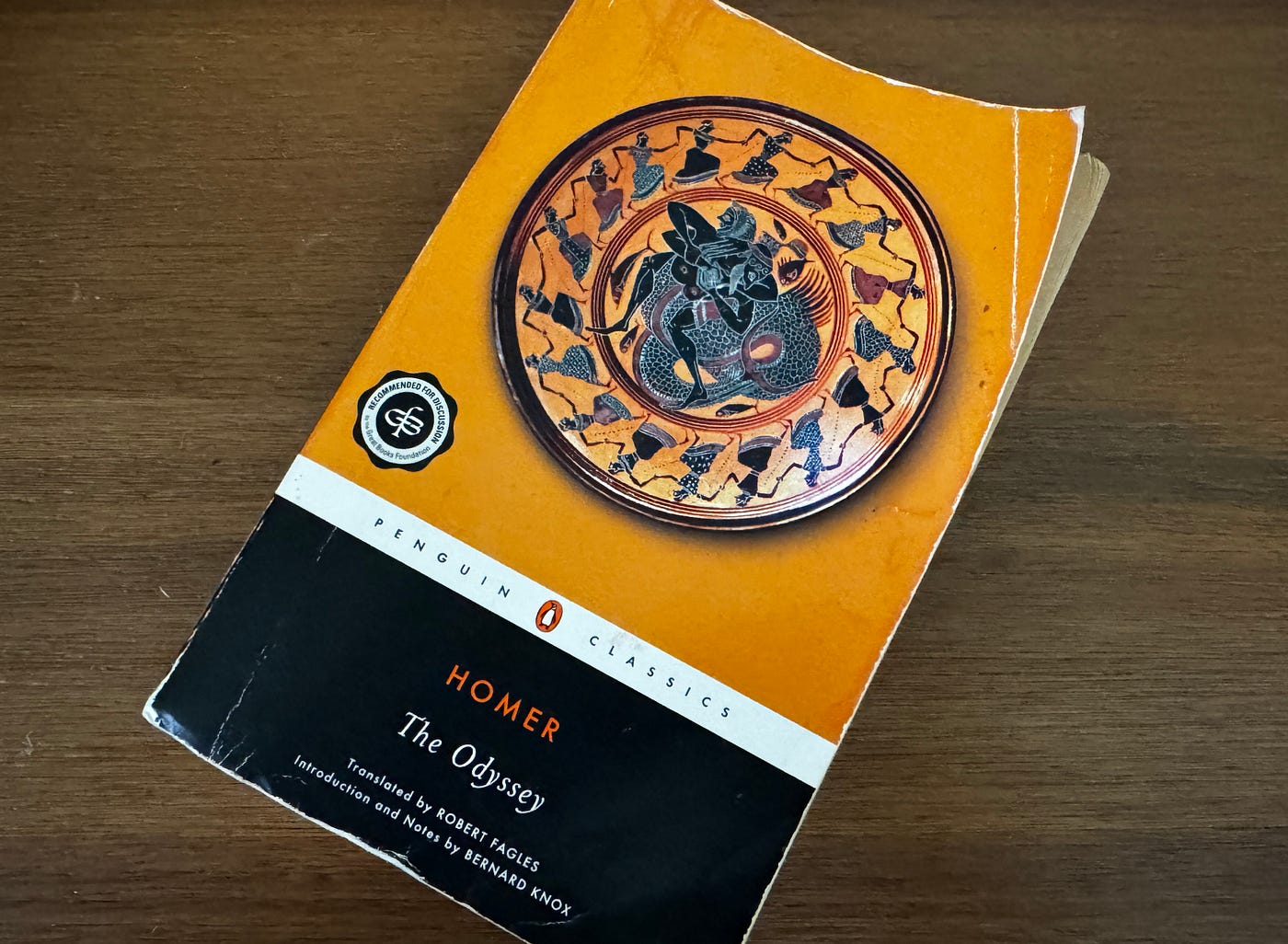
I was lucky enough to read the tale in conjunction with the book club of **The Culturist, a Substack newsletter run by Sean Berube**, whose insights added immensely to my understanding of the book.
The story is about the threat to us all of losing community. Greeks of the time, according to Berube, faced a world unruled by law, a world of violence, chaos, piracy, and wanton pillage and murder.
The refuges were the city-states governed by an invaluable idea holding it all together.
That idea is xenia — hospitality. In a larger way, xenia involves respect for community norms and the responsibilities we have in dealing with others.
The Odyssey is filled with examples of xenia. These are great feasts, in which the visitor is lavished with food and gifts, but is expected to entertain the hosts with stories, and, of course, respond in kind should he ever be the host.
And it’s filled with examples of the lonely, self-centered, brutish world we face without it.
Before we meet Odysseus, we meet some of the first fatherless characters in Western literature: the suitors invading Odysseus’s court. Their fathers were killed in the Trojan War. They are therefore uninstructed in a guest’s responsibilities in hospitality. They move in. They contaminate his court with unbridled consumption. They eat whatever they want, sleep with the maids, believing Odysseus also died in the war and his wife, Penelope, is therefore fair game to remarry.
Later, the mountainous cyclops, Polyphemus, we learn is “a grim loner, dead set in his own lawless ways” who “never mixed with others,” but in fact devours Odysseus’s men.
These are the worlds where xenia has been lost.
Odysseus’s story, Berube says, is of one man’s striving to restore behavior that solidifies, sustains community.
He has moments of weakness. He spends a year on an island sleeping with Circe, goddess of magic, forgetting all about returning home, until his men remind him of his duty.
In fact, Odysseus is a complicated hero. Strong, fearless, smart, inventive, prideful, egotistical, crafty, a plunderer, violent, vain — all in one guy.
He displays his talents for war and slaughter. But mostly, he uses creativity and ingenuity, bravery and wit — all in service of returning to family and restoring order to his kingdom that suitors have defiled.
The suitors remind me of designers of social media algorithms and those pestilent gambling apps, of junk food manufacturers, dope dealers.
With enormous resources, they invite our most selfish, lonesome human impulses, our consumption without limit, understanding that their best customers will be those who grow addicted to their products.
This newsletter of mine is a reader-supported publication, so why not go right ahead and consider becoming a free or paid subscriber.
They do so with apparently little feeling for their own community responsibility. Xenia seems to have deserted them, as it has Penelope’s fatherless suitors.
Odysseus, meanwhile, turns his back on pleasure to focus on the duty of returning home. He declines the offer the goddess Calypso’s offer of eternal life, and sex, if he will stay with her. He won’t stay on the island of the Lotus-Eaters, where those who eat the lotus lose all desire to return home.
“He realizes man is not made for pleasure,” Berube says. And to be deprived of death would be to deprive the soul of striving. What makes Greek gods so petulant at times is that they’re bored with their own immortality, must strive for nothing, freed of the consequences of their actions. They’re the lottery winners of the ancient Greek cosmology.
Greek’s imagine the gods to be like prison gang leaders I’ve known, alone in solitary cells, creating drama for gang followers they’ve never met because they can and they have nothing else to do.
But striving is part of the human condition, and “has a meaning that stands tall on its own,” Berube says.
It’s just that our modern consumer-product marketing is busy convincing us this is not true. That we’ll be happy by kicking back, endlessly consuming their products.
Through dopamine, our brains push us to strive, to explore, to create. Without it, we would find no wonder and excitement in any of that. Dopamine can also lead to addiction, pushing us to want that pleasure to the exclusion of everything else.
Odysseus, in modern terms, has (mostly) balanced his brain’s dopamine and the consequences of unrestrained pleasure.
Odysseus is the fully formed adult brain (though still weak at times, like any human); the suitors are the unguided child brain in action.
“The fullness of his nature is reached through his identity as king and restoring virtue to the kingdom,” says Berube.
One last thing:
I find The Odyssey superior to The Iliad.
The Iliad is about a later portion of the Trojan War. It’s slaughter for slaughter’s sake. It’s bravery in service of destruction.
Humans are pawns of frivolous gods (read dictators or tech corporations in our modern era), bored by their own immortality, playing havoc with the lives of mortals.
And it’s about one man’s petulance. Achilles, the great hero, rages because the Greek King Agamemnon has taken his slave woman. For hundreds of pages, he sulks off in his ship as Greeks and Trojans battle and his countrymen are slaughtered.
It all makes for a book about the results of the worst of human nature, and the absence of human free will.
The Odyssey, on the other hand, is about human ingenuity, one man facing challenge, adventure and using his own bravery and wit to overcome. He encounters deceased Achilles in the underworld — as if Homer shows us that the world of The Iliad is what Odysseus is trying to avoid by striving to return home to restore order.
Together, though, The Iliad and The Odyssey form an uncanny description of the two halves of the Western civilization that would grow from them. Warlike, destructive of humanity, corrupt, violent and conquering, on one hand. Inventive, brave, enriching to humanity, promoting knowledge, the individual, and generosity, on the other.
It’s almost as if blind Homer could see what was coming and presented it to us in two tales, each telling half the story.
메타데이터
- post_id
- f705f0e52675
- slug
- now-is-a-good-time-in-america-to-read-the-odyssey-f705f0e52675
- url
- https://medium.com/@samquinones7/now-is-a-good-time-in-america-to-read-the-odyssey-f705f0e52675
- canonical_url
- https://medium.com/@samquinones7/now-is-a-good-time-in-america-to-read-the-odyssey-f705f0e52675
- author_url
- https://medium.com/@samquinones7
- status
- ok
- fetched_at
- 2026-06-24 04:09:36