How ISO 717‑1 Turns Raw Acoustic Data Into Rw
A practical overview of how ISO 717‑1 converts spectral test data into single‑number airborne sound insulation ratings.
How ISO 717‑1 Turns Raw Acoustic Data Into Rw
A practical overview of how ISO 717‑1 converts spectral test data into single‑number airborne sound insulation ratings.
Airborne sound insulation tests generate third‑octave values from 100 Hz to at least 3150 Hz. These spectra describe performance in detail, but they are inefficient for design decisions or regulatory checks. ISO 717‑1 provides a standard method to compress this data into single‑number ratings such as Rw, R’w and DnT,w.
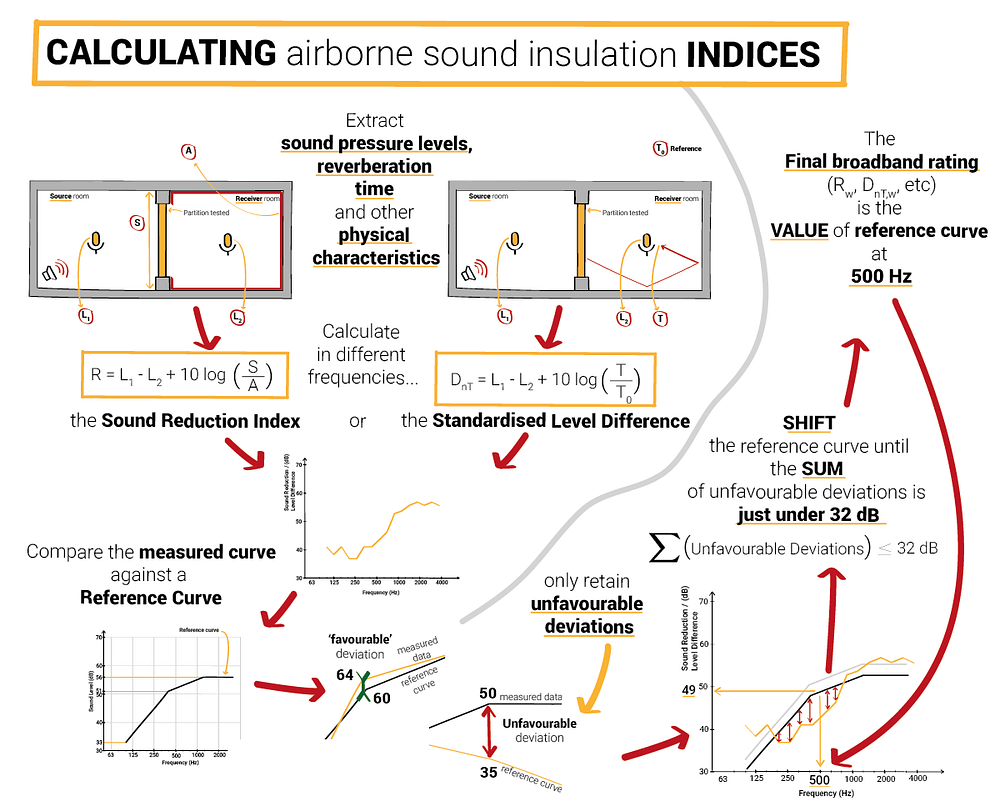
Visual explanation of ISO 717‑1 airborne sound insulation ratings.
From level differences to spectral indices
The first step is to convert measured sound pressure levels into spectral indices. When you want the performance of the partition itself, independent of room size, you use the Sound Reduction Index R (laboratory) or the Apparent Sound Reduction Index R’ (field). Both start from the level difference between source and receiving rooms and correct it using the absorption area of the receiving room.
When you are interested in how two spaces are acoustically separated in practice, you use the Standardised Level Difference DnT. Here the correction uses the measured reverberation time in the receiving room, normalised to a reference value, rather than the area of the element.
Applying the ISO 717‑1 reference curve
Once you have R, R’ or DnT across frequency, ISO 717‑1 defines a reference curve that approximates typical heavyweight constructions: lower insulation at low frequencies, essentially flat at higher frequencies. Using the Method of Comparison, you shift this curve in 1 dB steps until the sum of all unfavourable deviations (measured values falling below the curve) is as large as possible but does not exceed 32.0 dB. The value of the shifted curve at 500 Hz becomes the single‑number rating (Rw, R’w or DnT,w).
If you found this article useful, check out the full blog on Technical acoustic reporting services.
메타데이터
- post_id
- f7121bef708e
- slug
- how-iso-717-1-turns-raw-acoustic-data-into-rw-f7121bef708e
- url
- https://medium.com/@ateliercrescendo/how-iso-717-1-turns-raw-acoustic-data-into-rw-f7121bef708e
- canonical_url
- https://medium.com/@ateliercrescendo/how-iso-717-1-turns-raw-acoustic-data-into-rw-f7121bef708e
- author_url
- https://medium.com/@ateliercrescendo
- status
- ok
- fetched_at
- 2026-07-23 16:27:51

