Beyond Chatbots: How Conversational AI Is Becoming an Operational Layer
The conversational AI market was valued at $14.29 billion in 2024 and is projected to reach $41.39 billion by 2030. That growth isn’t…
Beyond Chatbots: How Conversational AI Is Becoming an Operational Layer
The conversational AI market was valued at $14.29 billion in 2024 and is projected to reach $41.39 billion by 2030. That growth isn’t driven by better chatbots. It’s driven by something more structural: AI that no longer just answers questions, but completes tasks inside real business workflows.
The shift reframes what conversational AI is for. Fluency matters less than follow-through. The question organizations are now asking isn’t “does the AI sound helpful?” — it’s “can the AI reliably act?” Trigger a process. Update a record. Resolve a request end-to-end without handing control back to the user.
That distinction separates the next generation of conversational AI from the generation before it.
From Scripted Bots to Intelligent Agents
Early chatbots were built for predictability. They handled FAQs, routed users through fixed menus, and deflected simple requests. This worked as long as conversations stayed narrow. The moment a request required context, judgment, or a sequence of actions across systems, those tools reached their ceiling — and users felt it.
The pressure to bridge that gap is what pushed conversational AI toward agent-based architectures. Modern systems are designed around three capabilities that earlier bots lacked entirely.
Reasoning over context means the system understands not just what the user said, but what they’re trying to accomplish — factoring in conversation history, account state, and business rules before responding. Tool use means the agent can query databases, call APIs, access knowledge bases, and create or update records inside live enterprise systems — not simulate those actions, but actually perform them. Multi-step execution means the agent can plan and carry out a workflow across multiple interactions rather than returning control to the user after each response.
According to McKinsey, 23% of organizations are already scaling AI agents in at least one operational area, while 39% are actively experimenting. Conversational AI is one of the most common entry points — because support, onboarding, and operational assistance are high-volume, high-repetition, and immediately measurable.
Five Trends Defining Conversational AI in 2026
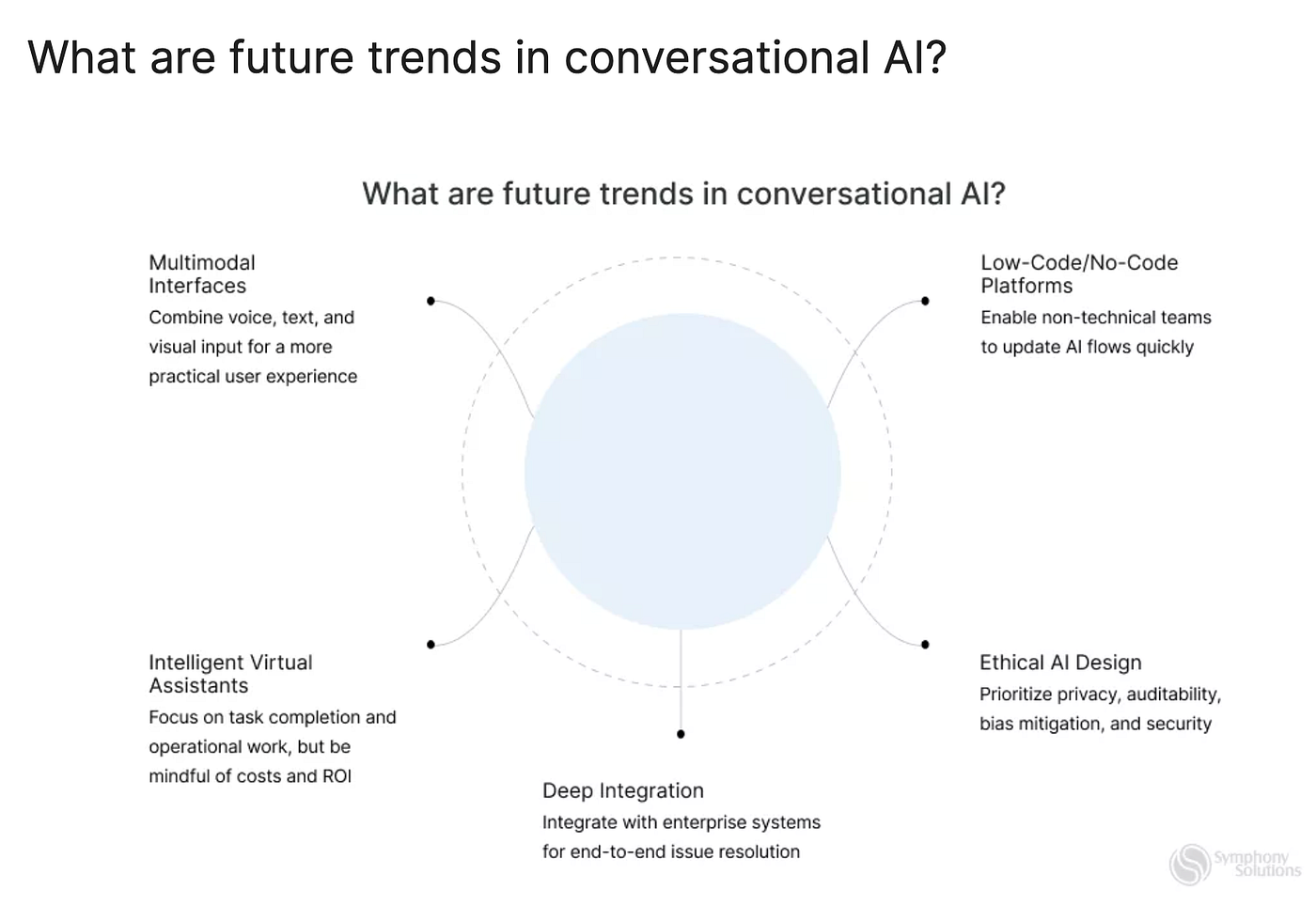
1. Agentic task completion is replacing conversational assistance. The fastest-growing shift is from talking to doing. Modern systems are designed to handle operational work: triage requests, gather missing inputs, take action across connected systems, and close the loop — without escalating back to a human. Gartner’s warning is worth noting here: over 40% of agentic AI projects may be canceled by 2027, typically because teams labeled basic automations as agents without the integration, governance, or clear ROI to sustain them. The teams succeeding focus on narrow, high-volume workflows with measurable outcomes — deflection rates, time-to-resolution, error reduction — rather than capability breadth.
2. Multimodal interfaces are removing the friction of text. Users don’t always want to type. Voice, screen sharing, and document upload are increasingly part of conversational AI interfaces — allowing users to speak a request, show an error message, or attach a document instead of describing everything in text. This matters most in mobile contexts, time-sensitive situations, and workflows where the issue lives on a screen rather than in memory. Multimodal design turns conversational AI into a guided, adaptive interface rather than a chat window with a text box.
3. Deep enterprise integration is the dividing line. Conversational AI that can’t access live data can’t resolve anything. As organizations move agents into customer-facing and operational workflows, real-time access to CRM, ERP, ticketing, knowledge bases, and identity layers is no longer optional — it’s the prerequisite for end-to-end resolution. McKinsey estimates that while 88% of organizations say they use AI, only about 7% have fully scaled it across their operations. Integration is the gap. Organizations that close it get agents that resolve; those that don’t get agents that deflect.
4. Low-code platforms are making iteration practical. Conversational flows change constantly — policies update, support journeys evolve, prompts go stale. Relying on engineering for every adjustment doesn’t scale. Low-code and no-code platforms let product, support, and operations teams modify conversational logic themselves. Forrester estimates that 87% of enterprise developers already use low-code platforms in some capacity. In conversational AI, this approach is becoming standard for the interface layer, where speed of iteration is what keeps the system current.
5. Governance and ethics are becoming design requirements. As conversational AI handles payments, account changes, identity checks, and personalized promotions, trust moves from a secondary concern to a core one. Privacy by default, auditable action trails, bias mitigation in high-stakes contexts, and security controls against prompt injection and data leakage are increasingly embedded at the design stage — not added after deployment. Both NIST’s AI Risk Management Framework and the EU AI Act (rolling out through 2025–2026) are pushing organizations toward accountability as a standard rather than an aspiration.
The iGaming Case: When Chatbots Break Fastest
iGaming exposes conversational AI limitations faster than most industries. Players expect instant, accurate help during onboarding, verification, navigation, and live play — often under time pressure, in multiple languages, and with real money on the line. In that environment, a static support flow that can’t access account state or take action is friction, not assistance.
The industry is responding by moving toward agent-based conversational AI that understands betting context, guides players through critical steps, and acts inside the product. BetHarmony — an AI-powered betting agent — illustrates the direction: 24/7 multilingual support, voice and text interaction, proactive offer surfacing, and deep integration with the platform it serves. It’s designed as part of the product experience, not a separate support channel bolted on afterward.
That integration model — conversational AI embedded in the product, with real-time access to live data and actions — is what separates effective deployments from expensive experiments across every industry.
What to Get Right Before Deploying
Three challenges consistently determine whether a conversational AI deployment delivers sustained value or becomes a maintenance burden.
Integration complexity is the most common slowdown. Legacy systems, fragmented data sources, and outdated knowledge bases make it harder for agents to access what they need or act where it matters. Solving this upfront — rather than discovering it in production — is the difference between an agent that resolves and one that apologizes.
Consistency and memory are what users notice first when they fail. An agent that forgets context, asks the same question twice, or gives contradictory answers across sessions erodes trust immediately. At scale, reliability depends less on model capability and more on how context, retrieval, and session memory are architected.
Security and access control become operational realities the moment agents can trigger actions. Clear permission boundaries, controlled API access, proper audit logging, and protection against prompt injection are infrastructure requirements — not configurations to add later when something goes wrong.
The Bottom Line
The conversational AI market is growing because the underlying technology is finally capable of something earlier systems couldn’t reliably deliver: completing work, not just facilitating conversation.
The organizations building durable value aren’t deploying AI that sounds better. They’re deploying AI that integrates deeper, governs more carefully, and measures what actually changes — resolution rates, handling time, escalation frequency, operational cost.
Conversational intelligence isn’t the next generation of chatbots. It’s a different category of software — one that belongs inside the product, connected to real systems, accountable for real outcomes.
Originally based on insights from Symphony Solutions https://symphony-solutions.com/insights/beyond-chatbots-future-conversational-ai-intelligent-interfaces
메타데이터
- post_id
- f717a2f6b010
- slug
- beyond-chatbots-how-conversational-ai-is-becoming-an-operational-layer-f717a2f6b010
- url
- https://medium.com/@symphony-solutions/beyond-chatbots-how-conversational-ai-is-becoming-an-operational-layer-f717a2f6b010
- canonical_url
- https://medium.com/@symphony-solutions/beyond-chatbots-how-conversational-ai-is-becoming-an-operational-layer-f717a2f6b010
- author_url
- https://medium.com/@symphony-solutions
- status
- ok
- fetched_at
- 2026-06-22 17:31:34




