Omnipotence, Ballast, and Posture
Ecosystems, wakesurfing boats, and the language we speak
Omnipotence, Ballast, and Posture
Ecosystems, wakesurfing boats, and the language we speak
In my office I designed a 55-gallon aquarium with South American cichlids.
Every morning I turn on the lights. Then feed them.
Why?
I’m a guy with a God complex.
Let there be light!
Now there’s food.
I’ll trade your rib for a female.
Plants? — let it be so.
Oxygen? — bam!
Driftwood, gravel, stones.
On Sunday, I rested.
My ecosystem needs a filter change.
Turns out, omnipotence has a maintenance schedule.
Why so specific with the fish?
It feels Type A or OCD even. Pet stores have a lot of different kinds of fish. All shapes, sizes and colors.
They do.
My concept: create a South American river basin under glass. Stock it with a few colorful personalities from that region. That way they all speak the same language.
Not kidding.
It’s posture.
When I feed them the Oscar darts with fins flared, “Hey mister Dempsey, I eat first.” Dempsey backs off looking for food that floated in a different direction.
If I introduced African cichlids to the tank, they posture differently. Rather than harmony there would be chaos. Fish would die.
I’m cultivating an ecosystem.
Think stewardship not cock fighting.
Keely and I met in the fall. By the time spring rolled around we’d discovered that home canned tomatoes ran in our blood.
Adding fruit trees and a garden to our landscape made sense. Some people are content with a couple of tomatoes and pepper plants in pots.
That’s fine.
We went all in on a bigger space for fruit and veggies because we preserve them.
Nothing elevates chili in January more than home grown tomatoes.
In the fall I shred our leaves and compost them. Throughout the year we add kitchen scraps and lawn clippings too. We end up with nutrient rich soil for the entire garden.
As I’m working in the garden, neighbors will stop and say, “You know, they sell vegetables in the grocery store.”
No doubt.
Having a garden is about more than just the produce.
It’s transformative.
Stepping into our space takes me back to my grandmother’s farm.
Hearing bobwhites calling in the distance.
Ma’s voice — shaped by age, her Kentucky roots, and menthol cigarettes comes to life in my heart.
My mind replays stories she told of her childhood as she made cobbler with raspberries we’d just picked.
I’ll find toads, swallowtail larvae on our dill. There’s a connectedness that’s missing when I grab the handle of a grocery cart.
Robins nest in our apple trees. Wrens find safety in nearby ornamental grass.
Sweat
Sunlight
Breeze
As evening settles and light fades, the bats come out to play. I move from garden to patio, surrounded by perennials and coniferous shrubs, the lightning bugs rise and flash leaving me in a state of childlike wonder.
As a kid our neighborhood was bordered to the East by a creek, crooked creek — a tributary of White River.
Mom took me there with a friend when we were little. There was something mysterious about that part of the creek. We called it the lagoon.
There were ruins of an old trestle. Big carved limestone blocks tossed like dominos. Something only heavy equipment could lift.
The water was clear to the eye, not to the immune system. Fish of different sizes and variety swam in the lagoon. We waded both directions for hours catching crawdads, snakes, or a glimpse of something else. To us — a natural resource. Not to everyone though. To some it’s a place to abandon unwanted items seen and unseen.
Waterways and lakes are a gift. Glaciers shaped the basins. Snowmelt and storms keep them alive.
Around here we took that gift and mucked it up.
Keely and I live near the same creek.
Not planned
Just happened
When we moved in, septic tanks.
Now? City sewers.
It seems the stuff from our septic tank liked wading in the creek as much as us. Eventually — accurate term. The city had to act.
The same thing happened at the lake. In my essay, A Change In Taste, we had an E. coli issue caused in part by farming.
We also have a problem with hitchhiking.
Hitchhiking isn’t just for hippies and serial killers. Aquatic plants and mollusks use it too.
Picture a mussel trying to catch up
to the car that pulled over more than 200 feet away.
With one foot.
Difficult.
The signs went up:
ramps.
Marinas
Bait stores.
Beware: Zebra mussels.
They arrived in ballast water from Russia. By the time they slipped through the St. Lawrence Seaway to our lake, they were hungry and ready to mingle.
Like that uninvited party guest that won’t leave, they ran the native mussels out of the lake.
They’re clingy. In every sense.
Water intake — clogged.
Jump barefoot — sliced
The fish are scratching their heads with their pectoral fins. What are these things?
I whisper to them in the morning while waiting for my ski brothers. “They’re like potato chips. Nobody can eat just one.”
Nothing
Must be my posture.
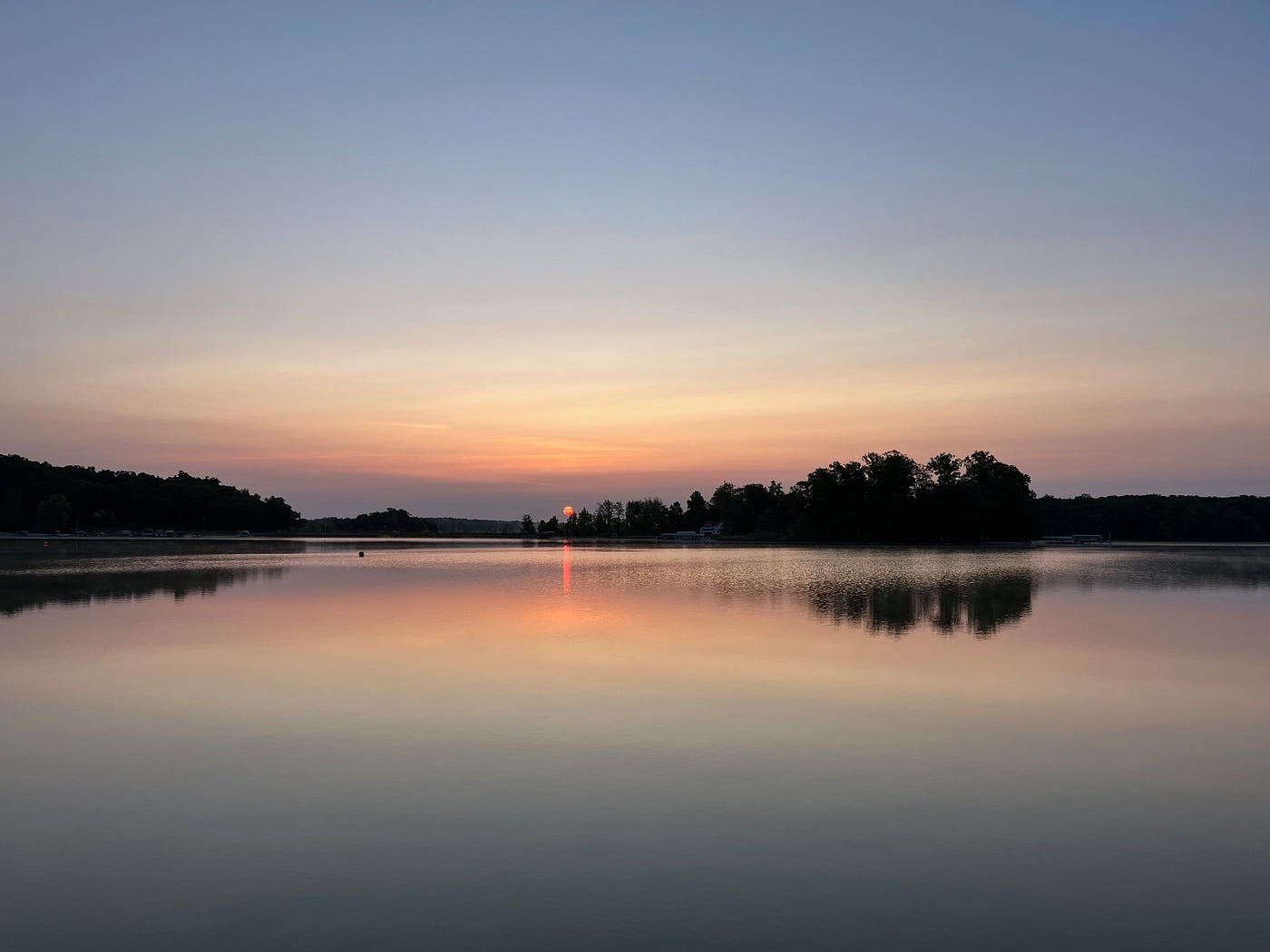
We’ve always skied early. Now, it’s earlier — dawn.
Have to.
The wakesurfing boats have disrupted our start time. They’ve replaced zebra mussels as the new opportunist.
Turns out they’re disrupting a lot.
Leave it to American ingenuity to build a boat that creates a wave big enough to surf behind.
These boats will blast anything on a playlist.
Across the lake
Like the zebra mussels
Invasively occupying space.
What if I don’t want Eminem with my coffee? That’s ok Lil Reese’s coming up next.
Red Wing Blackbirds? Not on their list.
It’s all about the surfer, not the lake.
Energy that tosses moored boats like tub toys.
Tied off at a pier?
Parallel to their wake?
Damage.
Not if. When.
My ski boat — on a lift.
Our pontoon — perpendicular to their waves. All four corners, lashed. Two to the pier. Two — eight-foot poles, driven three feet below the lakebed.
Not my first rodeo.
By the end of the summer, bent like boomerangs. The pier side — broken decking.
Fishermen? Capsized.
Eight-foot chunks of wetland shear off and drift.
They wash ashore. Then.
Towed out.
Chopped up.
Skied around like buoys.
Wakesurfing boats are built with ballast tanks. Jets. Surf gates.
Engineered turbulence.
Turns out the jets stir the lake bottom twenty feet down. That silt drifts in and settles near shore where aquatic plants lived — past tense. How do the fish feel about that? They were unavailable for comment.
Aquatic plants are called weeds. Easier to digest.
They feel creepy brushing against you, what’s it matter?
Ask the little fish who use them to hide, breathe, clean the water.
On our chain of lakes, lakefront property isn’t chump change — even if you commute by helicopter.
Private lakes have begun banning these boats — too much erosion.
Our lake?
State property.
State representatives speak a different language.
Posture.
In January lake friends called. A house bill was proposed to begin scaling back the boat’s influence.
Baby steps.
I spoke to the house subcommittee.
For the fish, cattails, and their friends.
We speak the same language.
When the sun sets and the engines fall quiet,
it’s amazing what you can hear
if you’re listening.
메타데이터
- post_id
- f725213ef2b1
- slug
- omnipotence-ballast-and-posture-f725213ef2b1
- url
- https://medium.com/@greg.phelps/omnipotence-ballast-and-posture-f725213ef2b1
- canonical_url
- https://medium.com/@greg.phelps/omnipotence-ballast-and-posture-f725213ef2b1
- author_url
- https://medium.com/@greg.phelps
- status
- ok
- fetched_at
- 2026-06-09 15:37:30