OPHI and the Need for a New Information Architecture
Modern civilization became digital because information could be measured, compressed, transmitted, stored, and corrected. Classical…
OPHI and the Need for a New Information Architecture
Modern civilization became digital because information could be measured, compressed, transmitted, stored, and corrected. Classical information theory made that possible. It gave engineers a mathematical language for uncertainty, noise, signal capacity, redundancy, and reliable transmission. Without that foundation, there is no internet as we know it, no modern telecommunications, no efficient data compression, no large-scale digital infrastructure.
But the world has moved beyond the original problem.
The central question is no longer only whether information can move through a noisy channel. The harder question is whether that information should be trusted once it arrives.
This is where OPHI enters.
Classical information theory asks how much uncertainty exists in a message and how reliably that message can be transmitted. OPHI asks whether the message is stable, grounded, coherent, timestamped, reproducible, and valid enough to be admitted into a system as truth.
That distinction matters because modern information does not simply travel. It acts. It shapes decisions, triggers workflows, influences markets, guides infrastructure, enters scientific records, trains models, updates security systems, and increasingly participates in autonomous control. A signal that is successfully transmitted but structurally false can still cause damage. A fluent answer can still be ungrounded. A statistically likely output can still violate reality.
The old world needed information to arrive. The new world needs information to prove itself.
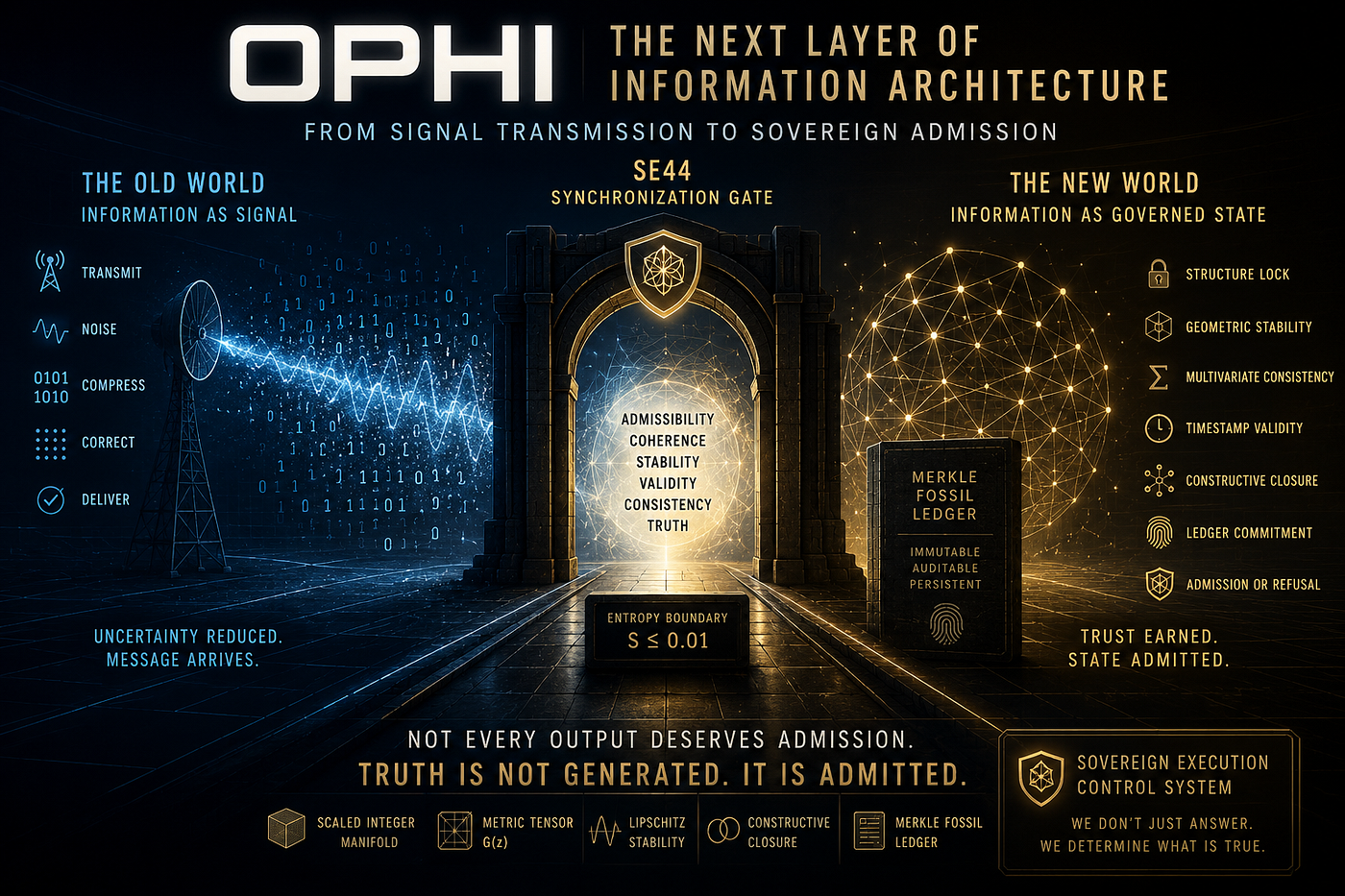
OPHI represents a shift from information as signal to information as governed state. It does not reject classical information theory. It extends the problem into a new layer: admissibility. In OPHI, information does not become trusted because it appears. It becomes trusted only after it survives constraint.
That is the deeper meaning of a Sovereign Execution Control System.
A normal predictive system produces output. An OPHI-style system controls whether an output is allowed to become part of the trusted state of the system. This changes the role of computation. The goal is not only generation, but validation. The system is not merely asking, “What is the next likely answer?” It is asking, “Can this state be admitted without corrupting the structure of reality inside the machine?”
That question becomes urgent in an age of generative AI.
Large models can produce persuasive language at scale. They can summarize, classify, explain, translate, compose, and infer. Yet their fluency often hides a serious weakness: prediction is not validation. A model can generate a citation that does not exist, explain a concept with missing constraints, produce a confident answer without a verified source, or create a plausible but false connection between facts.
For casual use, this may be acceptable. A brainstorm, a joke, a first draft, or a fictional scene can tolerate looseness. High-stakes environments cannot.
Cybersecurity, finance, infrastructure, scientific computation, autonomous systems, compliance, aerospace, medical-adjacent decision support, and industrial control require something stronger than plausible output. They require controlled admission, auditability, reproducibility, refusal under uncertainty, and traceable state evolution.
That is the need for the shift.
Shannon gave us the mathematics of signal transmission. OPHI proposes the architecture of trusted admission.
In classical information theory, entropy measures uncertainty. A surprising message may carry more information because it reduces uncertainty once received. In OPHI, entropy takes on a different role. It becomes a safety boundary. Excessive entropy is not treated as useful surprise by default. It may indicate drift, rupture, hallucination, adversarial contamination, or loss of structural coherence.
The SE44 Synchronization Gate captures this difference. Instead of allowing every generated emission to enter the trusted layer, SE44 enforces hard admissibility conditions, including entropy limits such as S ≤ 0.01. If an emission violates the boundary, it does not become truth inside the system. It may be refused, isolated, or redirected into the Mutable Shell for forensic containment.
This is one of OPHI’s most important principles. A refusal is not necessarily a failure. In a sovereign system, refusal can be a form of protection.
Most current AI systems are designed to answer. OPHI is designed to know when an answer does not deserve admission.
That creates immediate trade-offs.
A permissive model can keep talking even when it is uncertain. Users often enjoy that flexibility because it feels helpful. The danger is that the system may fill gaps with confident fabrication. OPHI closes much of that hallucination space through Mechanical Refusal. If the system cannot reach a stable Structure Lock across the agent mesh, it can produce zero trusted output rather than a polished guess.
This is the price of ledger purity. OPHI sacrifices some conversational freedom in exchange for stronger protection against unstable admission. In low-risk settings, that may feel excessive. In high-risk settings, it may be exactly the point.
OPHI also changes the shape of information itself.
Classical information theory often treats information as symbols, probabilities, and sequences. OPHI treats information as path-governed movement through a structured space. Instead of a flat chain of bits or tokens, the system places states inside a manifold. The Metric Tensor G(z) acts as a local ruler for that space, defining distance, curvature, and relational structure.
For a general reader, the idea is simple. OPHI does not only care what a system says. It cares where that statement lives in relation to other validated states.
For a technical reader, this means cognition is modeled as constrained state evolution across a latent manifold. Meaning is not merely produced as a sequence. It is governed as movement through a geometry. A valid state must preserve structure under transformation, remain close enough to grounded reference points, and avoid uncontrolled drift.
This is where Lipschitz stability matters. The condition L ≤ 1 means small changes should not explode into large distortions. In OPHI, that stabilizes state evolution by keeping perturbations inside a contractive regime. Errors, ambiguities, and weak deviations should decay back toward a stable attractor rather than amplify into rupture.
Many real failures begin small. A tiny numerical difference, a weak assumption, a slight misclassification, or an unsupported association can become dangerous if the system amplifies it. OPHI treats that amplification as an architectural risk. The purpose is not merely to correct bad outputs after the fact. The purpose is to constrain the path before bad outputs become admissible.
This is why OPHI is non-Markovian and path-governed.
A state is not judged only by its present appearance. Its history matters. Two outputs may look similar while having entirely different origins. One may emerge from a grounded and validated path. Another may be an accidental match produced by unstable reasoning. In OPHI, those are not equivalent. Truth requires ancestry, timestamping, multivariate consistency, and a traceable route through validation.
This makes OPHI fundamentally different from systems that only rank outputs by probability. Probability may tell us what is likely. It does not automatically tell us what is admissible.
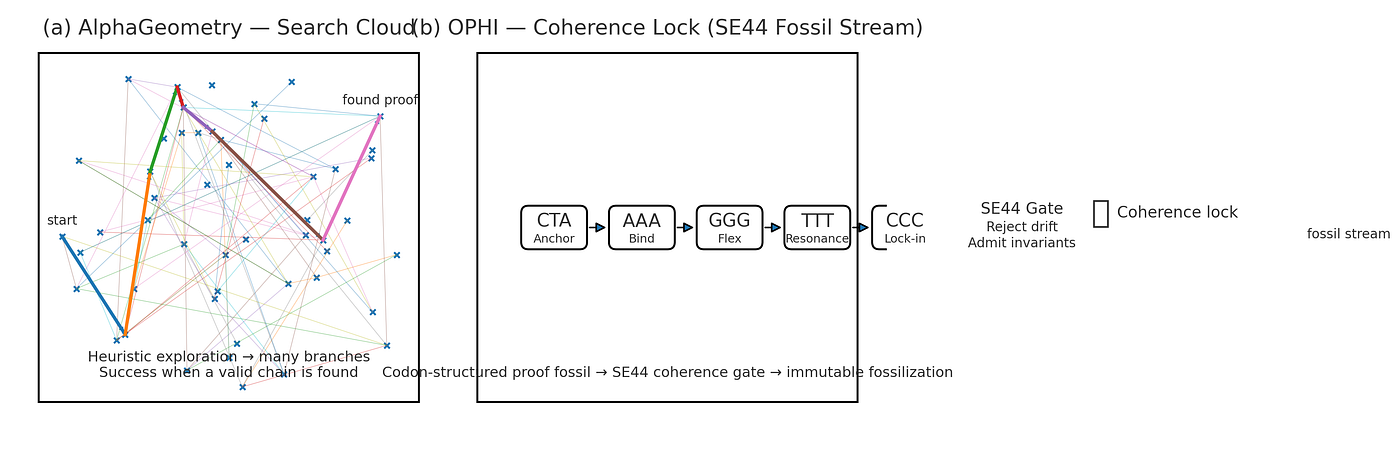
The Isomorphic Collapse operator, Ψ_iso, addresses ambiguity by searching for structural invariance across the 43-agent mesh. Instead of leaving a cloud of interpretations unresolved, the system attempts to collapse that cloud into a stable Structure Lock. When the invariant form is strong enough, the system can commit a validated transition. When it is not strong enough, the state remains outside the trusted core.
This process is called Constructive Closure.
Reliability comes from closure, not from endless plausibility. A state transition either satisfies the Unified Admission Rule or it does not. Once admitted, it can be fossilized into the Merkle Fossil Ledger as part of an irreversible, hash-chained record of cognitive ancestry.
That fossilization is a major part of OPHI’s value.
A normal system may produce an answer and then move on. OPHI preserves the validated path. It records what was admitted, when it was admitted, and how that admission relates to prior states. With timestamping and ledger commitment, memory becomes evidence. This matters in any environment where auditability, provenance, compliance, or post-incident review is important.
A scientific system needs to know where a claim came from. A cybersecurity system needs chain-of-custody. A financial system needs reproducibility. An autonomous control system needs accountability after failure. A regulatory system needs inspectable records.
OPHI turns validated information into accountable infrastructure.
The architecture also imposes serious engineering discipline. The Scaled Integer Manifold exists because floating-point arithmetic can produce small discrepancies across hardware. In ordinary systems, those discrepancies may be harmless. In a consensus system, they can fracture reality. A tiny numerical difference can change a hash, alter a validation outcome, or create disagreement between nodes.
To prevent Spectral Divergence, OPHI uses fixed scaling such as 1⁰⁴ and signed 64-bit integer representation. Every mathematical operation requires explicit rescaling to preserve numerical rigor. This creates bitwise reproducibility across heterogeneous hardware.
The benefit is strong: every node can arrive at the same calculated state.
The cost is also strong: implementation becomes harder. Developers lose the convenience of ordinary floating-point math. Compute and memory must be tightly coupled. Operations must be designed with deterministic precision. Some environments may require SoftFloat-style emulation or similar controls to guarantee identical results.
This is not a casual engineering choice. It is the price of deterministic truth.
The economic question is whether that price is worth paying.
The answer depends on the cost of being wrong.
For low-stakes applications, full OPHI enforcement may not be economically justified. Casual writing, entertainment, rapid brainstorming, loose ideation, early creative exploration, and low-impact summaries often benefit from flexibility. These contexts need movement before certainty. A rough idea may be useful precisely because it has not yet been collapsed into a final structure.
In these cases, a full Sovereign Execution Control System may be architecturally over-constrained and functionally prohibitive.
Creative exploration often depends on ambiguity. A writer may need several meanings to remain alive at once. A designer may need unstable visual associations. A researcher may need speculative links that are not yet grounded. Entertainment may thrive on discontinuity, exaggeration, surprise, contradiction, or symbolic distortion.
OPHI is built to narrow those possibilities before admission. The Isomorphic Collapse operator seeks structural invariance. The SE44 gate suppresses excessive entropy. Lipschitz stability prevents uncontrolled leaps. Constructive Closure turns validated states into committed structure. The Merkle Fossil Ledger gives those states historical weight.
Those are strengths when reality is at stake. They can become burdens when the goal is playful uncertainty.
A plot twist may look like a jump discontinuity. A surreal image may violate ordinary causality. A strange metaphor may begin as hallucinatory drift. A wild brainstorm may require exactly the kind of unstable association that OPHI would redirect into the Mutable Shell.
This does not mean OPHI has no role in creative systems. It means the enforcement layer should be staged. Let the early process remain loose. Let Infergence explore. Let the Mutable Shell hold unstable possibilities. Apply OPHI-grade validation only when the output is ready to claim truth, guide action, enter a record, or influence a consequential system.
That layered deployment is economically rational. Use flexible generation where failure is cheap. Use sovereign validation where failure is expensive.
In high-stakes domains, the economics change completely.
The upfront cost of OPHI may be higher than a simple inference wrapper, but cheap generation can become expensive when errors enter production. Invalid outputs create review burden, rework, compliance exposure, legal risk, operational uncertainty, incident response cost, and reputational damage. A system that looks inexpensive at deployment can become costly through correction and failure recovery.
OPHI’s economic value lies in reducing the total cost of trust.
It is most viable where verification is not optional. Cybersecurity, industrial control, autonomous infrastructure, financial risk systems, semiconductor manufacturing, scientific computation, compliance automation, and AI governance all depend on stable admission rules. These environments need reproducibility, audit trails, timestamped provenance, refusal under uncertainty, and strong protection against drift.
In those domains, OPHI is not expensive because it does more work. It is valuable because it prevents invalid states from becoming operational liabilities.
The trade-offs remain real.
OPHI reduces permissiveness. It increases engineering complexity. It can restrict creative fluidity. It demands numerical discipline. It may over-reject weak signals if thresholds are poorly tuned. A system that is too strict can become blind to emergence, especially when novel discoveries first appear as unstable anomalies.
This is why the Mutable Shell matters. Novelty that cannot yet be grounded should not automatically be destroyed. It can be isolated, examined, and revisited without contaminating the trusted ledger. That gives the architecture a way to protect truth while preserving the possibility of future insight.
The challenge is balance. Too loose, and the system admits drift. Too strict, and it chokes emergence. OPHI’s value depends on placing the validation boundary correctly for the task.
The broader implication is that AI cannot mature by scaling prediction alone. Larger models, faster inference, and more fluent generation will not solve the trust problem by themselves. The trust problem is architectural. Systems need to distinguish between generated information and admitted truth.
That distinction may become one of the defining lines of the next era.
The first era of digital information solved transmission. The second era solved large-scale generation. The next era must solve validation.
OPHI belongs to that third problem.
It reframes information as a state-bound asset that must survive coherence checks, entropy limits, geometric stability, deterministic execution, timestamp validation, multivariate consistency, and ledger commitment. It treats truth not as a sentence but as a validated transition with ancestry.
The shift is worth it wherever information has consequences.
It is not worth deploying at full force for every casual draft, joke, sketch, or brainstorm. In those cases, the architecture may be too heavy for the task. But when information enters systems that affect money, infrastructure, science, security, autonomy, compliance, or human safety, the cost of validation is often lower than the cost of failure.
That is the core economic argument.
The cheapest system is not always the one that produces the most output. In serious environments, the cheapest system is the one that prevents bad output from becoming expensive reality.
Classical information theory taught the world how to move information.
OPHI asks whether information deserves to become trusted reality.
That is the shift from signal to sovereignty, from prediction to admission, from fluent output to auditable truth.
메타데이터
- post_id
- f738f5a6e85a
- slug
- ophi-and-the-need-for-a-new-information-architecture-f738f5a6e85a
- url
- https://medium.com/@ophi06/ophi-and-the-need-for-a-new-information-architecture-f738f5a6e85a
- canonical_url
- https://medium.com/@ophi06/ophi-and-the-need-for-a-new-information-architecture-f738f5a6e85a
- author_url
- https://medium.com/@ophi06
- status
- ok
- fetched_at
- 2026-06-09 15:37:30