BSV, SPV, and the Return of Monetary Sovereignty
People have forgotten what money is.
BSV, SPV, and the Return of Monetary Sovereignty
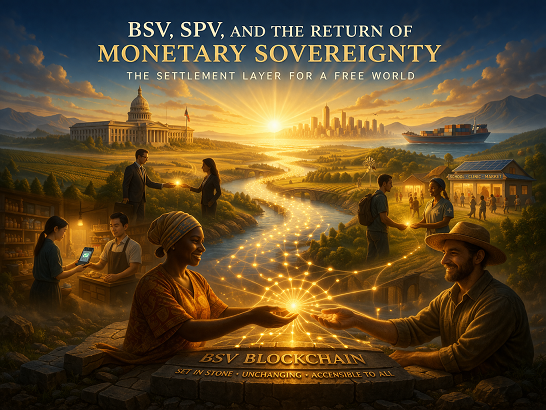
People have forgotten what money is.
Money is not merely a store of value. It is not a speculative instrument. It is not a synthetic claim shuffled between institutions. At its core, money must be peer to peer. That is its first principle. That is its moral structure. That is where its legitimacy begins.
Gold and silver did not fail as money because they were heavy. They failed because their peer-to-peer function was taken away. The moment people stopped exchanging the money itself and began exchanging warehouse claims, ownership slips, and IOUs instead, monetary power began to migrate away from the people. The issuers of those documents became the real handlers of value. They stood in the middle. They decided validity. They controlled redemption. They inherited the power that once belonged to the holders of money themselves.
That was the great monetary displacement.
Since then, most of humanity has lived under forms of money that are no longer truly sovereign in the hands of the people. What appears to be money is often only access to money, permission to use money, or a claim on money — managed, filtered, and surveilled by others. The public is told it is free, while the structure remains dependent on intermediaries. The people hold numbers. Others hold power.
True money must be used peer to peer, because only peer-to-peer money preserves direct possession, direct settlement, and direct economic dignity. And because money shapes the life of a nation, its authority cannot be vague, outsourced, or hidden behind technocratic fog. It must rest on a foundation that is publicly accountable. In earlier ages, this responsibility was visibly tied to the highest office of the realm — king, queen, emperor — those who could not escape blame when the people suffered. Money was understood as a matter of civilization, not merely finance.
Many centuries ago, China entered the post-coinage era through state-authorized paper money under imperial rule. The form changed, but the governing logic remained clear. Money still moved among the people with sovereign authority standing visibly behind it. It remained part of the nation’s order.
Europe took a different path. Post-coinage money expanded less through sovereign redesign and more through private notes, bank liabilities, and credit instruments. Rulers remained attached to coinage while monetary evolution increasingly passed into the hands of private issuers. From there, the story of modern money became the story of distance: distance between people and settlement, distance between nations and monetary control, distance between public trust and actual authority.
Today, even presidents and parliaments often do not stand as the true ultimate authorities over their own legal tender. Monetary authority is entangled with central banking structures, cross-border financial systems, and institutional networks that ordinary citizens neither see clearly nor control meaningfully. Sovereignty is spoken of politically, while monetary power remains elsewhere.
This is why the next form of money cannot merely be another version of the old deception.
The third money, if it is to emerge, must restore what history stripped away. It must be peer to peer. It must be ubiquitous. It must be inclusive. And it must be grounded in rules that no ruler, banker, parliament, company, foundation, or hidden alliance can rewrite at will.
This is where the importance of BSV Blockchain becomes civilizational, not merely technical.
Its promise is not only scale. Its promise is not only low fees. Its promise is not only capacity. Its deeper importance is that its base protocol is meant to be set in stone. That matters because money cannot become a trusted foundation for civilization if its core rules are forever mutable, forever political, forever subject to revision by committees and insiders. A changing protocol produces changing rights. Changing rights produce uncertainty. And uncertainty destroys the integrity of money.
BSV Blockchain’s inclusiveness also matters. A system with near-zero transaction costs and massive scale is not merely efficient; it is socially different. It allows participation without privilege. It lowers the threshold for entry. It opens the possibility that people, businesses, and institutions across the world can operate on a common economic data infrastructure without being filtered out by cost, congestion, or gatekeeping. Inclusiveness is not a side feature. It is one of the conditions for legitimate money in a connected age.
BSV Blockchain’s SPV should not be understood merely as one component of a scaling design. Its deeper meaning is philosophical. It expresses the principle that money should be settled peer to peer. Not symbolically peer to peer. Not rhetorically peer to peer. Actually peer to peer. Verification, exchange, and settlement must return to the edges — to the participants themselves — rather than being permanently absorbed into layers of institutional dependency.
In this view, SPV is not just an engineering method. It is a declaration about what money is supposed to be.
That is why this path stands apart. Most payment systems, including most so-called cryptocurrencies, do not truly restore peer-to-peer settlement in this civilizational sense. They reintroduce dependence in new forms: custodians, layered trust, off-chain concentration, governance capture, validation bottlenecks, or economic exclusion through cost and complexity. They may use the language of freedom while rebuilding the architecture of intermediation.
The future of money cannot be another maze of controlled access.
Gold and silver lost their place when peer-to-peer utility was broken. Paper systems expanded reach, but never solved the problems of transparency, inclusiveness, or ultimate sovereignty. The next money must do what previous forms could not. It must combine direct settlement, global reach, stable rules, and inclusive participation.
That is not only a monetary upgrade.
It is a civilizational correction.
메타데이터
- post_id
- f74f9df450b4
- slug
- skgremont-f74f9df450b4
- url
- https://medium.com/@bsvj/skgremont-f74f9df450b4
- canonical_url
- https://medium.com/@bsvj/skgremont-f74f9df450b4
- author_url
- https://medium.com/@bsvj
- status
- ok
- fetched_at
- 2026-07-29 06:51:31



