The Role of FFU Systems in Semiconductor Cleanroom Airflow Stability: Lessons From Real…
Introduction: Airflow Problems Are Often the Hidden Cause of Cleanroom Issues
The Role of FFU Systems in Semiconductor Cleanroom Airflow Stability: Lessons From Real Manufacturing Projects
Introduction: Airflow Problems Are Often the Hidden Cause of Cleanroom Issues
When people talk about semiconductor cleanrooms, they usually focus on cleanroom class, HEPA filters, or expensive production equipment.
However, during our communication with semiconductor manufacturers and cleanroom contractors, we found that one factor is often underestimated:
airflow stability.
A cleanroom can achieve ISO Class 5 cleanliness during testing, but maintaining stable performance during daily production is a completely different challenge.
Small airflow fluctuations can influence:
- Particle distribution
- Temperature uniformity
- Operator working environment
- Manufacturing yield
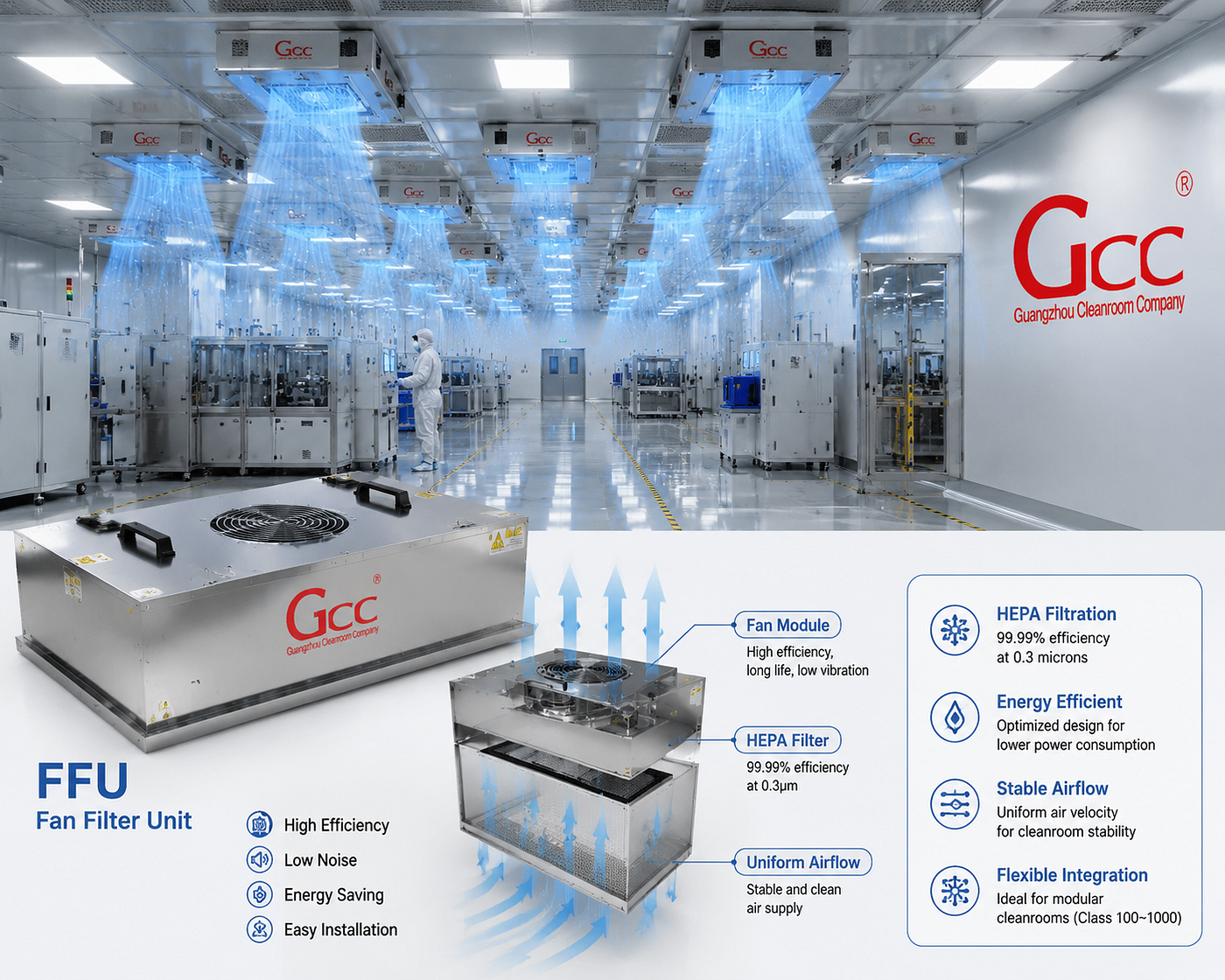
This is why Fan Filter Units (FFUs) have become an important solution in modern semiconductor cleanrooms.
GCC Tech provides energy-efficient FFU systems with HEPA filtration, designed for modular cleanrooms and Class 100 (ISO Class 5) applications.
Product reference: https://www.prefabcleanroom.com/sale-54375227-energy-efficient-ffu-with-hepa-filtration-for-modular-class-100-cleanrooms.html
Why Semiconductor Cleanrooms Need More Than Traditional Air Conditioning Systems
In a semiconductor facility, the HVAC system is responsible for maintaining the overall environment.
But production areas often require more precise airflow control.
For example:
A wafer inspection area may require:
- Extremely low particle concentration
- Stable vertical airflow
- Reduced turbulence around the working zone
A conventional air supply system may create uneven airflow distribution, especially in large cleanrooms.
Some areas may receive sufficient clean air, while others experience:
- Higher particle accumulation
- Airflow dead zones
- Unstable contamination control
This is where FFU systems provide an advantage.
What We Learned From a Semiconductor Assembly Project
Project Background
One of our semiconductor industry customers was expanding their precision assembly workshop.
The cleanroom had already been constructed according to ISO Class requirements.
However, after several months of operation, the production team noticed several issues:
- Particle levels fluctuated during working hours
- Cleaning frequency increased
- Operators reported inconsistent airflow feeling
- Some production areas performed better than others
The problem was not the cleanroom structure itself.
The main challenge was airflow distribution.
The Solution: Installing FFU Systems for Local Airflow Control

After evaluating the production environment, the engineering team introduced FFU units into the cleanroom ceiling system.
The goal was simple:
Create a more stable and controllable clean air environment.
The FFU system provided:
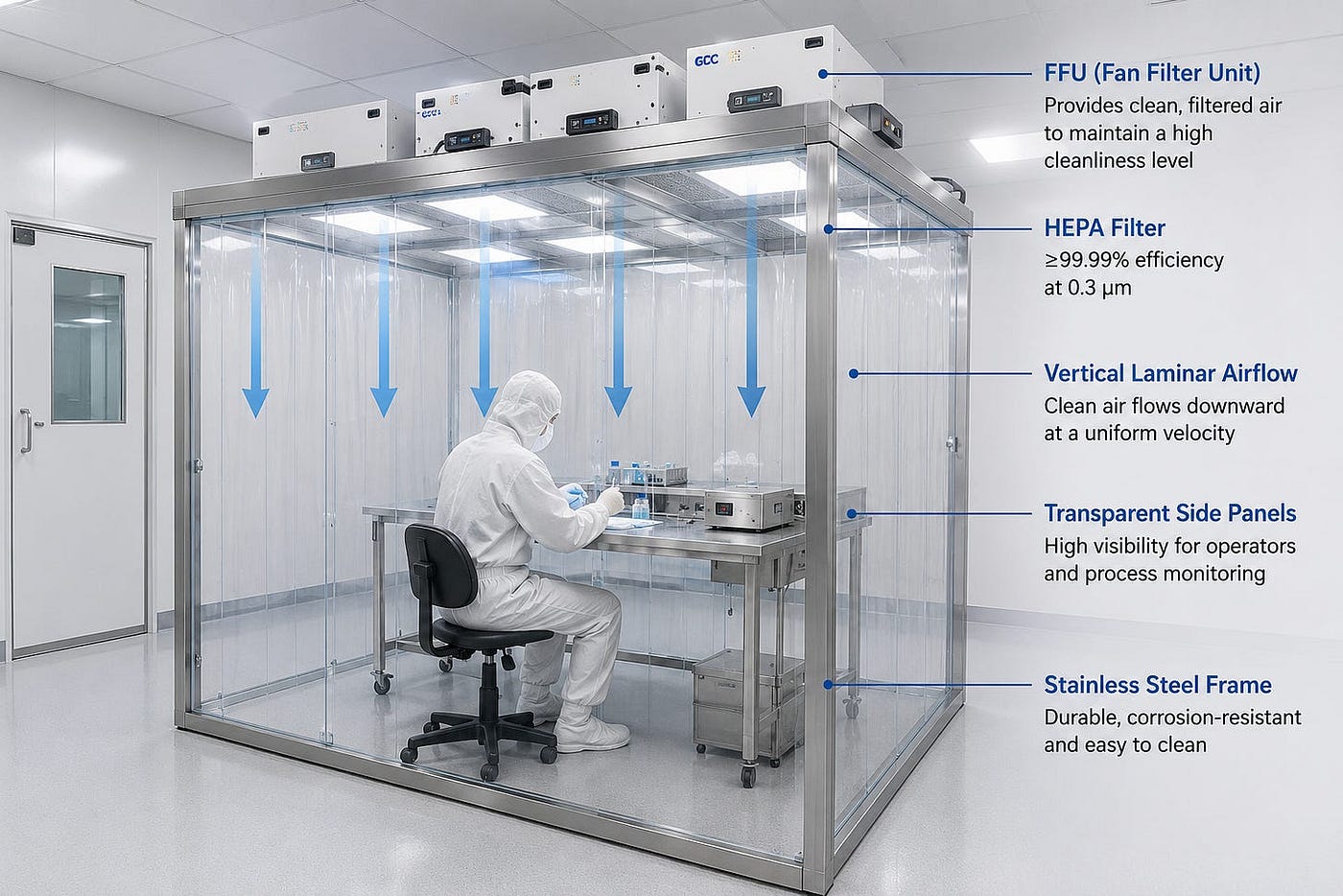
1. Uniform Vertical Airflow
Multiple FFU units were arranged across the ceiling grid.
The filtered air moved downward continuously, helping reduce particle suspension and improve contamination control.
2. Independent Airflow Adjustment
Unlike traditional centralized systems, FFUs allow individual control.
Different production zones can adjust airflow according to their requirements.
For example:
- Inspection areas require higher cleanliness stability
- Assembly areas require balanced airflow
- Temporary expansion areas can be adjusted separately
3. Efficient HEPA Filtration
Each FFU integrates HEPA filtration technology to remove airborne particles.
This makes FFU systems suitable for semiconductor environments where even microscopic contamination can affect product quality.
The Results After Implementation
After the FFU system was installed, the customer observed several improvements:
More Stable Cleanroom Conditions
Airflow became more consistent throughout the production area.
The difference between different working zones was reduced.
Improved Production Confidence
Operators no longer needed to frequently adjust production schedules because of environmental fluctuations.
Easier Future Expansion
Because FFUs are modular units, additional clean areas could be created without redesigning the entire airflow system.
Why FFU Systems Are Becoming Popular in Semiconductor Facilities
Based on our experience working with cleanroom applications, FFU systems provide several practical benefits.
Flexible Design
Semiconductor production environments change frequently.
FFU systems allow manufacturers to:
- Expand clean areas
- Modify layouts
- Upgrade specific zones
without major reconstruction.
Energy Efficiency
Modern FFU systems use efficient EC fan motors and optimized airflow designs.
Instead of operating the entire system at maximum capacity, manufacturers can adjust individual units according to actual requirements.
Better Maintenance
Traditional systems may require large-scale maintenance.
With FFU solutions:
- Individual units can be inspected
- Filters can be replaced separately
- Production interruption can be minimized
Applications of FFU Systems in Semiconductor Manufacturing
Today, FFU systems are widely applied in:
- Semiconductor assembly workshops
- Wafer inspection areas
- IC testing laboratories
- Microelectronics manufacturing
- Precision optical production
They are especially suitable for modular cleanrooms where flexibility and airflow control are critical.
Choosing the Right FFU Solution for Semiconductor Cleanrooms
When selecting an FFU system, engineers usually consider:
- Required cleanliness level
- Airflow velocity
- HEPA filter efficiency
- Noise level
- Energy consumption
- Maintenance accessibility
A well-designed FFU system is not only an air filtration device.
It is an important part of the entire contamination control strategy.
Conclusion
In semiconductor manufacturing, cleanroom performance is not only determined by achieving a cleanliness rating during qualification.
The real challenge is maintaining stable environmental conditions every day.
FFU systems provide semiconductor manufacturers with a practical way to achieve:
- Stable airflow
- Efficient particle control
- Flexible cleanroom expansion
Through years of cleanroom engineering experience, GCC Tech continues to provide clean air solutions for semiconductor and precision manufacturing industries.
Learn more about GCC FFU solutions:
메타데이터
- post_id
- f75b8a8bf703
- slug
- the-role-of-ffu-systems-in-semiconductor-cleanroom-airflow-stability-lessons-from-real-f75b8a8bf703
- url
- https://medium.com/@gcc_cleanroom/the-role-of-ffu-systems-in-semiconductor-cleanroom-airflow-stability-lessons-from-real-f75b8a8bf703
- canonical_url
- https://medium.com/@gcc_cleanroom/the-role-of-ffu-systems-in-semiconductor-cleanroom-airflow-stability-lessons-from-real-f75b8a8bf703
- author_url
- https://medium.com/@gcc_cleanroom
- status
- ok
- fetched_at
- 2026-07-14 05:24:17