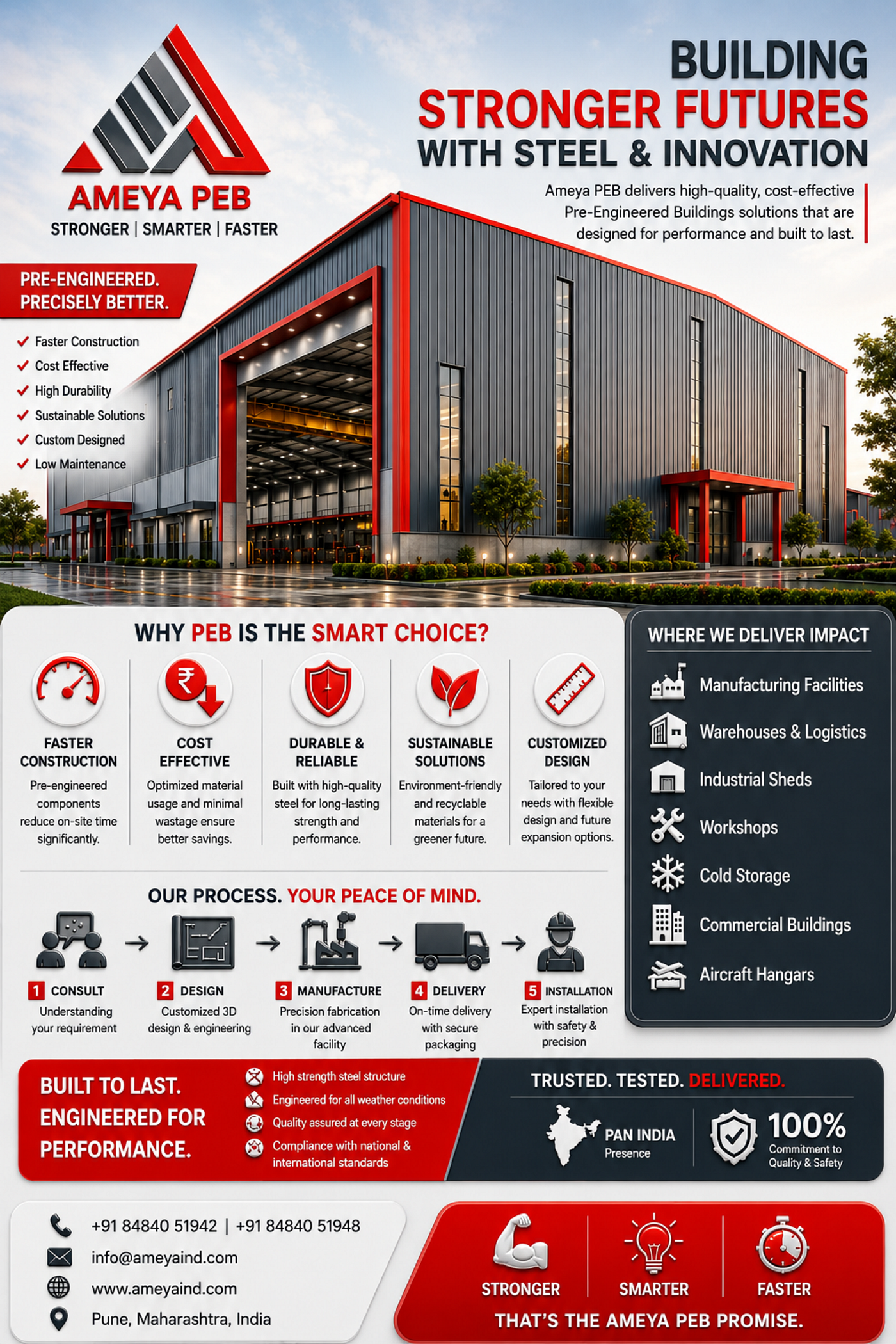
What is a Pre-Engineered Building (PEB)? The Complete Guide to Modern Industrial Construction
Across India’s industrial belts, a quiet revolution in construction has been reshaping how factories, warehouses, and logistics parks get…
What is a Pre-Engineered Building (PEB)? The Complete Guide to Modern Industrial Construction
[embed]
Across India’s industrial belts, a quiet revolution in construction has been reshaping how factories, warehouses, and logistics parks get built. Instead of months of on-site bricklaying and steel fabrication, businesses are turning to **Pre-Engineered Buildings (PEB)** — a method that compresses construction timelines while improving structural quality. This guide breaks down what PEB actually is, why it matters, and where it’s being used most effectively.
What is a Pre-Engineered Building (PEB)?
A Pre-Engineered Building is a steel structure in which all the major components — columns, beams, rafters, and roofing/wall panels — are designed, engineered, and manufactured in a factory before being transported to the construction site. Once delivered, the components are bolted together on-site, dramatically reducing the on-site labor and fabrication work that traditional steel construction requires.
In short: most of the “building” happens in a controlled factory, not on a muddy, weather-exposed job site. This single shift in where construction happens is what drives nearly every advantage PEB offers.
Why Are Businesses Switching to PEB Construction?
1. Rapid Deployment
Because structural components arrive pre-fabricated and ready to assemble, on-site work is limited mostly to erection. This can cut overall project timelines significantly compared to conventional construction, allowing facilities to become operational much faster.
2. Superior Quality Control
Factory-based manufacturing happens under consistent, controlled conditions — unlike open-air site fabrication, which is vulnerable to weather, inconsistent labor, and material handling issues. This results in tighter tolerances, more precise engineering, and stronger long-term durability.
3. Cost and Time Efficiency
Shorter construction timelines mean businesses start generating returns on their facility sooner. Reduced on-site labor requirements also lower overall project costs, making PEB an economically attractive option for large-footprint structures.
4. Flexible Scalability
PEB structures are engineered with future growth in mind. Because the steel framing system is modular, expanding a warehouse or factory — whether adding bay length or height — is significantly easier than retrofitting a conventional concrete structure.
Where Is PEB Technology Used?
PEB has become the preferred construction method for a range of high-performance industrial and commercial spaces, including:
- Modern warehouses and cold storage facilities
- Large-scale manufacturing units and factories
- Logistics parks and distribution centers
- Commercial workshops and industrial hubs
If your business needs a large, durable structure built quickly and cost-effectively, PEB is generally the most efficient construction method available today.
Frequently Asked Questions About Pre-Engineered Buildings
What does PEB stand for? PEB stands for Pre-Engineered Building, a construction method where steel building components are manufactured in a factory and assembled on-site.
Is a PEB structure as strong as conventional steel construction? Yes. PEB structures are engineered using precise structural calculations and manufactured under controlled factory conditions, which often results in greater consistency and strength than conventionally fabricated steel.
How much faster is PEB construction compared to traditional methods? While exact timelines depend on project size and complexity, PEB construction is widely recognized for significantly reducing project duration because most fabrication happens off-site in parallel with site preparation.
Can a PEB building be expanded later? Yes. One of the core advantages of PEB is modular scalability — bays can typically be added lengthwise, and structures can often be designed to accommodate future height extensions as well.
What types of buildings are best suited for PEB construction? PEB is most commonly used for warehouses, cold storage units, factories, manufacturing plants, logistics parks, and large commercial workshops — essentially any large-span structure where speed and cost-efficiency matter.
Is PEB construction more cost-effective than traditional building methods? Generally, yes. Reduced on-site labor, faster project timelines, and minimized material waste typically make PEB more cost-effective for large industrial and commercial structures, though exact savings depend on project specifics.
Build Your Next Industrial Facility with Ameya PEB
Ameya PEB specializes in turning structural visions into efficient, future-ready industrial facilities. Whether you’re planning a warehouse, factory, or logistics hub, our team can guide you through the entire PEB process — from design to delivery.
- Call: +91 8484051942 / +91 8484051948
- Email: info@ameyaind.com
- Website: www.ameyaind.com
#AmeyaPEB #PreEngineeredBuildings #IndustrialConstruction #Warehousing #SteelStructures #Manufacturing #Infrastructure #LogisticsParks #PuneBusiness #SustainableConstruction
메타데이터
- post_id
- f7615c25cfdb
- slug
- what-is-a-pre-engineered-building-peb-the-complete-guide-to-modern-industrial-construction-f7615c25cfdb
- url
- https://medium.com/@dgmarketing.ameya/what-is-a-pre-engineered-building-peb-the-complete-guide-to-modern-industrial-construction-f7615c25cfdb
- canonical_url
- https://medium.com/@dgmarketing.ameya/what-is-a-pre-engineered-building-peb-the-complete-guide-to-modern-industrial-construction-f7615c25cfdb
- author_url
- https://medium.com/@dgmarketing.ameya
- status
- ok
- fetched_at
- 2026-07-09 10:29:04