STRATEGY EXECUTION: Closing the Gap Between Plan and Practice #26
Visual Thinking for Transformation | Post 26 of 30
From Noise to Clarity | Track 9
STRATEGY EXECUTION: Closing the Gap Between Plan and Practice #26
Visual Thinking for Transformation | Post 26 of 30
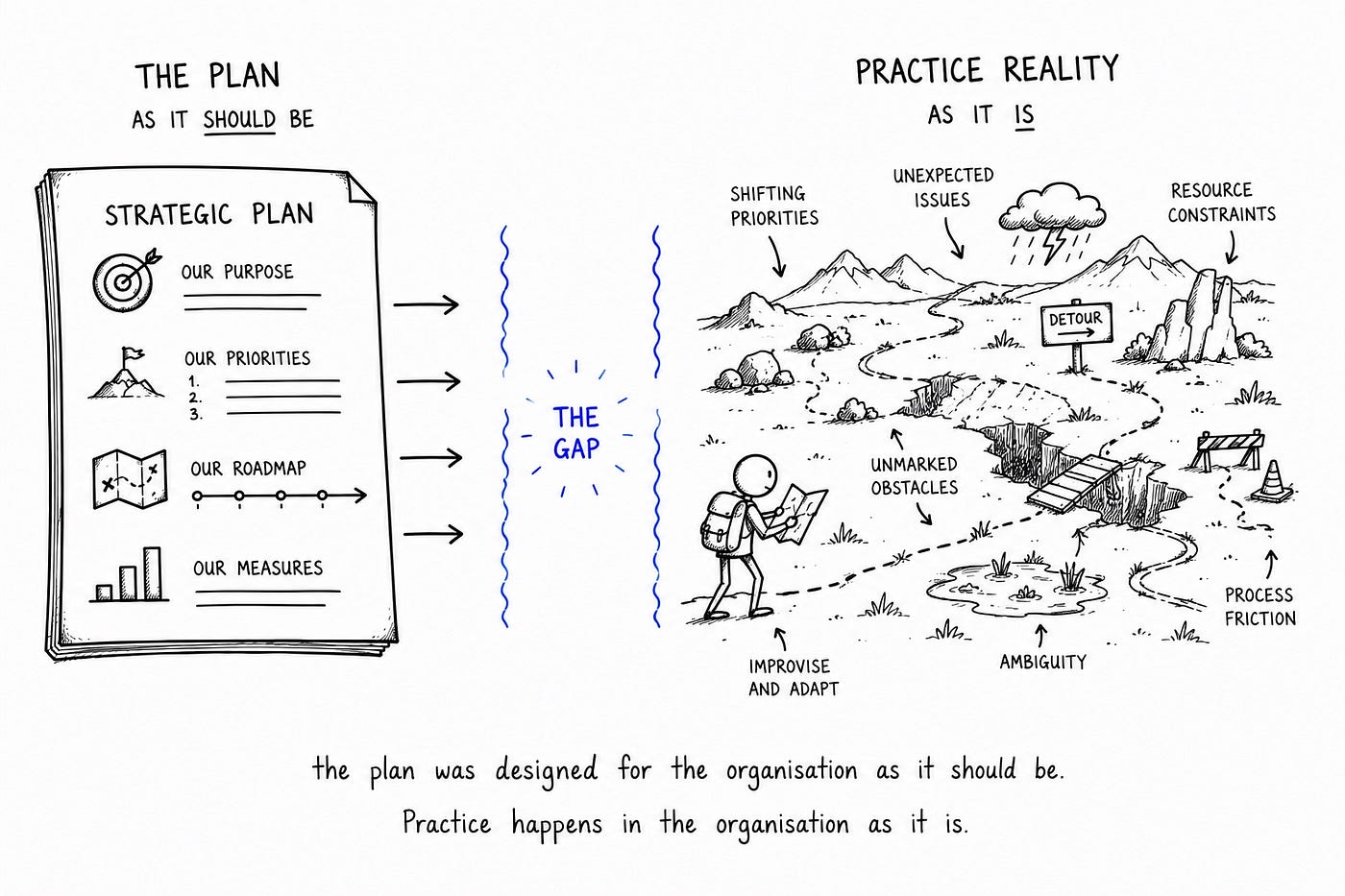
Before you read: think of a strategic plan you were asked to execute. At what point did the daily reality of the work diverge from what the plan described, and what produced that divergence?
Every strategic plan is an account of how an organisation intends to work. Every practice is an account of how an organisation actually works. These two descriptions are never fully the same, and the gap between them is not a minor discrepancy to be managed. It is the primary site where strategy execution either succeeds or fails, and it is almost entirely determined by the infrastructure of the organisation, the processes, roles, systems, meeting structures, information flows, and decision rights that shape what is possible in daily work.
When a strategy describes a new way of working, it is describing something that needs to happen in an existing operating environment. That environment was not designed for the new strategy. It was designed, or more often accumulated, for the work that preceded the strategy, and it is optimised, explicitly or implicitly, for that previous work. The new strategy has to land in this environment and find a way to take root. Where the environment supports the new way of working, it will. Where it does not, the practice will continue to reflect the environment rather than the plan, regardless of how clearly the plan is communicated or how committed the people are to executing it.
This is the infrastructure gap, the gap between what the plan requires and what the operating environment makes possible. It is the most common structural reason that strategy does not translate into changed practice, and it is almost entirely invisible in the strategy documents themselves, which describe desired outcomes without examining whether the existing operating environment can support them.
“Strategy describes the destination. Infrastructure determines whether the road exists.”
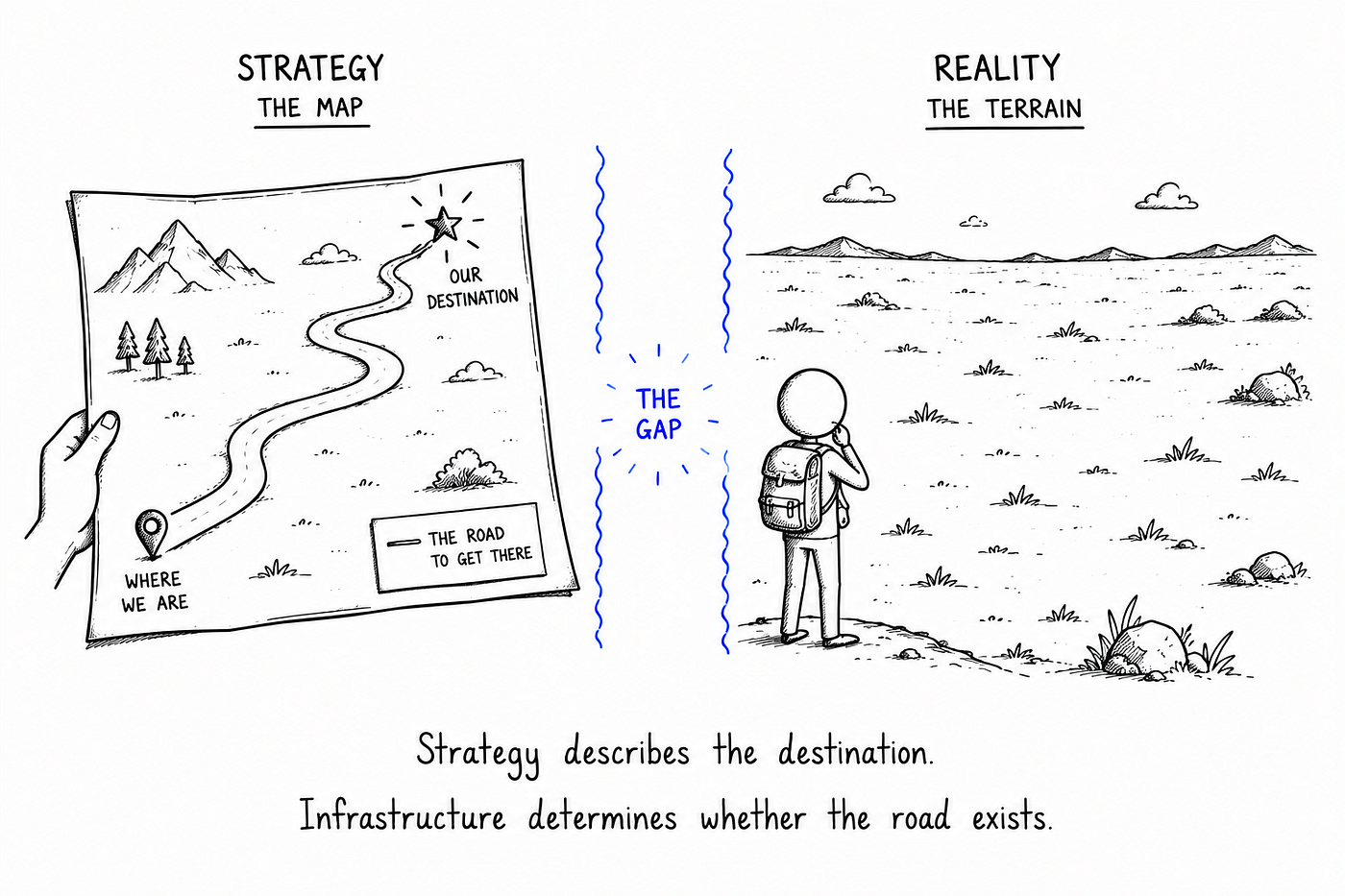
What the infrastructure gap looks like in practice
The infrastructure gap manifests in three consistent patterns that are worth recognising separately because they require different responses and because each one tends to be invisible to the people experiencing it, since they are operating inside the infrastructure rather than looking at it from outside.
The first is the meeting structure problem. Strategy is executed through the conversations and decisions that happen in regular organisational meetings. If the existing meeting structure does not include the right people, the right information, and the right decision rights to make the decisions the strategy requires, those decisions will not get made, or will get made incorrectly, regardless of what the strategy says. A strategy that requires cross-functional coordination to work will not be executed in an organisation whose meeting structure keeps functions siloed. A strategy that requires rapid decision-making at the frontline will not be executed in an organisation whose meeting structure escalates every significant decision upward through multiple layers before a response can be given. The meeting structure is the skeleton of the operating rhythm, and the operating rhythm determines what is actually possible in the time available.
In one case, a manufacturing organisation had a strategy that required its production and commercial teams to make joint decisions about production scheduling based on real-time demand signals. The strategy was sound and the logic was clear. But the existing meeting structure had production and commercial teams meeting separately, with a joint meeting occurring monthly. By the time the monthly joint meeting happened, the real-time demand signals that the strategy required them to act on had aged by weeks. The decisions being made in the joint meeting were decisions about history rather than decisions about the present. The infrastructure, in this case the meeting structure, made the strategy impossible to execute at the speed it required. Changing the meeting cadence to include a weekly joint session, combined with a shared dashboard of current demand signals, transformed the execution of the strategy in ways that months of communication about the strategy had never managed.
The second is the information flow problem. Strategy requires specific information to be available to specific people at specific times. If that information is not available in the right form at the right time, the decisions the strategy depends on cannot be made with the quality required. Most organisations have information problems that they have learned to work around so thoroughly that the workarounds have become invisible, and a new strategy that requires information to flow differently will encounter those invisible workarounds as friction without anyone being able to identify where the friction is coming from.
The third is the decision rights problem. Strategy frequently requires decisions to be made at different levels or by different people than the existing decision rights framework specifies. A strategy that requires customer-facing teams to make more autonomous decisions about pricing or service will fail if those teams do not have the decision rights to make those decisions, because they will continue to escalate upward regardless of what the strategy document says about empowerment. Decision rights are infrastructure. They determine what is actually possible at each level of the organisation, and they change only when someone explicitly changes them, in writing, with consequences attached.
“Where strategy and infrastructure conflict, infrastructure wins. Always. It was there first.”
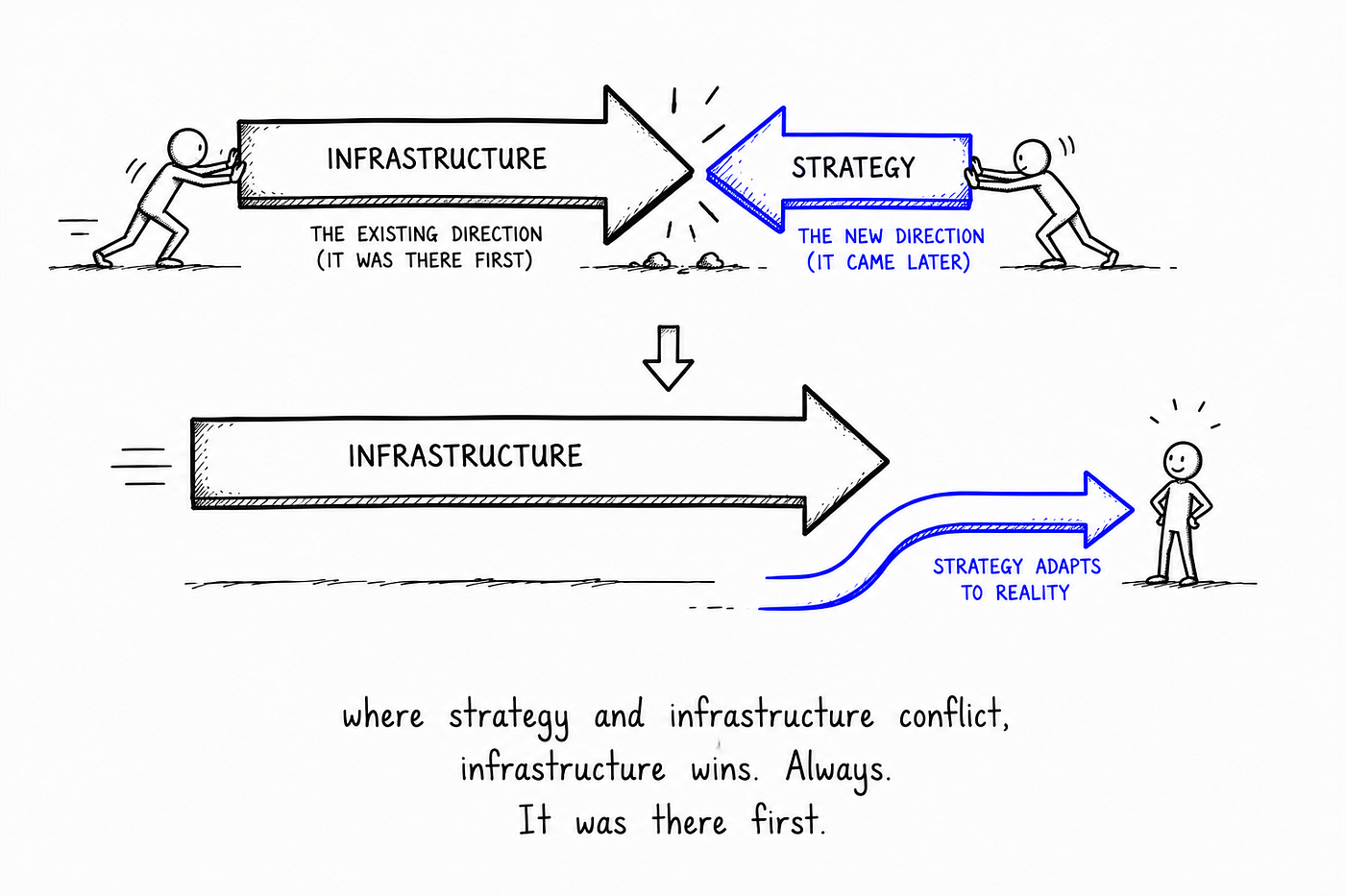
Identifying the infrastructure gap before it becomes a practice gap
The most effective intervention in closing the gap between plan and practice is identifying the infrastructure gaps before the strategy is launched into the existing operating environment. This requires a specific diagnostic effort that most strategy processes do not include: a systematic review of whether the existing meeting structures, information flows, decision rights, and process designs can support the new strategy, or whether they will work against it. This review is not a risk exercise or a compliance check. It is a design exercise, conducted with the aim of producing specific infrastructure changes that will be in place before the strategy is launched into the organisation.
This review is not complicated to conduct. It involves taking each major strategic objective and tracing the chain of decisions and actions that would need to happen for that objective to be achieved in daily practice, then examining whether the existing infrastructure supports each link in that chain. The question at each link is simple: does the current operating environment make this step possible without requiring heroic individual effort or workarounds? Where it does, no change is needed. Where it does not, the gap has been identified at the point where it can still be designed out rather than managed around after the fact.
In one case, a retail organisation was implementing a strategy to shift toward a more personalised customer experience. The strategy required customer-facing staff to make service adjustments based on individual customer preferences, which meant they needed access to customer preference data in the moment of the customer interaction. The strategy document described this capability clearly and the intent was genuine. When the infrastructure was traced, a gap became visible immediately. The customer data system was not accessible from the point-of-sale terminals the customer-facing staff used. The data existed. The decision rights to use it had been granted. But the information flow infrastructure did not connect the data to the moment when it was needed. The strategy had been designed and approved without anyone identifying this gap, and it would have become visible only when frontline staff discovered they could not do what the strategy asked them to do.
Identifying the gap before launch allowed the infrastructure problem to be addressed in the design phase, at a cost and a complexity that was a fraction of what it would have been after the strategy had been announced and the gap had been discovered in practice by the people who had been asked to execute it. The staff who eventually launched the personalised experience capability never knew about the gap, because it had been closed before they encountered it. That invisibility was not a failure of communication. It was the point.
“Infrastructure gaps found in design are fixable. The same gaps found in practice are a crisis.”
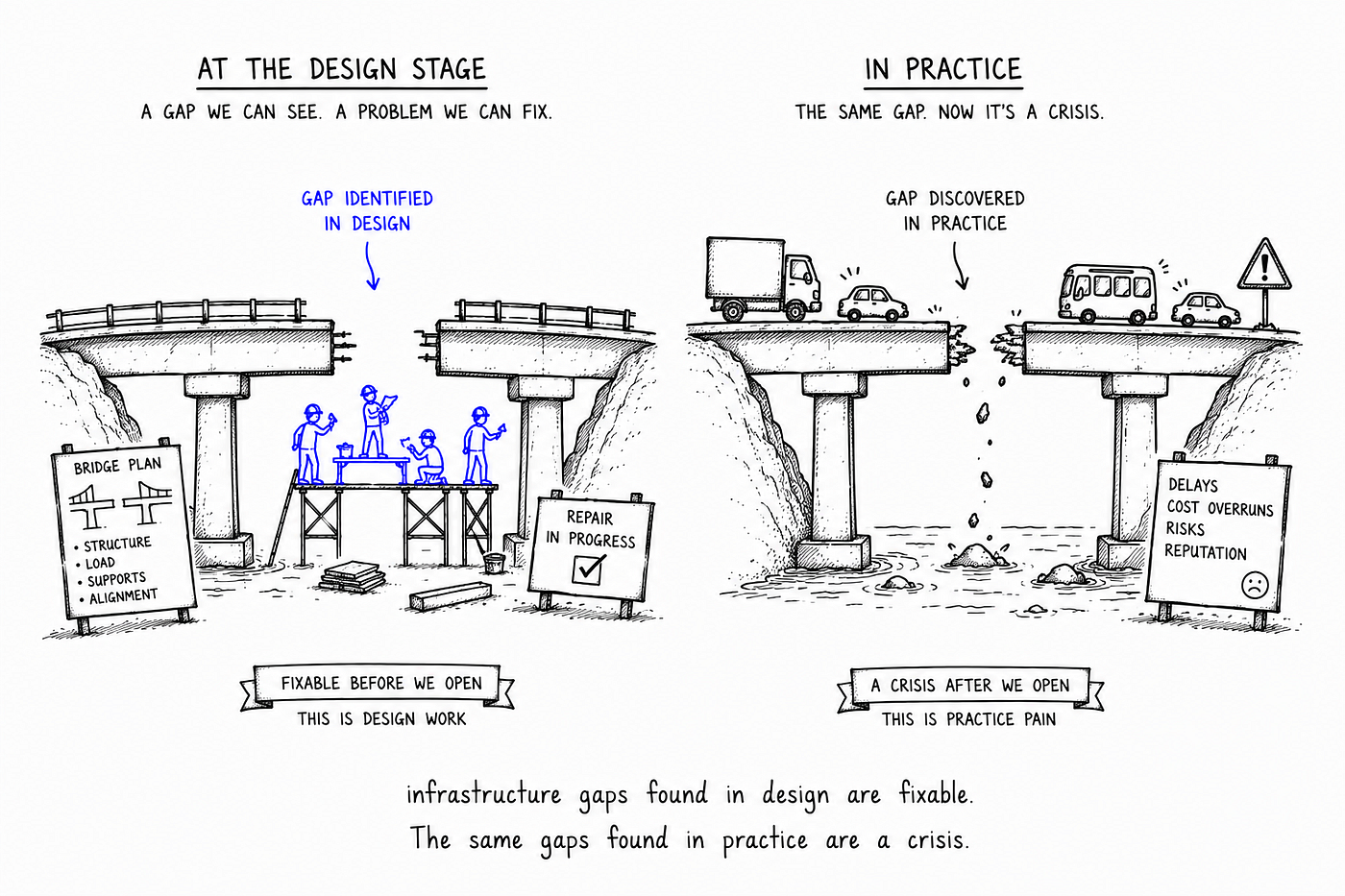
Building the infrastructure the strategy requires
Closing the plan-to-practice gap requires building, or adapting, the infrastructure that the strategy needs in order to become practice. This is the operational design work that most strategy processes defer and most execution efforts treat as someone else’s problem, to be sorted out once the strategy has been communicated and the teams have been briefed. It is, in reality, the most direct path from strategic intent to changed behaviour, and it deserves the same quality of design attention as the strategy itself, allocated at the same time rather than as an afterthought once the primary design work is complete.
Building the required infrastructure means, concretely, redesigning the meeting cadence to create the right conversations at the right frequency with the right people. It means mapping the information flows that the strategy requires and ensuring those flows are technically possible and operationally habitual. It means explicitly updating decision rights to match what the strategy asks of each level, and communicating those updates clearly enough that the people at each level know what they are now authorised to decide without escalating. It means examining the processes that sit between the strategy’s intent and its execution, and identifying the ones that will resist the strategy rather than support it.
None of this is glamorous work. It does not appear in strategy presentations or get celebrated at launch events. It happens in the weeks between strategy approval and strategy launch, in working sessions with the operational teams who will actually live inside the infrastructure being designed, whose knowledge of the existing operating environment is irreplaceable and whose involvement in the design of the new infrastructure is the most reliable way of ensuring that the gaps are found before the strategy has to run into them. It produces changes that look small from a distance and feel significant to the people doing the work, because it is the change that makes the strategy possible rather than merely plausible.
The plan describes the destination. The infrastructure is what determines whether the road to it exists. Without the infrastructure work, even the best-designed strategy remains a description of somewhere the organisation would like to go but has not yet built the conditions to reach.
What is the one infrastructure element in your current strategy that, if it does not change, will make the plan impossible to execute in daily practice?
Next time, we close this stretch with Making Strategy Visible Enough to Act On.
If this resonates, you will find a deeper exploration of how to see business situations clearly in The S.T.A.R. System: Applying Visual Thinking for Career & Business Success, available on Amazon.

Ai Yat Goh is the co-author of The S.T.A.R. System: Applying Visual Thinking for Career & Business Success(Marshall Cavendish Business, with Sherrie Low). Follow Ai Yat on LinkedIn and Medium.
VisualThinking #Transformation #StrategyExecution #Leadership #FromNoiseToClarity
BK HAN Candy Chan RH Malini GOW Hui Yian Germaine Kwek Lawrence Lee Joelynn Koh
메타데이터
- post_id
- f768bb2b4fa4
- slug
- strategy-execution-closing-the-gap-between-plan-and-practice-26-f768bb2b4fa4
- url
- https://medium.com/@aiyat.goh/strategy-execution-closing-the-gap-between-plan-and-practice-26-f768bb2b4fa4
- canonical_url
- https://medium.com/@aiyat.goh/strategy-execution-closing-the-gap-between-plan-and-practice-26-f768bb2b4fa4
- author_url
- https://medium.com/@aiyat.goh
- status
- ok
- fetched_at
- 2026-07-15 13:27:44