Stay Tuned: Interpreting Sugar Futures, 24 April 2024
Last week saw a lot of big swings in the commodities space, with the main energy futures (oil and natural gas) down, precious metal futures…
Stay Tuned: Interpreting Sugar Futures, 24 April 2024
Last week saw a lot of big swings in the commodities space, with the main energy futures (oil and natural gas) down, precious metal futures (gold and silver) relatively stable, and agricultural futures mixed.
The price of one agricultural commodity, however, has been quite surprising to watch: sugar (SB). While SB futures ended the week at $0.1979 per pound, down 3.13% in said week, last Wednesday saw it reach $0.192, its lowest point since March 2023. It has also been on a downtrend since the middle of November 2023.
However, we expect the SB futures to now consolidate upwards for about a month, just like in the two previous times after a big downtrend (January and March 2024), and we will be looking for a clear sign of stabilization before investing.
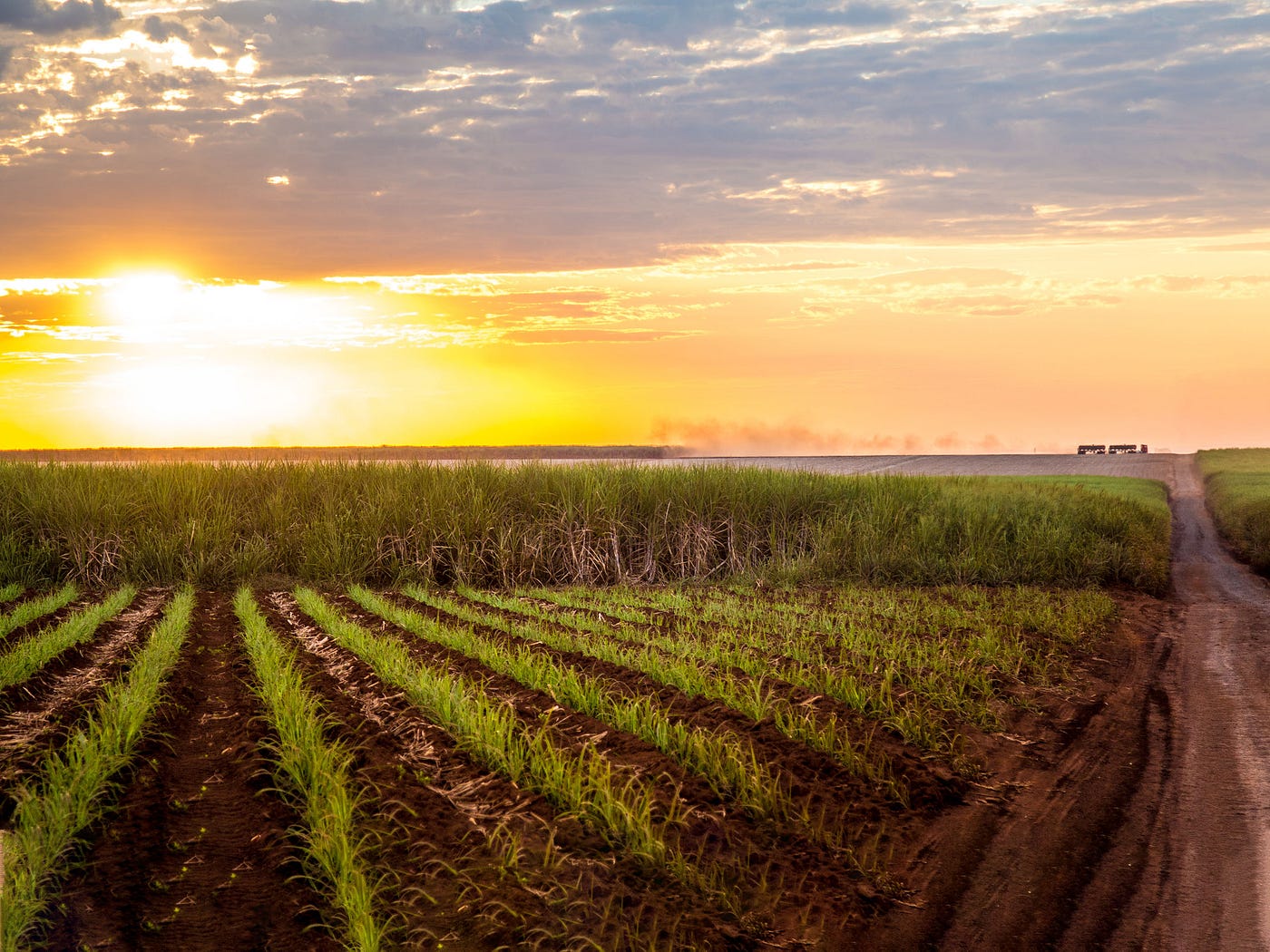
A sugar cane farm (Source: Tereos)
Sugar is a globally utilized product used in food consumption, and one plant used in the production of sugar is sugar cane. At a market level, SB futures (also known as Sugar No. 11) are futures contracts to reference the price of global raw cane sugar, where each contract traded on the Intercontinental Exchange (ICE) is 112,000 pounds. Raw cane sugar’s biggest producer and exporter is Brazil (with total production for the 2022/23 period at 22% and total exports at 44%), and a significant amount is produced in India (18%), the European Union (8%), Thailand (6%), China (5%), and the United States (5%). Of these nations, sugar traders pay attention to Brazil, India and Thailand.
In terms of specific numbers, global sugar production was at 175.3 million metric tons in the 2022/23 period. Out of that, Brazil produced 38 million (with 28.2 million exported), India 32 million (with 7.4 million exported) and Thailand 11.1 million (with 9.5 million exported). Also, ending stocks were at 38.9 million, of which Brazil had 0.7 million, India 5.3 million and Thailand 7.7 million.
As brought up in our last article, Brazil has faced concerns about dry conditions and excess rainfalls, due to the El Nino weather event, and its impact on its agricultural products, especially in the coffee and sugar-growing zones. Recent forecasts of adequate rainfall for the country’s key growing regions in April seemed to have also been erased, with new forecasts of dry weather expected at least until the end of the month.
Moreover, India and Thailand were plagued with dry conditions last year. Given India’s 29.6 million metric tons of domestic consumption and 2024 being an election year, India decided last October to halt exports of sugar for an indefinite period. Recent concerns include a surge in demand for sugar consumption in the country, due to heat waves and election rallies, as it is more than the average rise between mid-March and mid-June and likely to lift sugar prices.
Despite all these concerns, sugar crops in Brazil, India and Thailand have indicated higher expectations of sugar production. Brazil is seeing new investment to expand production and expecting around 43 million metric tons in 2024/25, India is expecting around 33 million tons in 2023/24, and Thailand is expecting around 9 million tons, one million tons more than previously expected. Not only that, but weakness in the Brazilian real and the Indian rupee has so far prevented a sharp rebound in the price of sugar, allowing for lower USD prices at a greater volume from local farmers.
The positioning of large investors in sugar futures, based on the Commitment of Traders (COT) report and using data going back to 2019 (as shown in Graph 1), is currently at its lowest point since October 2022. This tells us that interest has fallen off in this specific asset, and as such there is room for the price to rise where interest picks up.

Graph 1: COT report chart since 2019
In recent months, we have seen a clear downtrend in the price of sugar (as shown in Graph 2), with strong drops followed by what seemed to be a month of consolidation. Indeed, there are two instances where the price of sugar drops so fast that the relative price distance from the EMA ends up outside the Keltner Channel band width, but within a few days the relative price distance goes back inside the band width and a new short-term uptrend appears. This was the case between November 2023 and January 2024, as well as February 2024 and March 2024.
Recently, the price of sugar has dropped so much that the relative price distance has dropped below the band width, and as such we can expect the price of sugar to roughly stabilise for a few days or weeks before starting a new short-term uptrend.

Graph 2: Percentage Exposure Spread from their Median Position for each Actor since 2023
After analysing the fundamental and technical information surrounding sugar futures, we believe the best approach would be to sell puts. Currently, the futures price is in the 19–20 range, and based on past trends there is good reason to believe the price won’t go below 19 for the next few weeks. As such, we recommend going for the 19.25 strike, where the May/July bid and ask is between 0.22 and 0.26.
This would allow for a margin of safety because even if the investor lost the premium due to a futures price drop, the capital should be protected as long as the price does not go below 19. Also, this would be approximately a 1.25% yield across three weeks, meaning above 15% annualized. Therefore, writing a put at 19.25 appears solid from a risk-return perspective.
With the last report from the USDA on world sugar production, markets and trade published in November 2023, the next report will be out in under one month, on the 23rd of May. This report should provide preliminary figures for the 2023/24 period, with the final figures provided on the 21st of November 2024, alongside the expected figures for the 2024/25 period. The May 2024 report will be important for future trends in the price of SB futures.
Our purpose in providing these reports for free to the public is to take the mystery out of data science and show in a general sense how it can be used to validate across investment classes, prices and time frames. If you would like more detailed and specific information, please do not hesitate to contact us at cotreport@boral.ch for pricing.
Sources: IBKR, COT reports, Reuters, USDA
— — — — — — — — — — — — — —
Hi, my name is Alex, and this is a thought piece called “Stay Tuned,” on one topic where there is a macro turning coming soon. If you like what you read, please hit the “like” button and follow me.
Disclaimer: This is provided for informational purposes only and is not meant to be financial advice. You should do your own research and seek independent advice from regulated professionals. Any investment’s value can fall and rise, leaving your capital at risk.
메타데이터
- post_id
- f780e1655a0e
- slug
- stay-tuned-interpreting-sugar-futures-24-april-2024-f780e1655a0e
- url
- https://medium.com/@finalexh/stay-tuned-interpreting-sugar-futures-24-april-2024-f780e1655a0e
- canonical_url
- https://medium.com/@finalexh/stay-tuned-interpreting-sugar-futures-24-april-2024-f780e1655a0e
- author_url
- https://medium.com/@finalexh
- status
- ok
- fetched_at
- 2026-06-27 23:56:40