What XOra Getting a Call Right Taught Me About the Future of Conversational AI
Enterprise voice AI has spent years promising natural conversation and delivering scripted frustration. The gap between what these systems…
What XOra Getting a Call Right Taught Me About the Future of Conversational AI
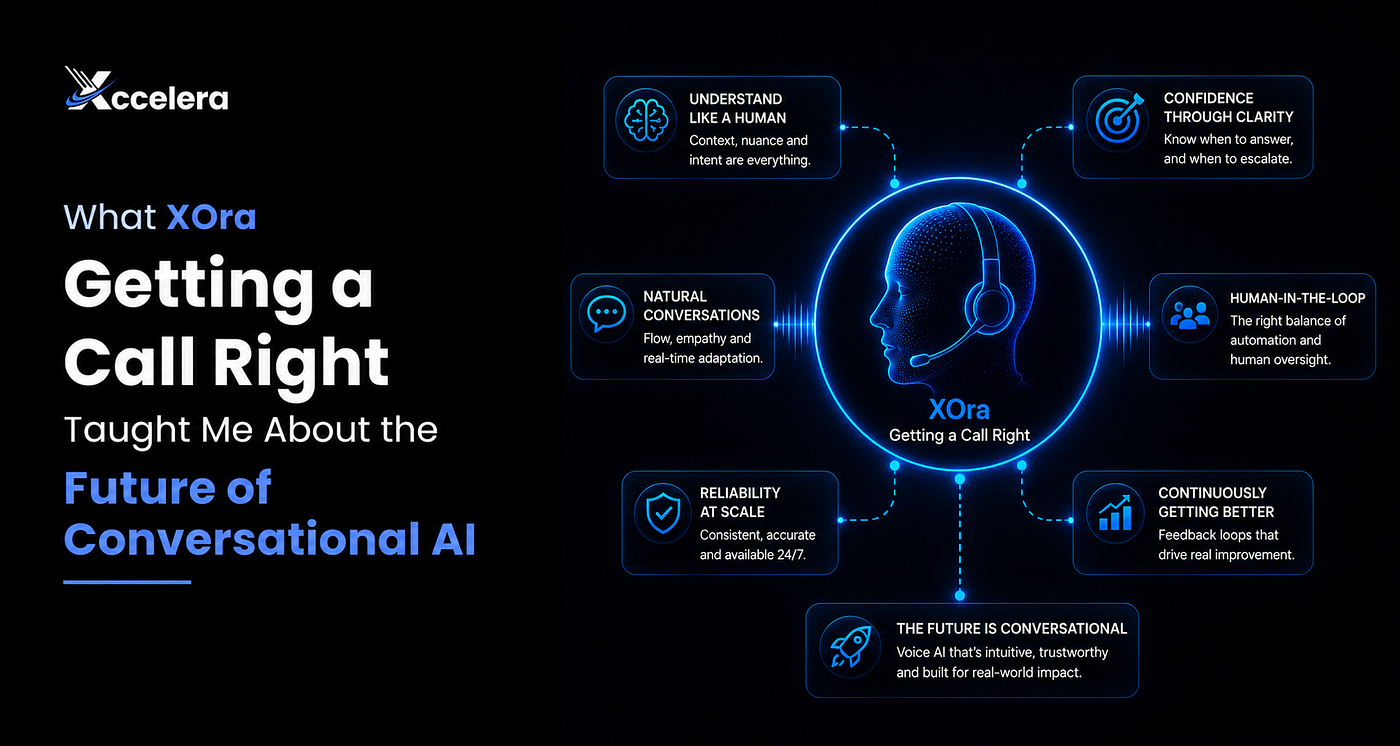
Enterprise voice AI has spent years promising natural conversation and delivering scripted frustration. The gap between what these systems claim to do and what customers experience on a call has become a credibility problem the industry can no longer paper over.
What changes that equation is not a better marketing claim or a smoother boardroom demo. It is architecture, real-time intent recognition, and a system that executes actual actions without delay. XOra’s voice agent is where that shift stops being theoretical and starts being operational.
Why Conversational AI Has Been Getting Phone Calls Wrong For Years
The failure is architectural before it is anything else. Most deployments start from a structurally broken premise, and no amount of LLM sophistication fixes a flawed foundation beneath it.
Scripted Logic Cannot Survive an Actual Conversation
Legacy voice systems, regardless of the model powering them, were designed around predictable caller behavior.
Real callers deviate from expected phrasing constantly. They interrupt, loop back to earlier parts of the call, and reference context that was established three turns ago.
When the architecture beneath the voice layer is monolithic, a single unscripted input breaks the interaction.
Analysis from enterprise voice practitioners confirms that building conversational AI voice agents on one massive prompt instruction block forces the system to scan thousands of tokens on every turn, creating internal confusion that surfaces as hesitation and error to the caller.
Monolithic Architecture Is the Core Failure Point
Beyond prompt structure, most teams build for demo environments rather than production conditions.
Controlled settings produce confident results. Real deployment, with overlapping accents, emotional callers, and genuinely unpredictable language, exposes every gap in the system.
Layered on top of this is a psychological residue: years of broken IVR experiences have trained enterprise customers to distrust automated voice systems before the first word is spoken.
What Getting a Call Right Actually Requires Under the Hood
Once the architecture problem is properly understood, the engineering requirements become specific and non-negotiable. Each component in the pipeline must function without accumulating delay.
The Pipeline From Voice Input to Verified System Action
A functional voice agent is not a single model. It is a precision pipeline. Automatic speech recognition converts spoken input to text in milliseconds. Natural language processing extracts meaning from that text.
A large language model reasons through the appropriate response given full conversation context.
Text-to-speech delivers that response in a voice that does not betray machine origin. Each layer hands off to the next without adding latency.
Humans pause roughly 200 milliseconds between conversational turns. Any system adding seconds to that exchange cannot produce a natural interaction, regardless of how intelligent the response itself is.
Latency Is Not a Technical Detail. It Is the Entire Experience.
What determines whether a call feels human or robotic is response speed. Sub-second latency is not an engineering preference; it is the baseline requirement for caller trust.
When response time lags, callers repeat themselves, lose confidence, and immediately escalate. The pipeline must be engineered end to end with that ceiling in mind before a single production conversation goes live.
Intent Recognition Is the Variable That Separates Execution From Conversation
Knowing what a caller said is simpler than understanding what they need and then acting on it without pause. That gap between processing language and completing an action is where most voice platforms stop being useful.
Context Persistence Across Multi-Turn Dialogue Is Non-Negotiable
Modern conversational AI voice agents route interactions using real-time signals: intent, sentiment, caller history, and urgency level. That routing only works when the system retains context across every turn.
If a caller references something from two minutes earlier and the agent has no memory of it, the conversation breaks.
Industry research confirms that systems capable of identifying speaker intent from indirect language, maintaining conversational memory across a full call, and adjusting responses based on emotional signals represent the current enterprise-grade benchmark.
From Answering Questions to Completing Workflows
The operational value of intent recognition is not in producing better answers. It is in triggering backend execution.
When an agent detects a booking request, the response should not be verbal confirmation followed by a human follow-up.
The action, whether scheduling, CRM update, or support ticket creation, should complete within the call itself. That is the line between a voice platform that generates responses and one that drives measurable outcomes.
The Business Case That Enterprise Leaders Cannot Keep Ignoring
The argument for voice AI is no longer speculative. The financial data from production deployments has made the investment decision straightforward for operational leaders reviewing cost against headcount.
Cost Compression Is Already Happening at Scale
Industry data confirms that AI-powered voice infrastructure operates at a fraction of the per-call cost of human agent infrastructure.
Production deployments across enterprise contact centers have grown at triple-digit rates year over year.
Organizations already running voice AI at scale report multi-year returns that clearly justify the deployment investment.
The market trajectory reinforces this momentum: the global voice AI agents market is forecast to reach 47.5 billion dollars by 2034, driven almost entirely by enterprise adoption pressure converting from cost center management to operational efficiency.
First-Contact Resolution Becomes a System-Level Outcome
When voice agents connect to backend systems and operate with full intent-awareness, first-contact resolution stops depending on individual agent skill. It becomes a function of system design.
Callers reach resolution in a single interaction. Repeat calls drop. Escalations shrink. These are not qualitative improvements; they are measurable operational outcomes that leadership can track against deployment cost from quarter one of any deployment cycle.
Why Agentic Voice AI Now Demands Autonomous System Integration
Conversation capability is only as valuable as the execution it triggers. A voice agent that talks but cannot act is a liability masquerading as a solution.
Voice That Cannot Execute Is Just Another Bot
Industry analysis positions the current period as the inflection point where voice AI shifts from an interaction layer to an execution layer. That shift requires direct integration with CRM platforms, calendars, enterprise resource systems, and support infrastructure.
Without those connections, a voice agent can only offer verbal acknowledgment and promise a human follow-up. That promise is precisely what enterprise teams are trying to eliminate.
Agentic voice AI closes the loop by completing the action inside the call, not scheduling it for someone else to handle later.
The Architecture Behind Mid-Call Workflow Completion
When a sales lead calls and the agent qualifies intent, updates the CRM record, schedules the follow-up meeting, and confirms availability in under two minutes without any human involvement, that is agentic execution.
It requires API connectivity, backend trigger logic, and a voice system with enough contextual awareness to recognize when the workflow is complete. That architecture is what separates a production-grade deployment from a demo that impresses in a conference room and collapses inside a real contact center.
XOra Closes the Gap Between Conversation and Execution
Voice AI that only talks has reached the end of its usefulness for enterprise operations. The organizations gaining ground now are deploying agents that listen with precision, understand with context, and execute without delay.
XOra, Xccelera’s AI Voice Agent, is built on exactly that architecture: sub-second latency, real-time intent detection, multi-language capability, and direct CRM and calendar integration that completes actions within the call itself.
Lead qualification, appointment scheduling, outbound follow-up, and support resolution all run through a single intelligent system.
For enterprise teams ready to move beyond voice automation that sounds capable toward voice execution that delivers outcomes, XOra is the operational infrastructure that makes it real.
메타데이터
- post_id
- f78afebc8ed2
- slug
- what-xora-getting-a-call-right-taught-me-about-the-future-of-conversational-ai-f78afebc8ed2
- url
- https://medium.com/@xcceleraai/what-xora-getting-a-call-right-taught-me-about-the-future-of-conversational-ai-f78afebc8ed2
- canonical_url
- https://medium.com/@xcceleraai/what-xora-getting-a-call-right-taught-me-about-the-future-of-conversational-ai-f78afebc8ed2
- author_url
- https://medium.com/@xcceleraai
- status
- ok
- fetched_at
- 2026-06-09 15:37:30





