A Reflection on Love, Masculinity, and Emotional Cowardice in The Blonde One (2019)
The Kind of Heartbreak That Arrives Quietly
A Reflection on Love, Masculinity, and Emotional Cowardice in The Blonde One (2019)
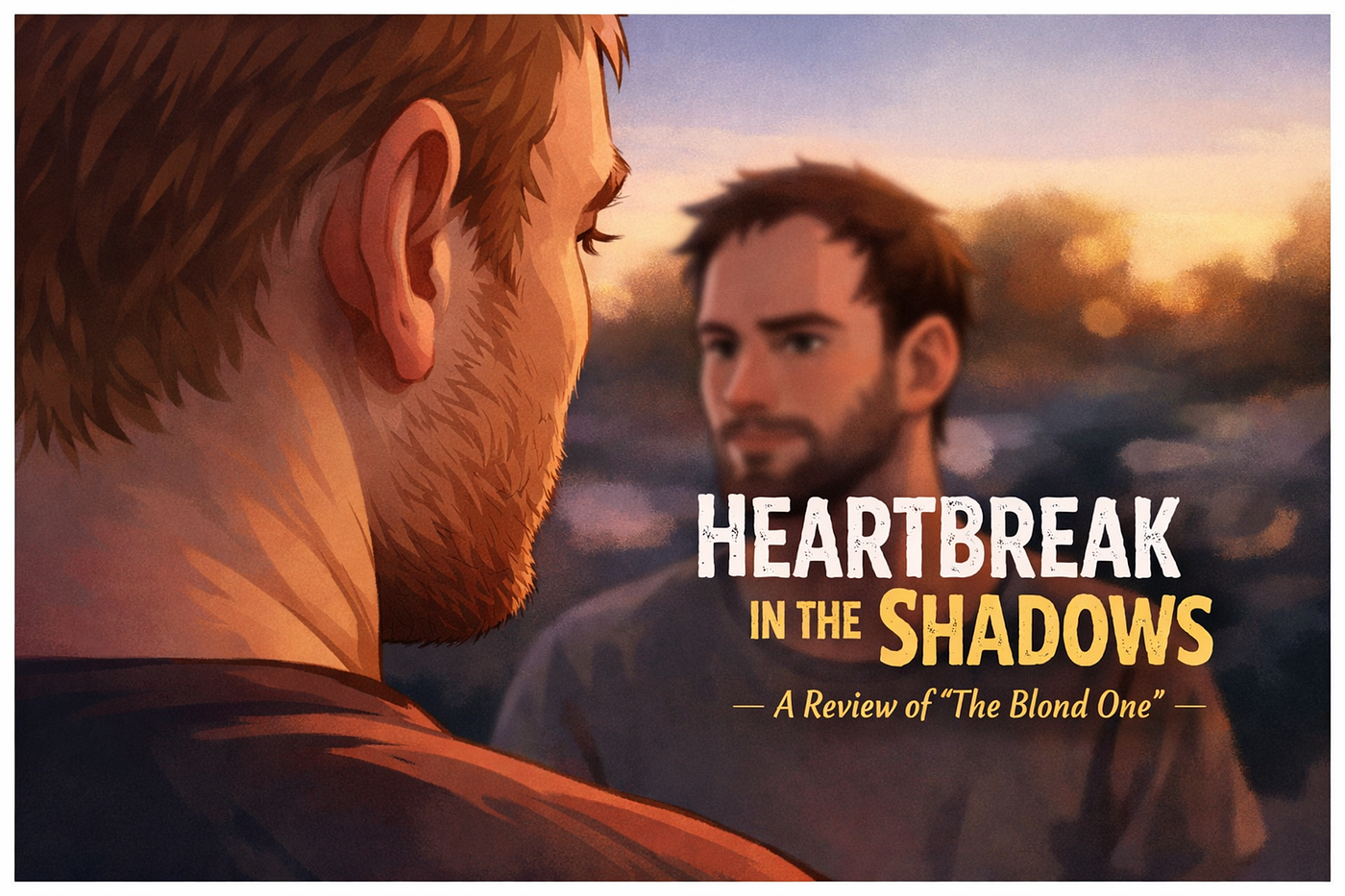
Heartbreak in the Shadows
The Kind of Heartbreak That Arrives Quietly
The Blonde One is a heart-wrencher, though not for the reasons I expected. What begins as a quiet, tender exploration of attraction slowly unravels into something far more painful — not tragedy in the dramatic sense, but heartbreak born from emotional cowardice.
Gabriel becomes the emotional anchor of the film. His performance is astonishingly subtle. His eyes carry longing, hesitation, and hope — a kind of fragile optimism that feels almost sacred. He is shy, observant, and careful with his presence. There is nothing performative about him. He does not demand attention; he waits for permission to exist in the space he shares with Juan.
That vulnerability makes what follows even more devastating.
The early scenes between the two men are electric in their restraint. The slow build — the quiet courage it takes for them to finally give in to their attraction — feels earned and sincere. Nothing is rushed. Nothing is exaggerated. Desire grows slowly in silence.
But when Juan returns to sleeping with his girlfriend and casually entangles himself with others, the trajectory of the story becomes painfully clear.
What could have been growth becomes avoidance.
When Freedom Becomes Emotional Carelessness
Juan frames his behavior as freedom. As he say it that he “belongs to no one.” Yet that freedom often reads less like independence and more like recklessness, an impulse-driven refusal to consider the emotional cost of his actions.
His closeted nature does not manifest as fear alone, but as a form of emotional irresponsibility. The damage he causes is not loud, but it is real.
What struck me most is how recognizable this dynamic feels in man-to-man dating. The experience of genuinely liking someone, but not reciprocated. The awkward confrontation. The quiet minimization:
“We didn’t have anything serious.”
That quiet dismissal hurts more than betrayal or rejection. And the film captures that brutal, familiar ache with unsettling accuracy.
I was angry at Juan for days after watching the film. That lingering frustration may be its greatest achievement.
Because the story does not exaggerate. It simply reflects something painfully real. And most of us experience too.
The Language of Silence
Visually, The Blonde One mirrors Gabriel’s inner world restrained, quiet, and heavy with unspoken tension.
Director Marco Berger understands that desire often speaks through stillness rather than dialogue. The cinematography avoids dramatic flourishes, opting instead for intimate framing and long silences. The camera lingers on faces, particularly Gabriel’s, allowing subtle expressions to carry emotional weight.
At times, the close shots feel almost invasive, forcing the audience to sit inside his vulnerability rather than observe safely from afar.
Physical proximity becomes one of the film’s most powerful storytelling tools. Juan and Gabriel are often placed extremely close within the frame on trams, in narrow hallways, on a shared couch. Their bodies share space long before their words acknowledge anything between them.
Gabriel, bookish and restrained, carries longing in stillness. The camera frequently lingers on his gaze watching Juan move around their apartment, watching him parade casually nude after being with his girlfriend.
Nothing explicit is needed.
The stolen glance is enough.
Even the domestic spaces feel complicit in their intimacy. Cramped apartments, shared bedrooms, narrow corridors the mise-en-scène compresses them together while emotionally they remain suspended in uncertainty.
Under ordinary suburban lighting, desire does not look glamorous.
It looks hesitant.
It looks real.
Masculinity and the Performance of Normalcy
If the visuals whisper desire, the social world surrounding the characters shouts repression.
Juan lives comfortably within heteronormative routine — girlfriend, beer, footbol, crude jokes among male friends. His social environment embodies casual machismo. Homophobic comments pass as humor. Statements like “Weak fathers raise queer sons” hang in the air without challenge.
The cruelty is normalized.
For a closeted man, survival often means performance.
Juan performs heterosexual ease. He performs indifference. He performs freedom.
“I belong to no one.”
But freedom without courage becomes recklessness.
It is easier for him to parade naked after sex with his girlfriend than to acknowledge the vulnerability of loving Gabriel.
Gabriel, in contrast, does not perform. His queerness is neither flamboyant nor declared it is internal, observant, cautious. His silence is not weakness; it is a form of self-preservation.
He understands the social cost of exposure in a world where masculinity is constantly policed in locker rooms, at workplaces, and even among friends.
In that world, softness must remain hidden.
And when softness does appear, it must remain temporary.
When Love Cannot Compete With Fear
The ending of The Blonde One does not explode.
It erodes.
By the time Juan’s girlfriend becomes pregnant, the narrative’s direction feels inevitable. His decision is not dramatic it is logical. He returns to the life that requires the least explanation.
Stability. Social approval. Fatherhood. Safety.
In many ways, his choice makes sense.
But logic does not soften impact.
Gabriel’s heartbreak is not theatrical. It is quiet, the quiet of a man who finally understands that love cannot compete with fear.
The affair, intimate and passionate as it became, was always suspended between possibility and retreat.
What makes Gabriel’s departure powerful is its dignity.
He does not beg. He does not expose. He does not weaponize what they shared.
He simply removes himself.
There is relief in that choice.
Not because the pain disappears, but because self-respect reenters the frame.
The Quiet Truth the Film Leaves Behind
The Blonde One stayed with me longer than I expected.
Not because it shattered me dramatically, but because it quietly reflects a truth many would rather not confront:
Love without courage is rarely enough.
The film reminds us that same-sex romance is not always defeated by hatred. Sometimes it is defeated by hesitation. By unfinished courage. By men who cannot yet withstand the social cost of authenticity.
We have seen versions of this story before or should I say we experience this kind of story before.
But its familiarity is precisely the point.
For many, this is not fiction.
It is memory.
And sometimes, the only happy ending available is the moment you decide you deserve more and to be loved openly.
메타데이터
- post_id
- f79efe6c4875
- slug
- a-reflection-on-love-masculinity-and-emotional-cowardice-in-the-blonde-one-2019-f79efe6c4875
- url
- https://medium.com/@j.e.pahiyom/a-reflection-on-love-masculinity-and-emotional-cowardice-in-the-blonde-one-2019-f79efe6c4875
- canonical_url
- https://medium.com/@j.e.pahiyom/a-reflection-on-love-masculinity-and-emotional-cowardice-in-the-blonde-one-2019-f79efe6c4875
- author_url
- https://medium.com/@j.e.pahiyom
- status
- ok
- fetched_at
- 2026-07-31 18:50:38



