Ray Chen and Grieg’s Violin Sonata №3:Chaos, Memory, and the Discovery of Voice
A violin sonata does not live on the page.
Ray Chen and Grieg’s Violin Sonata №3:Chaos, Memory, and the Discovery of Voice
A violin sonata does not live on the page.
It lives in the body of the player, in the arc of the bow, in the column of air that vibrates between instrument and listener. Its life is renewed with every rehearsal, and every practice session is a fresh negotiation with the work itself.
When world-renowned violin virtuoso Ray Chen returned to Grieg’s Violin Sonata №3, the occasion was something more than preparation for performance.
It was a renegotiation on three fronts at once: with tradition, with technique, and above all with the musician’s own evolving voice.
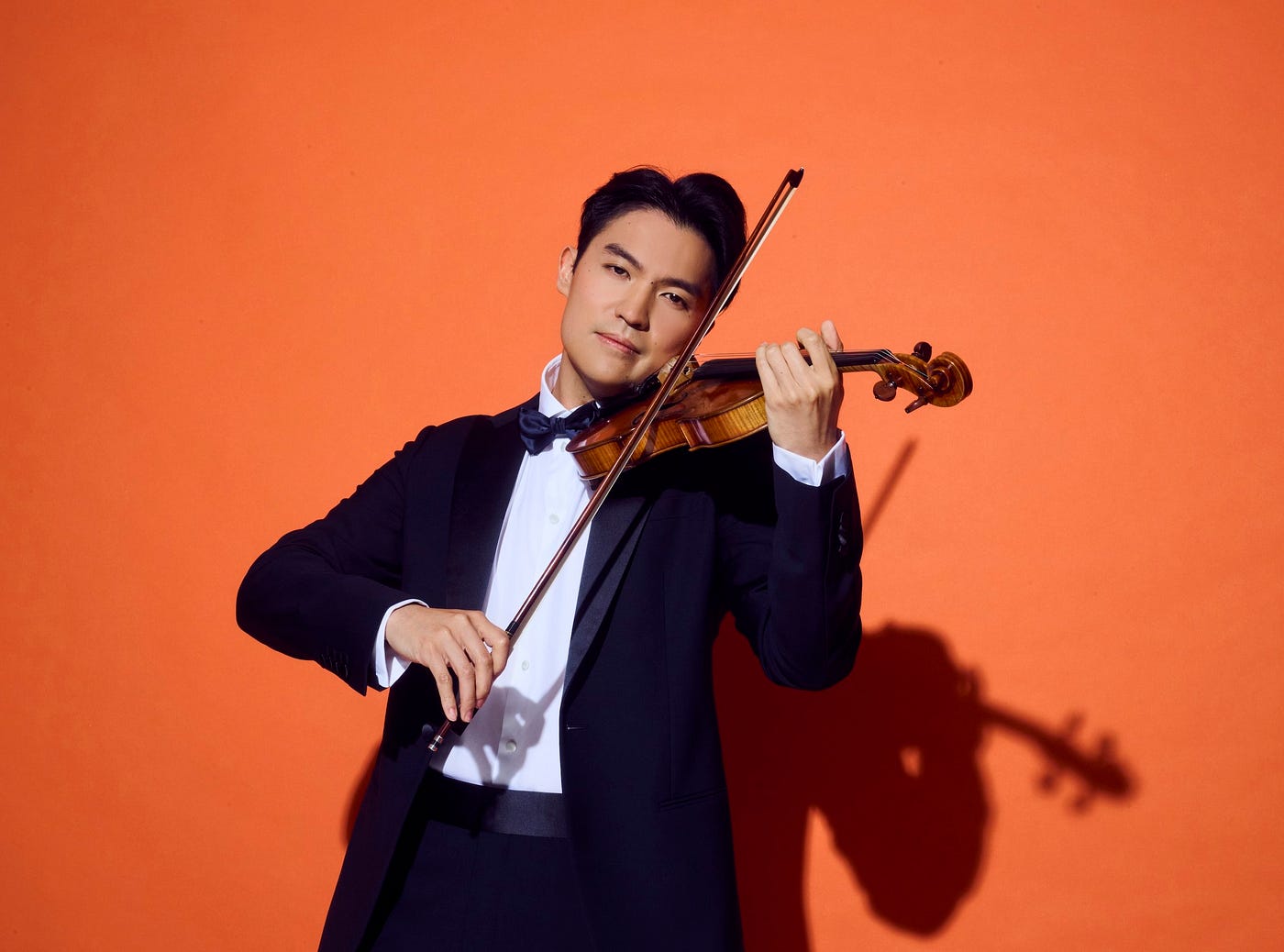
Image Source: RAY CHEN HomePage
Grieg in 1887: The Weight of a Small Nation’s Voice
When Edvard Grieg completed this sonata in 1887, Norwegian Romanticism was at a moment of intense internal tension.
To be a composer from a small nation writing in the shadow of Brahms and Wagner, at a time when German Romanticism exerted near-gravitational force over European musical life, was to face a choice that was less aesthetic than existential: capitulate to the dominant idiom, or resist it.
Grieg chose neither direct confrontation nor outright rejection.
He inhabited the structural rigour of German classical form while filling it, quietly and insistently, with the lyrical distinctiveness and rhythmic acuity native to the North.
That the first movement’s opening draws nothing overtly from Norwegian folk idiom yet somehow breathes the vastness of a northern landscape is a testament to the depth of that assimilation.
Grieg borrowed the architecture; the rooms, he furnished entirely on his own terms.
From this, a first philosophical premise emerges: that chaos, understood here as the pressure of overwhelming external forces, is not the enemy of growth.
It is the very soil in which a distinctive voice takes root. Grieg did not flourish despite the dominance of German Romanticism; he found himself, in part, because of it.
Ray Chen brought this historical consciousness directly to bear on his interpretive stance.
Cultivating a critical distance from the excesses that recording culture of the 1990s made fashionable, he sought to hold two qualities in simultaneous tension: the decisive clarity he admired in the great masters of an earlier generation, Heifetz chief among them, and the refined restraint demanded by contemporary sensibilities.
The tension between the weight of tradition and the independence of interpretation is, as it happens, precisely the problem Grieg spent his entire compositional life attempting to resolve.
[embed]
First Movement: Sustaining Direction Within Chaos
Allegro molto ed appassionato.
The opening chord in A minor arrives like a door thrown suddenly open.
The first theme, hurled out in forte by piano and violin in unison, offers no foothold of stability.
The tonality shifts and shudders, the rhythms surge forward, and just when the lyrical second theme seems to offer a moment’s reprieve, the tension floods back.
The development section tightens this instability with relentless precision.
Structure exists, but the content within it mounts a constant resistance.
That is the drama of the first movement.
Ray Chen gave particular attention to the agitato passages, varying articulation and dynamics with continuous, fine-grained subtlety, conjuring moments in which the music seems, in his own words, to be dying.
It was an intentional vulnerability: a re-creation, within the music itself, of the particular silence that follows the collapse of violent energy.
Technically, this movement poses a fundamental question of direction to any violinist.
Do you press forward, or hold your ground?
For Chen, tempo is not a constraint but a voyage of freedom. His conviction is that the direction once chosen must be sustained even as chaos mounts around it.
This is not merely a technical resolution.
It is a philosophical one: not to surrender one’s governing principle to the turbulence of the moment, while still transmitting that turbulence with absolute honesty.
The interpreter walks the line between being consumed by the music and containing it, and the line is never quite the same twice.
[embed]
Second Movement: Memory as the Root of Identity
Allegretto espressivo alla Romanza.
Moving from E minor into a suffusing E major, this movement traces a tonal journey from shadow toward light. Its subtitle, Romanza, is not incidental: the movement does not trade in heated passion but speaks in the language of deep interiority.
The violin’s melodic lines breathe in long, unfolding phrases while the piano holds steady beneath them, moving like water through the texture.
Recurrence is the movement’s structural soul.
When the theme returns in a different key, it is not mere repetition. It is the same melody seen in a different quality of light. In music, return is an act of memory performed across time.
Chen described this experience as meeting an old friend: a person long absent who has changed in ways both visible and invisible, yet whose essential self remains unmistakably, irreducibly intact.
The warmth of that recognition is what this movement carries.
Here a second philosophical premise surfaces: that memory is not merely decorative to identity but constitutive of it. It can be buried; it cannot be destroyed. And when it resurfaces, it does so not with fanfare but with the quiet certainty of something that was always there.
In this movement, Chen was acutely deliberate about tonal colour. He kept the warm, resonant qualities of the G and D strings at the fore and withheld the luminosity of the E string for the moments when it would matter most.
This was not a timbral decision in isolation but a narrative one.
Memory returns first in the lower registers, quietly, with the kind of certainty that requires no announcement. Then, when the moment is fully prepared, the E string sings.
His deliberate avoidance of slides in this movement belongs to the same understanding.
Gratuitous sentimentality does not honour memory; it dilutes it. His insight that simplicity yields the more profound response finds its most delicate expression here, where every note placed in reserve makes the notes that finally arrive resound with twice their natural weight.
[embed]
Third Movement: Potential Is Not Made. It Is Revealed.
Allegro animato.
The movement from A minor to a triumphant A major does not merely brighten the sonata’s atmosphere.
It harvests everything that has come before.
The fierce thematic material of the first movement returns in transformation; the lyrical elements of the second reappear in new dress.
Chaos is not dissolved here; it is organized.
Energy is not dispersed; it is unified into something coherent and luminous.
There is an important philosophical distinction concealed within the structure of this movement.
The arc it describes is not that of a deficient being made capable through ordeal, the conventional arc of Western heroic narrative.
It is the arc of a complete seed finally flowering: potential that was always present, always latent, now fully disclosed.
What the journey accomplishes is not the manufacture of something new but the revelation of what was irreducibly there from the beginning.
Ray Chen’s most decisive technical insight arrived here. Having relied on more elaborate fingering systems in earlier stages of preparation, he discovered that simpler positions produced a more vivid and immediate tonal palette.
The finding was technical, but its implications ran deeper. Technique is a means, not an end.
When elaboration is stripped away, the essential voice of the music becomes audible.
Potential reveals itself most clearly not through accumulation but through subtraction.
The dialogue between violin and piano in this movement also merits attention. It is here that the two instruments achieve their most equal and dynamically reciprocal exchange across the entire sonata.
The violin does not lead while the piano follows; two distinct voices enter into genuine conversation.
This parity is hard-won, and its arrival constitutes one of the movement’s quiet triumphs.
A brief comparison with Heifetz is instructive. What one hears in his surviving recordings of the third movement is dazzling velocity and an almost inhuman precision.
But what Chen was reaching for was not that velocity: it was the inner weight each note carries.
Contemporary audiences, he observed, do not want mere brilliance. They want speed that does not rob each moment of its meaning. His interpretation was oriented precisely toward that demand.

Image Source: RAY CHEN Instagram
Environment as Source: Fireworks and the Discipline of Attention
During the practice session, there was a moment no one could have scripted.
As New Year fireworks sounded outside, bleeding through into the practice room, Chen did not receive them as an intrusion. He reinterpreted them as a ritual: a ceremonial banishment of what he called the demon of lost motivation, and through that reinterpretation, an external disturbance became artistic sustenance.
This reflects a third philosophical premise, one that runs through the compositional logic of Grieg himself: that the environment is not an obstacle to creation but one of its sources.
Grieg drew the Norwegian landscape into his music, the sound of fjords, the resonance of mountains, not as decoration but as substance. Nature was not something to be shut out in the act of composition. It was composition’s deepest origin.
Chen also noted, with evident satisfaction, that his technique had matured with age in ways he had not fully anticipated: his little finger grown stronger, his vibrato richer and more supple, his command more efficient.
The evolution from youthful repetition toward the analytically grounded economy of mature practice is itself a form of environmental change, an ongoing conversation between the musician and the physical instrument of his body.
Long practice, in this sense, does what sustained attention always does: it strips away accumulated habit and draws the practitioner closer to the essential.
[embed]
Interpretation as the Recovery of One’s Own Voice
A sonata’s opening theme functions as the name by which the entire work organises itself.
In the Third Sonata, the first movement’s principal theme returns, transformed, across the subsequent movements, holding the whole structure together as a single coherent utterance. A theme may appear to vanish; it has not vanished. It lies dormant in another form, waiting to resurface when the structure requires it. Identity can be submerged; it cannot be dissolved.
When Ray Chen subjected received performance practice to critical scrutiny and established his own governing principles, he was engaged in precisely this act of recovery.
The task involved sorting through everything absorbed from teachers, from tradition, from great predecessors, distinguishing what had been genuinely assimilated from what had merely been imitated, and arriving, finally, at what was irreducibly his own.
To find one’s interpretive voice is to reclaim, in a sense, one’s name.
His observation that conventional readings of the Tchaikovsky concerto strike him as overly cerebral, even as he acknowledged their beauty, reflects a characteristically honest ambivalence toward tradition.
The ambivalence itself is significant. He is not rejecting tradition; he is wrestling with it at full strength. It is only from within that full engagement, not from a safe critical distance, that he draws his conclusions.
One must first know the rules completely before one can make them truly one’s own.

Image Source: RAY CHEN Fan Blog
Coda: A Seal, Not a Summary
Grieg’s coda is a seal.
The fierce material of the first movement, the lyrical memory of the second, the passionate resolution of the third: all of it condenses into the final bars and is inscribed there permanently.
It is not a summary of what has come before.
It is the mechanism by which the sonata’s resonance continues to sound inside the listener long after the last note has ceased.
The relief and quiet gratitude Chen expressed at the close of the first movement, his assessment that the atmosphere was dark but entirely fitting, belongs to the same spirit.
Not a perfect conclusion but a truthful one.
Not a resolution that dissolves everything but one that acknowledges everything.
That darkness is part of this sonata’s character, and that character suits both his instrument and his musical nature. That is precisely what the coda says.
The insights Ray Chen reached across this practice session converge on five propositions.
Chaos is not failure; it is the ground in which a distinctive voice takes root.
Memory is the deep structure of identity, capable of being buried but never truly destroyed.
Potential is not manufactured through accumulation; it is discovered through subtraction, and reveals itself most clearly when elaboration falls away.
The environment is not an obstacle to creation but one of its primary sources. And the act of declaring one’s own interpretive principles, of naming one’s own voice, changes the musical world in which one works.
All of this, it turns out, Grieg had already inscribed into this sonata in 1887.
One violin virtuoso, more than a hundred and thirty years later, sat down and read that inscription again.
A violin sonata does not live on the page.
It is reborn with each rehearsal, with each performance. Ray Chen’s Grieg is still in progress. And it is precisely that incompleteness that keeps it alive.
Written from direct observation of the practice session.

Image Source: RAY CHEN Homepage
메타데이터
- post_id
- f7acce35e5f4
- slug
- ray-chen-and-griegs-violin-sonata-3-chaos-memory-and-the-discovery-of-voice-f7acce35e5f4
- url
- https://medium.com/@aza4202/ray-chen-and-griegs-violin-sonata-3-chaos-memory-and-the-discovery-of-voice-f7acce35e5f4
- canonical_url
- https://medium.com/@aza4202/ray-chen-and-griegs-violin-sonata-3-chaos-memory-and-the-discovery-of-voice-f7acce35e5f4
- author_url
- https://medium.com/@aza4202
- status
- ok
- fetched_at
- 2026-07-13 06:23:13