Oura data and fatigue
I have been experiencing mild to moderate fatigue for many months, if not years. About six months ago I bought an Oura ring with the intent…
Oura data and fatigue
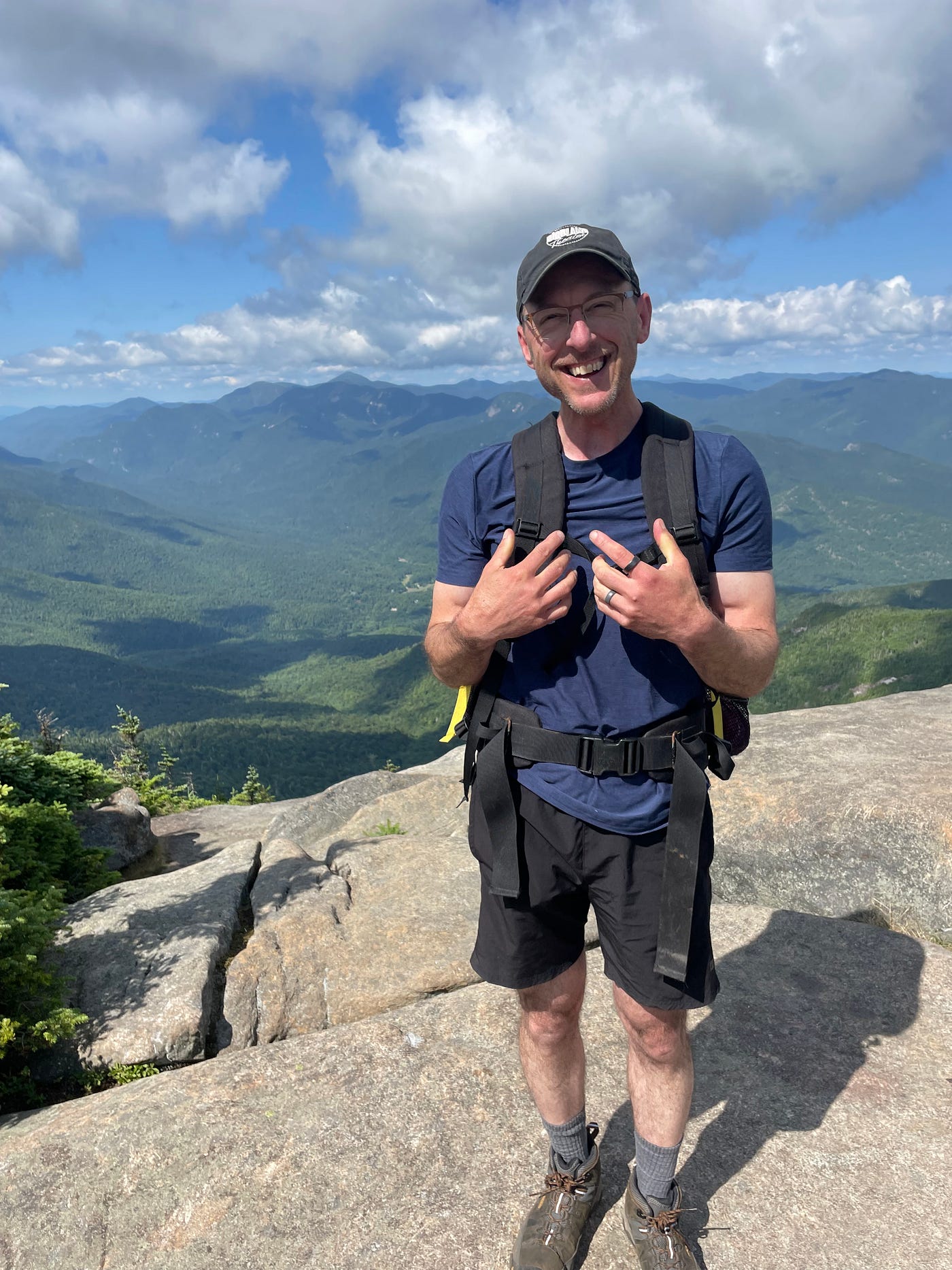
The author at the summit of Giant Mountain in the Adirondacks. Note the Oura ring!
I have been experiencing mild to moderate fatigue for many months, if not years. About six months ago I bought an Oura ring with the intent of seeing if I could get a handle on my fatigue. Oura offers detailed sleep data as well as resilience measures that are based on resting heart rate and heart rate variability (HRV), among other things. I decided that a fun data analytics project would be to download my raw data and see if I could plot a chart showing my resting heart rate and resilience over time. Specifically I wanted to know if big output days — days with heavy exercise like long hikes — were having an impact on my resting heart rate, resilience, and fatigue. My suspicion is that I will eventually be diagnosed with mild ME/CFS since I definitely experience post-exertional malaise (PEM), which is a hallmark symptom of the disease.
I decided to use R to do this mini-project since I had begun learning it in the Google Data Analytics Certification. To be clear, I used Chat-GPT to help me through the process of generating the R code, although I had to make many tweaks along the way to get what I wanted. As someone learning R, I found Chat-GPT to be very helpful; however, I would not want to rely on it exclusively for generating code. Once I have a good grasp on R, I plan to just use Chat-GPT to explore areas of R that may be completely new to me, like functions that I didn’t know existed previously.
Here is the knitted HTML file of my mini Oura data analysis.
[embed]**Resting Heart Rate and Resilience Report** joemarocco.github.io
By looking at the chart, we can see that when I first got my Oura ring, my resting heart rate was a tad above 70bpm, which is fairly high for someone who is in good shape. I had spent the winter doing what I usually do — cutting firewood with a chainsaw in deep snow and hauling it by hand with a sled. It is probably obvious that this is difficult work, and it is. As the long Adirondack winter dragged on, I became more and more dragged out myself, and my sleep was not good (although I didn’t have an Oura ring yet so I didn’t know how bad it was).
Once I got the ring, I had a better picture of what was actually going on. My sleep architecture was actually not bad, but my total sleep was on the low side. For a normal, healthy person, my sleep probably would have been adequate to maintain energy, but for me, it wasn’t.
This was when I also started learning about the nervous system and its role in sleep, heart rate, and HRV. I began to slow down and to do daily resonance breathing work — but only about 10 minutes a day. This is where we can see my resting heart rate dropping down below 70 into a healthier, yet still elevated, high 60s. I began to feel less fatigued and my sleep was improving!
And then, in August, I began taking long hikes with my family. These can be seen as the black circles in the graph — days when my active calorie burn was > 500 calories. Shortly thereafter my resting heart rate started to rise and my resilience eventually dropped from “solid” to “limited.” I began to experience poor sleep once again and my fatigue returned April levels.
So, this chart tells a clear story about my physiology: heavy exercise results in lowered resilience.
There is one anamolous thing, though. In May and early June I had several days with > 500 active calorie burns, but my resting heart rate continued to drop. I can only attribute this to the fact that I was continuing to religiously spend 10 minutes a day doing resonance and other breathing exercises, whereas by mid-August I had fallen out of the habit. So, I am tempted to conclude that breathing exercises can actually mitigate the effects of heavy exercise, for me, at least.
The takeaway: I need to keep breathing.
메타데이터
- post_id
- f7be6b08e5e2
- slug
- oura-data-and-fatigue-f7be6b08e5e2
- url
- https://medium.com/@joe.marocco/oura-data-and-fatigue-f7be6b08e5e2
- canonical_url
- https://medium.com/@joe.marocco/oura-data-and-fatigue-f7be6b08e5e2
- author_url
- https://medium.com/@joe.marocco
- status
- ok
- fetched_at
- 2026-07-16 05:07:50