This Christian Influencer Thinks “Church Hurt” Isn’t Real
Spiritual Trauma, Religious Systems, and the Problem With Blaming “Susan”
This Christian Influencer Thinks “Church Hurt” Isn’t Real
Spiritual Trauma, Religious Systems, and the Problem With Blaming “Susan”
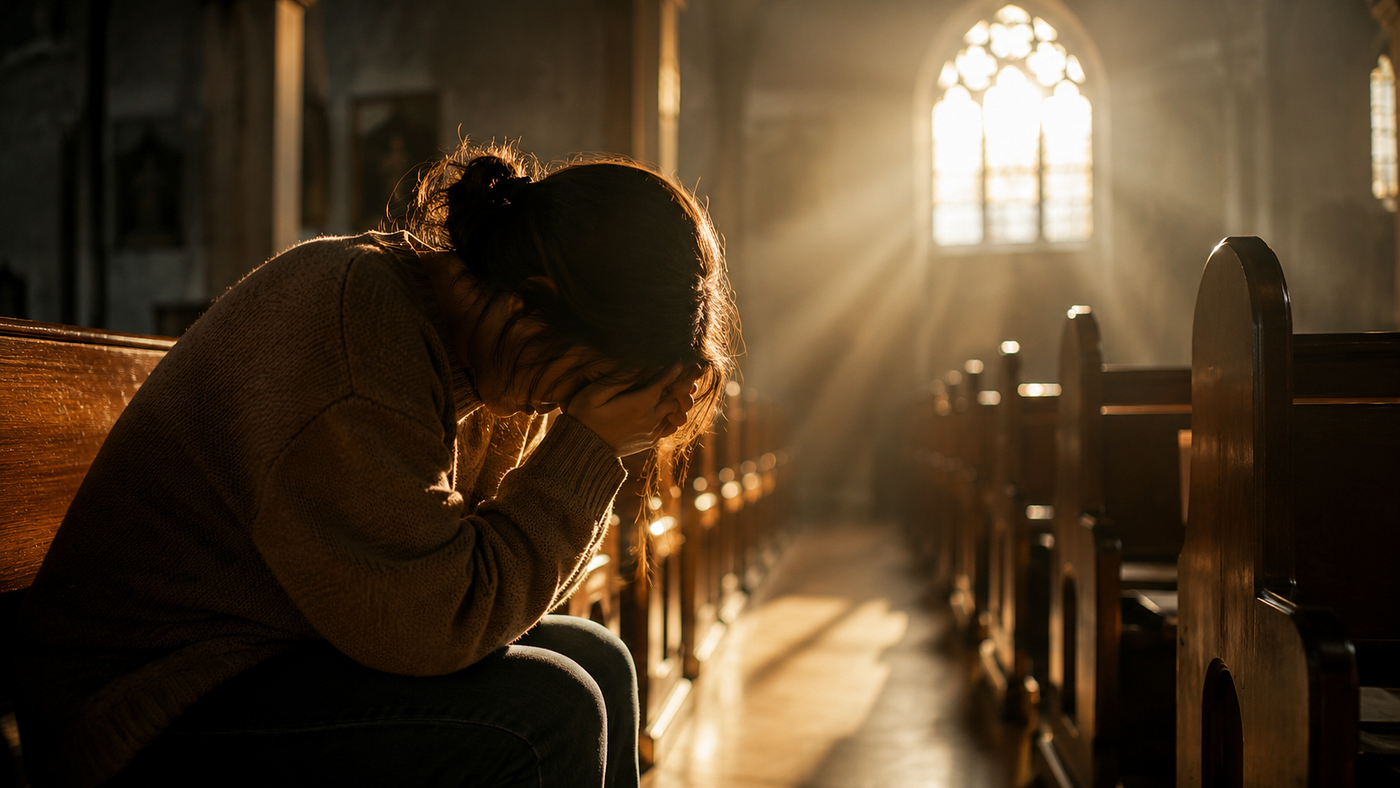
Image created by author on Canva Pro
Apparently, we’ve all been using the phrase “church hurt” incorrectly.
That’s the big revelation from Christian Instagram influencer Milicent Sedra, whose recent reel confidently informed the internet that the church did not actually hurt you.
Susan did.
You see, according to Sedra, saying “church hurt” is unfair because the church is “the bride of Christ.” The real problem is that a few flawed individuals offended you, and you’ve accidentally blamed the entire church for their behaviour.
Now, if the name Milicent Sedra rings a bell, there’s a reason for that. If not, let me tell you about her.
Sedra is a young Australian preacher and social media personality connected to the Melbourne based church C3 Powerhouse, and over the last couple of years, she has built a sizable online following through bold, highly confident takes on Christianity, culture, demons, mental health, gender, and spiritual warfare.
I’ve written about her before.
In one reel, she suggested that what we call mental illness is just demonic activity hiding behind psychological labels. In another, she framed anxiety and depression through an intensely spiritual warfare lens that I believe could be deeply harmful to vulnerable people already struggling with mental health issues.
Truthfully, I hate writing articles like this.
I genuinely dislike calling people out by name. I know there is a real human being on the other side of the screen. I know social media can turn disagreement into spectacle. I know Christians can become cruel to one another very quickly.
Still, there comes a point where certain forms of “Christianity” become so spiritually and psychologically toxic that staying silent feels irresponsible.
And this reel hit a nerve for me.
Because while Sedra’s argument sounds clever on the surface, it completely misunderstands why so many people use the phrase “church hurt” in the first place.
“The Church Didn’t Hurt You. Susan Did.”
In the now viral Instagram reel, Sedra tackles the concept of “church hurt” head-on. The tone is confident, punchy, and dismissive in that uniquely social media preacher kind of way, where complex human experiences are flattened into a 60-second hot take delivered with absolute certainty.
Her basic argument is this:
People should stop saying “the church” hurt. According to Sedra, individuals may have sinned against you, offended you, or treated you badly, but it is unfair and divisive to blame “the church” as a whole.
To make her point, she compares church hurt to blaming “food” for obesity. Food itself is not the problem, she argues. Specific bad food is the problem. Likewise, the church is not the problem. Certain bad people are.
Here is the full transcript of the reel:
“The main reason people stop going to church? Church hurt. They got hurt, they got offended. This terminology of church hurt, it’s actually problematic. It’s very divisive language, because it’s to suggest the thing that hurts you is the church, the body of Christ.
The church didn’t hurt you, Susan hurt you.
If I was to ask you, write down a list of all of the names of the actual people that offended you, what you’ll find is probably not the church hurt you, but like three people offended you.
Stop attributing the sin of Susan to the bride of Christ. Church hurt is like saying, food made me fat. No, food did not make you fat. Food is a category. Bad food made you fat. McDonald’s made you fat.
But you actually need good food to survive.
Don’t demonize the category of the church, because it’s necessary in your life. Without the church, your Christianity dies, your spirituality dies.
Don’t demonize the church as a category, when there are bad churches. But the church, the bride of Christ, is not the problem.
And if Jesus Christ loves the church that much, then he died for it.
You ought to as well.”
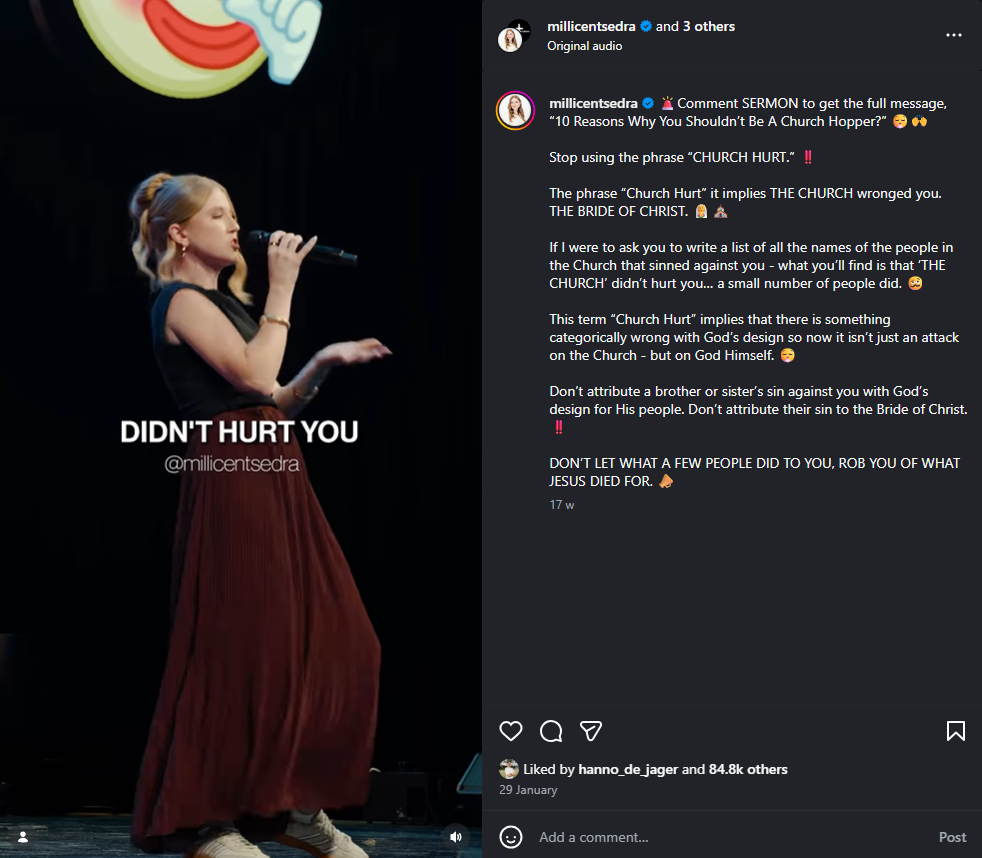
Source: Instagram
On first listen, I can already hear some Christians nodding along.
It sounds balanced.
Measured.
Even spiritually mature.
The problem is that beneath the polished delivery sits an understanding of trauma, systems, power, and spiritual abuse that is painfully shallow.
A Convenient Way to Avoid Accountability
What bothers me most about Sedra’s reel is not simply that it is simplistic. It is that it quietly removes accountability from church systems themselves.
According to her framework, the church is almost untouchable as a category. The problem is never the culture, the structure, the theology, the leadership environment, or the repeated patterns. The problem is merely a handful of flawed individuals who behaved badly.
Susan hurt you.
Three people offended you.
That sounds reasonable until you spend five minutes listening to the actual stories people are telling.
Many people describing “church hurt” are not talking about one awkward disagreement after a Sunday service. They are talking about years spent inside environments that shaped the way they saw themselves, God, authority, sexuality, doubt, mental health, and belonging.
They are talking about cultures where questioning leadership decisions was treated as betrayal against God himself, cultures where people stayed silent because raising concerns made them the problem.
Cultures where image management mattered more than honesty.
Cultures where vulnerable people were taught to distrust their own instincts.
Cultures where shame, fear, guilt, and spiritual pressure were normalized in the name of holiness.
That is not merely “Susan being mean.”
That is systemic.
And churches can absolutely create systems that cause harm.
We already understand this in every other area of life. If dozens of employees leave the same workplace describing bullying, fear, manipulation, and toxic leadership, we do not say, “Well, technically Dave hurt you, not the company.” We start asking whether something unhealthy exists within the culture itself.
Churches should not be exempt from the same scrutiny simply because they use spiritual language.
In fact, religious environments can become uniquely powerful because they shape far more than behaviour. They shape identity, morality, relationships, purpose, belonging, and a person’s understanding of God. When harm happens in that context, it often cuts far deeper than ordinary conflict because the wounds become tangled up with faith itself.
What makes Sedra’s argument even stranger is that Jesus himself constantly criticised unhealthy religious culture, not just isolated individuals. Imagine if Jesus had looked at the Pharisees and said, “Hey guys, let’s not blame the system as a whole here. It’s really just Gary being a bit intense about hand washing and Steve overreacting to the Sabbath rules.”
No. Jesus repeatedly addressed the culture itself. He challenged the way the system functioned, the way religious power operated, and the way ordinary people were being crushed under it.
The prophets did the same thing long before him.
Entire churches in the New Testament are rebuked.
Entire communities are challenged.
Entire spiritual cultures are called unhealthy.
So when modern Christians act as though acknowledging systemic church problems is somehow an attack on “the bride of Christ,” it can start to feel less like spiritual wisdom and more like institutional defensiveness.
And honestly, that defensiveness is often part of the wound itself.
The problem becomes even harder to ignore when you look at the countless abuse scandals that have emerged across churches over the years. In many of those cases, the issue was never just one abusive leader acting alone. The deeper issue was the culture around them. People stayed silent. Leadership protected the institution. Victims were pressured not to “damage the witness of the church.” Concerns were minimized, buried, spiritualized, or quietly moved out of sight while the system carried on as normal.
That is exactly why phrases like “church hurt” exist in the first place. People are often trying to describe not merely what one individual did to them, but the way an entire environment responded when harm occurred.
Hurt People Often Still Love the Church
One thing that really bothers me about Sedra’s reel is the way it subtly reframes wounded people as though they are unfairly attacking Christianity itself.
That has not been my experience at all.
Most people I know who talk about “church hurt” did not leave because they hated the church. Many stayed far longer than they should have because they loved it deeply and desperately wanted it to work.
These were often the people who arrived early and left late. The people who said yes every time help was needed. The people who did kids ministry for years, played in the worship band, ran small groups, went to conferences, volunteered at youth camps, prayed at altar calls, and genuinely believed they were helping build something beautiful.
For many of them, church was woven into almost every part of life. Their closest friendships were there. Their routines were there. Their language for understanding God and themselves was there too. That is part of why the fallout can feel so disorienting when things eventually unravel.
That is exactly why the pain runs so deep when things fall apart.
Research from the Barna Group found that 37% of non-churchgoing Americans said they avoid church because of negative experiences with churches or church people. More significantly, Barna found that the overwhelming majority of unchurched people were previously active churchgoers themselves. These are not outsiders criticizing Christianity from a distance. In many cases, they are former insiders who once defended the church just as passionately as Sedra is defending it now.
I honestly think this is what people like Sedra miss.
Most people talking about “church hurt” are not sitting around looking for reasons to attack Christianity. A lot of them are heartbroken. Some lost entire friendship circles after leaving. Some spent years pouring energy, time, money, and trust into communities that suddenly no longer felt emotionally safe. Others are trying to rebuild their lives after discovering that the version of God they were taught left them anxious, ashamed, or constantly afraid.
That kind of loss can be psychologically brutal because religion does not merely shape behaviour. It shapes identity. Studies into spiritual abuse and religious trauma regularly describe people experiencing confusion, anxiety, isolation, identity disruption, and profound emotional distress after leaving unhealthy church environments. Many former churchgoers describe feeling as though they lost not just a community, but an entire framework for understanding themselves and the world around them.
That is why Sedra’s “Susan hurt you” line feels so painfully inadequate to me. Most people are not trying to say that one awkward Christian offended them once. They are trying to describe the collapse of an entire spiritual world that once held enormous meaning in their lives.
And honestly, when someone is carrying that kind of grief, correcting their terminology probably should not be the first response.
Healing Starts With Honesty
One of the strangest things about Sedra’s reel is that it frames acknowledging church harm as though it is somehow an attack on the church itself.
In reality, refusing to acknowledge harm is usually what allows it to keep spreading.
Every healthy relationship understands this principle instinctively. If a husband hurts his wife, healing does not begin with, “Well technically marriage didn’t hurt you.” If a workplace becomes toxic, employees are not helped by management insisting the culture is fine while quietly blaming a few difficult personalities. Real healing only becomes possible once somebody is willing to honestly admit that something unhealthy has been happening.
Church should not be exempt from that process simply because Christians use phrases like “the bride of Christ.”
To be clear, I understand why Christians feel protective of the church. I still feel that instinct myself sometimes. The church has also fed people, comforted people, baptized people, buried people, prayed for people, and carried people through the darkest moments of their lives. Some of the kindest and most beautiful humans I have ever met were Christians trying sincerely to love God and others well.
Still, love should not make us incapable of honesty.
If anything, genuine love should make honesty more important, not less.
The irony is that the Bible itself constantly models this kind of honesty. Scripture does not present God’s people as flawless institutions that must be protected from criticism at all costs. Israel is rebuked repeatedly. Religious leaders are challenged repeatedly. Entire churches in Revelation are warned that they have become spiritually unhealthy. The biblical story is full of people confronting corruption, hypocrisy, abuse of power, and spiritual blindness from within the community itself.
That is not hatred of the people of God.
That is accountability.
And honestly, many wounded people would probably settle for far less than perfection from the church. Most are not demanding flawless leaders or flawless communities. They simply want their experiences acknowledged without being minimized, spiritualized, or explained away.
Telling hurting people, “The church didn’t hurt you,” may sound like a defence of Christianity, but for many people it lands as another refusal to listen honestly to what they experienced in the first place.
Dan Foster is the author of “The Bible is Your Story: What the characters of Scripture reveal about the patterns shaping your life.”
The Backyard Church is not just a blog. It’s a real online community for people who have faith but can’t, don’t, or won’t go to church. Join today.
If you’re a writer or blogger who wants to grow your voice and build momentum online, I also run Bloggers Academy — a smaller community where I teach what I’ve learned growing from zero to 100,000+ followers. Learn more here
For more articles on life, faith, and spirituality, Sign-up for my newsletter. Also, feel free to send questions and story ideas to thebackyardchurch@gmail.com
메타데이터
- post_id
- f7cfc95ee01d
- slug
- this-christian-influencer-thinks-church-hurt-isnt-real-f7cfc95ee01d
- url
- https://medium.com/backyard-theology/this-christian-influencer-thinks-church-hurt-isnt-real-f7cfc95ee01d
- canonical_url
- https://medium.com/backyard-theology/this-christian-influencer-thinks-church-hurt-isnt-real-f7cfc95ee01d
- author_url
- https://medium.com/@danfosterwriter
- status
- ok
- fetched_at
- 2026-06-09 15:37:30