From Symmetry to Synergy
How Copernicus, Kepler and Newton explored (and tamed) the structure of the heavens
From Symmetry to Synergy
How Copernicus, Kepler and Newton explored (and tamed) the structure of the heavens
The path to our modern view of nature, especially of the laws governing the dance of celestial bodies, was hard and tortuous. The main obstacles were notions about the world, created by God, had to be: perfect. Which she isn’t. So let’s start with
Copernicus: Nature is Perfect
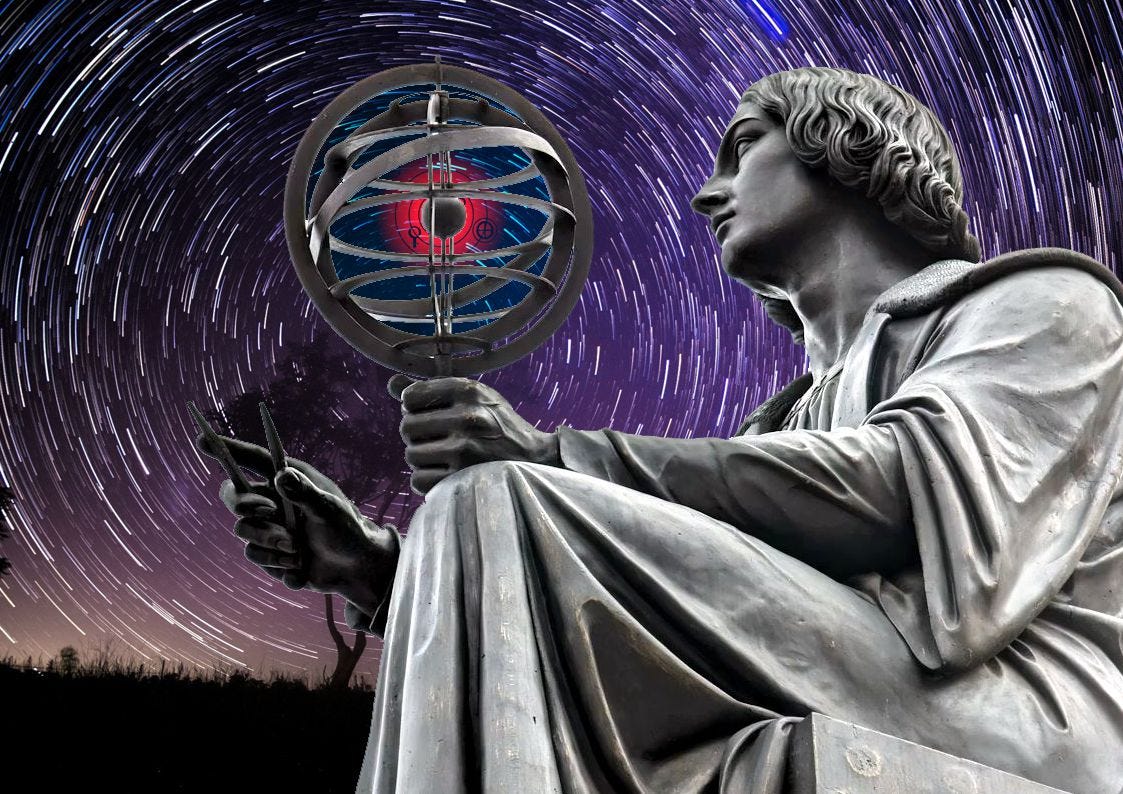
The planets: revolving around the Sun. Collage by author
The whole world is harmony and number. Pythagoras
Nicholas Copernicus (1473–1543), the German scholar from Poland, was the first to formulate a heliocentric system that was widely used and became the basis of our Western understanding of the world. Even in ancient times, Aristarchus of Samos had assumed that the sun was at the center and that the earth and moon orbited around it. But it was only with Copernicus’ precise sketches and calculations that the system, despite the resistance of the Catholic Church (but with the approval of the Jesuits), became widespread and soon generally recognized. There was only one small problem with the system: it wasn’t right.
Now everyone will say: But the planets do orbit the sun! No, they don’t; they describe elliptical orbits. The difference is huge in purely theoretical terms, and obviously in purely mathematical terms too. And that’s the point: Using the system of Copernicus, the positions of the planets could be calculated less precisely than the (entirely wrong) methods of Ptolemy. So one might conclude that Ptolemy is right and Copernicus is wrong. This, of course, is not true. Copernicus had the right idea, but he was missing one little thing. Ptolemy had the right calculation method, but no idea of how the universe looked or worked (which he wasn’t interested in).
So if Copernicus had changed a small thing about his system, leaving circles, embracing ellipses … but he couldn’t. He did not arrive at his system through lengthy observation or exhausting calculations, but through theological considerations, like Kepler and Newton after him. God, the thinking goes, is perfect, so He created a perfect world. This perfection must appear in the immutable and sublime laws of celestial mechanics. The most perfect figure is the circle; Consequently, celestial bodies must move in a circular manner through space. Any other form would be unworthy of God.
In particular, ellipses are completely unthinkable according to this line of thought. Firstly, they are not perfect, which you can tell at first glance: their egg shape is quite flabby compared to the perfectly round shape of the circle. And secondly, the central body (the sun for the planets, the earth for the moon) should be in a focal point, not in the center. Such arbitrariness is absolutely unworthy of God and therefore not possible.
Nevertheless, Copernicus deserves the credit for having spread the idea of the heliocentric system. At the center of the solar system is the central fire, the sun, not the earth. This put him at odds with the church, and that is why his writings were only printed after his death and only distributed secretly. After all, Galileo was also a supporter of the Copernican system (circular planetary orbits), while Kepler, like Copernicus, who was also a deep believer, discovered the true shape of the planetary orbits through laborious calculations.
Kepler: The World is Ordered

The universe: consisting of perfect geometrical bodies. Collage by author
The geometric (that is, quantitative) figures are things of reason. Reason is eternal. So the geometric figures are eternal, and truth was in the Spirit of God from eternity. Johannes Kepler
Johannes Kepler (1571–1630), a contemporary of Galileo, in a certain sense continued the ideas of Copernicus. Since his own life was determined by chaos and terror, he sought all the more spiritual perfection, which he projected into nature, where he did not find it. He created the first — and so far only — mathematical-geometric world system to explain the distances between planets. His “Harmony of the World” contained the five regular bodies as well as the sphere, because there were six planets known at that time. By cleverly nesting the six three-dimensional structures within each other, he was able to provide a purely geometric explanation of the distances of the planets from the sun. (You can see that Kepler naturally assumed Copernicus’ heliocentric system.) As with Copernicus, the idea of perfection was also the decisive intellectual design criterion for Kepler. Because the five Platonic solids, which are bounded by regular polygons, were also called “perfect” solids. And the sphere, as a spatial analogue to the circle, is perfect anyway.
Kepler’s system had two disadvantages. Firstly, it didn’t provide any real explanation, and secondly, it wasn’t expandable. There are other planets beyond Saturn, and they no longer have a place in Kepler’s “Harmonic World”.
Fortunately, Kepler was as passionate an idealist as he was a convinced realist. The dissemination of logarithms in 1617 by the Englishman Henry Briggs made arithmetic much easier. Nevertheless, it took Kepler eight years (and immense hard work and endless patience) to determine the true shape of Mars’ orbit from the observational data of his employer, Tycho de Brahe. And it was an ellipse — no divine perfection could help it. It was Kepler’s great achievement to have accepted this fact, despite his obsession with perfection, the highest form of symmetry.
After this mental and spiritual breakthrough, it was not difficult for him to grasp the laws of planetary movements. They were the starting point for Newton’s world system. The fact that Kepler did not recognize the quadratic distance law was due to a wrong understanding of the central force. Kepler thought that it appeared two-dimensional, i.e., in the plane of the planetary orbits. But then the distance law would be linear, not square. The truth remained reserved for the creator and at the same time the perfector of classical physics.
Kepler’s three laws:
(1) The orbit of a planet is an ellipse with the Sun at one of the two foci.
(2) A line segment joining a planet and the Sun sweeps out equal areas during equal intervals of time.
(3) The square of a planet’s orbital period is proportional to the cube of the length of the semi-major axis of its orbit.
None of these laws is symmetrical!
Newton: Living With Contradictions

The apple and the moon: obeying the same law of mutual attraction. Collage by author
I don’t know how I appear to the world; but I see myself as a little boy playing on the shore, finding here and there a smoother pebble or a prettier shell, while the great ocean of truth lies impenetrable before me. Isaac Newton.
Like his predecessors, Isaac Newton (1642–1727) was a deeply devout and religious person. He devoted most of his energy to Bible studies. In modern parlance, he looked for a Bible Code that would enable him to classify the history of humanity according to biblical words and to predict its future. He concluded that the Jews would get their own state in 1948 — a truly remarkable prediction.
He distributed the rest of his time and energy on theoretical and practical alchemical studies as well as on the foundation of classical physics and calculus. Only the latter achievements of this profound spirit were preserved for posterity. By the time his theological and alchemical writings were finally acknowledged, the separation between science and religion had long since become insurmountable, and so they were hushed up. You don’t want to put the great scholar in the vicinity of astrologers and Jehovah’s Witnesses. But for Newton, science (“natural philosophy”) and religion still formed a unity.
That’s why some of his physical ideas are of theological origin. Absolute space is the area inhabited by God — hence “absolute”. Gravity, discovered and theoretically described (but not explained) by Newton, is an outgrowth of God’s will. In addition, God occasionally intervenes in world events because, without this divine intervention, the universe would have collapsed long ago. Modern cosmology can only explain that this is not the case with the help of the “Big Bang”, but if it hadn’t been for that, all matter would have already come together in a super black hole to say “hello” to every particle that ever existed (und would exist no more).
Newton became known for his three axioms, which are still part of classical physics. His sense of reality is astonishing: one of these axioms contradicts the other, because one is symmetrical and the other is not. Here they are:
(1) A body remains at rest, or in motion at a constant speed in a straight line, unless it is acted upon by a force.
(2) At any instant of time, the net force on a body is equal to the body’s acceleration multiplied by its mass or, equivalently, the rate at which the body’s momentum is changing with time.
(3) If two bodies exert forces on each other, these forces have the same magnitude but opposite directions.
Newton’s third axiom says: actio = reaction, i.e. force = counterforce. Newton means that two bodies attract each other at the same time, and that the common attraction lies in the line connecting the centers of gravity of the two bodies. Not only does the earth hold the moon under its spell with its gravity, the moon also pulls on the earth, and that’s why the tides occur, because the earth’s crust itself is too rigid to rise, but the waters of the seas are not. The two forces must be in line, otherwise there would be shear forces (lateral forces) that would lead to a destabilization of all planetary orbits.
Newton’s second axiom brings mass, force and acceleration together. Opposing axiom #1, you need a force. Or vice versa: Every change in path (= acceleration) causes an (inertial) force, e.g. centrifugal force; as a formula: F = m a. The mass is the inertial mass. This law is asymmetrical and specifically contradicts Axiom 3. There is no second force, an enigma still unsolved.
This contradiction seems to have been noticed explicitly by the Austrian physicist and philosopher Ernst Mach. He put forward a bold hypothesis: the counterforce of inertia was the effect of all the masses in the universe. Albert Einstein was so impressed by these ideas that he wanted to incorporate them into his general theory of relativity. It failed, and Einstein got rid of inertia with a trick: He set inertia = gravity, which is already wrong in simple cases, e.g. with the Coriolis force, which cannot be replaced by any gravity. Einstein explained gravity through the curvature of space, and so all problems seemed solved.
More on gravity:
[embed]The Mystery of Gravity It remains unsolved — but there seems to be a solutionpeterripota.medium.com
More on inertia:
[embed]The Mystery of Inertia It’s stranger than gravity — which is strange enough!peterripota.medium.com
메타데이터
- post_id
- f7d057378dfc
- slug
- from-symmetry-to-synergy-f7d057378dfc
- url
- https://medium.com/@peterripota/from-symmetry-to-synergy-f7d057378dfc
- canonical_url
- https://medium.com/@peterripota/from-symmetry-to-synergy-f7d057378dfc
- author_url
- https://medium.com/@peterripota
- status
- ok
- fetched_at
- 2026-07-10 19:34:48