The Book of Jashar: Apocryphal or Canon?
Why are Apocryphal Books appearing in Scripture?
The Book of Jashar: Apocryphal or Canon?
Why are Apocryphal Books appearing in Scripture?
This piece examines the Book of Jashar as a revealing example of how ancient Jewish literature could be cited within Scripture without being treated as authorized. It explores the tension between apocryphal or extracanonical writings and the recognized biblical canon, arguing that the mention of Jashar reflects the use of respected historical or poetic sources rather than proof that every cited text belonged in Scripture. At the same time, the writing moves beyond historical analysis to consider the spiritual implications of canon formation, inviting readers to reflect on how tradition, discernment, and divine revelation continue to shape the understanding of sacred texts.
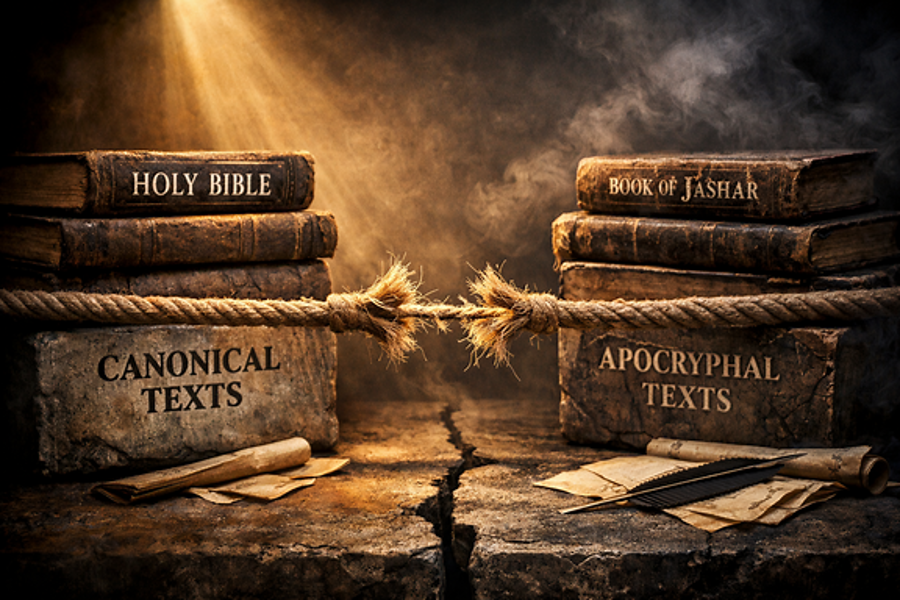
Image created on Copilot Designer
Introduction
Interest in Jewish apocryphal and extracanonical writings from the Second Temple period has grown as readers seek historical and theological context for the world of the Bible. Texts such as 1 Enoch and Jubilees often attract attention because they expand on brief biblical episodes and help explain why later authors allude to themes that appear only briefly in the authorized or canonical text. Their existence raises an important question: when Scripture refers to other writings or ideas known in the ancient world, does that mean those sources should also be treated as part of the canon?
That question comes into sharp focus in Joshua 10:13, where the narrative refers to the Book of Jashar in connection with Joshua’s command for the sun to stand still during battle. Because Jashar is cited within Scripture yet was not preserved in the Hebrew canon, it has become a point of controversy in debates over non-authorized writings. This writing argues that the reference is best understood as the use of a respected historical or poetic source rather than as absolute evidence that every cited work belonged in Scripture. From there, the discussion opens onto a wider issue: how communities of faith recognized authoritative texts, and how believers continue to think about canon, tradition, and divine revelation. This is a lesson in biblical discernment.
The Book of Jashar
The Hebrew Sefer ha-Yashar (“Book of the Upright” or “Book of the Just”) is mentioned only twice in the Hebrew Bible, in Joshua 10:13 and 2 Samuel 1:18. Most modern scholarship treats it not as a lost authorized book but as an ancient sourcebook—a collection of heroic poetry or battle songs celebrating major events and figures in early Israelite history. That view is based on the poetic character of the material associated with it in Joshua and David’s lament over Saul and Jonathan, as well as on the broader practice of citing older source collections within biblical narrative.
At the same time, the exact identity of the work remains uncertain. Some ancient and medieval interpreters did not think Jashar was a separate lost book at all. Rabbinic and later Jewish traditions sometimes identified it with an already recognized biblical book or with a broader corpus of sacred instruction, while other interpreters suggested it may have been known in antiquity as a collection of songs. The surviving works now called Sefer ha-Yashar are much later compositions, especially medieval texts, and are not regarded by scholars as the original source cited in Joshua and Samuel.
Why Jashar was excluded from the Hebrew canon is not completely known. The best explanation is not that early Jewish authorities necessarily rejected Jashar as false, but that it did not function as Scripture in the way the Torah, the Prophets, and eventually the Writings did. In Jewish canon formation, books came to be recognized as authoritative because they were preserved, read, and received within Israel’s sacred tradition. A sourcebook such as Jashar can be respected and even quoted, based on certain sensitivities, and still not be granted authorized status. In that sense, Jashar resembles other lost works mentioned in the Hebrew Bible: useful as historical or poetic sources but not preserved as part of the canon itself.
It is better to regard the original Book of Jashar as a lost ancient source remembered by the biblical writers than to treat any later published “Book of Jasher/Jashar” as a missing book of Scripture. Its citation in the Hebrew Bible shows that non-authorized texts were known and valued in ancient Israel, but citation alone was not enough to place a work inside the canon. The later medieval works bearing the same title may still be of historical interest for the study of Jewish interpretation, yet they should not be confused with the lost book referred to in the biblical text. The serious and mature biblical believer must ask in prayer why certain books that are preserved are excluded and on what basis.
Why does this matter?
In one sense, I have added a level of nuance to the discussion of the approved biblical canon and the sources that informed such decisions. My purpose in doing so is to serve as a reminder that our God is active and living. We are not slaves to long-dead words and documents in which some people placed in high positions by men have the final say on biblical truth. The Spirit of God still reveals and clarifies His messages, and it may well be that some of His channels were stifled or eliminated over time.
If the authentic original Book of Jashar is lost in antiquity, then the subject is closed; however, it is not unlike the Spirit of God to reveal hidden truths in His own time and place. Much as the Ethiopian Orthodox Bible preserved books that were considered missing until now — not that the books were missing but withheld for a later period of time — these are the actions of a vital relationship and understanding of God. The letter kills, but the Spirit brings life and light to hidden things.
Conclusion
It was not my purpose to debate the truthfulness of Joshua’s command for the sun not to move during his battle. I have read many scientific opinions on this phenomenon and why it would be impossible without the complete disruption of the earth’s surface. It was a time when there was no real concept that the earth itself turns and that the sun did not rotate around the world. There was no real concern then about how it was done — only that it was done from their perspective.
How many times have we experienced what seems like a stalling of time when we desired to get somewhere and feared being late, only to find that we arrived exactly on time? If we consciously set our minds to observing these slips in time, we might be amazed. It was not the literal sun standing still, nor was it the earth ceasing to rotate. It was faith that his request would be answered as he focused on the battle ahead. There is much we do not perceive in our slice of reality.
For those who think I am engaging slippery and controversial ground, I agree. I have come to think that the Spirit of God continues to share both new and old revelations, and that men have made selections on what they favor while discarding what they do not value. The subject of canon itself is more institutional than spiritual. It gives a level of consistency and safety desired by most, but our Lord did not give His Spirit for us to build safety — quite the opposite. The Spirit leads where He may, and the believer must learn to be open to His voice and to how He reveals knowledge.
What is hidden will be revealed, but in its proper time. Discernment is meant to see consistency and avoid conflict in doctrine, but not to shut out all teaching that may shed historical and contextual light on the meanings of Scripture.
Endnotes
-
“Book of Jashar,” The Oxford Dictionary of the Jewish Religion, summarized in Oxford Reference, describes Jashar as a lost work of ancient Hebrew poetry mentioned in Joshua 10:13 and 2 Samuel 1:18 and commonly understood as containing heroic material.
-
“JASHER, BOOK OF,” Jewish Encyclopedia, notes the long history of debate over whether Jashar was a separate lost book, a book of songs, or a title interpreted in other ways by rabbinic tradition.
-
“Jashar,” HarperCollins Bible Dictionary, via Bible Odyssey, characterizes the source as a collection of archaic heroic poetry known in ancient Israel but no longer extant.
-
Apocrypha, Encyclopedia Britannica, explains that apocryphal works are writings outside an accepted canon and distinguishes extracanonical literature from authorized Scripture.
-
“Bible Canon,” Jewish Encyclopedia, outlines the development of the Hebrew canon and the principle that some religious writings were treated as outside the recognized collection of sacred books.
-
For the later medieval work also called Sefer HaYashar, see Sefaria, which identifies that text as a medieval ethical composition rather than the ancient source cited in Joshua and Samuel; compare also the later midrashic work described in standard reference summaries.
메타데이터
- post_id
- f7d92c2bd488
- slug
- the-book-of-jashar-apocryphal-or-canon-f7d92c2bd488
- url
- https://medium.com/the-dove/the-book-of-jashar-apocryphal-or-canon-f7d92c2bd488
- canonical_url
- https://medium.com/the-dove/the-book-of-jashar-apocryphal-or-canon-f7d92c2bd488
- author_url
- https://medium.com/@bobrussell27
- status
- ok
- fetched_at
- 2026-06-25 12:15:08