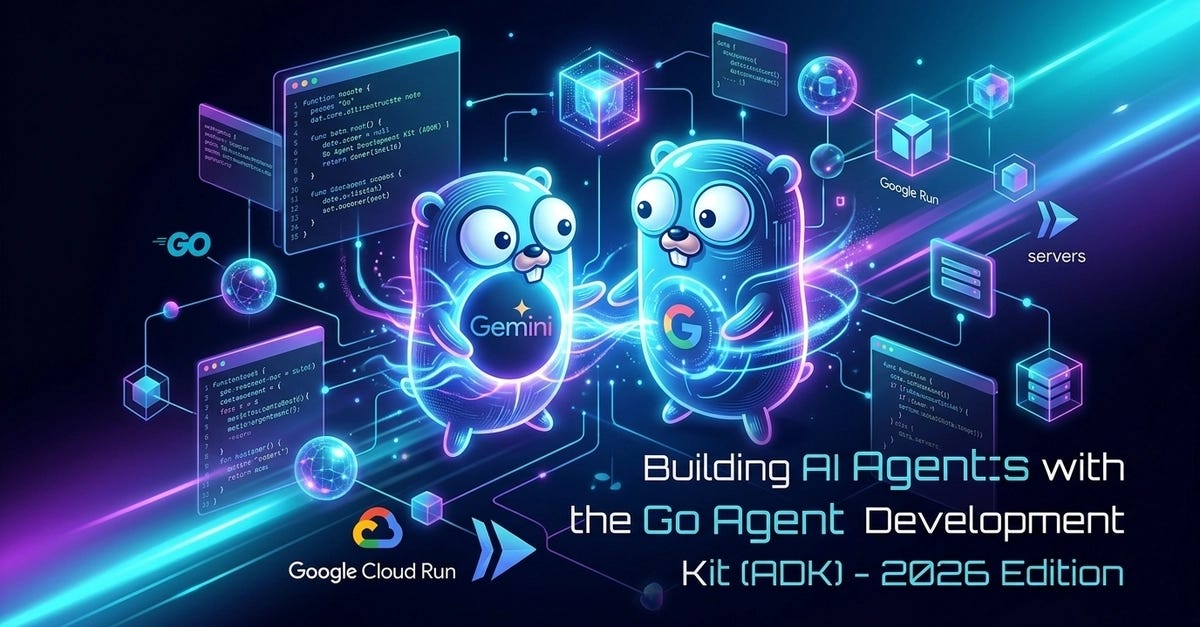
Building AI Agents with the GO Agent Development Kit (ADK 2.x) — 2026 Edition
This article presents a Hello World sample application written with the 2.x series of the Agent Development KIt (ADK) in the Go programming…
Building AI Agents with the GO Agent Development Kit (ADK 2.x) — 2026 Edition
This article presents a Hello World sample application written with the 2.x series of the Agent Development KIt (ADK) in the Go programming language.
So Where did this all Come From?
What is old is new! ADK Go originally supported the ADK 1.0 release.
The original hello world ADK Go article is here:
This article updates the tech stack to the latest version — including ADK 2.x and newer Go Compilers and libraries.
Summary of 2026 Updates (v2 — Go ADK 2.x Migration)
This updated edition incorporates several key architectural improvements, production hardening, and dependency upgrades over the initial release:
- Go ADK 2.0 Core Upgrade: Upgraded to (
google.golang.org/adk/v2, GA released June 30, 2026 at adk.dev/2.0/), introducingagent.Contextfor unified tool context management and callback execution pipelines. - Google GenAI SDK Upgrade: Upgraded to (
google.golang.org/genai) with native Vertex AI authentication auto-detection. - Go Toolchain & Module Directives: Updated runtime environment to with
go 1.26.5module directives across all sub-modules. - A2A (Agent-to-Agent) Multi-Agent System: Integrated
github.com/a2aproject/a2a-go(v0.3.15) with sub-modules (a2a-client-go,a2a-server-go,a2a-master-go,a2a-gemini3-go) for multi-agent delegation. - Structured Logging (
slog) Standardization: Standardized logging onslogwithJSONHandleracross all entrypoints for native Google Cloud Logging compatibility. - Graceful OS Signal Contexts: Integrated
signal.NotifyContext(context.Background(), os.Interrupt)across all sub-module entrypoints to handle container termination cleanly. - Robust Tool Input Validation: Added input bounds checking for
rollDieTool(sides <= 0) to prevent runtime panics from malformed LLM tool calls. - Safe Dockerfile
CMDGeneration: Fixedcloudrun.goto construct container arguments withjson.Marshal, ensuring validCMDsyntax regardless of feature flags. - Unified Multi-Module Makefile: Updated root
Makefileto format (go fmt), lint (go vet), test (go test), build, and clean across all 5 submodules (hello-agent,a2a-client-go,a2a-gemini3-go,a2a-master-go,a2a-server-go). - Verified Build & Test Suite: All unit tests (
go test -v ./...), formatting (go fmt), linting (go vet ./...), andmake buildpass with 0 errors.
Native Go Agent Development with the Go ADK
This tutorial provides a comprehensive guide to building, running, and deploying native AI Agents using the Go programming language and the official Go Agent Development Kit (ADK) ( google.golang.org/adk).
What Is Go?
Go (Golang) is an open-source programming language created at Google. Renowned for its simplicity, concurrency support via goroutines, and fast execution speed, Go is an exceptional choice for building high-throughput microservices and distributed agent systems.
Prerequisites & Go Version Upgrades
This project has been updated to run on Go 1.26 (specifically **go1.26.5 linux/amd64**) with go 1.25.0 module directives across all sub-modules.
1. Installing or Upgrading Go with GVM (Go Version Manager)
If you are using gvm to manage Go installations:
# Dependencies for Linux / Debian / Ubuntu
sudo apt-get update
sudo apt-get install -y bison curl git mercurial make binutils gcc build-essential

# Install GVM (if not already installed)
bash < <(curl -s -S -L https://raw.githubusercontent.com/moovweb/gvm/master/binscripts/gvm-installer)

# Install and switch to Go 1.26.5
gvm install go1.26.5 -B
gvm use --default go1.26.5
2. Validating Installed Go Version
Verify that your active Go binary is Go 1.26.5:
$ go version go version go1.26.5 linux/amd643. Module Version Directives (go 1.26.5)
All go.mod files in this workspace use go 1.26.5 directives to support modern language features and telemetry packages required by Go ADK 2.0 ( google.golang.org/adk/v2 v2.1.0).
What is the Go Agent Development Kit (ADK 2.x)?
The Go Agent Development Kit (ADK 2.0) ( google.golang.org/adk/v2) is a code-first toolkit developed by Google for building, evaluating, and deploying sophisticated AI agents.
Key Features:
- Model-Agnostic & Deployment-Agnostic: Optimized for Gemini models on Google Cloud Vertex AI or Google AI Studio, but designed for cross-framework compatibility.
- Unified Context & Tool Handling: Uses
agent.Contextto pass unified invocation state, session management, and Human-in-the-Loop (HITL) tools. - A2A (Agent-to-Agent) Protocol Support: Native integration with
github.com/a2aproject/a2a-go(v0.3.15+) for multi-agent collaboration. - Built-in CLI & Web UI Tools: Local interactive debugging out of the box.
Official Repositories & Docs:
- Documentation & GA Portal: https://adk.dev/2.0/
- Go ADK 1.x Compatibility & Migration Guide: https://adk.dev/2.0/#adk-go-1x-compatibility
- Go ADK GitHub Repository: https://github.com/google/adk-go
- Google Gen AI Go SDK: github.com/googleapis/go-genai
Key Dependencies (go.mod)
The updated agent stack relies on the latest releases:
module hello-agent go 1.26.5 require ( google.golang.org/adk/v2 v2.1.0 google.golang.org/genai v1.65.0 github.com/a2aproject/a2a-go/v2 v2.3.1 )Checking the Developer Environment
Clone the repository and set up environment credentials:
git clone https://github.com/xbill9/adk-hello-world-go
cd adk-hello-world-go
1. Authentication & Environment Setup
Run init.sh to initialize settings:
$ source init.sh
--- Authentication Method ---
Do you want to use a Gemini API Key for authentication? (y/n): n
--- Setup complete ---
Then load project-wide environment variables using set_env.sh:
$ source set_env.sh
--- Setting Google Cloud Environment Variables ---
Checking gcloud authentication status...
gcloud is authenticated.
Exported PROJECT_ID=comglitn
Exported PROJECT_NUMBER=1056842563084
Exported GOOGLE_CLOUD_PROJECT=comglitn
Exported GOOGLE_GENAI_USE_VERTEXAI=TRUE
Exported GOOGLE_CLOUD_LOCATION=us-central1
--- Environment setup complete ---
If Google Cloud authentication expires, refresh credentials:
gcloud auth login
gcloud auth application-default login
Building, Formatting, and Testing All Agent Submodules
The project includes unified Makefile targets for linting, formatting, compiling, and testing all 5 agent submodules ( hello-agent, a2a-client-go, a2a-gemini3-go, a2a-master-go, a2a-server-go):
# Format code across all submodules
make format

# Lint code with go vet across all submodules
make lint

# Run unit tests across all submodules
make test

# Build executables across all submodules
make build

# Clean build artifacts
make clean
Production Hardening & Best Practices
1. Structured Logging with slog
All entrypoints use slog configured with JSONHandler to emit logs compatible with Google Cloud Logging:
logger := slog.New(slog.NewJSONHandler(os.Stdout, nil))
slog.SetDefault(logger)
2. Graceful Shutdown Signals
Service entrypoints use signal.NotifyContext to handle SIGINT and SIGTERM signals gracefully during Cloud Run container lifecycle events:
ctx, cancel := signal.NotifyContext(context.Background(), os.Interrupt)
defer cancel()
3. Defensive Tool Parameter Validation
Custom agent tools validate input bounds to prevent runtime panics when executing tool calls generated by LLMs:
func rollDieTool(ctx agent.Context, args rollDieToolArgs) (int, error) {
    if args.Sides <= 0 {
        return 0, fmt.Errorf("number of sides must be greater than 0, got %d", args.Sides)
    }
    return rand.Intn(args.Sides) + 1, nil
}
Running the ADK Agent Locally
Option A: Terminal CLI Interface
Run the agent interactively in your terminal using cli.sh:
$ source cli.sh
go run agent.go

User -> what can you do?

Agent -> I can help you with a variety of tasks! I can answer questions, search information on Google, and tell you current time or weather in any city.

User -> what is the weather in NYC?

Agent -> The current weather in New York City is sunny with a temperature of 65°F (18°C)...
Option B: Local Web UI
Launch the embedded Web UI with web.sh:
$ source web.shNavigate to http://localhost:8080 in your browser to interact with the visual chat interface.
Agent-to-Agent (A2A) Multi-Agent Architecture
The 2026 update introduces full Agent-to-Agent communication modules:
hello-agent: Core single-agent implementation.a2a-server-go: Exposes agent capabilities over A2A HTTP endpoints.a2a-client-go: Client library for dispatching requests to remote A2A agents.a2a-master-go&a2a-gemini3-go: Orchestrators for complex multi-agent workflows using Gemini models.
Cloud Run Deployment Strategies
Strategy 1: Quick Deployment via Docker & Cloud Build (quickrun.sh)
Deploy to Google Cloud Run using the automated build script:
$ source quickrun.sh
Building using Dockerfile and deploying container to Cloud Run service [adk-hello-world-go]...
✓ Building Container...
✓ Creating Revision...
✓ Routing traffic...
Service URL: https://adk-hello-world-go-1056842563084.us-central1.run.app
Strategy 2: Official adkgo CLI Deployment
Build the adkgo CLI tool from the adk-go upstream repository:
cd ~
git clone https://github.com/google/adk-go
cd adk-go
go build ./cmd/adkgo

# Deploy using adkgo
./adkgo deploy cloudrun \
    -p $GOOGLE_CLOUD_PROJECT \
    -r $GOOGLE_CLOUD_LOCATION \
    -s adk-hello-world-go \
    -e ./hello-agent/agent.go
Strategy 3: Local Proxy Access to Cloud Run (proxy.sh)
Connect to your deployed Cloud Run service locally:
$ source proxy.sh PROXY URL http://127.0.0.1:8081/ui/?app=hello_time_agent Proxying to Cloud Run service [adk-hello-world-go] in region [us-central1]Summary & Next Steps
In this updated version:
- All submodules were migrated to Go ADK 2.0 (
google.golang.org/adk/v2v2.1.0) and Google GenAIv1.65.0running on Go 1.26. - Custom function tools were updated to accept
**agent.Context** for unified session state, execution flow, and tool confirmation. - Full support for A2A multi-agent workflows was integrated.
- Production hardening for structured logging, signal handling, input validation, and JSON-marshaled Dockerfile generation was applied.
- Local CLI, Web UI, and Cloud Run serverless deployment channels were verified and tested cleanly across all submodules.
Originally published at https://dev.to on July 26, 2026.
메타데이터
- post_id
- f7debc15bee0
- slug
- building-ai-agents-with-the-go-agent-development-kit-adk-2-x-2026-edition-f7debc15bee0
- url
- https://medium.com/google-cloud/building-ai-agents-with-the-go-agent-development-kit-adk-2-x-2026-edition-f7debc15bee0
- canonical_url
- https://medium.com/google-cloud/building-ai-agents-with-the-go-agent-development-kit-adk-2-x-2026-edition-f7debc15bee0
- author_url
- https://medium.com/@xbill999
- status
- ok
- fetched_at
- 2026-08-17 07:46:50