How I Cracked OffSec’s OSWP on My Second Attempt: My Full Journey, Preparation, and Honest Review
The Offensive Security Wireless Professional (OSWP) certification has always been known as the go-to exam for anyone wanting real, hands-on…
How I Cracked OffSec’s OSWP on My Second Attempt: My Full Journey, Preparation, and Honest Review
The Offensive Security Wireless Professional (OSWP) certification has always been known as the go-to exam for anyone wanting real, hands-on wireless penetration testing skills. What makes OSWP interesting is that it doesn’t rely on flashy tools, automation, or GUIs it forces you to understand Wi-Fi at its core: the protocols, frames, drivers, encryption, and manual attacks.
I completed the OSWP certification. But I didn’t pass it the first time, and honestly, I’m glad I didn’t.
My first attempt taught me how easy it is to underestimate OffSec exams, and my second attempt taught me how to prepare the right way.
Here’s my complete journey: the course, the preparation, the mistakes, and how I finally passed.
Why I chose the OSWP Certification
As someone working in cybersecurity, I’ve always been drawn to the idea of understanding networks at a deeper level, especially wireless networks. While many certifications focus on general pentesting, OSWP is one of the very few that focus entirely on Wi-Fi security.
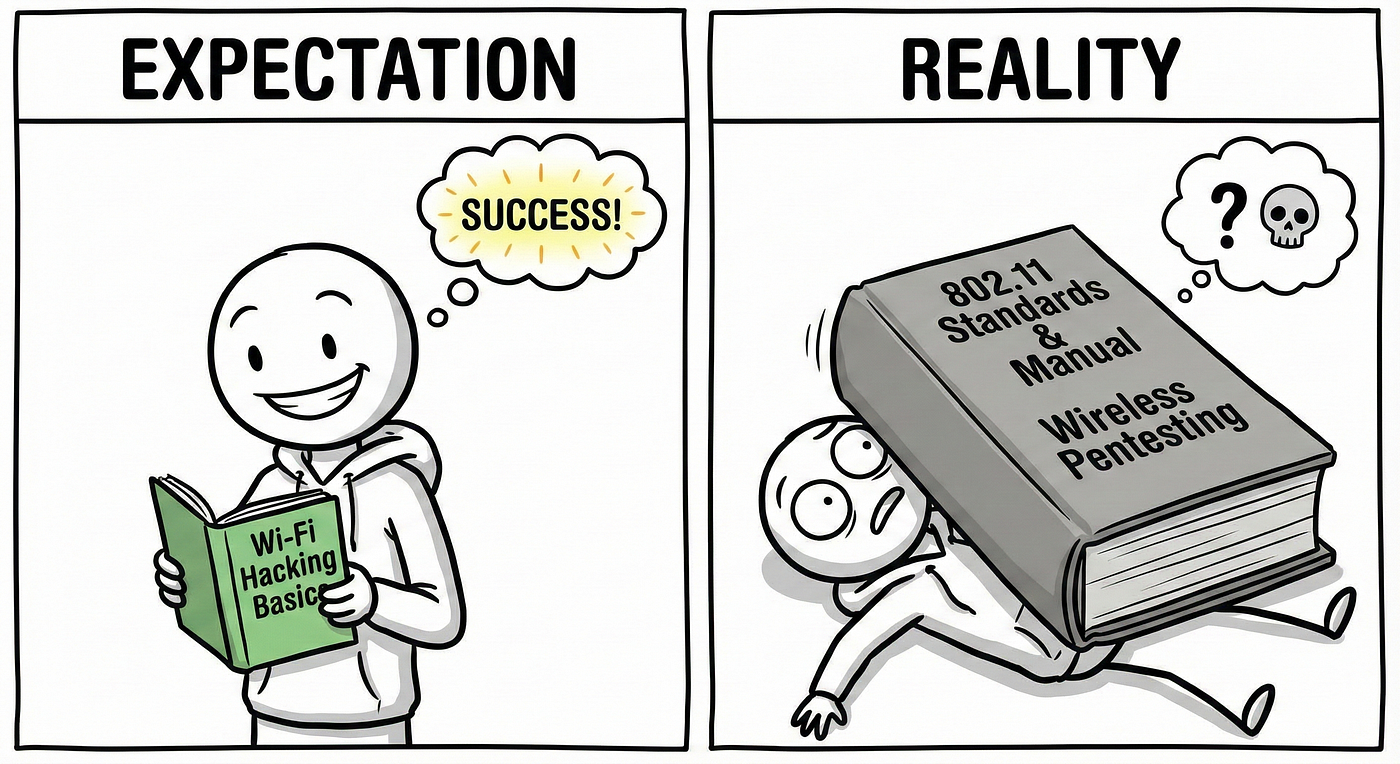
I chose OSWP because:
- OffSec has a strong reputation for real.
- OSWP is the only mainstream wireless pentesting certification.
- The course teaches manual techniques instead of automation.
- Wi-Fi is everywhere, and understanding how to attack/defend it is extremely practical.
Even though the course is small compared to other offsec courses, it provides excellent fundamental knowledge that every pentester or security analyst should know.
What’s Inside the OSWP Course (The Syllabus)
The OSWP course includes:
- IEEE 802.11
- Wi-Fi Encryption
- Linux Wireless Tools and Drivers
- Wireshark Essentials
- Frames and Network Interaction
- Aircrack-ng Essentials
- Cracking Authentication Hashes
- Attacking WPS
- Rogue Access Points
- Captive Portals
- WPA Enterprise
- Bettercap Essentials
- Chipset and Driver Identification
- Kismet Essentials
- Manual Network Connections
- Wireless Network Architecture
The modules are well written and explain the underlying concepts clearly. One downside, however OffSec does not provide any labs for OSWP.
So you must build your own practice environment.
One thing I kept hearing from people preparing for OSWP was:
“The first chapter on IEEE 802.11 is boring.”

I understand why it’s heavy on theory, standards, and frame types. But let me say this clearly: do not skip it.
If anything, the first chapter is one of the most important parts of the entire course. Here’s why.
- It gives you a deep understanding of the 802.11 standard.
- You learn about frame types, subtypes, roles, and behaviour.
- You understand how Wi-Fi devices communicate.
- It builds intuition for both attacking and defending wireless networks.
- It helps you make sense of every capture you perform during the exam.
From an organization’s perspective, knowing how Wi-Fi behaves at a protocol level helps you understand weaknesses, detect attacks, and design secure architectures. It strengthens both offensive and defensive skills.
So even if it feels slow in the beginning, treat Chapter 1 as the foundation of everything you’ll do later. It makes the rest of the course and the exam much easier and more logical.
How I Practised (Because OffSec Gives No Labs)
To prepare properly, I followed two parallel approaches.
Building My Own Wireless Lab at Home

This was my primary training method set up.
- A router.
- A Wi-Fi card (TP-LINK TL-WN722N)
- Kali Linux.
- Multiple SSIDs with different configurations.
I practised:
- Packet capturing and frame filtering (Wireshark).
- Deauthentication.
- WPS attacks.
- WPA2 handshake captures and cracking.
- Rogue access point creation.
- Captive portal attacks.
- WPA Enterprise is using a local FreeRADIUS server.
This helped me understand the behaviour of wireless attacks, not just the commands.
Using WiFiChallenge Labs

This platform turned out to be extremely useful, especially when revising Link.
It provides:
- Realistic Wi-Fi attack scenarios.
- Different types of networks to practice on.
- Tasks similar to what you might see on the OSWP exam.
It saved me from physically setting up routers every time and helped me refine my speed and accuracy.
My First OSWP Attempt: And Why I Failed

Let me keep this simple: I failed because I underestimated the exam.
I thought it would be straightforward since OSWP deals with Wi-Fi, something I’ve worked with before. But once the timer started, reality looked different.
What went wrong:
1. Time Management
I didn’t expect certain attacks to take longer. I lost precious minutes troubleshooting instead of progressing.
2. Stress
When one method didn’t work, I got stuck trying to fix it rather than switching strategies.
3. Incomplete Preparation
I didn’t practice WPA Enterprise enough, and it showed.
4. Tunnel Vision
I spent too long on one network, triggering a chain of delays.
Even though failing an exam is unpleasant, it showed me exactly what I needed to fix. That clarity made my second attempt far easier.
My Second Attempt: What I Changed
Between both attempts, I changed my entire approach.
1. I Practised Under Exam Conditions
- Timing each attack.
- Following a structured workflow.
- Practising frame level filtering.
- Repeating difficult modules until they were smooth.
- This made me much faster and more confident.
2. I Used WiFiChallenge More Seriously
Instead of casual practice, I treated every challenge like an exam task:
- No guessing.
- No shortcuts.
- Exact frame captures.
- Clean documentation.
- Over time, I developed automatic patterns and troubleshooting instincts.
3. I Managed Stress More Effectively
This was one of the biggest improvements. During the second attempt.
- If an attack took too long, I moved to the next task.
- If something didn’t work, I switched tools/methods.
- I stayed calm and avoided tunnel vision.
- I documented my steps clearly and consistently.
This simple change made the entire exam feel more controlled.
Passing OSWP: The Result

My second attempt felt completely different:
- Tasks were clearer.
- My environment was stable.
- My captures were correct.
- My workflow was organised.
- And most importantly, I stayed calm.
After submitting the report, I waited for the result, and finally saw the email I wanted: I passed.
It felt especially rewarding because I had failed the first time. The journey made the success meaningful.
Conclusion: The Mindset to Pass OSWP

At its core, the OSWP certification is not just about running commands or capturing handshakes. It’s about understanding how Wi-Fi truly works and applying that knowledge under time pressure.
If I had to summarise everything I learned, it would be this:
- Learn the basics properly. Don’t skip the fundamentals, especially IEEE 802.11. When you understand the architecture and frame behaviour, every attack becomes easier.
- Think about how things work, not just what to type. OSWP rewards understanding, not memorisation. Know why packets behave the way they do.
- Manage your stress and time wisely. The exam isn’t difficult because of complexity, it’s difficult because of time pressure. Stay calm, stay structured.
- If you get stuck, take a short break. A fresh mind solves problems faster than a stressed one. Step back, breathe, and return with clarity.
- Look at problems from different angles. If one method doesn’t work, switch to another. Wireless attacks are dynamic.
- Screenshot everything. Your report depends on it. Captures, commands, outputs document consistently.
- Write a clear, well structured report. Good documentation can be the difference between passing and failing.
Follow these principles, practice with intention, and you’ll be fully prepared to pass OSWP, whether it’s on your first attempt or your comeback story like mine.
For me, OSWP was an excellent learning journey. It improved my wireless knowledge, made me more confident technically, and reminded me never to underestimate OffSec exams.
Failing the first attempt was frustrating, but passing on the second attempt was even more satisfying.
OSWP isn’t just a certification. It’s a mindset. And once you understand that, you will pass.
메타데이터
- post_id
- f7ec6b400441
- slug
- how-i-cracked-offsecs-oswp-on-my-second-attempt-my-full-journey-preparation-and-honest-review-f7ec6b400441
- url
- https://meetcyber.net/how-i-cracked-offsecs-oswp-on-my-second-attempt-my-full-journey-preparation-and-honest-review-f7ec6b400441
- canonical_url
- https://meetcyber.net/how-i-cracked-offsecs-oswp-on-my-second-attempt-my-full-journey-preparation-and-honest-review-f7ec6b400441
- author_url
- https://medium.com/@sudheeshgl
- status
- ok
- fetched_at
- 2026-06-26 03:39:16