Knowing Isn’t Enough: Why Some Explanations Persist Even When They Fail
How systems that understand their own dysfunctions keep operating with explanations that fail to explain them.
Knowing Isn’t Enough: Why Some Explanations Persist Even When They Fail
How systems that understand their own dysfunctions keep operating with explanations that fail to explain them.
👉 Prefer to read this article in Portuguese? Click here: **Saber Não Basta: Porque Algumas Explicações Persistem Mesmo Quando Falham**
👉 Want a clear, visual version of the argument? 🎥 Watch the video: **Knowing Isn’t Enough: What Is Functional Underdevelopment?**
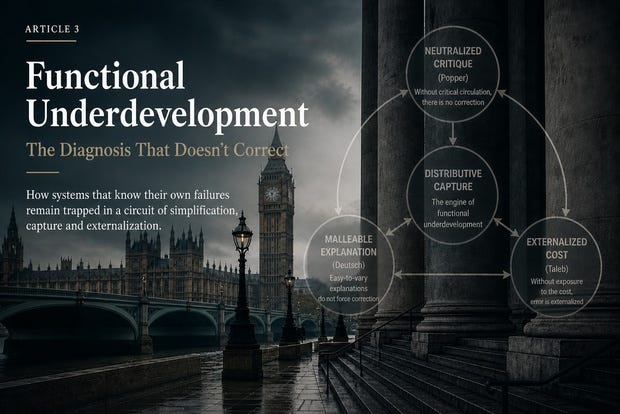
Article 3 of the “Functional Underdevelopment” series.
Why do systems that know what is wrong fail to correct it?
This is one of the most persistent — and least well-explained — questions in contemporary economies. In many domains, the diagnosis is clear, repeated, and broadly accepted. And yet, correction does not follow.
The discussion that followed the first two articles in this series (Francisco, 2026a, 2026b) raised a demand that cannot be ignored.
One reader pressed precisely the point where the argument most needs to deepen: if a system knows and still fails to correct, then the question is no longer merely diagnostic. It becomes epistemological.
What kind of explanation are we using when we say “the system knows”? And what kind of explanation would be required for that knowing to compel correction?
Another reader took the pressure one step further. He suggested that incentives do not merely constrain action; over time, they filter what a system is able to recognize as actionable knowledge.
In systems where diagnosis abounds but correction does not, certain interpretations become legible while others become invisible — not because they are incorrect, but because they are incompatible with the system’s internal logic. The dysfunction is not merely tolerated; it is cognitively normalized.
These two pressures — one bearing on the epistemic standing of the diagnosis, the other on its political viability — converge in the same direction.
This article is a response to both. It needs to make a move that the first two did not: to bring into view the criterion by which we distinguish an explanation that has the force of a mechanism from one that has only the force of a narrative.
1. Two Explanations That Appear to Explain
On British stagnation, two readings dominate the serious public debate, and both deserve examination before any alternative is proposed.
The first is institutionalist. It holds that the problem lies in short-term electoral incentives, political fragmentation, and capture by organized interests. It has empirical merit: each of these observations has evidence behind it, and the previous two articles in this series drew on them with confidence.
The second is culturalist. It holds that the problem is the erosion of public virtue, the loss of institutional trust, and the weakening of civic mediation structures. This reading also has merit: the evidence on declining social capital in the United Kingdom is robust, and the effects on collective capacity for cooperation are real.
The difficulty does not lie with either reading taken in isolation. It lies in the fact that both, in the form in which they circulate, absorb any subsequent development without changing in substance.
If reform comes, they will say that institutions adapted or that civic culture renewed itself. If reform does not come, they will say that institutions remained captured or that civic culture remained degraded.
In any future scenario, the explanation survives — and that very power of survival is what should be regarded with suspicion.
It is worth noting that both readings circulate in pro-state and anti-state registers alike: institutionalists who advocate more regulation invoke the first; institutionalists who advocate less invoke it too, with the sign reversed.
The analysis that follows takes no position on the optimal size of the state. It takes a position on what distinguishes, in any configuration, an explanation with the force of a mechanism from a narrative that survives by changing form.
There is a more uncomfortable observation still to make. These explanations are not vague by accident. They are products of systems with an interest in explanations that can accommodate any development without forcing correction.
An explanation that pinpointed a determinate mechanism — and that could not be deformed when the facts changed — would be uncomfortable for those who would have to draw consequences from it. Systems select, not consciously but through cumulative filtering, the explanations that preserve them.
2. The Criterion of Good Explanations
David Deutsch proposed, in the first chapter of The Beginning of Infinity, a criterion for distinguishing genuine explanations from those that only appear to explain. In the glossary of that chapter, he defines the criterion in lapidary terms: a good explanation is one that is hard to vary while still accounting for what it purports to account for (Deutsch, 2011, p. 37)[1].
The illustration Deutsch uses is the passage of the seasons. The Greek myth of the seasons — Persephone descending into the underworld for half the year, Demeter grieving and preventing plants from growing — is a testable explanation in the broad sense. It makes a prediction (the annual cycle).
But it is an easy-to-vary explanation: nearly every detail can be replaced with another without the explanation ceasing to explain. The gods can be different gods, the contract can be a different contract, the sadness can be a different emotion. Had the ancient Greeks discovered that the seasons in the southern hemisphere are reversed, the myth could easily have been adapted to accommodate that observation.
The astronomical theory of the seasons — the tilt of the Earth’s axis relative to the plane of its orbit — is qualitatively different. Each element plays a functional role without which the explanation collapses. It cannot be varied at will. If there were evidence of reversed seasons in the southern hemisphere, the theory would not need to be adjusted to accommodate it — the theory already explains it. And if such evidence contradicted the theory, the theory would fall whole, not piecemeal.
The difference between the two explanations is not falsifiability in the cartoon sense — the notion that any contrary observation immediately knocks down a theory. There is a familiar line of criticism that argues, with reason, that simply-understood falsifiability is a poor criterion, because important theories withstand initial discrepant observations and should not be abandoned for that reason.[2]
But the response is not to abolish the criterion; it is to refine it. Both explanations of the seasons, the mythical and the astronomical, make verifiable predictions in some sense. The difference is structural: the bad explanation is a flexible arrangement that survives by changing form; the good explanation is a constrained proposition that survives — when it survives — because its elements are interdependent, and its reach extends beyond the cases that motivated it.
This is the criterion we need. Not as an instrument of philosophy of science, but as an analytical tool for examining the explanations in circulation about why the United Kingdom knows and does not correct.
This is where the criterion begins to do real work: it is no longer enough to explain — one must explain without being able to vary arbitrarily.
3. What Happens When We Apply the Criterion
When we apply this criterion to the explanations in circulation, something curious happens: neither of them has elements whose functional role is unalterable. In both, any detail can be replaced with another without the explanation ceasing to explain.
The institutionalist reading can swap “political fragmentation” for “excessive centralization,” “electoral incentives” for “bureaucratic dynamics,” and continue to function as an explanation. The culturalist reading can swap “decline in social capital” for “identity fragmentation,” “erosion of public virtue” for “rising individualism,” and likewise continue to function.
These explanations are, by Deutsch’s criterion, indistinguishable from myth — though invoked in academic register.
The main difference is that, in this case, the gods have been replaced by variables.
Not because the explanations are wrong in all their observations.
But because they are arrangements flexible enough to accommodate any development.
The system produces enough clarity to recognize the problem, but not enough epistemic freedom to resolve it.
The question is no longer which of the two readings is correct.
The question is another:
Is there an alternative explanation that satisfies the criterion — an explanation hard to vary that accounts for the facts without being deformable when the facts change?
If these explanations survive precisely by being able to vary, then the problem lies not only in what they explain, but in the structure that allows them to keep explaining without correcting.
It is that structure we now need to identify.
4. The Popper-Deutsch-Taleb (PDT) Framework as an Attempt
That structure can be described simply: as the combination of three interdependent failures.
What is proposed here is an attempt — deliberately exposed to criticism — to formulate that structure in a way that satisfies Deutsch’s criterion, applied to the problem of corrective blockage.
I designate this effort as the PDT framework, in reference to the three authors whose contributions structure it: Karl Popper, David Deutsch, Nassim Taleb. Each covers a distinct dimension of the failure of the corrective system (Francisco, 2025).
From Popper, the framework retains a single central idea: progress depends on subjecting dominant explanations to criticism capable of replacing them. Without that subjection, there is no learning; the system repeats itself. This is the dimension of critical circulation (Popper, 2002).
From Deutsch (2011), the framework retains the criterion of good explanations: criticism only bites when it confronts bad explanations with explanations that are genuinely hard to vary.[3] Good criticism against pliable explanations is absorbed without effect. This is the dimension of explanatory quality.
From Taleb, the framework retains the principle of asymmetric exposure: when the costs of error are externalized — when those who decide have no skin in the game — the correct explanation, even when produced, does not reach those who would have to pay for the correction. This is the dimension of exposure to costs (Taleb, 2018).
The central formulation of the framework is this: functional underdevelopment is the state in which criticism, explanatory quality, and exposure to the costs of error fail simultaneously, in such a way that each of the three failures stabilizes the other two.
The decisive point — and what makes the framework hard to vary — is that these three failures are not independent.
They are produced by the same mechanism of distributive capture.
Capture selects explanations compatible with its own perpetuation — easy-to-vary explanations, because hard-to-vary ones would be uncomfortable.
These easy-to-vary explanations neutralize criticism before it can become corrective.
And the asymmetry of exposure ensures that, even when some criticism does force recognition, it does not reach those who would have to pay for the correction.
It is a single machine with three points of manifestation.
Figure 1 synthesizes this mechanism. In it, the three failures — critical circulation, explanatory quality, and exposure to the costs of error — appear not as independent dimensions but as interlinked components of a single blockage system. The diagram makes visible what the text describes in the abstract: each failure reinforces the other two, forming a closed loop that stabilizes the pattern of non-correction.

Figure 01: The three interdependent failures of functional underdevelopment — neutralized critical circulation (Popper), pliable explanations (Deutsch), externalized cost of error (Taleb). Distributive capture, at the center, is the mechanism that produces and stabilizes the three failures simultaneously. The curved arrows indicate mutual reinforcement among them.
There is a point worth highlighting before going further, because it is where hasty readings most easily go astray. Distributive capture is not, in this framework, a synonym for state intervention.
It can operate in systems with a large state (public clientelism, patronage networks) or with a small one (private oligopolies that capture weak regulation, dominant positions in markets with high entry barriers). What constitutes functional underdevelopment is not the presence or absence of the state — it is the configuration of the three corrective axes.
Removing any one of the three authors destroys the explanation.
Without Popper, the axis of criticism is missing, and the framework becomes static description.
Without Deutsch, criticism does not bite, and the framework becomes pious.
Without Taleb, the correct explanation does not force correction and the framework becomes naïve.
The three are interdependent in the same way that the axial tilt, the Earth’s sphericity, and the geometry of solar incidence are interdependent in the explanation of the seasons. Remove one piece, and the explanation falls whole.
5. What This Does to the Reading of the British Case
Applied to the United Kingdom, the PDT framework retroactively reorganizes the previous two articles.
The British case is particularly legible, but not exceptional.
Were it exceptional, the problem would be simpler — and probably less interesting.
Analogous patterns are observable in other European economies, where diagnosis accumulates with similar clarity without producing proportional correction.
What in those articles appeared as institutional mechanisms — rent capture in housing, asymmetric incentives in regional investment, equilibrium of non-correction in public services — is now visible as the local manifestation of a more general pattern.
Articles 1 and 2 were already preparatory cases for this framework; they just did not yet know it. That preparatory function is not limited to the United Kingdom as an empirical case, but to the fact that in it the mechanism appears with sufficient clarity to be recognized in other contexts.
The practical difference, when one moves from a purely institutionalist reading to a PDT reading, lies in three displacements.
First, the problem stops being explained by symptoms — austerity, Brexit, the pandemic, exogenous shocks — and starts being explained by an architecture that explains why the symptoms succeed one another without altering the pattern.
Second, the problem stops being explained by intentions — politicians without courage, electorates without vision, institutions without energy — and starts being explained by a configuration in which even correct intentions would be neutralized by the way the system selects explanations and distributes exposure.
Third, and perhaps most uncomfortably, the framework makes it predictable that partial reforms that do not touch the architecture will be absorbed without altering the pattern — not through failure of execution and regardless of whether they point toward a larger or smaller state, but by design of the mechanism that both tend to leave intact.
The PDT reading does not deny the observations of the political economy of housing or regional inequality.
It explains why those observations survive as observations, year after year, without being converted into correction. And it explains why they continue to survive even after each new diagnosis is published, commented on, debated — and shelved.
6. What Is at Stake
The PDT framework is an attempt, not a conclusion. It presents itself as such: it offers itself to the criterion it defends. It is falsifiable in Deutsch’s refined sense — not in the cartoon sense by which any contrary observation knocks the theory down. It is hard to vary because any weakening of any one of the three axes brings down the whole framework.
If it were possible to show a system in which these three failures were present without producing functional underdevelopment, the framework falls.
If it were possible to show functional underdevelopment without those three failures, the framework also falls.
This exposure to refutation is deliberate.
If the framework holds, its usefulness will not depend on the specificity of the British case, but on its capacity to identify analogous configurations wherever they arise. That is what distinguishes a structural proposition from a narrative that survives by changing form.
There is, however, a deeper implication than the framework’s viability. When a structure of incentives stops coordinating and starts constraining a system’s very capacity to know itself, the question ceases to be political in the conventional sense.
It becomes a question about the possibility of social knowledge.
If the problem were merely not knowing, the solution would be cumulative: more data, more analysis, more debate.
But the problem, as the framework suggests, is another.
It is the possibility of systems producing knowledge sufficient to recognize error — without producing the conditions to correct it.
When that happens, the problem is not the absence of knowledge. It is the presence of knowledge without the capacity to make it corrective. That is the frontier the PDT framework attempts to make visible.
And it is also why, if the framework is wrong, it should fall whole.
In the next article, the framework moves from being a proposition to being an instrument. A matrix of quadrants will distinguish empirically four possible configurations of the three failures, situating the United Kingdom in relation to cases where the pattern is more crystallized — such as South Africa or Mozambique.
Deutsch’s criterion still holds: the matrix will only be useful if it is hard to vary, that is, if each quadrant corresponds to a configuration that cannot be deformed when the facts change.\
Relevant References
Deutsch, D. (2011). The Beginning of Infinity: Explanations that Transform the World (1st ed.). Penguin Books.
Francisco, A. (2025, October). Moçambique em Vias de Subdesenvolvimento: Más Explicações, Bloqueios Estruturais e Fragilidade Sistémica (Mozambique on the Road to Underdevelopment: Bad Explanations, Structural Blockages, and Systemic Fragility). Conferência Anual do Observatório do Meio Rural (OMR) 2025.https://www.youtube.com/watch?v=1FBvvIMUdno
Francisco, A. (2026a, April 19). A Grã-Bretanha sabe o que está errado. Esse é exactamente o problema. Substack.com. https://open.substack.com/pub/aasfrancisco/p/a-gra-bretanha-sabe-o-que-esta-errado?utm_campaign=post-expanded-share&utm_medium=web
Francisco, A. (2026b, April 24). Não É Falha. É Incentivo. Substack.com. https://open.substack.com/pub/aasfrancisco/p/nao-e-falha-e-incentivo?r=1khqf2&utm_campaign=post&utm_medium=web
Popper, K. (2002). Conjectures and Refutations: The Growth of Scientific Knowledge. Routledge.
Taleb, N. N. (2018). Skin in the Game: Hidden Asymmetries in Daily Life. Random House.
[1] The passage from the glossary of Deutsch’s Chapter 1 — “An explanation that is hard/easy to vary while still accounting for what it purports to account for” — is the operational criterion that structures this article.
[2] On the criticism of simplified falsifiability, see Mano Singham, “The Idea That a Scientific Theory Can Be ‘Falsified’ Is a Myth,” Scientific American, in which the author argues — with reason — that the Popperian criterion, simply understood, is insufficient. The position taken in this article is that this criticism is correct as regards the cartoon version of the criterion, but that the response is to refine the criterion (with Deutsch) rather than abolish it: falsifiability refined by the hard-to-vary criterion preserves what Popper got right and eliminates what Singham, with reason, contests.
[3] On the hard-to-vary criterion, there is a substantive debate in the literature. For an internal critique of the criterion from the Bayesian camp, see Richard Ngo, “Deutsch and Yudkowsky on scientific explanation,” LessWrong (2021), arguing that hard-to-vary may be a less articulated version of the classical simplicity criterion. For an exploration of the contemporary relevance of the criterion in domains beyond philosophy of science, see Daniel C. Elton, “Applying Deutsch’s concept of good explanations to artificial intelligence and neuroscience — an initial exploration,” Cognitive Systems Research (2021), arXiv:2012.09318. For a recent application of the criterion to the design of artificial intelligence systems, see Carlos E. Perez, “The Fragility of Truth: Why Good Explanations — and Good AI — Must Be Hard to Vary,” Intuition Machine / Medium (2025). The constructor theory program of Deutsch and Marletto represents the most ambitious development of this line of thought.
메타데이터
- post_id
- f7f1fa1c8ddc
- slug
- knowing-isnt-enough-why-some-explanations-persist-even-when-they-fail-f7f1fa1c8ddc
- url
- https://medium.com/the-geopolitical-economist/knowing-isnt-enough-why-some-explanations-persist-even-when-they-fail-f7f1fa1c8ddc
- canonical_url
- https://medium.com/the-geopolitical-economist/knowing-isnt-enough-why-some-explanations-persist-even-when-they-fail-f7f1fa1c8ddc
- author_url
- https://medium.com/@aasfrancisco
- status
- ok
- fetched_at
- 2026-06-14 16:15:44