What really happens inside soil when geotextiles are introduced
Geotextiles don’t change soil strength; they work by interacting with the soil to redistribute stresses, control deformation, manage water…
What really happens inside soil when geotextiles are introduced
Geotextiles don’t change soil strength; they work by interacting with the soil to redistribute stresses, control deformation, manage water flow, and preserve layer integrity.
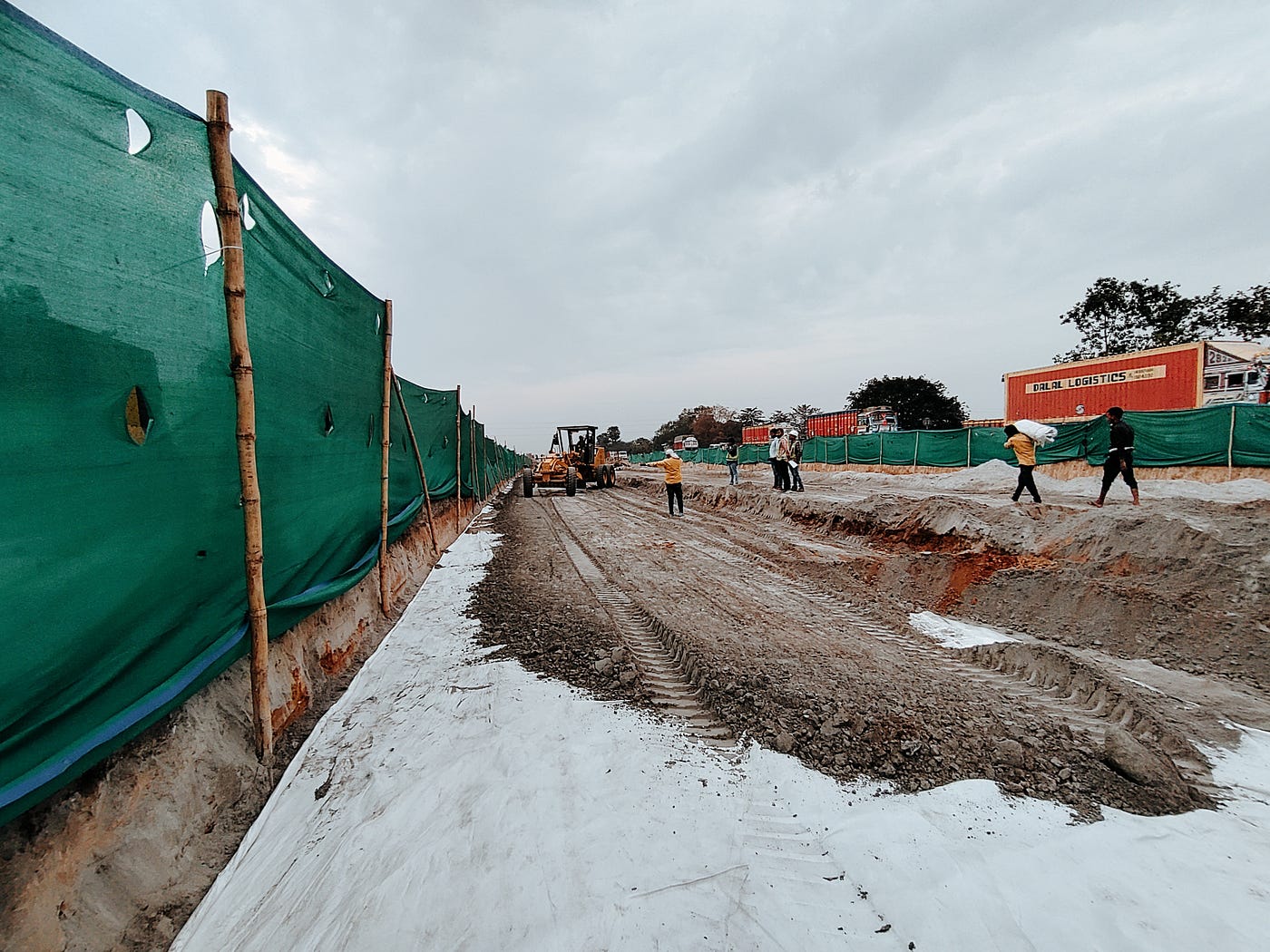
Geotextiles are often described as “soil improvement materials,” but this description can be misleading. Geotextiles do not change the fundamental nature of soil. Instead, they modify how soil responds to load, deformation, and water movement by introducing tensile resistance and controlled interfaces within the soil mass.
Understanding what truly happens inside the soil when a **geotextile is introduced requires looking at soil–structure interaction**, not just material properties.
Stress redistribution begins immediately
In an unreinforced soil system, applied loads travel downward in a bulb-shaped stress distribution. Weak subgrades experience high localized stresses, leading to excessive settlement and shear failure.
When a geotextile is placed within the soil profile, part of the applied load is transferred into the geotextile as **tensile stress**. This causes:
- Redistribution of vertical stresses over a wider area
- Reduction in stress concentration on weak subgrades
- Improved load-spreading efficiency
The geotextile itself does not carry compressive load. Its contribution comes entirely from tension mobilized through soil–geotextile interaction.
Lateral restraint of soil particles
Granular soils tend to spread laterally when subjected to traffic or **embankment** loads. This lateral movement reduces confinement and accelerates rutting and deformation.
A geotextile placed at a soil interface restrains this movement by:
- Developing friction and interlocking with the surrounding soil
- Limiting othe utward displacement of particles
- Increasing effective confinement in the soil layer
This mechanism is particularly important in pavement bases and working platforms, where lateral spreading governs long-term performance.
Separation prevents loss of structural integrity
One of the most immediate effects of a geotextile is separation between dissimilar soil layers.
Without a separator:
- Fine subgrade soils migrate upward
- Aggregates penetrate downward
- The base layer progressively loses stiffness
With a geotextile in place:
- Particle migration is restricted
- Layer thickness and gradation are preserved
- Structural capacity is maintained over time
This function does not improve soil strength, but it prevents strength degradation, which is equally critical.
Filtration controls soil–water interaction
Water movement within soil can cause internal erosion, pore pressure buildup, and loss of fines.
A properly designed geotextile acts as a filter, allowing water to pass while retaining soil particles. This results in:
- Controlled seepage paths
- Reduced excess pore water pressure
- Improved stability under saturated conditions
Filtration performance depends on matching geotextile opening size to soil gradation. Poor selection can lead to clogging or piping.
Drainage modifies pore pressure behavior
Some geotextiles and geocomposites provide in-plane drainage, offering preferential flow paths for water.
This alters the internal soil response by:
- Accelerating dissipation of pore pressures
- Reducing softening under cyclic loading
- Improving stability in fine-grained or saturated soils
Drainage does not strengthen soil directly, but it preserves effective stress, which governs soil strength.
Tensile forces develop only after deformation
A critical but often misunderstood point is that geotextiles do not act immediately.
Tensile forces in the geotextile develop only after:
- Soil attempts to deform
- Relative displacement occurs at the interface
This means:
- Some deformation is necessary to activate reinforcement
- Geotextiles control deformation rather than eliminate it
This behavior is consistent with reinforced soil theory and tensioned membrane concepts.
Reduction in deformation, not an increase in soil strength
Laboratory tests may show higher apparent CBR or modulus values in reinforced systems, but this does not mean the soil itself has become stronger.
What actually happens is:
- Strains are reduced under the same load
- Load is shared between the soil and the** reinforcement**
- The composite system behaves more efficiently
The soil’s shear strength parameters remain unchanged.
Long-term performance depends on interaction, not material alone
The effectiveness of a geotextile is governed by:
- Soil type and gradation
- Moisture condition
- Confinement and cover thickness
- Installation quality
A high-strength geotextile installed incorrectly or used in the wrong application may provide little to no benefit.
Final takeaway
When geotextiles are introduced into soil, they do not “improve” soil in isolation. They create a composite system where deformation is controlled, stresses are redistributed, water movement is managed, and structural layers are preserved.
The real value of geotextiles lies not in their material strength, but in how effectively they interact with soil.
메타데이터
- post_id
- f7ff3a59e080
- slug
- what-really-happens-inside-soil-when-geotextiles-are-introduced-f7ff3a59e080
- url
- https://medium.com/@strataglobal/what-really-happens-inside-soil-when-geotextiles-are-introduced-f7ff3a59e080
- canonical_url
- https://medium.com/@strataglobal/what-really-happens-inside-soil-when-geotextiles-are-introduced-f7ff3a59e080
- author_url
- https://medium.com/@strataglobal
- status
- ok
- fetched_at
- 2026-07-15 00:11:25