The Roadmap to Financial Freedom: How to Stop Surviving and Start Building Wealth
Most people don’t dream about becoming millionaires overnight.
The Roadmap to Financial Freedom: How to Stop Surviving and Start Building Wealth
Most people don’t dream about becoming millionaires overnight.
They simply want to stop worrying every time a bill arrives.
They want to take a vacation without feeling guilty. Sleep peacefully knowing they have an emergency fund. Invest confidently for the future. And eventually reach a point where money creates opportunities instead of stress.
Yet millions remain trapped in the same cycle:
Earn → Pay Bills → Wait for Payday → Repeat.
It’s easy to believe financial freedom is reserved for entrepreneurs, celebrities, or people born into wealth.
But that’s one of the biggest myths in personal finance.
The truth is that wealth isn’t luck — it’s a system.
Once you understand that system, every financial decision becomes easier.
In this guide, you’ll discover a practical roadmap to financial freedom by improving your financial literacy, eliminating bad debt, investing wisely, and building habits that create lasting wealth.
Let’s begin.
1. The Foundation: Upgrade Your Financial Literacy
Before you invest money, invest in your knowledge.
Financial literacy is the skill that separates people who earn money from people who build wealth.
The good news?
You don’t need a finance degree.
Just a few consistent habits can dramatically improve your understanding of money.
Start with these simple daily habits:
✅ Read financial news for five minutes every morning.
Instead of scrolling endlessly through social media, spend five minutes learning what’s happening in the economy.
Over time, you’ll naturally understand investing, inflation, interest rates, and market trends.
✅ Watch one 15-minute finance video during lunch.
Thousands of free educational videos explain budgeting, investing, taxes, and wealth building in simple language.
One short lesson every day adds up to more than 90 hours of learning every year.
✅ Listen to finance podcasts while commuting.
Driving, walking, or traveling?
Turn that time into learning time.
Even listening at 2× speed allows you to absorb valuable ideas without changing your schedule.
The Financial Literacy Formula
Building financial knowledge doesn’t require perfection.
It simply requires repetition.
Learn → Practice → Apply → Repeat
Knowledge compounds exactly like money.
The more you learn, the better decisions you make.
The better your decisions, the faster your wealth grows.
2. Clear the Path: Eliminate Debt with the Debt Snowball Method
Trying to build wealth while carrying high-interest debt is like trying to fill a bucket with a hole in the bottom.
Before accelerating toward financial freedom, you need to stop the leaks.
One of the most effective strategies is the Debt Snowball Method.
Unlike methods that focus only on mathematics, the debt snowball focuses on psychology.
People stay motivated when they experience quick wins.
Those small victories create momentum — and momentum creates lasting change.
Here’s how the Debt Snowball Method works: Step 1: List every debt you have.
Arrange them from the smallest balance to the largest balance, regardless of interest rate.
Step 2: Continue making the minimum payment on every debt.
This protects your credit and keeps accounts current.
Step 3: Put every extra rupee toward the smallest debt.
Every bonus, refund, or extra income goes to eliminating that first balance as quickly as possible.
Step 4: Once the smallest debt disappears, roll that payment into the next debt.
Now you’re attacking the second debt with even more money every month.
This creates the famous “snowball effect.”
Each victory makes the next one easier.
Eventually, the entire debt stack disappears.
Financial freedom always feels closer after each debt you eliminate.
3. The Accelerator: Saving vs. Investing
Many people believe saving money is enough.
Saving is important.
But saving alone rarely creates wealth.
Let’s imagine two people.
Person A: The Saver
Every month, they deposit money into a savings account.
It’s safe.
It’s predictable.
But over decades, inflation slowly reduces the purchasing power of those savings.
Person B: The Investor
Instead of letting money sit idle, they invest consistently in diversified assets designed for long-term growth.
Their investments earn returns.
Then those returns begin earning returns.
This is the magic of compound growth.
Why Investing Wins
Investing gives your money a job.
Instead of working only for your paycheck, your money starts working for you.
Long-term investing offers three major advantages:
Your money earns compound returns. Investments have historically outpaced inflation over long periods. Wealth grows exponentially instead of linearly.
Imagine two investors starting at the same age.
One saves diligently but never invests.
The other invests consistently over 40 years.
By retirement, the saver may accumulate around $413,000, while the investor’s portfolio could potentially exceed $2.1 million, depending on investment returns and contributions.
That’s the incredible power of compound interest.
The earlier you start, the more time becomes your greatest financial asset.
4. The Execution: Habits That Build Wealth
Knowledge without action changes nothing.
The wealthiest people in the world don’t rely on motivation.
They rely on habits.
Here are four habits that consistently move people toward financial independence.
Pay Yourself First
Instead of saving whatever remains at the end of the month, save first.
Automate transfers into savings or investments the moment your income arrives.
Future-you deserves to be paid first.
Set Clear Financial Goals
“Wealth” is too vague.
Instead, define measurable goals like:
Save ₹1,00,000 for an emergency fund. Invest ₹10,000 every month. Eliminate all credit card debt within one year.
Specific goals create focused action.
Invest Every Month
Many beginners wait for the “perfect” time to invest.
Unfortunately, perfect timing rarely exists.
Consistency beats market timing.
Investing every month builds discipline while reducing the emotional impact of market fluctuations.
Protect Your Health
Health and wealth are deeply connected.
Medical emergencies can erase years of savings.
Exercise regularly.
Sleep well.
Eat nutritious food.
Take preventive care seriously.
A healthy body is one of the best long-term financial investments you can make.
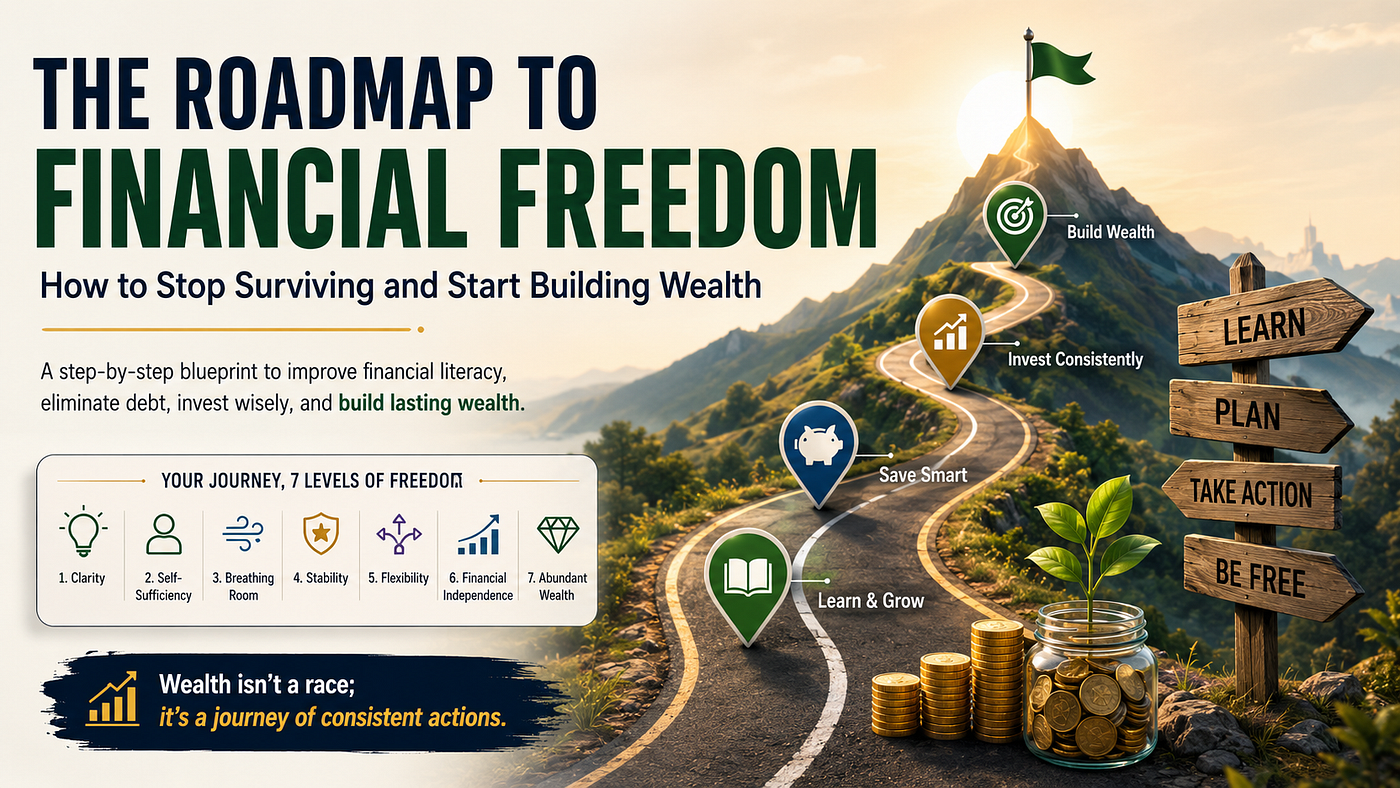
5. The Destination: The 7 Levels of Financial Freedom
Financial freedom isn’t one giant leap.
It’s a staircase.
Every level represents meaningful progress.
Level 1 — Clarity
You know exactly how much you earn, spend, save, and owe.
No more guessing.
Level 2 — Self-Sufficiency
Your income comfortably covers your essential expenses.
You’re no longer relying on others financially.
Level 3 — Breathing Room
You escape the paycheck-to-paycheck lifestyle.
Unexpected expenses become manageable instead of disastrous.
Level 4 — Stability
You’ve eliminated bad debt and built an emergency fund covering six months of expenses.
Financial anxiety begins to disappear.
Level 5 — Flexibility
You have roughly two years of living expenses saved or invested.
Career decisions become choices — not necessities.
Level 6 — Financial Independence
Your investments generate enough income to cover your living expenses.
Work becomes optional.
Not mandatory.
Level 7 — Abundant Wealth
Money is no longer a source of stress.
Instead, it becomes a tool for creating opportunities, supporting loved ones, giving generously, and living life on your own terms.
Remember:
You don’t jump from Level 1 to Level 7 overnight.
You simply keep climbing.
One habit.
One investment.
One smart decision at a time.
Your Financial Freedom Action Plan
Every wealth-building journey follows the same basic path.
First, improve your financial literacy.
Then eliminate high-interest debt.
Begin investing consistently.
Develop habits that support long-term success.
And continue progressing through each level of financial freedom.
None of these steps require perfection.
They simply require consistency.
Because here’s the truth:
Wealth isn’t a race. It’s the result of thousands of smart decisions repeated over time.
Start where you are.
Use what you have.
Keep moving forward.
Your future self will be grateful you started today.
Frequently Asked Questions: What is the Debt Snowball Method?
The Debt Snowball Method is a debt repayment strategy where you pay off your smallest debt first while making minimum payments on the rest. Each paid-off debt creates momentum, making it easier to eliminate larger debts.
Is saving better than investing?
Saving is ideal for short-term goals and emergencies, while investing is generally more effective for long-term wealth because it has the potential to outpace inflation through compound growth.
Why is financial literacy important?
Improving financial literacy helps you make informed decisions about budgeting, debt, investing, taxes, and long-term wealth creation.
How long does it take to achieve financial freedom?
There is no universal timeline. Your journey depends on your income, savings rate, investment returns, and spending habits. Consistency matters far more than speed.
Final Thoughts
Financial freedom isn’t reserved for a lucky few.
It’s available to anyone willing to learn, take action, and stay consistent.
Every budget you stick to.
Every debt you eliminate.
Every investment you make.
Every lesson you learn.
All of it moves you one step closer to the life you’ve imagined.
📌 Enjoyed this guide?
If you found this article valuable, follow the Medium publication for practical, research-backed insights on personal finance, investing, and wealth building.
And don’t forget to save our visual frameworks on Pinterest so you can revisit these strategies whenever you need a financial reset.
메타데이터
- post_id
- f7ffbf53d15e
- slug
- the-roadmap-to-financial-freedom-how-to-stop-surviving-and-start-building-wealth-f7ffbf53d15e
- url
- https://medium.com/@praxilonpulse/the-roadmap-to-financial-freedom-how-to-stop-surviving-and-start-building-wealth-f7ffbf53d15e
- canonical_url
- https://medium.com/@praxilonpulse/the-roadmap-to-financial-freedom-how-to-stop-surviving-and-start-building-wealth-f7ffbf53d15e
- author_url
- https://medium.com/@praxilonpulse
- status
- ok
- fetched_at
- 2026-07-08 21:20:17