Alaska
A shift in perspective from control to trust leads to unexpected abundance.
Inspirational Short Story
Alaska
Beneath the Aurora Sunrise
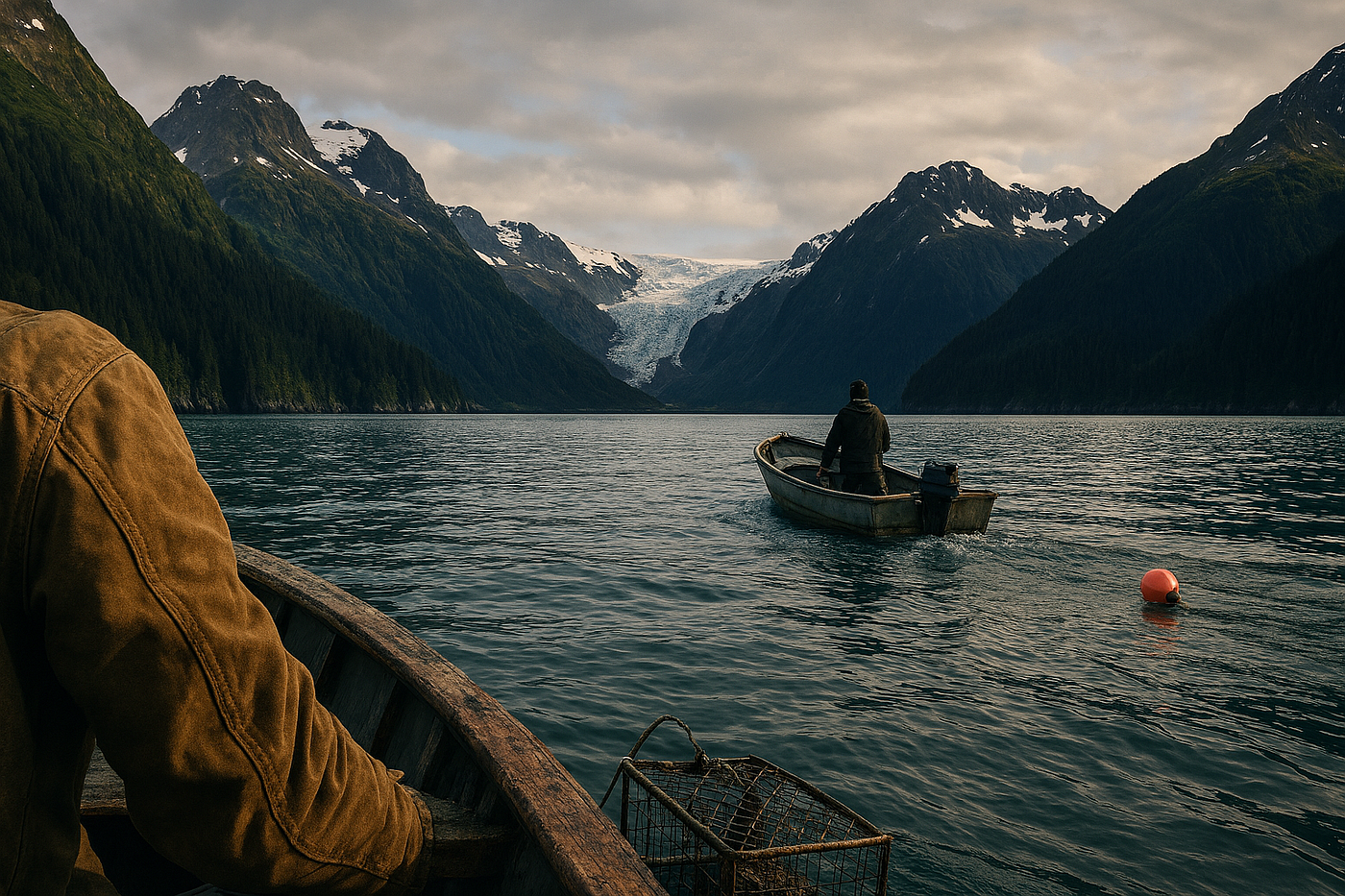
“The first rule of the sea, young man, is that it does not care for your plans,” Finnigan said, his voice a gravelly melody that wrestled with the wind. “It will swallow your boat, your hope, and your pride without a second thought. Are you prepared for that?”
In the unforgiving wilderness of Seward, Alaska, a young man seeks to escape his past to find a new beginning.
Elias, a newcomer to this land of striking beauty and even sturdier people, gripped the worn gunwale of the fishing skiff. His knuckles were bone-white, a stark contrast to the deep umber of his inherited Carhartt jacket.
He had come to Seward, Alaska, with a suitcase full of city dreams and a heart full of unresolved questions, hoping that the vast, austere wilderness could offer a clarity that concrete could not. Finnigan, with his salt-and-pepper beard and eyes the color of glacier lakes, was the first person he had met here. A mentor of the most unforgiving kind.
“I am prepared,” Elias lied, the words catching in his throat.
The Resurrection Bay stretched before them, a canvas of shifting slate and emerald. Whales spouted in the distance, their misty breaths hanging in the frigid air like fleeting prayers.
The air smelled of salt and life. And something ancient. Something that carried the weight of forces far greater than human will.
The Exit Glacier, a sought-after landmark, stood sentinel in the distance, a towering, radiant monument of frozen time. Elias found himself staring at its receding face, a visible reminder of change and impermanence. The locals spoke of it with somber reverence, a physical manifestation of a world they knew was irrevocably shifting.
They were not heading for the open sea, not yet. Their mission was simpler, more fundamental: setting crab pots in the sheltered coves. A rhythmic ritual of baiting traps, heaving them overboard, and marking their location with buoys. It was a monotonous task, yet Finnigan performed it with quiet grace, his movements precise.
“There is no rushing the tides,” Finnigan mused, his gaze fixed on the water. “No shouting at the storms. You must learn to listen, to feel the pull, to know when to push and when to yield.”
Elias had not expected these philosophical musings from a fisherman. He had expected gruff instructions, a lesson in survival. Instead, Finnigan was offering something more; a lesson in esse, a call to encounter yourself in the living moment. This place, Elias was beginning to understand, was not just about catching fish. It was about catching yourself.
That evening, as the sky morphed from radiant sapphire to gradient violet, a gentle snowfall draped the small harbor town turning it into a silent, breathtaking winter wonderland. Elias walked along the main street, the lights of the storefronts casting a warm, inviting glow on the fresh snow powder.
He passed the Alaska SeaLife Center, its large windows offering a glimpse into a quiet ballet of seals and puffins, a testament to the thriving, resilient life beneath the surface. A peace he had never known suddenly settled within him, as if the town, the snow, the water, and all of creation conspired in a single, sacred breath, inviting him to be still.
The next morning, the snow had transformed the landscape. It was a blank slate, and the world seemed new.
Finnigan met him at the dock, his face etched with worry, a kind of weary resolve.
“The buoys are gone,” he said simply.
Elias’ chest tightened. Their crab pots, their entire livelihood for the week, had vanished. He imagined the strong currents, the hidden rocks, the capricious whims of a sea that simply took what it wanted.
“It happens,” Finnigan said, his voice devoid of anger. “Sometimes the sea claims its own.”
Elias, however, was not so accepting. The weight of failure pressed against his ribs. He had invested all his savings into this trip, into this new life. He could not return home empty-handed, not after all he had risked. So he rowed. All day. Eyes scanning the water, searching for the flash of bright orange buoys against the gray. Finnigan, a silent companion, watched him with sad patience.
Hours later, defeated and shivering, Elias returned to the dock. The sun was setting, a fiery spectacle that painted the snow-covered mountains in hues of rose and gold. He found Finnigan sitting on an overturned bucket, gazing at the water.
“I am sorry,” Elias said, the words feeling utterly inadequate. “I do not know what happened.”
“I do,” Finnigan replied, a small smile playing on his lips. “I saw them this morning. I pulled them up.”
Elias froze, a wave of confusion and indignation washing over him. “You… you took our pots?”
“No,” Finnigan said, his smile widening. “I did not take them. I moved them. To a new spot, a better spot. I saw the weather changing, a storm coming. I knew the old location would be a graveyard.”
Elias stared at him, speechless. He had been so consumed by his own fear, his own perceived loss, that he had not considered the possibility of a different reality. The pots were safe. Not lost. Just moved.
And in that moment, he realized Finnigan had been teaching him a lesson not about fishing, but about faith. It was a lesson about trust, about looking beyond what you see, about believing in something you cannot yet grasp.
The next morning, the true purpose of Finnigan’s actions became clear. The storm hit, a fierce, howling tempest that would have indeed destroyed their gear. They rode it out in the shelter of the harbor, the boat rocking gently, a safe haven from the chaos.
When the storm passed, they went out and retrieved the pots. They were not only full, but overflowing, a bounty that surpassed anything Elias had imagined. Finnigan had not only protected their livelihood, he had also multiplied it.
It was a simple, quiet revelation. The greatest dangers were not the ones you could see, but the ones you could not. And the greatest gifts were not the ones you earned, but the ones you were given by someone who saw what you could not.
That evening, as the Northern Lights danced across the heavens in shimmering curtains of green and violet, Elias stood on the dock, watching the sky. He thought of his fears, his anxieties, his need to control everything.
He had come to Alaska seeking answers, but what he had found was something more. He had found a mentor who, through his actions, had shown him that faith was not a blind leap into the unknown, but a quiet trust in the unseen, a willingness to be moved by a force that knew the tides better than you ever could.
He had thought that he was learning to fish, but he was learning to live. He had thought that he was learning to survive, but he was learning to thrive. The greatest bounty was not in the crabs that they caught, but in the peace that had now settled in his heart.
He looked at Finnigan, who stood beside him, watching the celestial dance. Finnigan did not say a word, but in the silent communion of the moment, Elias understood. He had come to the last frontier, and he had finally found his new beginning.
메타데이터
- post_id
- f81a7994dc0d
- slug
- alaska-f81a7994dc0d
- url
- https://medium.com/inspirational-short-stories/alaska-f81a7994dc0d
- canonical_url
- https://medium.com/inspirational-short-stories/alaska-f81a7994dc0d
- author_url
- https://medium.com/@communionbookclub
- status
- ok
- fetched_at
- 2026-07-17 23:41:04