The Titanic Wreck Is Disappearing
A lost bronze goddess, a fallen railing, and the bacteria slowly eating the most famous ship in history.
The Titanic Wreck Is Disappearing
A lost bronze goddess, a fallen railing, and the bacteria slowly eating the most famous ship in history.
The Titanic wreck is not frozen in time.
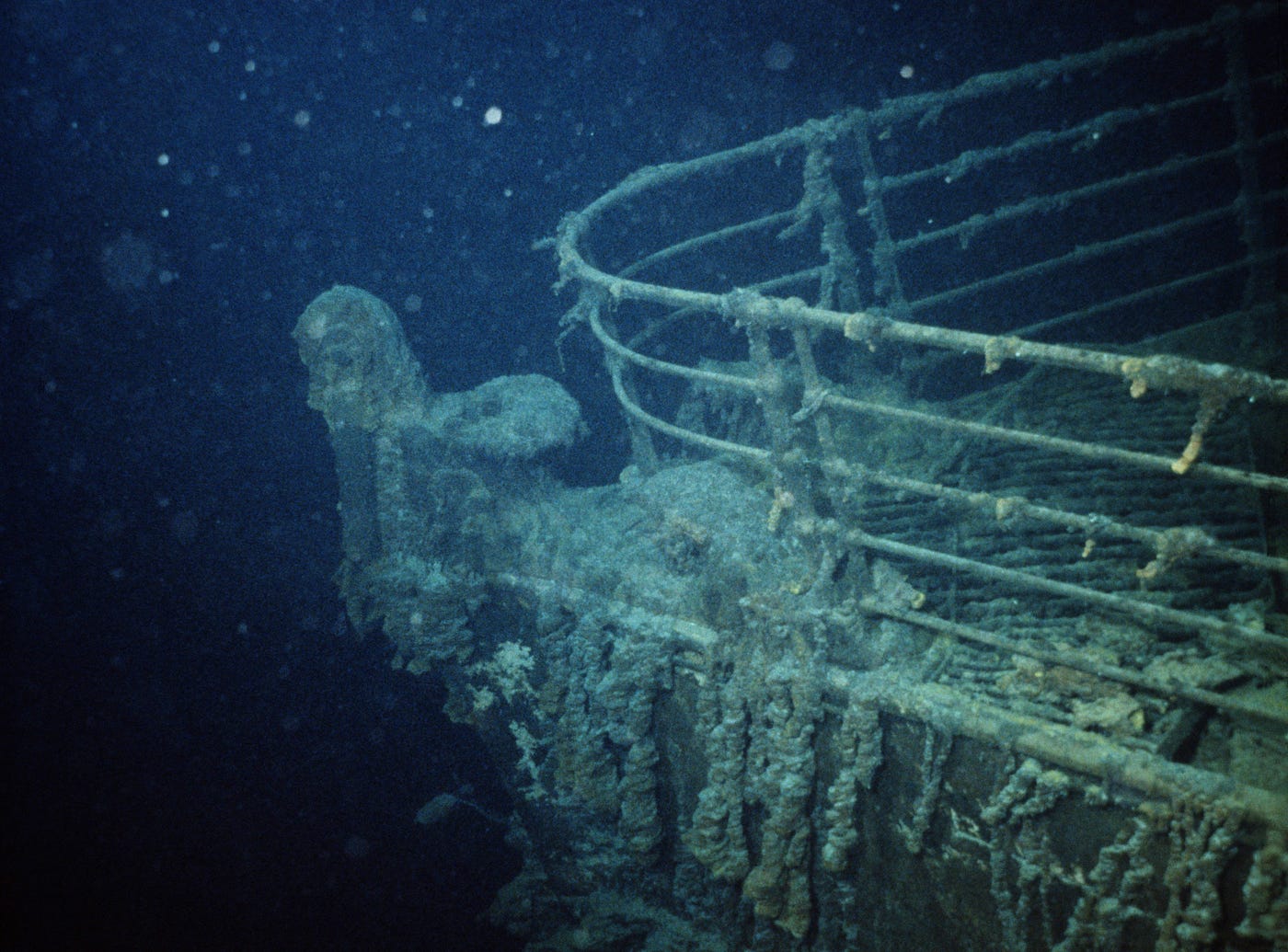
More than 3,800 metres beneath the North Atlantic, the most famous ship in history is changing every day. Her railings are weakening. Her steel is being eaten away. Strange rust-coloured formations hang from her hull like melting candle wax.
For years, people thought those formations were simply rust. They are not. They are alive.
They are colonies of bacteria, slowly consuming the Titanic’s iron in the freezing dark. And while the ship is disappearing, she is still giving up secrets. In 2024, an expedition returned to the wreck site and found something almost nobody expected.
[embed]
The Titanic Wreck Rests in One of Earth’s Harshest Places
When the Titanic struck an iceberg and sank on April fourteenth, 1912, she did not settle gently onto the seabed. She broke apart.
The two halves of the ship fell more than three kilometres through total darkness, drifting and tumbling into a world no human being had ever seen. Today, the Titanic lies around three thousand eight hundred metres down, deeper than ten Eiffel Towers stacked on top of one another.
At that depth, everything becomes hostile.
There is no sunlight. The water stays just a degree or two above freezing. The pressure is hundreds of times greater than the air pressure we feel at the surface, strong enough to crush metal in an instant.
For a long time, scientists thought these conditions might preserve her.
No sunlight to fade her. Very little oxygen to rust her. Water so cold that decay should slow almost to a halt. The Titanic, some hoped, might remain almost perfectly preserved, a ghost ship frozen in the dark.
The deep ocean had other plans. The Titanic is not preserved like a museum exhibit. She is being consumed.
How Robert Ballard Found the Titanic Shipwreck
For more than seventy years, the Titanic was truly lost.
People knew roughly where she had gone down, somewhere off the coast of Newfoundland, but the Atlantic is vast and deep. Expedition after expedition failed. The most famous ship in the world had been swallowed whole.
Then, in 1985, oceanographer Robert Ballard entered the story.
Ballard took a research vessel into the North Atlantic and began sweeping the seafloor with a camera-equipped robot called Argo. For days, the screens showed nothing but sand, sediment, and empty darkness.
Then, in the early hours of September first, something appeared.
It was not the ship itself. It was debris.
A trail of scattered wreckage led the team to one of Titanic’s massive boilers. Its rivet pattern matched old photographs exactly. They had found her.
Soon after, the bow emerged from the blackness.
The news travelled around the world. After seventy-three years, the “unsinkable” ship had finally been located.

The Secret Mission Behind the Discovery
The public story was only part of the truth.
Ballard’s real mission had almost nothing to do with the Titanic. He had been sent by the United States Navy to find and survey two American nuclear submarines lost at the bottom of the Atlantic.
The Titanic was the cover story.
If Ballard had time left after the military work, he was allowed to look for her. While studying the submarine wrecks, he learned something crucial: when a vessel sinks and breaks apart at depth, it leaves behind a long debris trail.
So instead of searching directly for Titanic’s hull, he searched for her wreckage trail and followed it home.
That technique found the ship.
The discovery became one of the greatest shipwreck finds in modern history. Yet behind the headlines, it was also the public face of a Cold War mission.
Titanic Rusticles Are Eating the Ship Alive
When cameras first moved close to the wreck, they revealed something strange.
Long, rusty icicles hung from the railings, portholes, and steel walls. They looked like melted candle wax. For years, people assumed they were ordinary rust formations caused by metal sitting in seawater.
The truth is stranger.
Those formations are called rusticles. They are not just rust. They are living communities of bacteria.
These microscopic organisms feed on the ship’s iron, slowly turning Titanic’s steel into fragile, dripping formations. They have been doing it for more than a century.
Every day, the Titanic’s iron is being transformed by living organisms too small to see.
The process is slow, but relentless. The bacteria do not hurry. They do not stop. Over time, their appetite may be what finishes the wreck.
Not a storm. Not an earthquake. Not one sudden collapse. Just the patient work of life in the deep sea.
The Titanic Debris Field Tells a Bigger Story
The bacteria are not the only threat.
In 2010, researchers from RMS Titanic and the Woods Hole Oceanographic Institute set out to map the wreck properly. They sent robots back and forth across the seabed, row by row, capturing tens of thousands of images.
The technique was described as “mowing the lawn.”
The goal was to create a detailed picture of the entire wreck and the debris field around it.
That debris field is enormous. The wreckage and scattered belongings cover around fifteen square miles of seabed. The bow lies relatively upright and still recognisable. The stern, far more destroyed, rests roughly six hundred metres away, facing the opposite direction.
The mapping project revealed a sobering truth.
The Titanic is being damaged from two directions at once:
- Nature, through bacteria steadily consuming her iron.
- Human curiosity, through decades of expeditions and submersibles that have visited the wreck.
Some visits left scars. Some disturbed the site. Some knocked pieces loose simply by being there.
The Titanic is being worn down by the smallest living things in the ocean and by the people trying to study her before she disappears.
The 2024 Titanic Expedition Changed Everything
In 2024, RMS Titanic Incorporated returned to the wreck site.
It was the company’s ninth expedition to the Titanic, but the first in fourteen years. Fourteen years is a long time to leave a dying ship alone in the dark.
Nobody knew exactly what they would find.
Over twenty days, the team captured more than two million photographs of the wreck and surrounding debris field. They recorded the Titanic in higher resolution and greater detail than ever before.
Every rivet. Every railing. Every plate of steel. Every shattered fragment in the mud.
The expedition gave researchers a clearer view of the ship than they had ever had since she sank.
But the team was also searching for something specific. A small bronze statue, only around sixty centimetres tall. Her name was Diana.

The Lost Diana of Versailles
The Diana of Versailles once stood in Titanic’s First Class Lounge.
She was a bronze statuette of the Roman goddess Diana and represented everything the ship was meant to be: wealth, beauty, refinement, and grandeur. In her prime, she was part of the most luxurious passenger space on the vessel.
When the Titanic broke apart, the lounge was ripped open.
Diana was thrown into the freezing water and fell through kilometres of darkness until she came to rest somewhere in the debris field.
She had been seen only once, in an old photograph from the 1980s. After that, she vanished again.
No expedition could find her. The debris field was too large. Visibility was poor. A sixty-centimetre statue lying in sediment is almost impossible to relocate.
Many experts believed she was gone for good.
Found With Only Hours Left
The 2024 team knew roughly where Diana might be. But knowing the general area and finding a small bronze statue on the Atlantic floor are very different things.
They searched day after day. Nothing.
The expedition was almost over. Twenty days at sea, two million photographs, and the object they most wanted was still hidden in the dark.
Then, in the final hours, the light caught something half-buried in the muck. There she was. The Diana of Versailles.
Fully intact. Lying exactly where she had fallen more than a century earlier.

Diana of Versailles, found on the seafloor
The 2024 expedition recovered a piece of Titanic’s lost soul from the darkness, just before time ran out.
For the researchers, it was the discovery of a lifetime. The first clear images of Diana in decades had finally been captured.
The hope now is that, on a future expedition, the statue may be lifted from the seabed and preserved.
But the same expedition that found Diana also delivered heartbreaking news.
The Titanic’s Famous Bow Railing Has Fallen
For decades, the bow of the Titanic carried a small miracle.
Despite the pressure, bacteria, decay, and the passage of more than a century, the railing at the very front of the ship remained standing.
For many people, that railing is the most recognisable part of the wreck. It is the place where Titanic still seems to cut forward into the darkness.
After thirteen days of surveying the debris field, the 2024 team guided their cameras toward the bow. Something was wrong.
A section of the famous railing, around four and a half metres long, was gone from the port side.
The railing had not crumbled into dust. It had fallen as one piece and now lay on the seafloor below the bow.
It had survived for more than a century. Then, sometime in the years since the previous detailed look at the wreck, it finally gave way.
The Titanic is not a fixed monument. She is a fading one.
Every expedition now is a race against time: to record her, map her, and understand her before more of her slips into the mud.
Discovery and Decay Are Happening Together
That is the strange truth of the Titanic today.
She is still giving up lost treasures, like Diana, found in the final hours of a twenty-day expedition. At the same time, she is losing pieces of herself, like the fallen bow railing.
Discovery and decay are happening together.
The bacteria are still feeding on her iron. The rusticles are still growing. The bow is weakening. The decks are failing.
One day, the great ship may fold in on herself completely and become little more than a reddish stain on the seafloor, a smear of iron-rich sediment marking where the Titanic used to be.
We are saying goodbye to her slowly.
One image at a time. One expedition at a time. One lost piece at a time.
Far below the waves, in the cold and silence, the Titanic remains.
She is still changing. Still disappearing. Still capable of surprising us.
The 2024 expedition proved both sides of her story. A lost goddess was found. A famous railing had fallen. The wreck is not simply a relic of the past. It is an active, fragile place where history is still unfolding.
The deeper we look, the clearer the truth becomes:
The Titanic is not just a shipwreck. She is a countdown.
메타데이터
- post_id
- f83166b33583
- slug
- the-titanic-wreck-is-disappearing-f83166b33583
- url
- https://medium.com/@uncharted.depths.business/the-titanic-wreck-is-disappearing-f83166b33583
- canonical_url
- https://medium.com/@uncharted.depths.business/the-titanic-wreck-is-disappearing-f83166b33583
- author_url
- https://medium.com/@uncharted.depths.business
- status
- ok
- fetched_at
- 2026-08-03 10:08:56