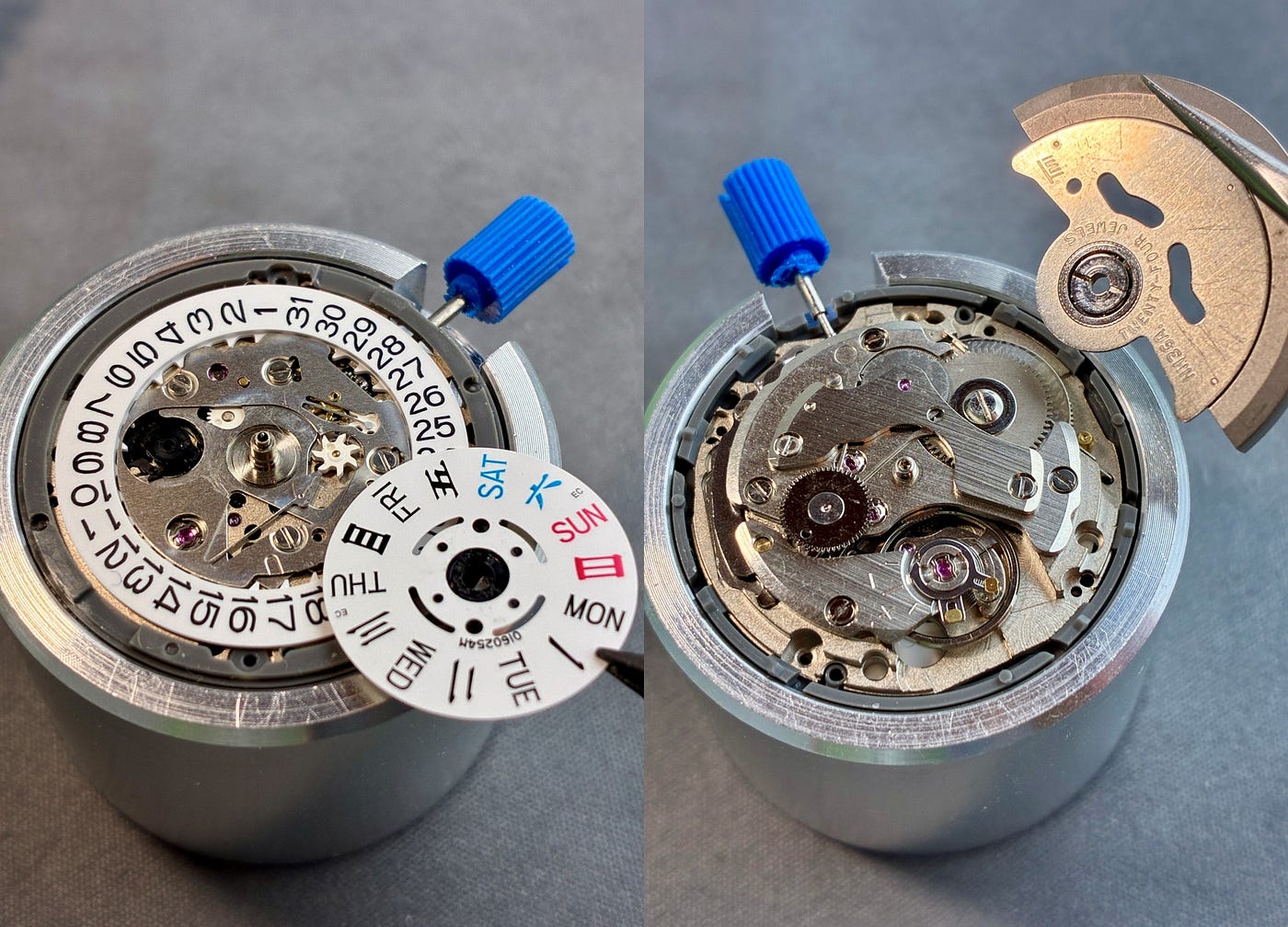
Servicing a 1990s Swatch Automatic (ETA 2842): ETA 2824’s Inconspicuous but Serviceable Little…
Before Sistem51, Swatch mechanical movements were actually something — inside plastic cases!
Servicing a 1990s Swatch Automatic (ETA 2842): ETA 2824’s Inconspicuous but Serviceable Little Brother
Before Sistem51, Swatch mechanical movements were actually something — inside plastic cases!
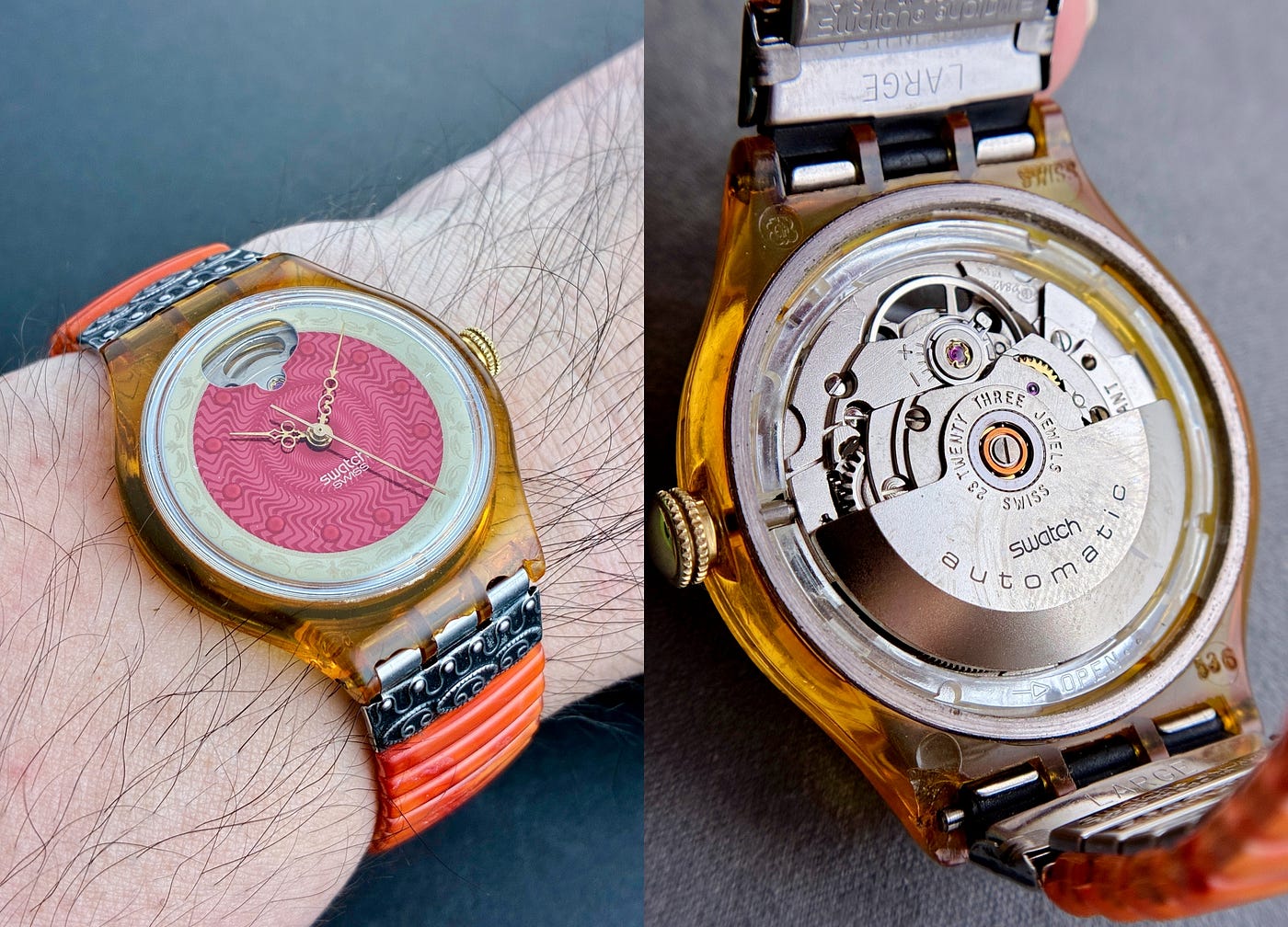
I bought this watch online with a relatively low price — probably with a bit of luck, as the seller had misspelled the word “Swatch” in the first place and made it unsearchable otherwise. I only found it by browsing his list of wares, looking for watches that I can buy and try to service myself. And this is officially my first Swiss movement service.
The ETA 284x series movements was created in the 1990s for Swatch, which were based on the popular ETA 2824 with lower frequency (3 Hz instead of 4) and a few plastic bearings. As these were placed in plastic cases with dubious water-resistance capacity, perhaps they were meant to be disposable, much like the unserviceable Sistem51.
On the other hand, the 284x has the same size and design (except lack of calendar works in most versions) as the 2824. Since authentic ETA 2824 would be more difficult and more expensive to find today, this is maybe the closest alternative to have a piece of ETA legacy on my repair bench (which is, sadly, just an ordinary study desk).
ETA 2800 Family: History and Design
Heinrich Stamm and “System ETA”
Heinrich Stamm, who joined ETA in 1939 at the age of 42, brought many influential achievements for ETA and Eterna, including the ETA 1080 with true center-driven second (1947) and the first Eterna-Matic calibres with ball-bearing automatic winding rotors (Eterna 1100 series, 1948).
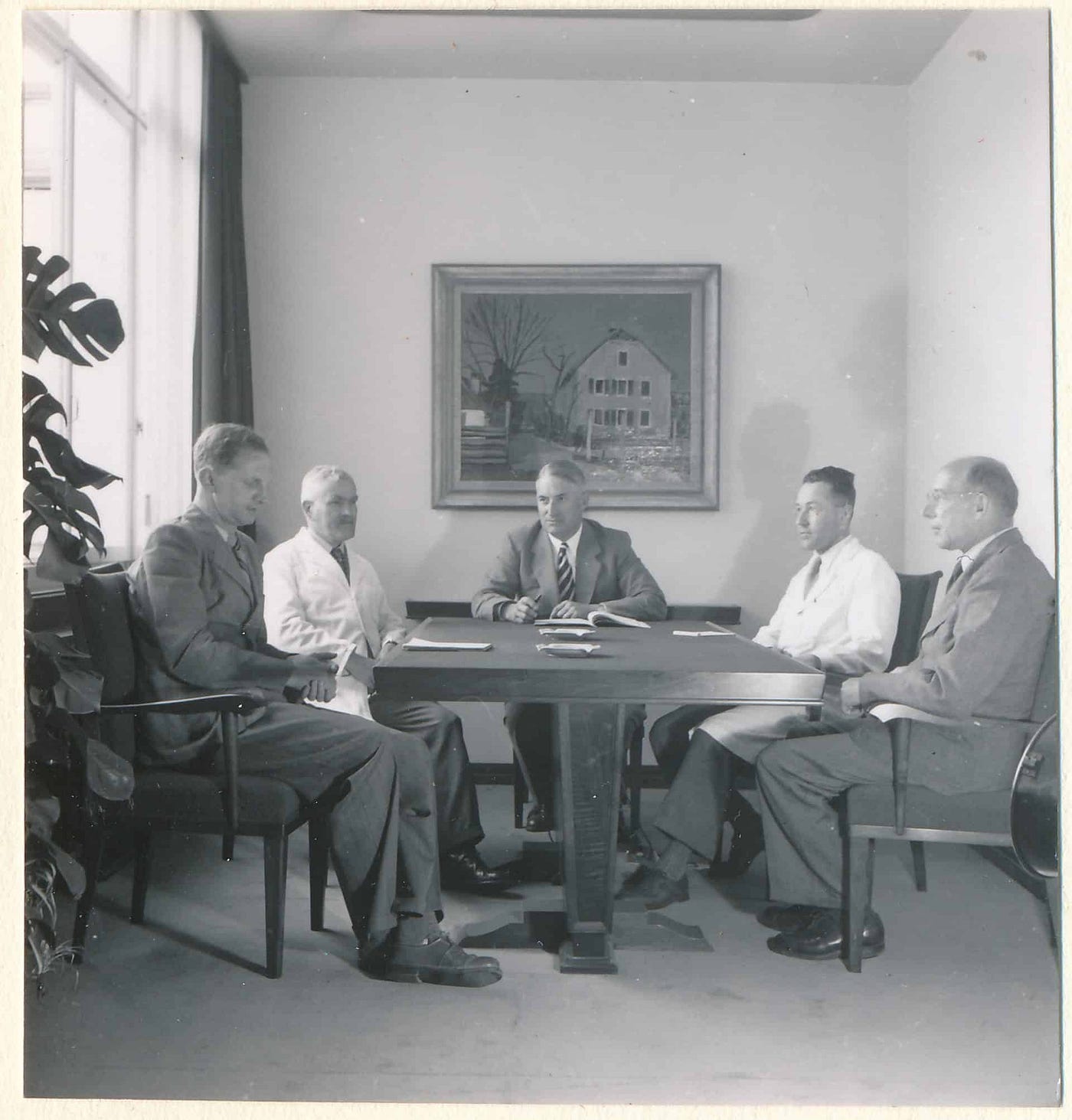
Heinrich Stamm (second one on the left), 1955. The person in the center was Rudolf Schild-Comtesse, Eterna’s president and ETA‘s board member/administrator. (Source)
But the most important of all was perhaps the CH297900A patent filed in 1951, which invented the so-called “System ETA” design — indirect-driven minute hand and direct-driven second.
Compared to the indirect-driven second architecture, which requires a spring to hold down the center second pinion with extra friction to avoid backlashs, or the ETA 1080-type structure, where the center wheel and fourth wheel have to overlap each other in the center, Stamm’s design has several advantages:
- The barrel and the balance wheel can be larger since part of the gear train is out of the way, and it’s possible to make the overall movement thinner as the gear train do not need to overlap.
- A steady sweeping second hand without backlash.
- The cannon pinion (where the minute hand is installed) no longer relies on direct friction contact on the center wheel or 2nd wheel. The patent also claimed that this model eliminates the tiny backlash of the minute hand.
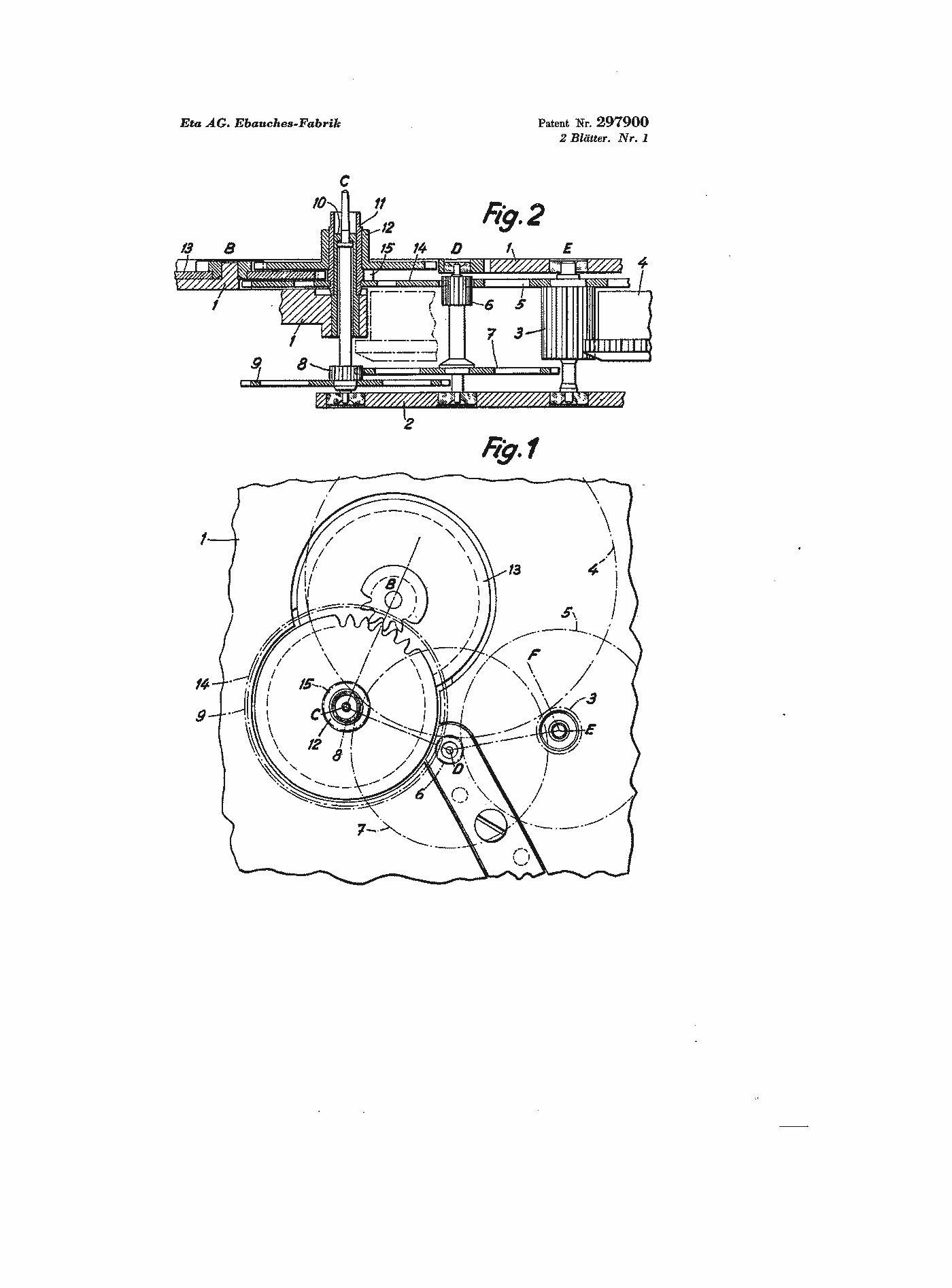
Patent CH297900A “Clock with indirectly driven minute hand”.
It is unclear where did Stamm get the inspiration from, if any; some pointed to the Roskopf pin-lever movements, created by Georges Frederic Roskopf in 1867. These movements, with the purpose to simplify the structure and cost, drives the minute/hour hands directly from the barrel so the 2nd wheel is not centered, resulting a big barrel with more power reserve.
Some others believe that Zenith’s Calibre 135, developed by Jobins Zenith in 1949, may be another source of influence — it drives a small minute hand pinion from an off-center 2nd wheel, resulting a big balance wheel that would excel in chronometer tests.
In any case, Stamm clearly understood the need to move the 2nd wheel out of the way, and the first calibres to adopt the “System ETA” design was the Eterna 1400 series for the Eterna-Matic watches. (The earlier Eterna 1100 and 1200 series were true center-driven seconds like the ETA 1080.)
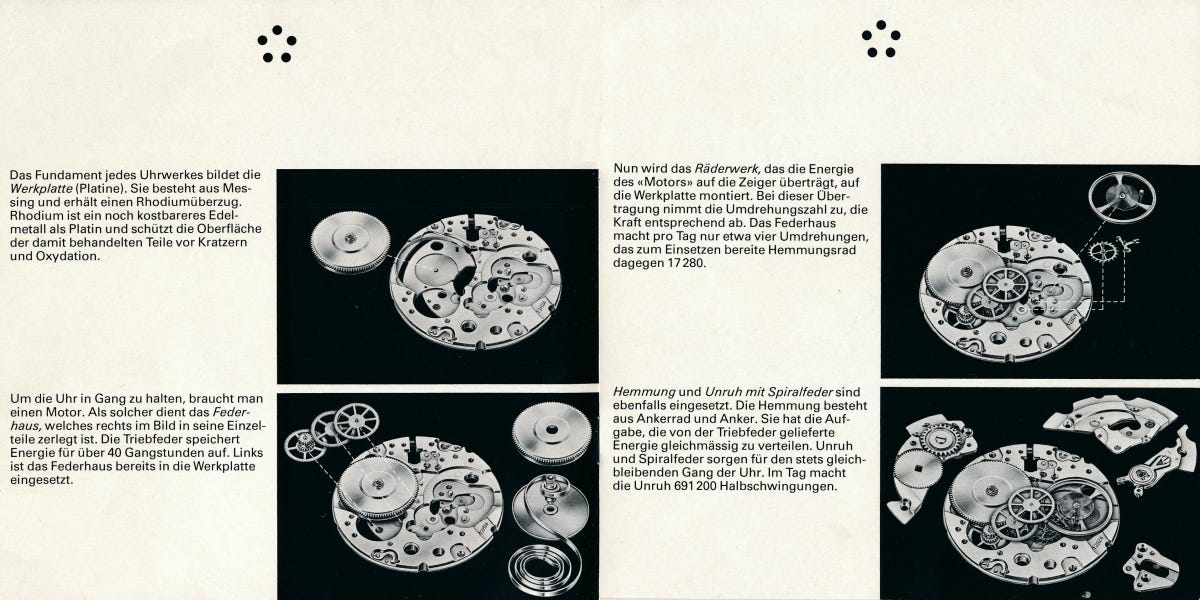
Eterna brochure around 1960s, which showcased a 12824 movement (Eterna’s version of ETA 2824?) with its gear train design. (Source)
The Eterna 1400 series did not have a consistent overall design; for example, the slim 1456U and 1466U was the direct base and predecessor of ETA 2892 (developed by Stamm‘s apprentice Anton Bally), while there are others quite alike to the ETA 2390/2450 series. Some ETERNA 1500 series calibres, like 1521 and 1541, are incredibly similar to ETA 2750 series (which are already pretty close to the 2800 series).
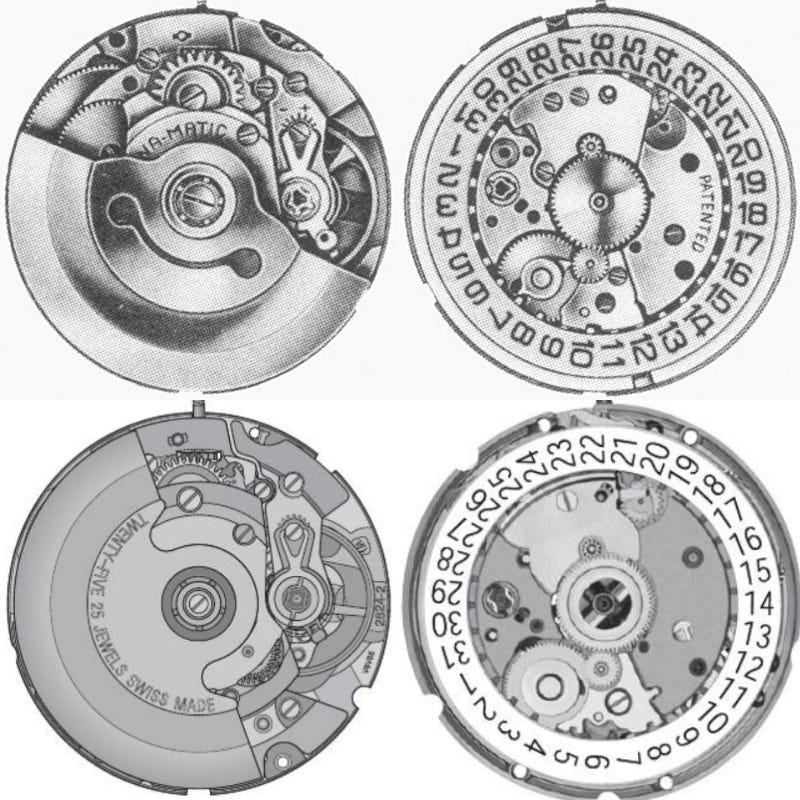
Eterna 1541 (up) and modern ETA 2824–2 (down). The 1541 has the same size of 2824 (11.5 ligne and 4.6 mm in height), but runs in 3Hz with an older keyless work design.
So the ETA 2800 series was not just something out of blue in the age of quartz crisis, but built upon and refined from a reliable design of the late 1960s, and the legacy lives on more than half of a century.
Fun fact: the Miyota 9000 series has a gear train that clearly adopted the System ETA design except for the positions of the excapement wheel/balance wheel. As it share other similar specs (frequency, diameter and height) to the ETA 2892, I would say the Miyota 9000 series was designed to be a cheaper alternative hence a direct competitor for the 2892.
ETA and Swatch
In 1931, the Swiss government and banks formed ASUAG (Allgemeine Schweizerische Uhrenindustrie AG), or the “Swiss Watch Cartel”, to save the Swiss watchmaking industry from the Great Depression.
Eterna was forced to be merged into ASUAG in 1932, with its movement branch separated as ETA SA and handed over to one of the ASUAG founders, Ébauches SA (a group of movement makers formed in 1926 including A. Schild, A. Michel and FHF).
Ébauches SA ad in the 1930s to 1940s. (Source)
Despite so, both Eterna and ETA were managed by Rudolf Schild-Comtesse, whose grandfather, Urs Schild, was one of the founders of Eterna. (Eterna, originally Dr. Girard & Schild, was renamed to “Fabriques Eterna, Schild frères & Co.” in 1907; Schild frères means “Schild brothers”. Eterna was originally a brand name of a alarm watch.) Also, Urs Schild's brother Adolf Schild was the founder of A. Schild; A. Schild would eventually merge with ETA in 1979.
Fast forward to 1983, the quartz crisis bankrupted both ASUAG and its main competitor, SSIH (Société Suisse pour l’Industrie Horlogére SA, including Omega, Tissot, Lemania and others). The two were merged by the Swiss government and banks as ASUAG-SSIH.
It is said that Ébauches SA, fearing that the merge deal started in 1982 had taken too long and the groups may collapse before getting things done, had taken a bold move to aggressively consolidated itself by merging all of ASUAG’s movement manufacturing under one single flag — ETA SA Fabrique d’Ebauches. The hands were forced, new hopes were found, and thus the ASUAG-SSIH was born.
Around the same time, the ETA engineers Elmar Mock and Jacques Müller developed a thin quartz watch with only 51 parts. Combined with Nicolas G. Hayek’s new production and marketing strategy, the colossal success of Swatch (“second watch”) not only saved the group, but also paved the way for Hayek to take control of ASUAG-SSIH in 1985, renaming it to SMH (Société de Microélectronique et d’Horlogerie). It would be renamed to the Swatch Group in 1998.
It is said that ETA owned 80% Swiss movement sale in the early 2000s. However, due to some twisting decisions between the Swatch Group and Swiss government for the past two decades, ETA today rarely provide movements to brands outside of the Swatch Group. The void is filled by ETA 2824 and 2892 clones, like Sellita SW200 and SW300 (and many, many others), as their rights had expired in the 2000s.
The ETA 284x series
The ETA 284x movements were mostly designed for Swatch in the 1990s and are based on ETA 2824. There are 4 known variations:
- 2840: 11.5 ligne, 4.6 mm in height, which is the same size of ETA 2824; 23 jewels (minus 2 from the first reversing wheel). No date, no second hacking. Running in 21,600 bph (3 Hz) instead of 4 Hz, no micro-adjustment in the regulator, uses Novodiac anti-shock instead of Incabloc.
- 2841: skeleton version, including an open barrel. Uses plastic pallet fork (the escapement wheel is metal), perhaps built using materials similar to the ones found in Sistem51 and basic version of Powermatic 80; 21 jewels.
- 2842: very similar to 2840, with both date and no date versions available.
- 2846: day-date, slightly thicker (5.05 mm), with 17 or 21 jewels. Not exclusive to Swatch.
Disassembly
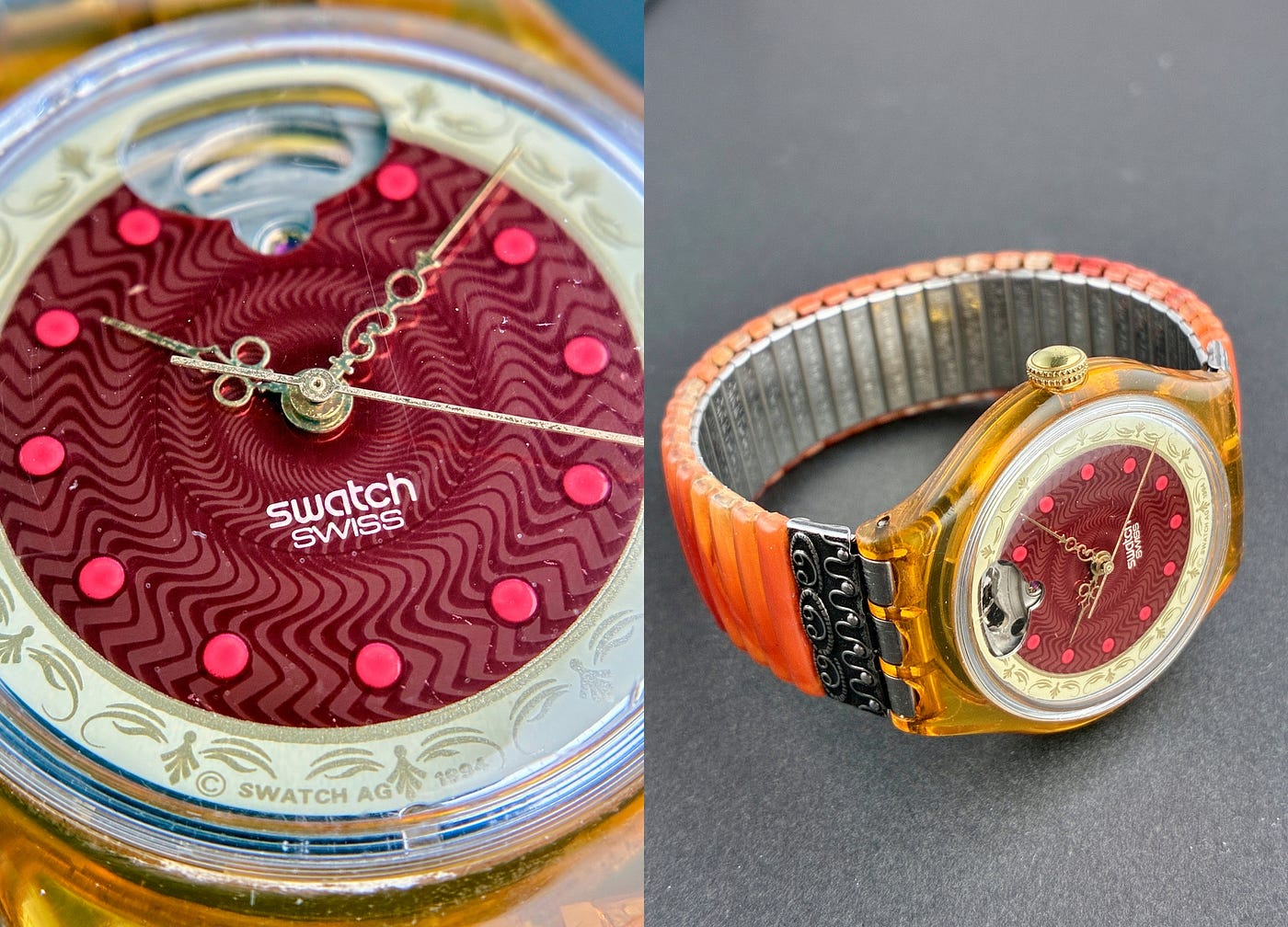
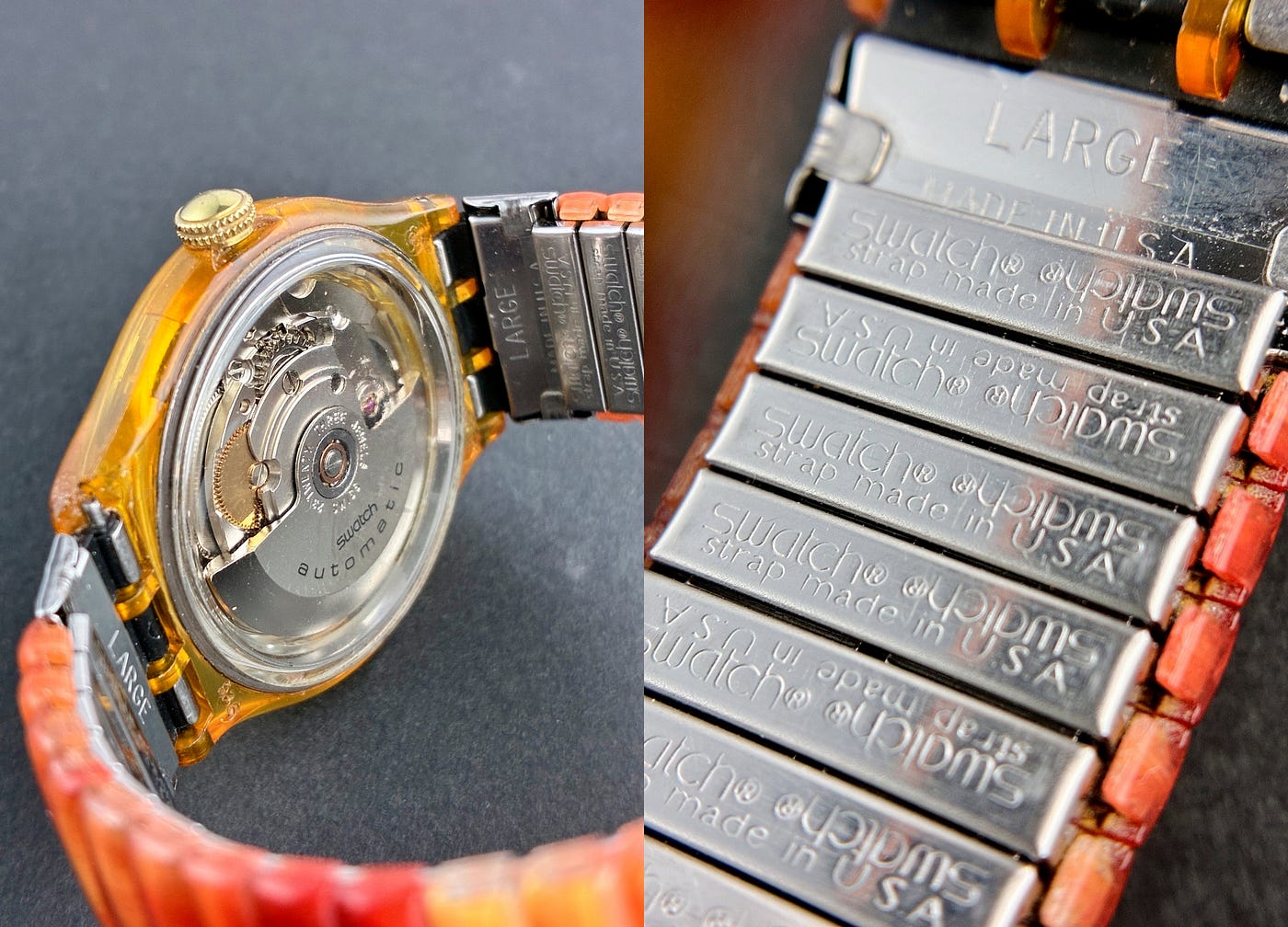
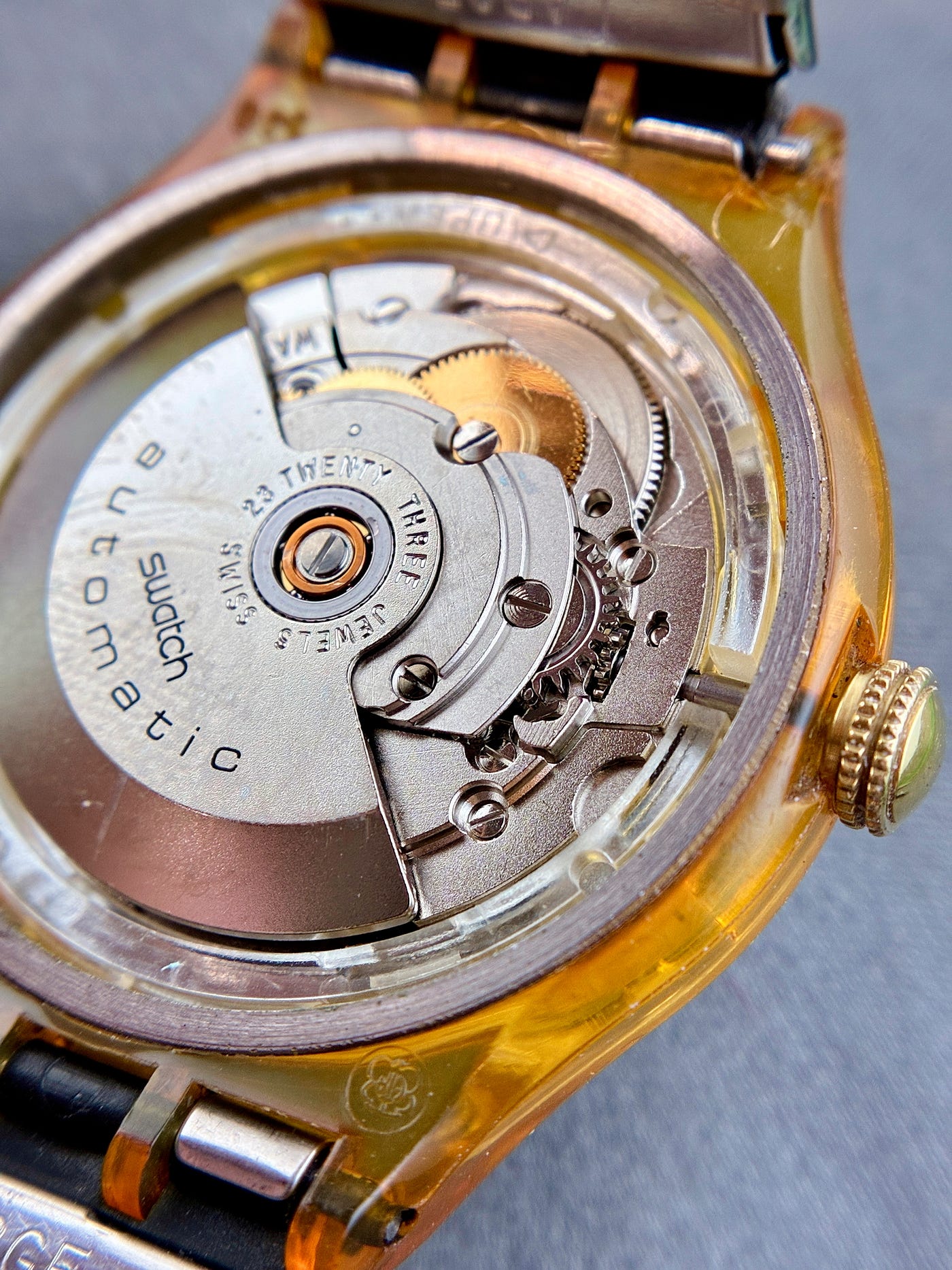
The movement we are servicing here is a 2842 without date.
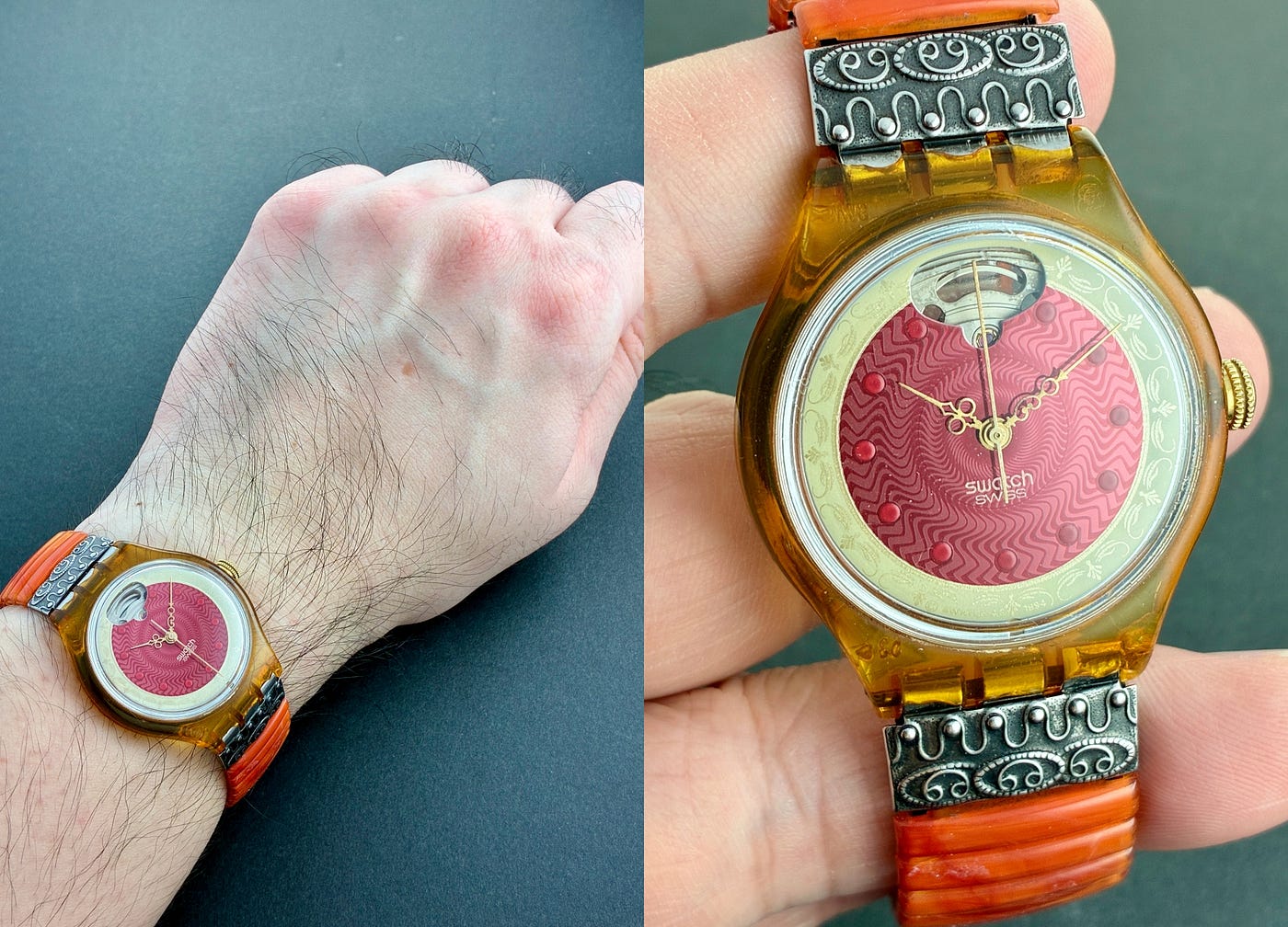
The dial (open at 12 o’clock around the balance wheel) indicated it was made in 1994. The elastic bracelet is made in U.S.A. The case diameter is roughly 36.5 mm.
To remove the stem, pull the crown to the time setting position, and use a 1 or 1.2 mm flat head screwdriver to press the setting lever axis opening near the stem.
If you do so without pulling the crown out, the yoke may dislodge itself from the clutch wheel, and you wouldn’t be able to put the stem back other than re-assemble the keyless work.
And if you press the setting lever axis too far with some pointed thing, the parts may also dislodge beyond their normal places and you might bend the setting lever spring as well.
The movement is wrapped by a plastic holder, and you can rotate the whole thing counter-clockwise to “unlock” it from the case.
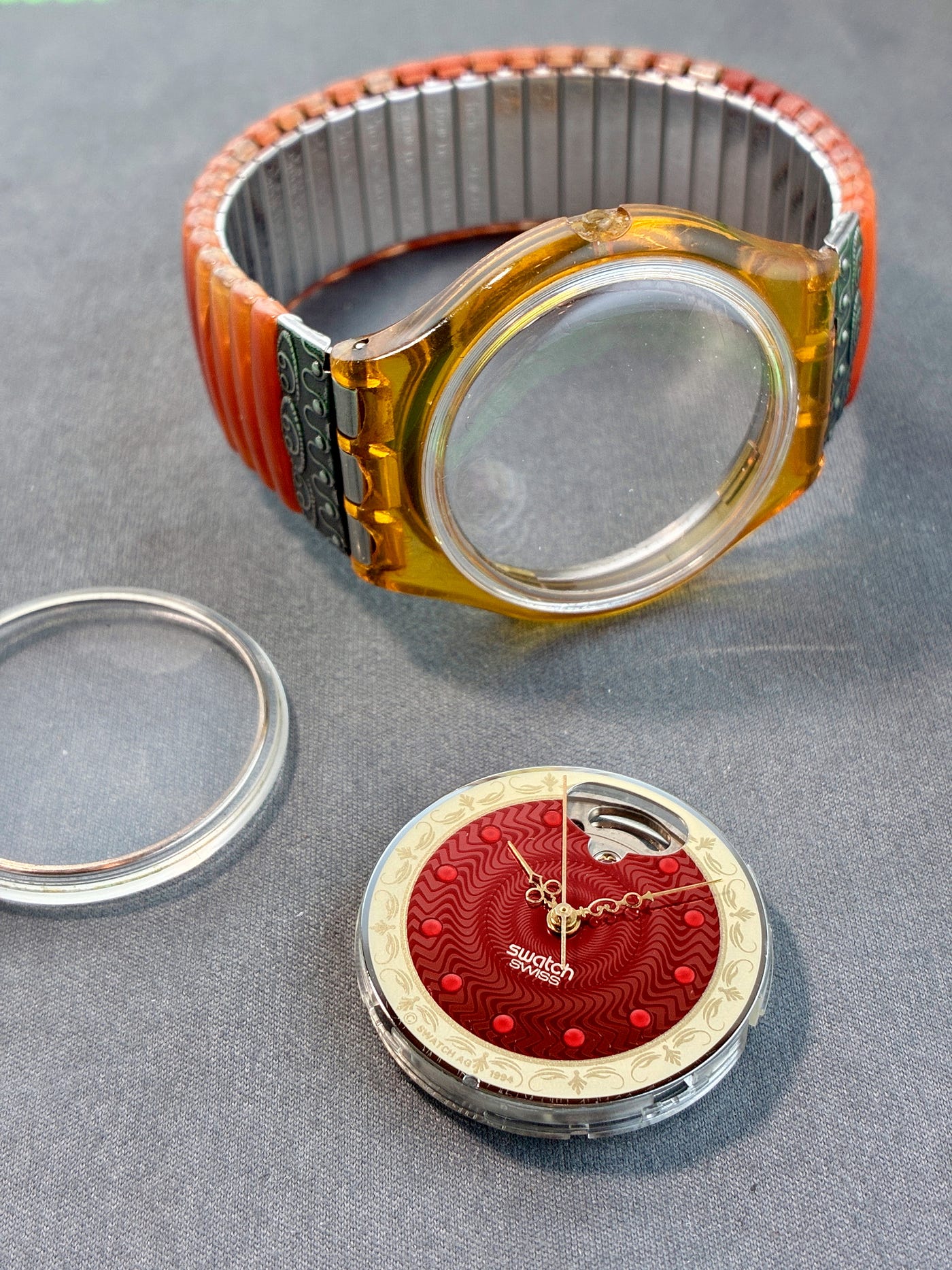
The dial is a simple flat metal to sit on the top rim of the plastic holder.
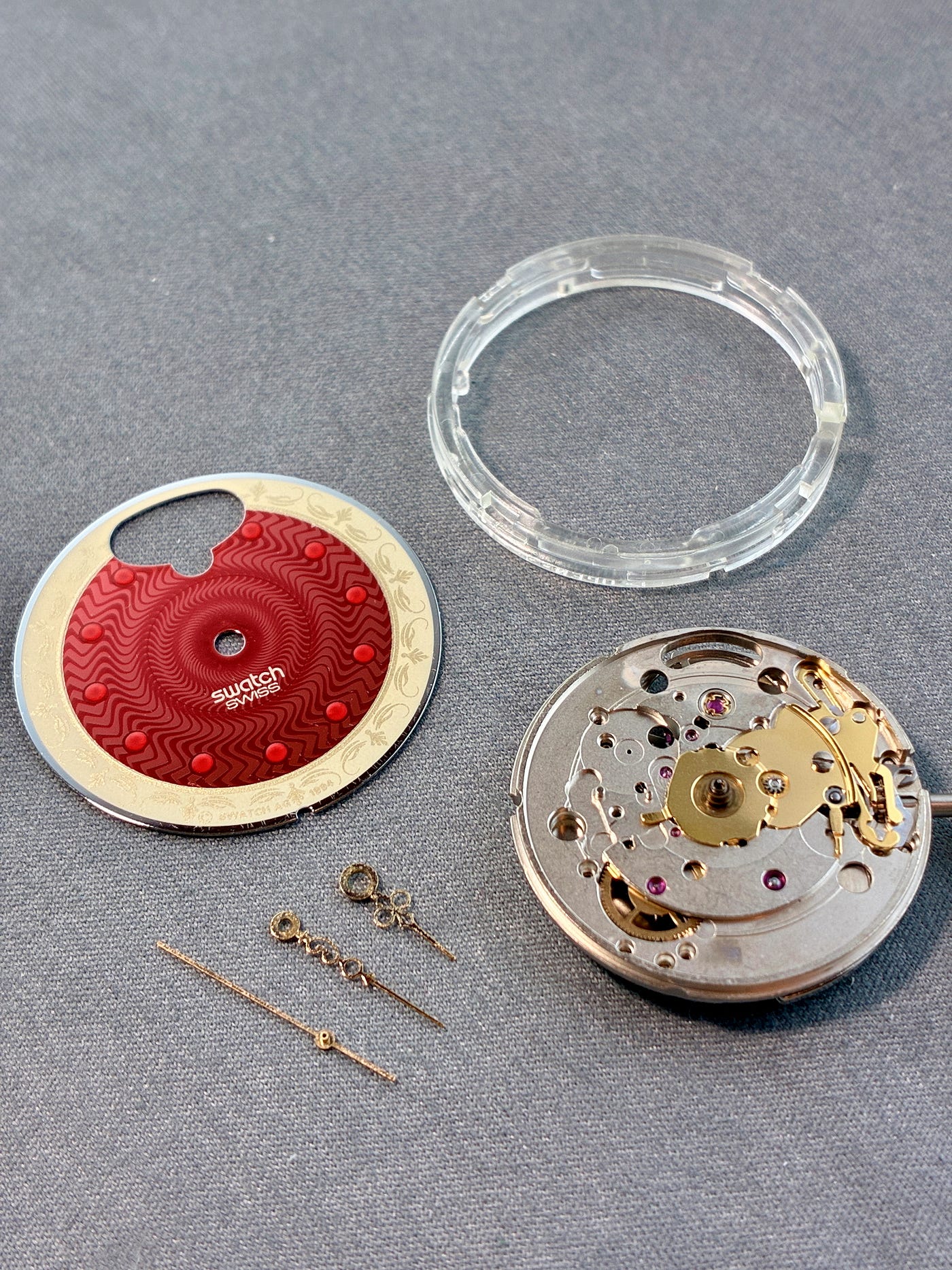
From the dial side of the movement, you can tell the baseplate has the spaces for calendar work. Also, the setting lever spring (very similar to 2824 design) has only two slots for two crown positions — manual winding and time setting.
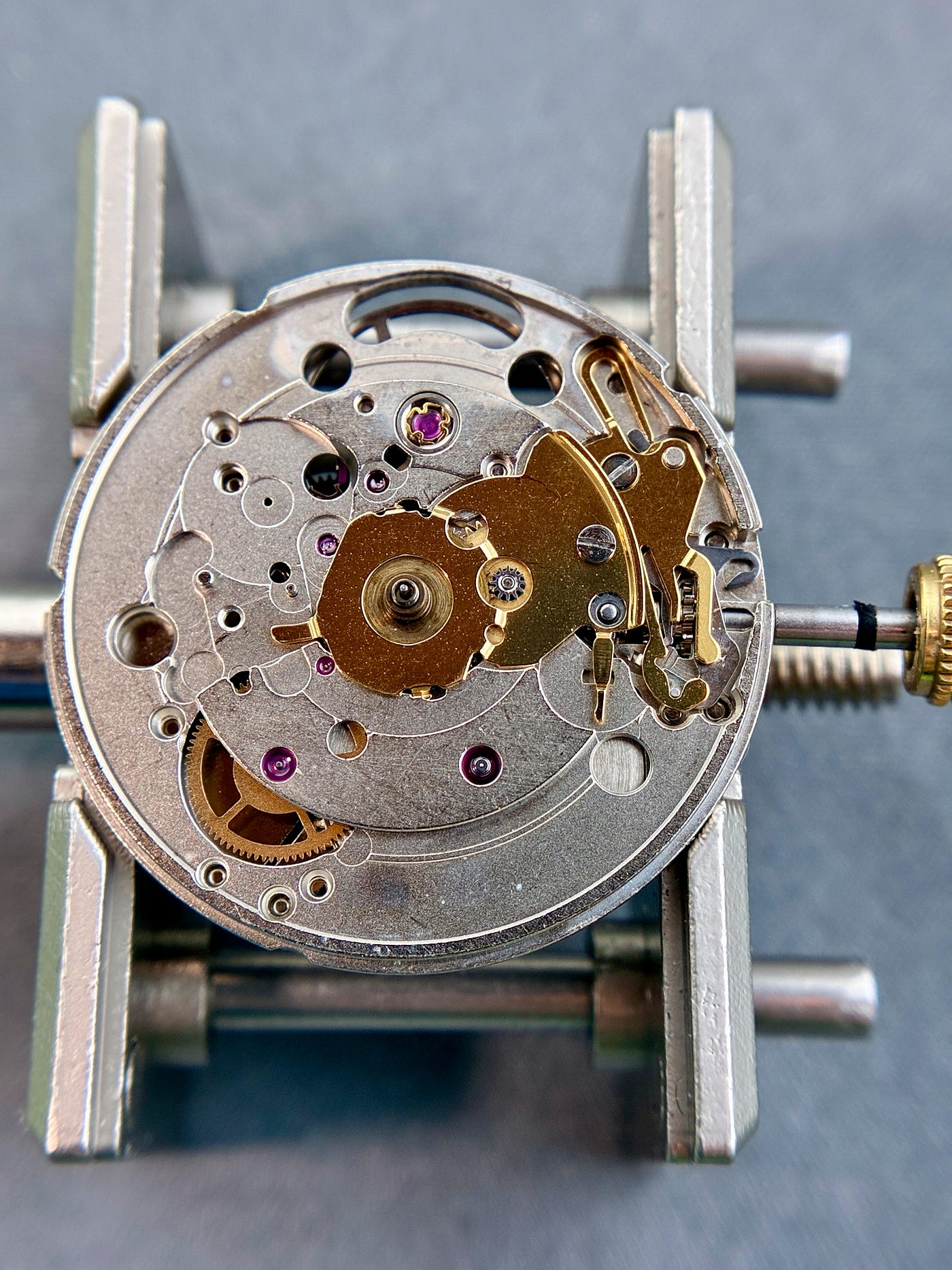
The gear train side of the movement.
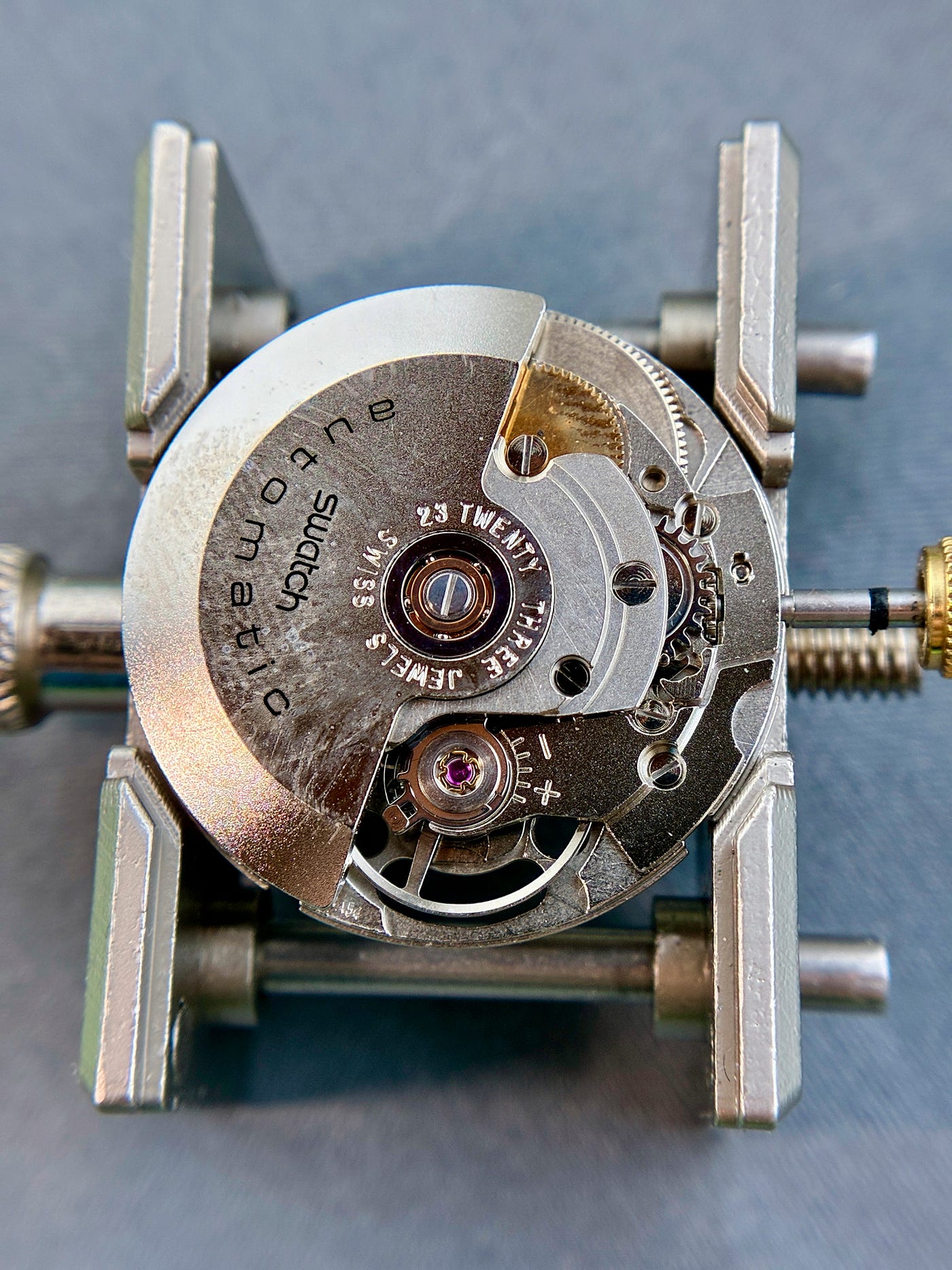
Remove the rotor first.
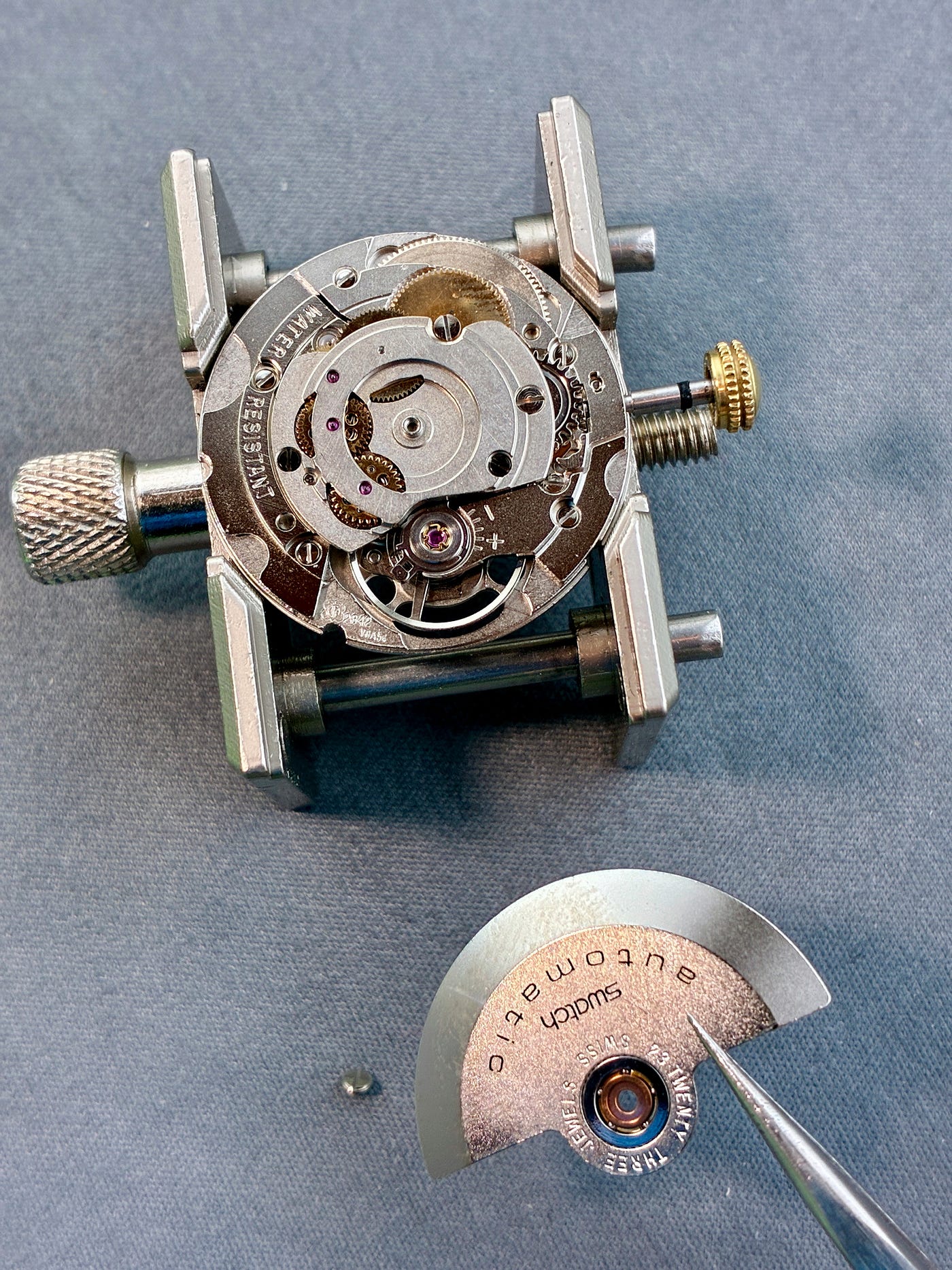
Flip back and remove the cover plate for time setting wheels.
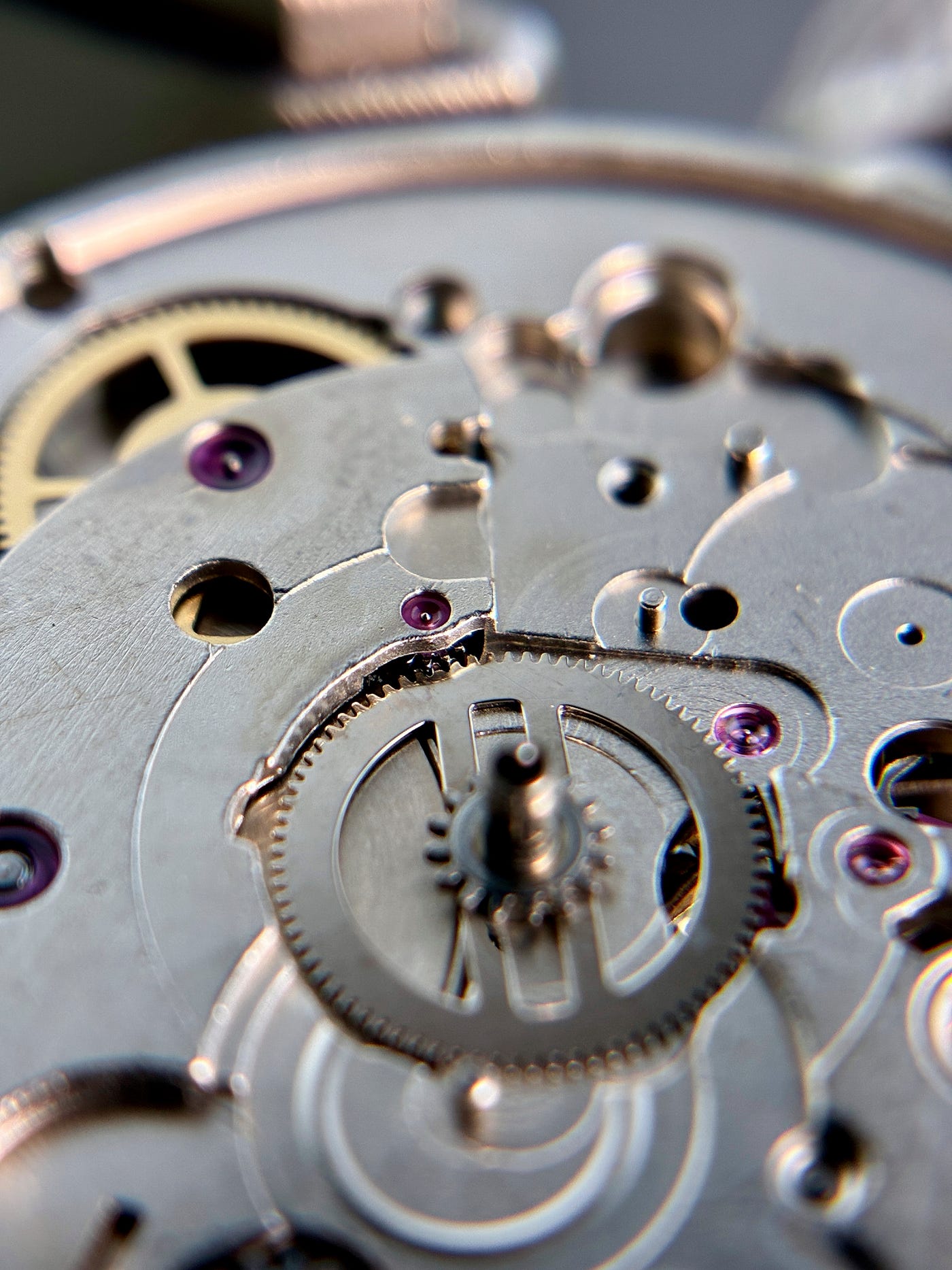
Look closely to the cannon pinion (where the minute hand is installed) and its drive wheel, it is in fact driven by the third wheel in the gear train, with one end sticking out from below. This is the so-called indirect-driven minute hand.
The cannon pinion is fit onto the drive wheel and would turn together by friction. But when the user turns the crown to set time, the cannon pinion would be turned independently by the minute wheel beside it.
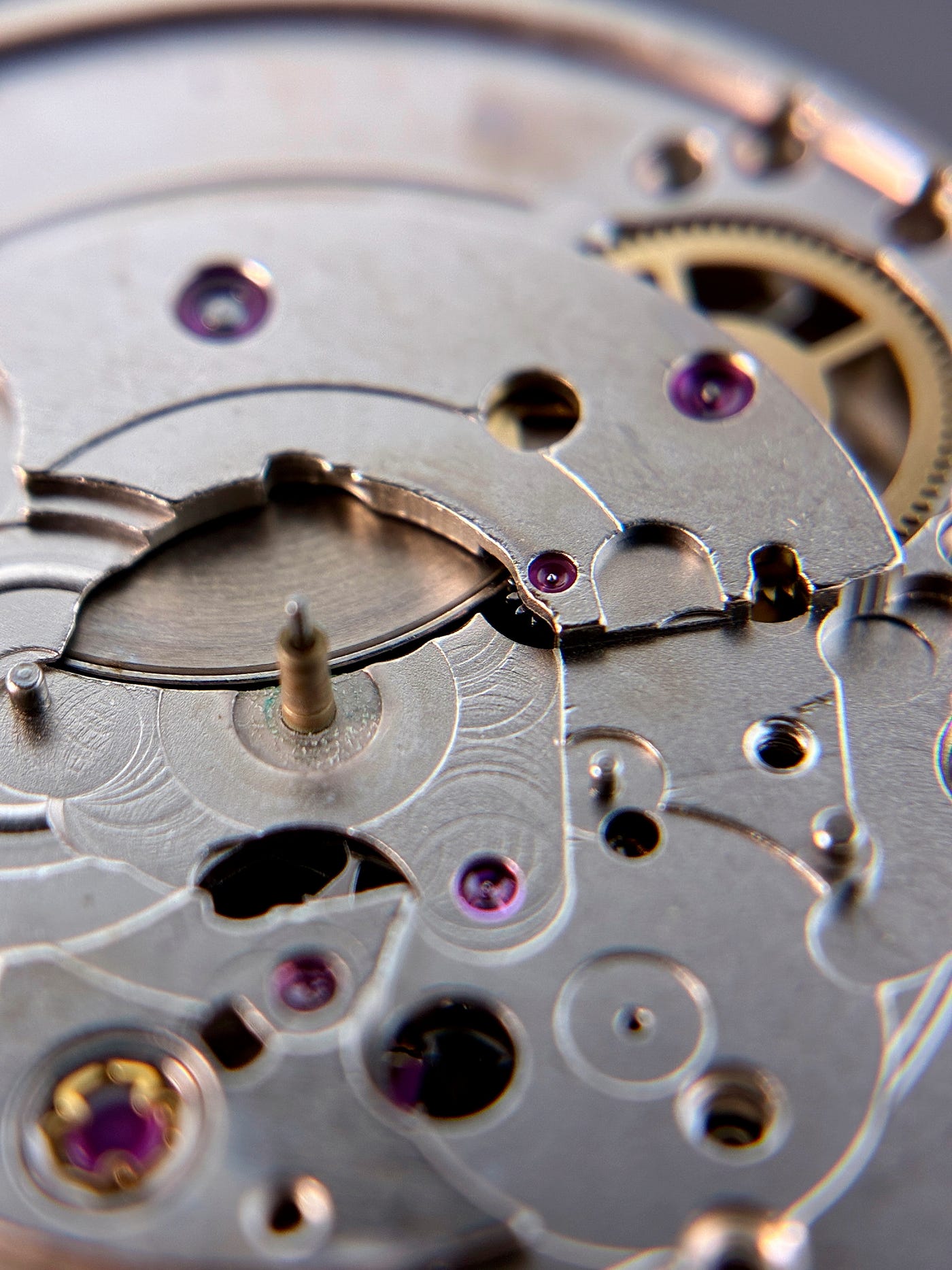
Here‘s another shot of the third wheel pinion without the cannon pinion/drive wheel.
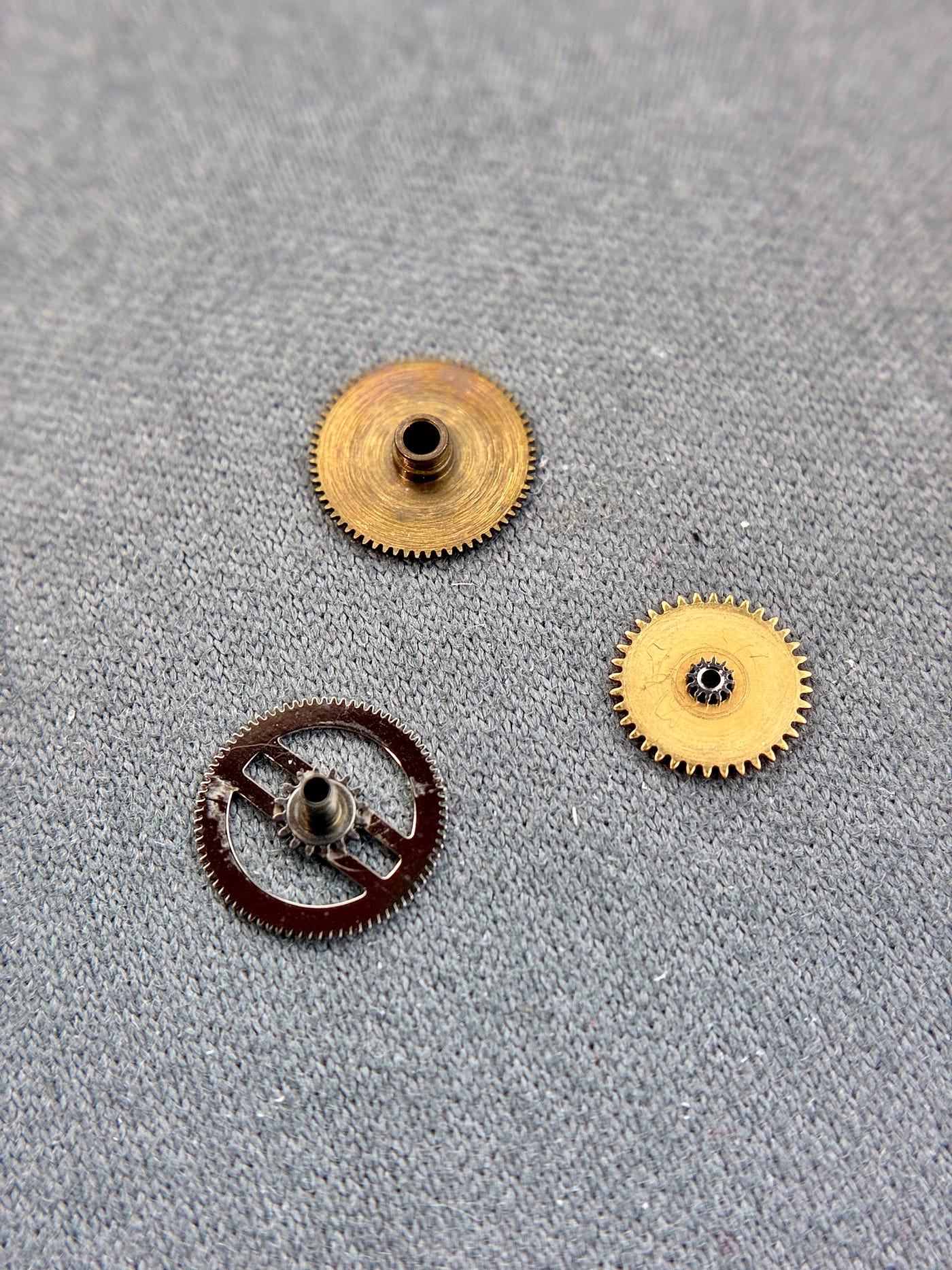
Remove the time setting wheels.
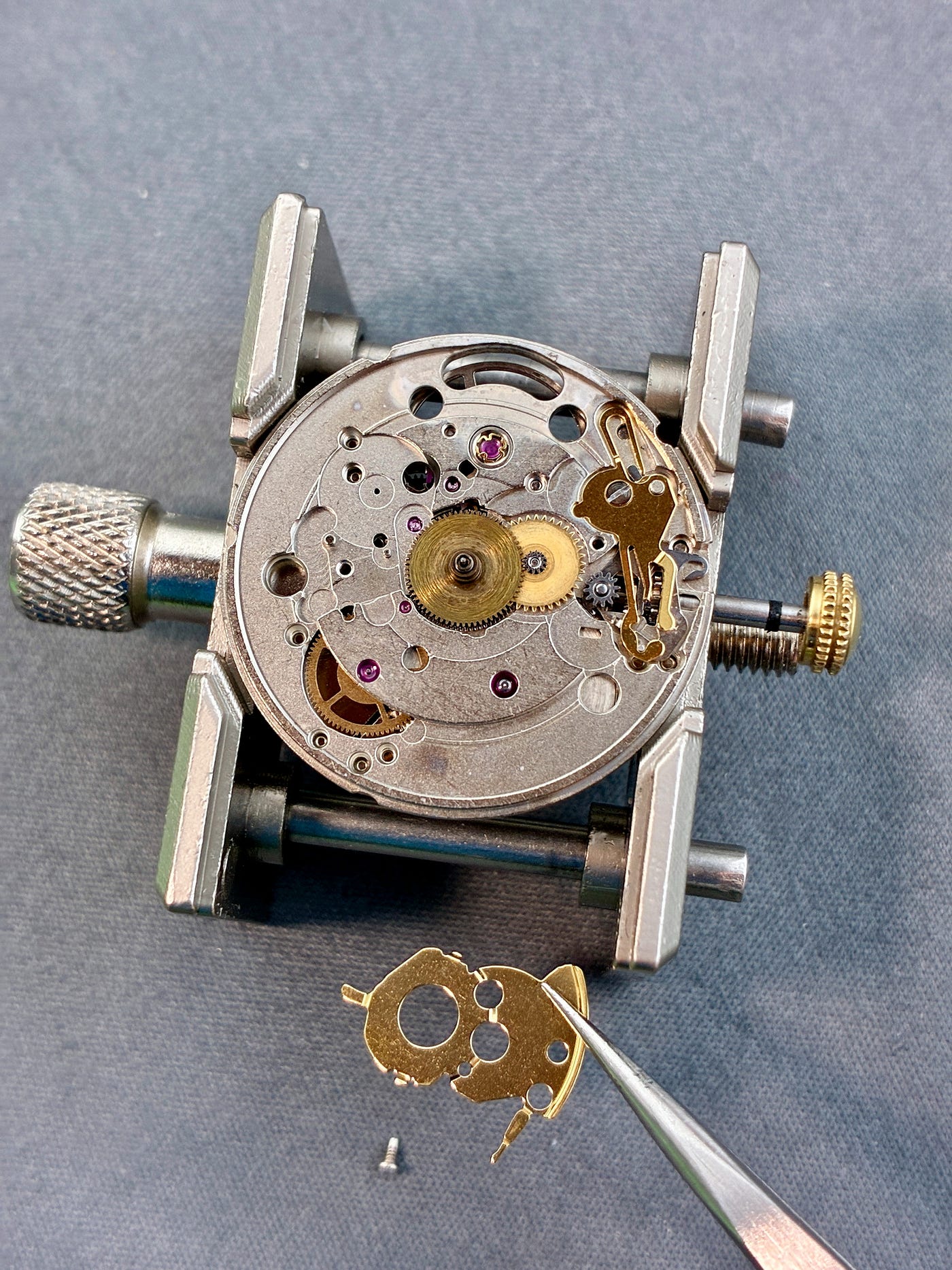
Without the calendar work to worry about, we can move on to deal with the keyless work.
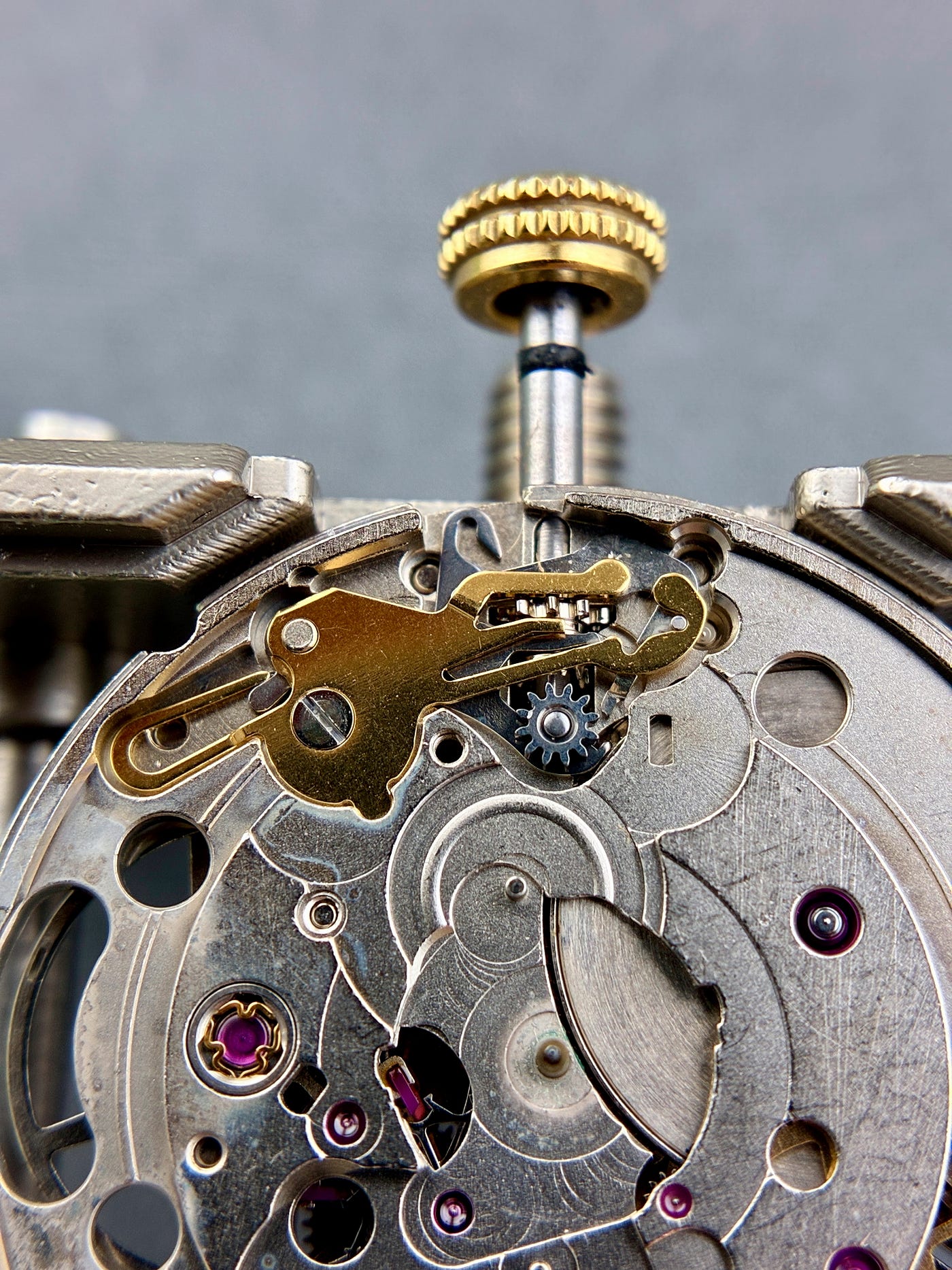
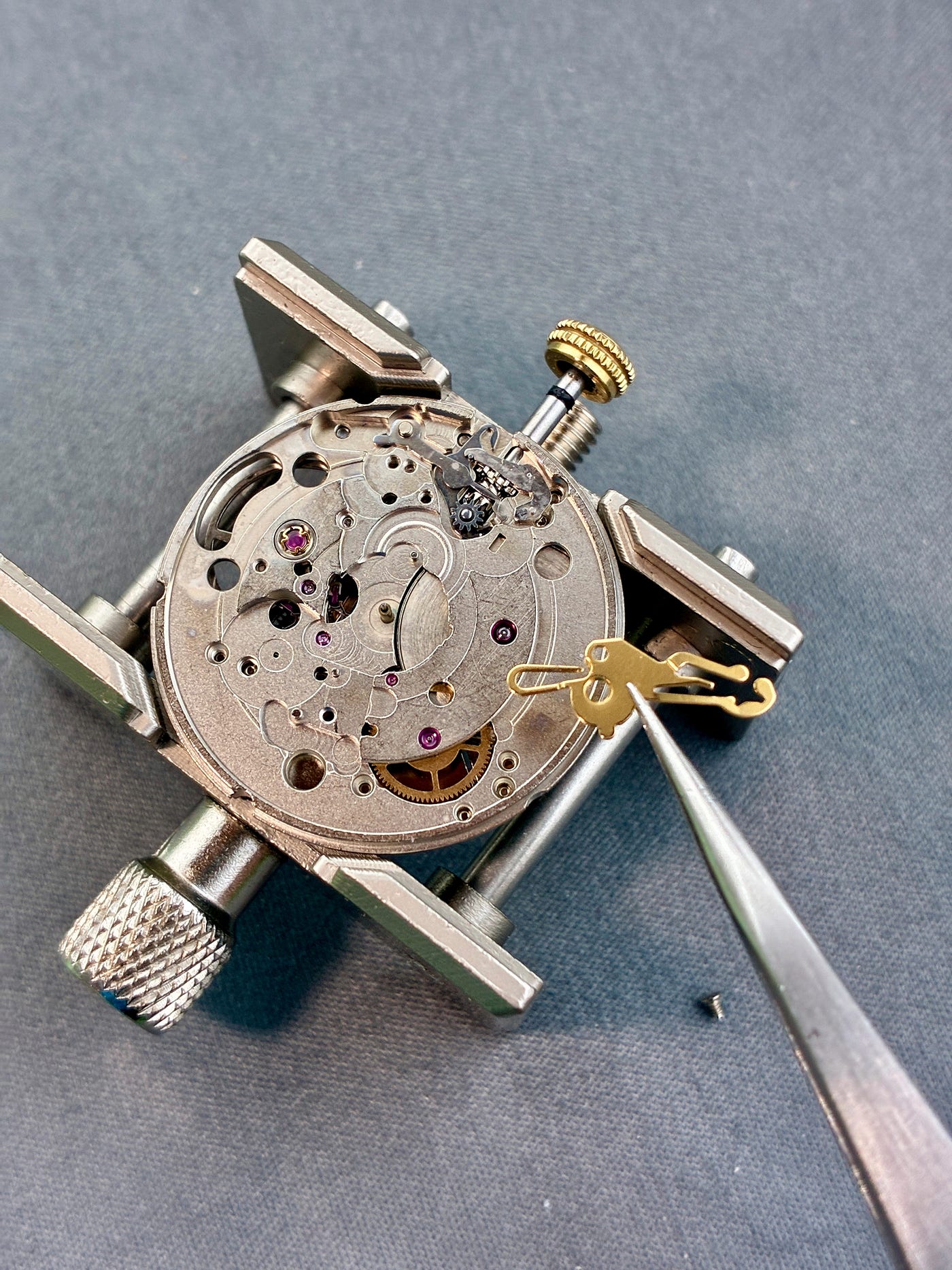
Remove the setting wheel spring, which also contains the yoke spring on the other end, and serves as the cover plate for multiple parts.
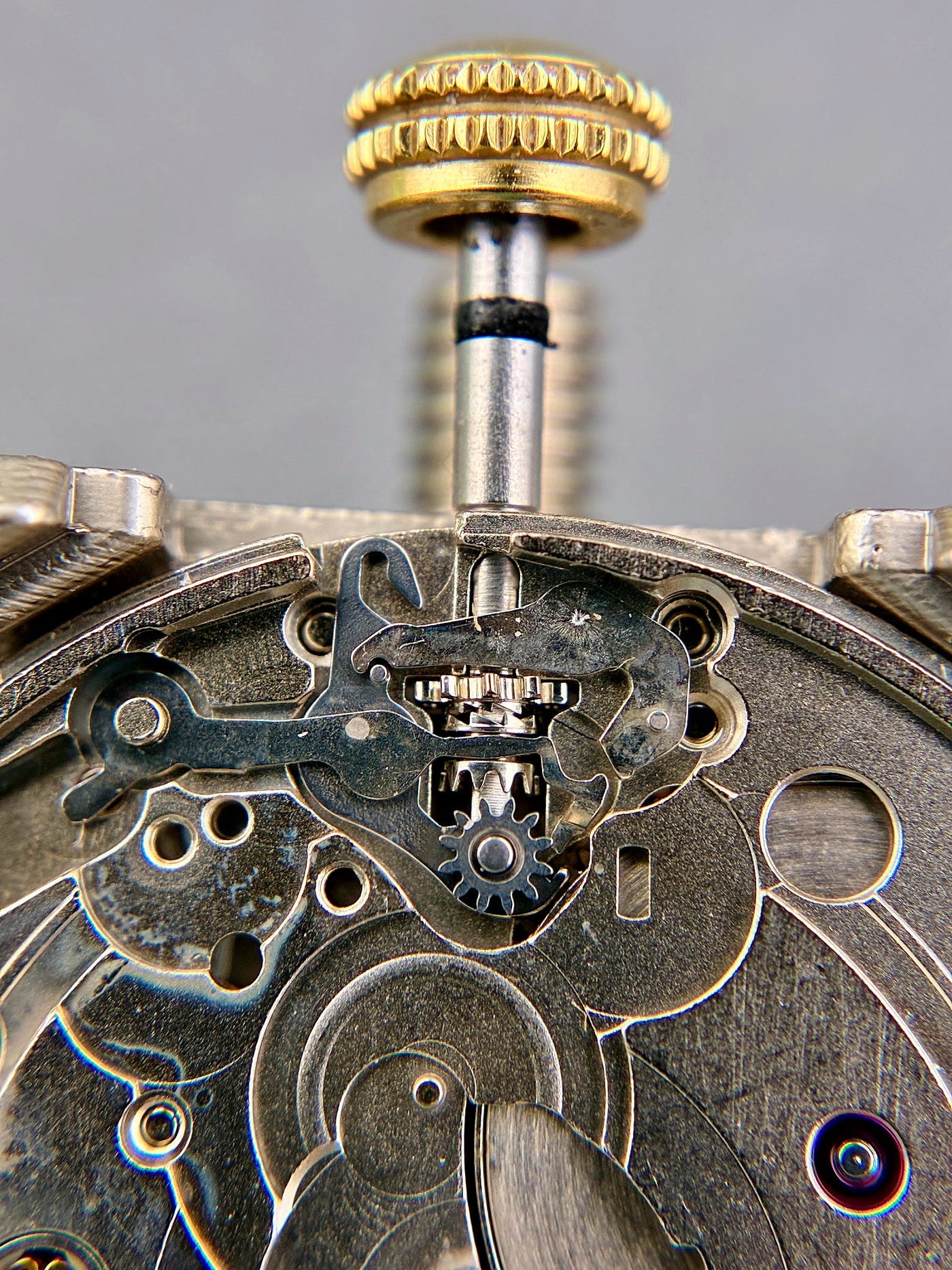
When the crown is pulled, the setting lever (top rght) would push the yoke (middle left) downwards, connecting the clutch to the setting wheel. The lever with the setting wheel would also be turned clockwise as well, moving the setting wheel toward the minute wheel.
In the normal (first) position, the clutch would turn the winding pinion behind it, which connects to the crown wheel on the other side.
On the 2824, there is a middle position for date quick-set, where the setting wheel would connect the date corrector wheel (which is not present in this movement).
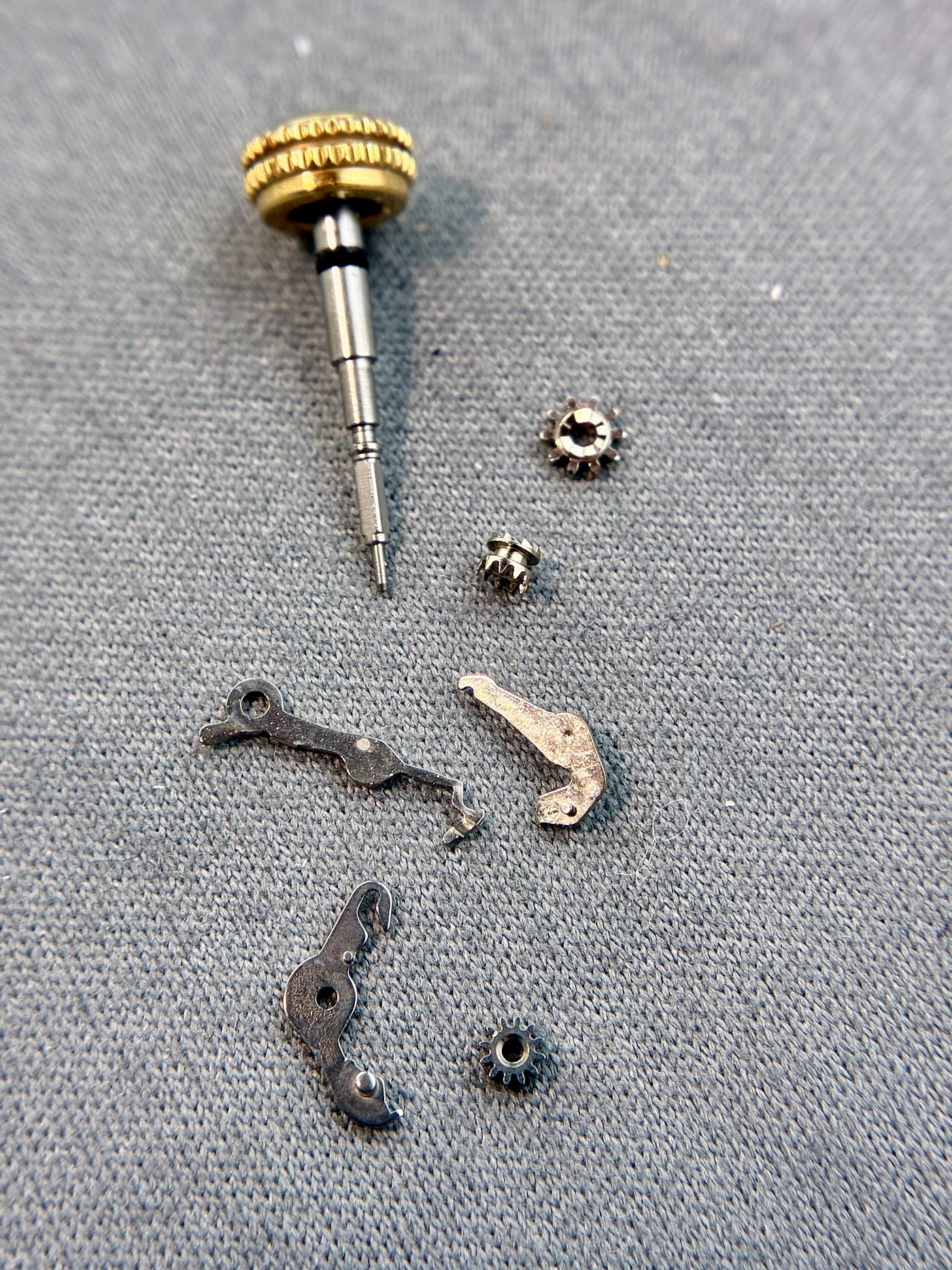
Remove the crown and the rest of the keyless work.
Move on to the gear train side, we first remove the automatic framework.
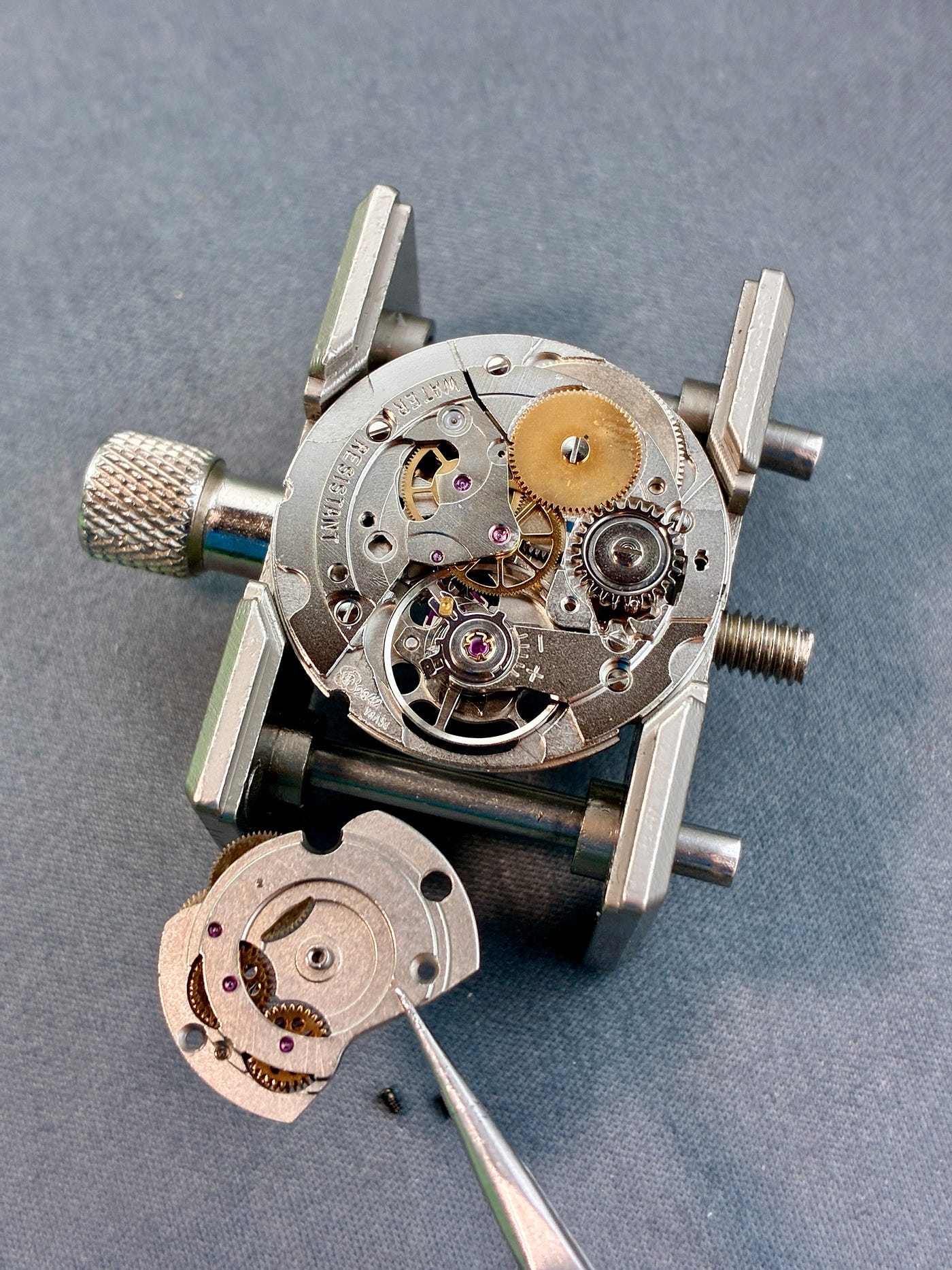
The framework contains a few wheels for two-way automatic winding.
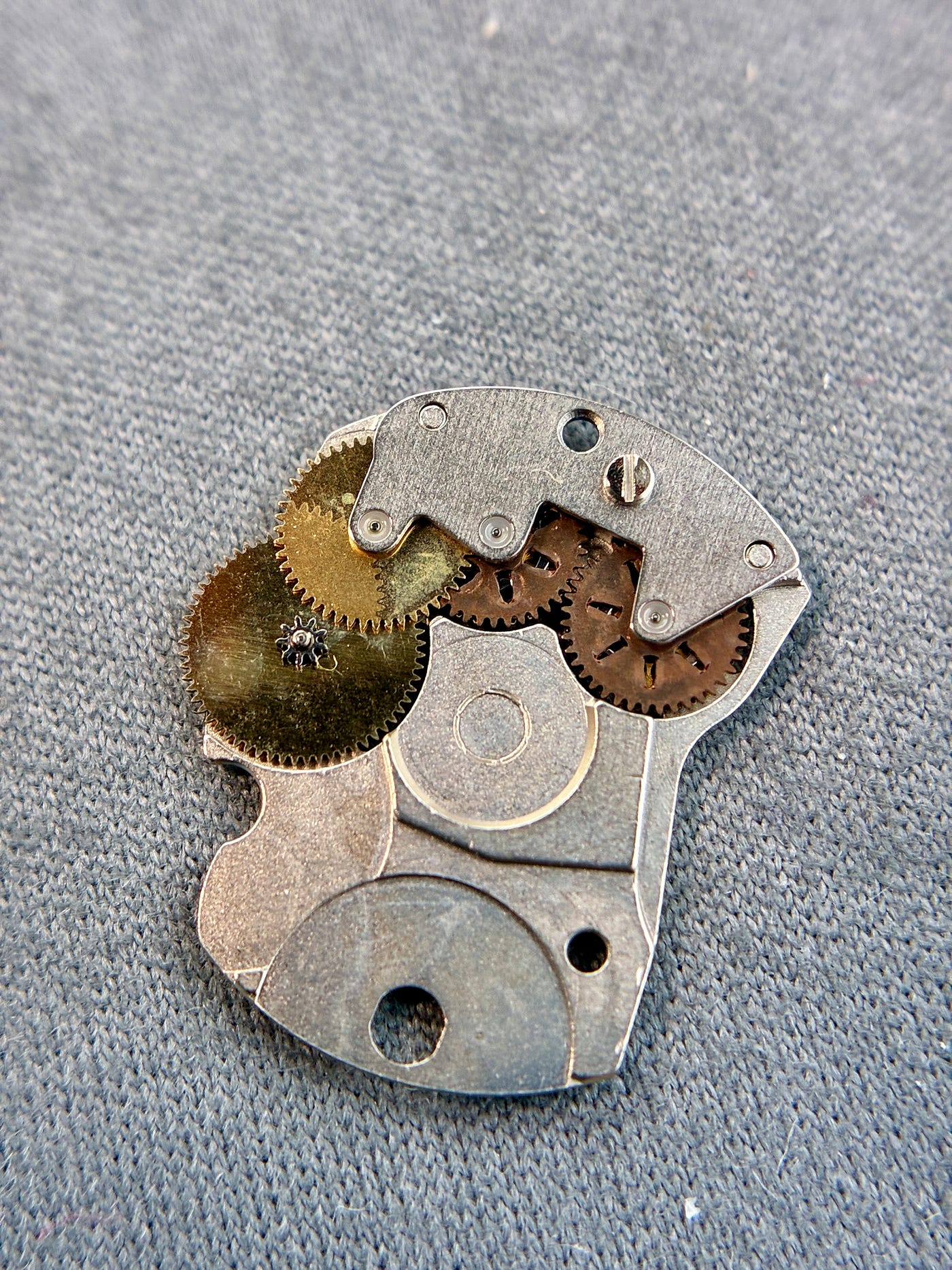
From left to right:
- ratchet wheel drive wheel
- reduction wheel
- reversing wheel
- auxiliary reversing wheel
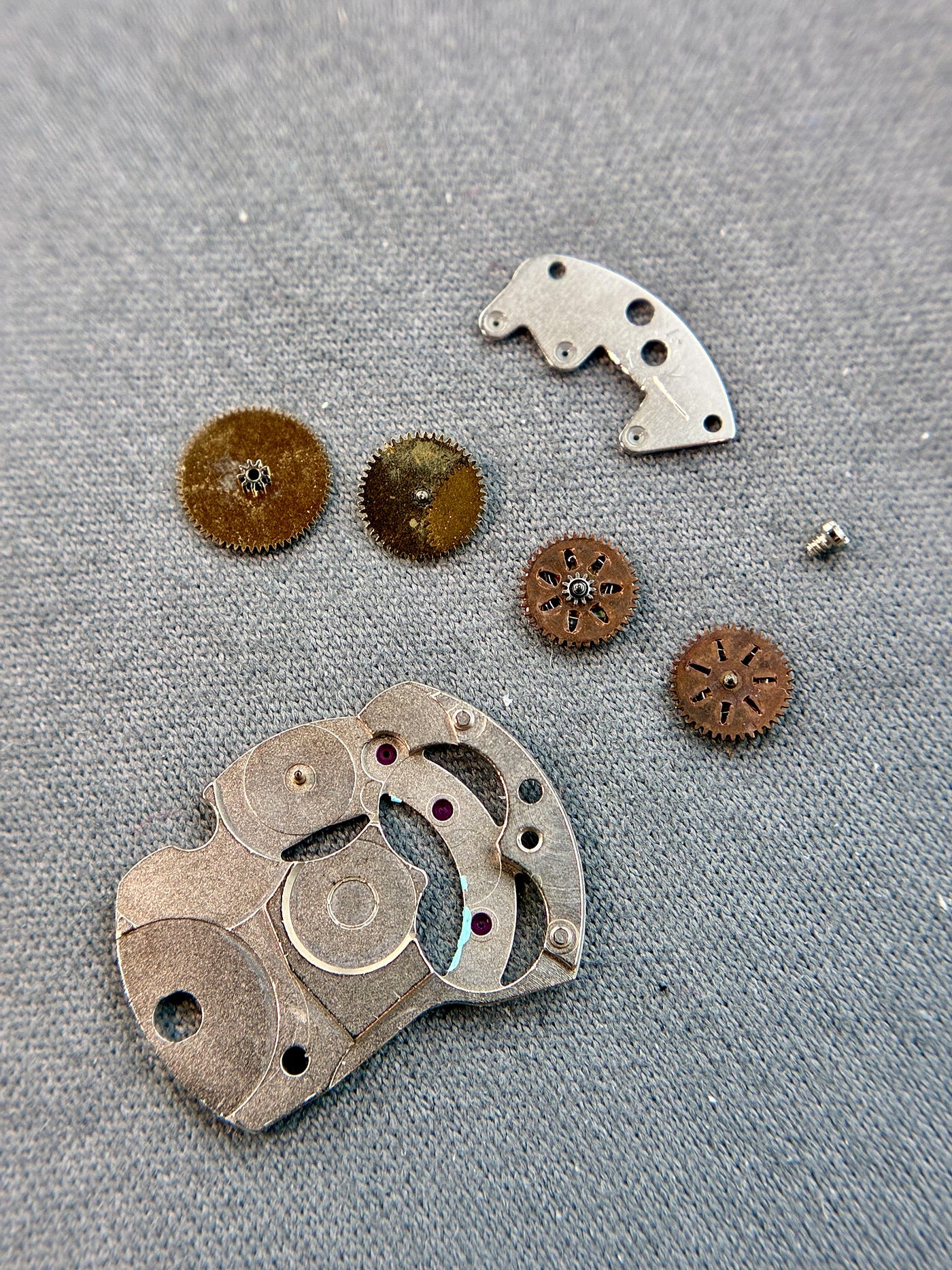
The reversing wheels have two small springs between the two wheels, so the top wheel can only turn the bottom wheel one way but not the other. The top wheels are also smaller, so they do not touch each other, while the larger bottom wheels are coupled.
When the rotor rotates and move both top wheels, only one of the bottom wheel would turn (the other would be turned as well and slide on the springs, not affected by the top wheel). Which is why the reduction wheel and drive wheel will always turn in one direction — wind the mainspring regardless of how the rotor moves.
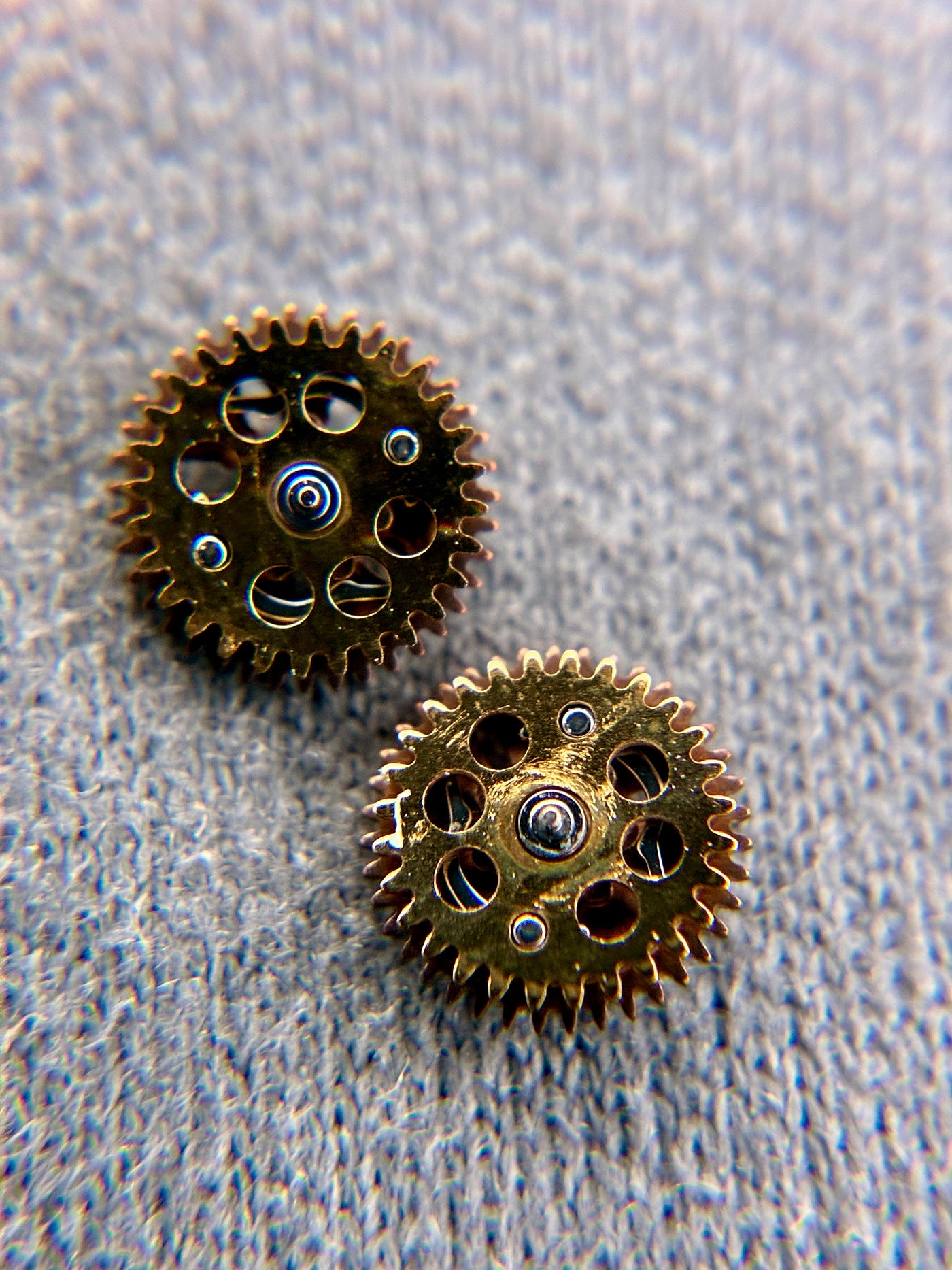
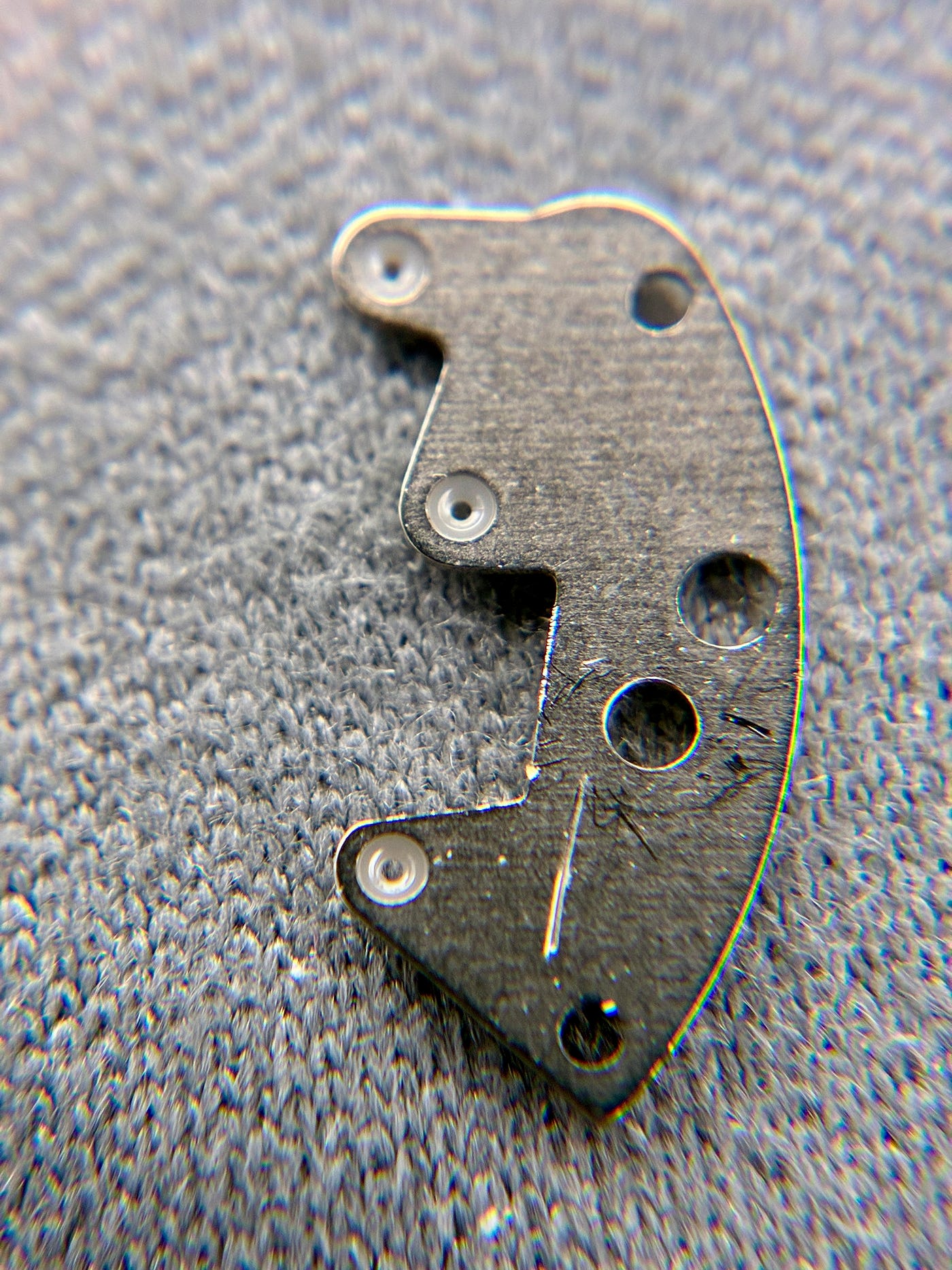
Let’s take a look at the bottom plate of the automatic framework as well. Note that these bearings are plastic instead of jewels. (The scratch was the result of trying to unscrew an unexpectedly tight screw.)
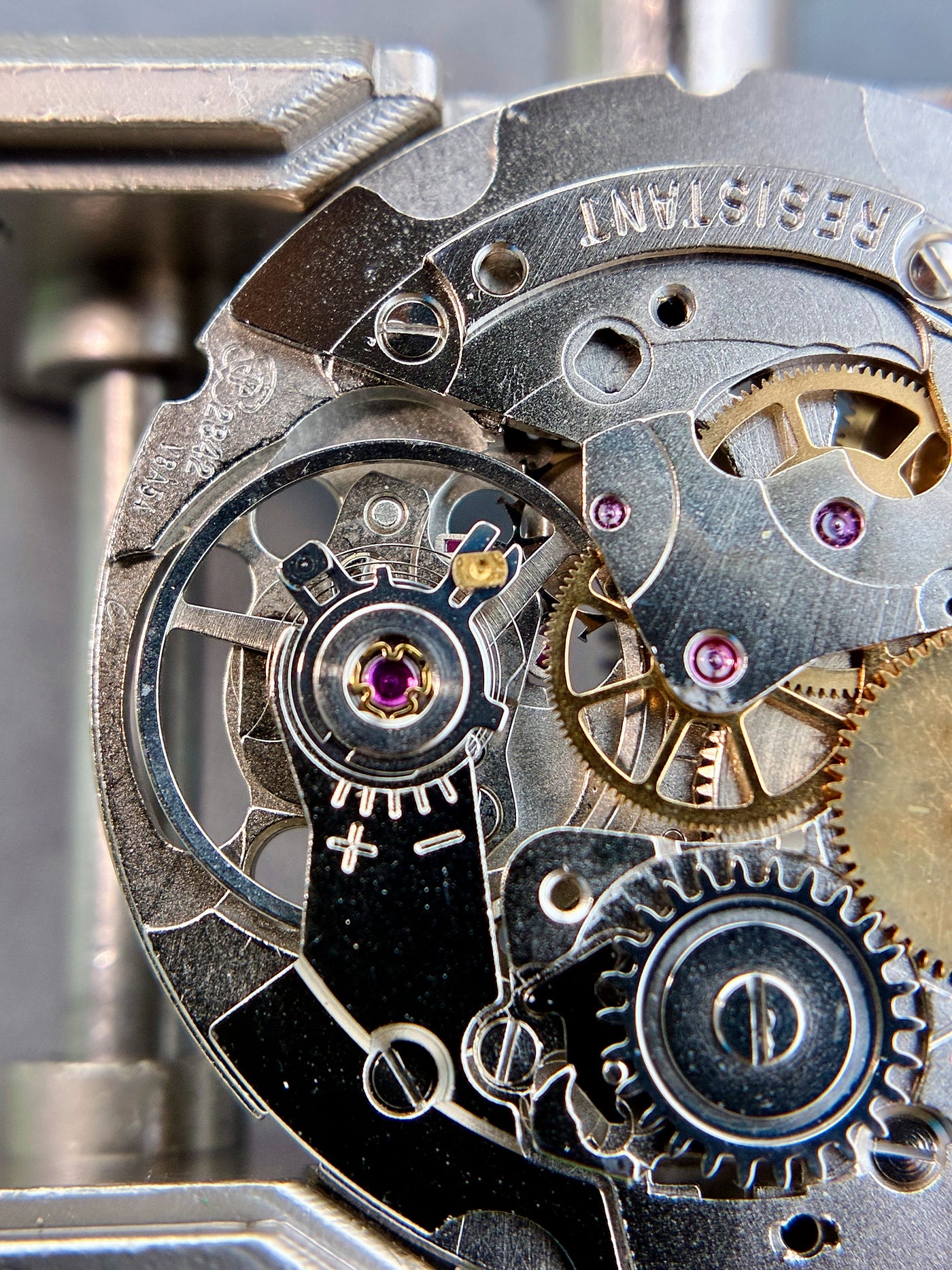
Now a closer look of the balance wheel and part of the gear train.
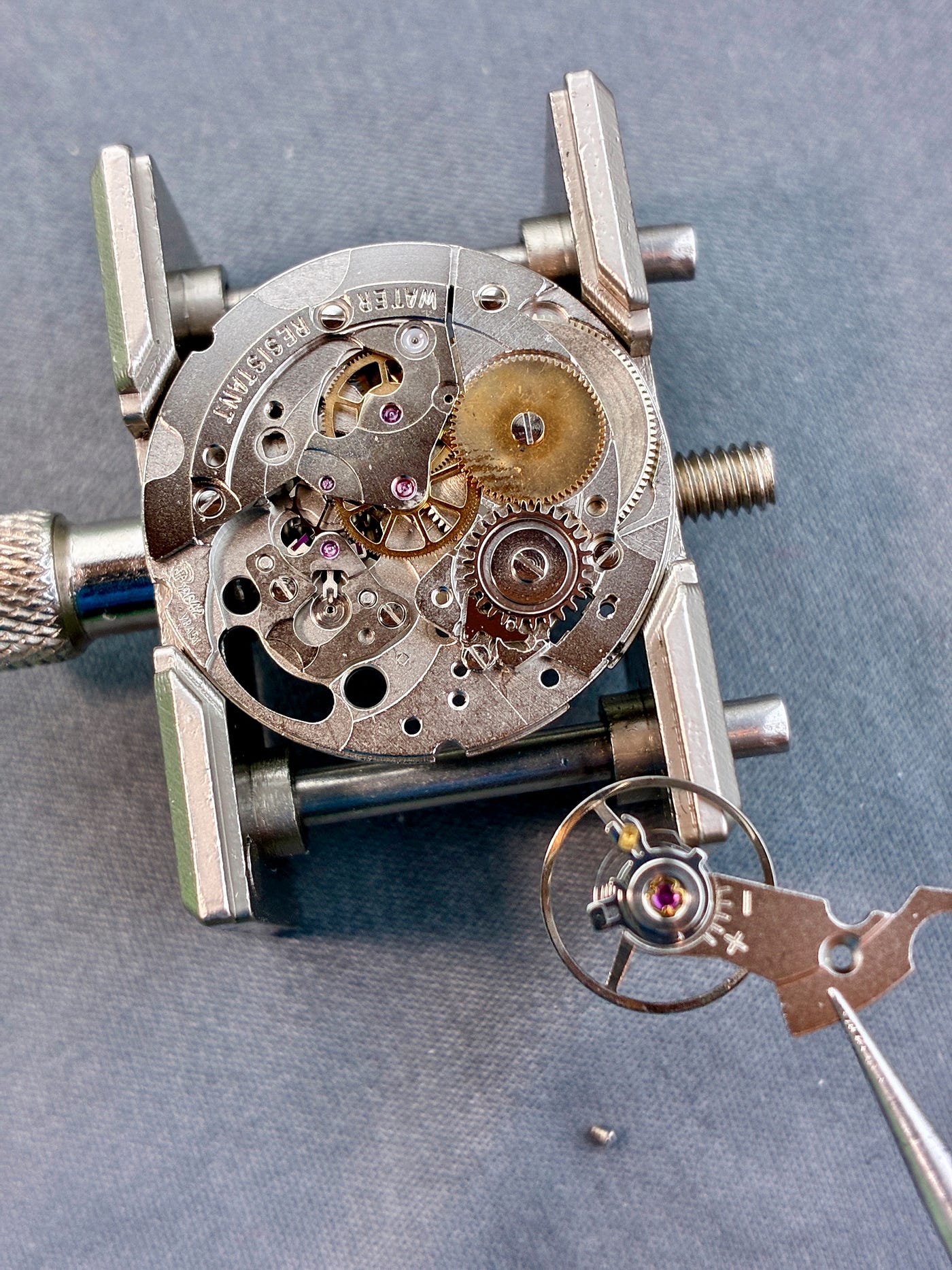
Remove the balance wheel and bridge.
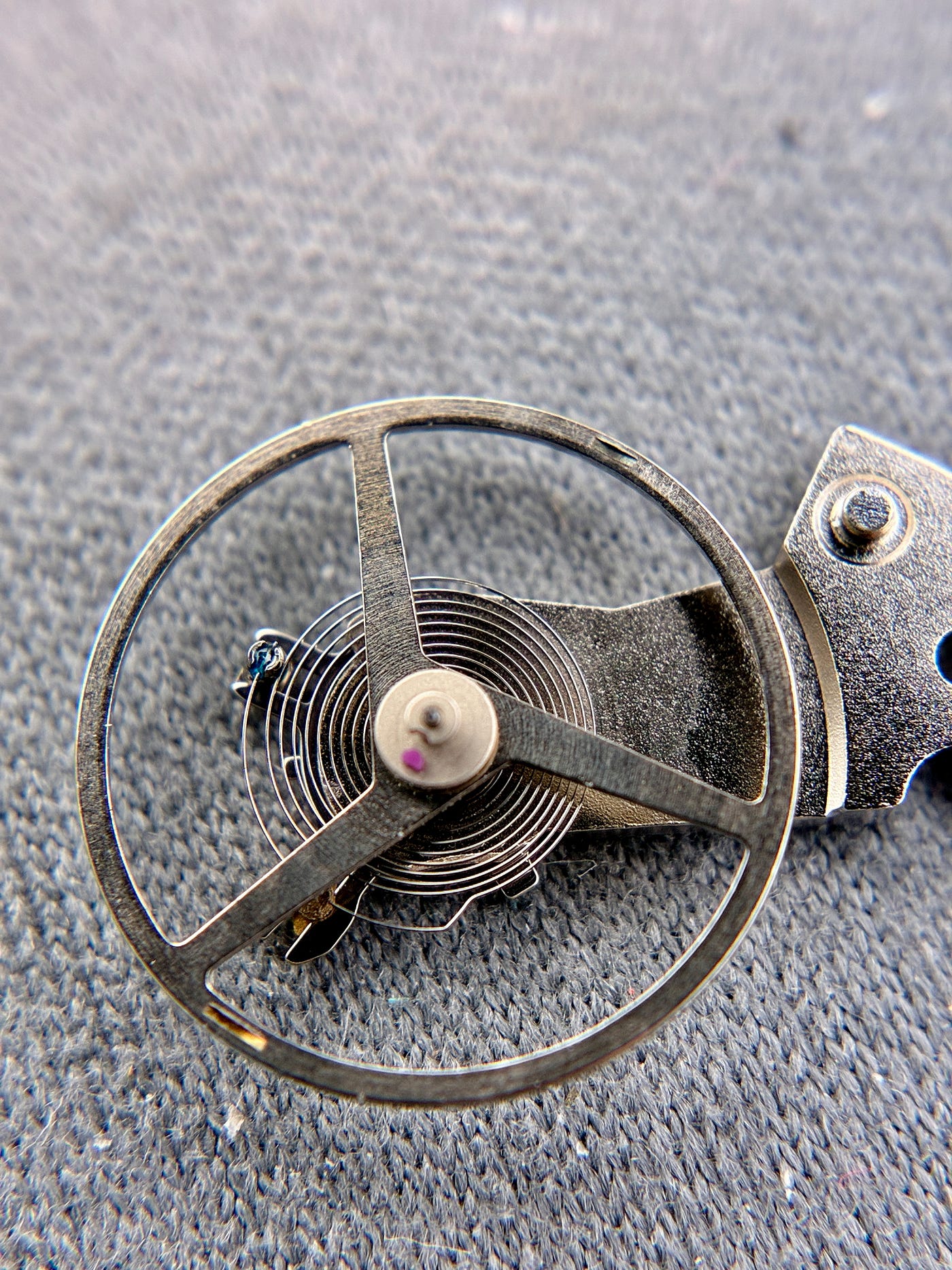
The hairspring is slightly off-center, but not bad.
Remove the crown wheel, which is the wheel directly turned by the winding pinion.
Note the oval-shaped axis of the crown wheel, and the click with its U-shaped click spring.
The click spring is incredibly easy to lose. You pull it out with tweezers in one go. If you are not sure about it, wrap a zip bag around the movement and try to pry up the spring from outside.
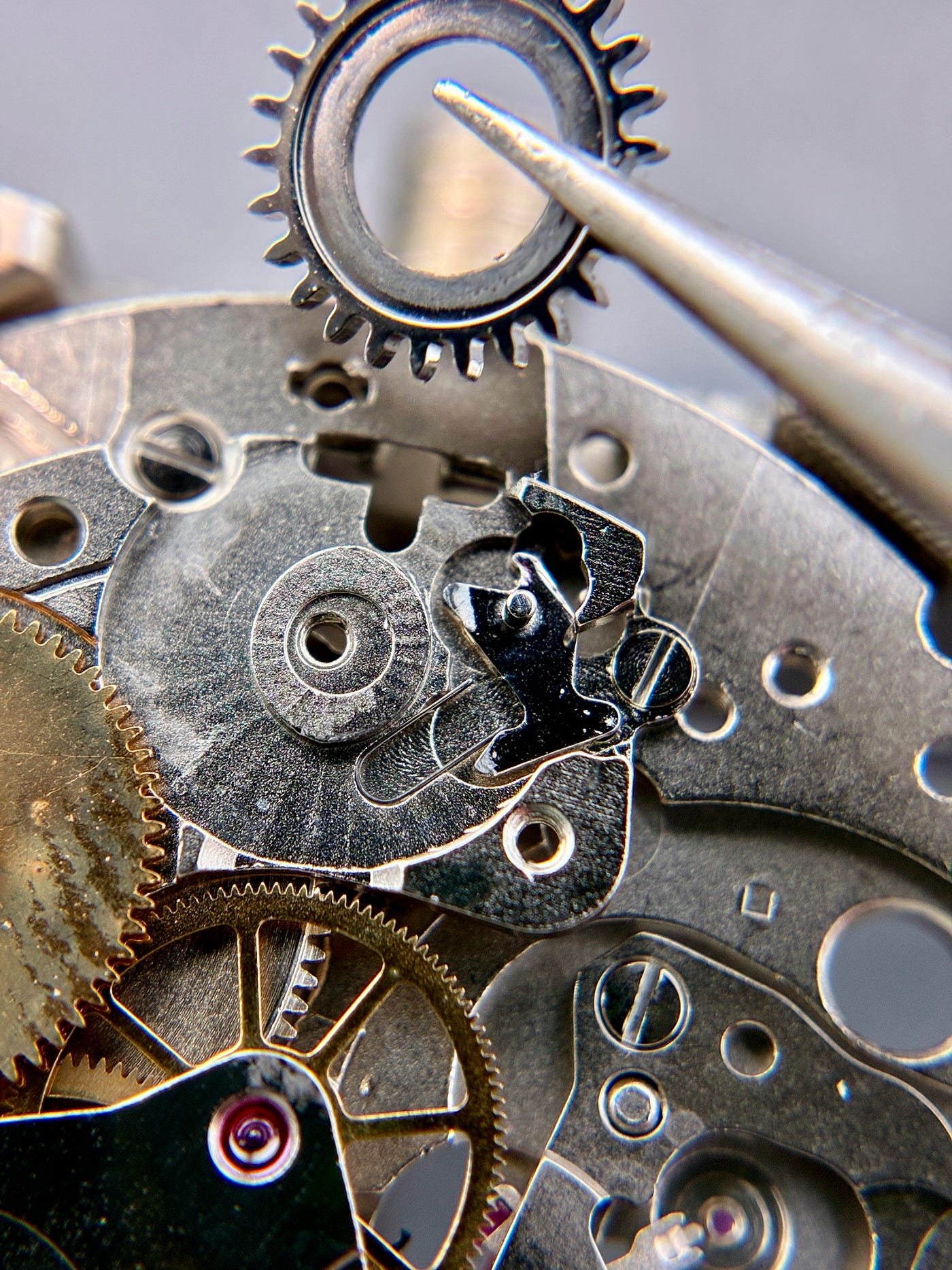
Traditionally, the click would be at the ratchet wheel, which connects the arbor (mainspring center axis). The click stops the ratchet wheel to turn backwards, forcing the mainspring to release its power by pushing against the barrel. The barrel turns as the first wheel in the gear train.
The ETA movements moved the click to the crown wheel, which is designed to slide when needed:
- During manual winding, the winding pinion push the crown wheel toward the ratchet wheel. The click stops the crown wheel turning backwards whenever you stop winding.
- If the winding pinion somehow turns backwards (not possible by design), the crown wheel would simply be pushed away from the ratchet wheel, avoiding doing anything to the ratchet wheel and mainspring.
- When the ratchet wheel is turned by the automatic framework, the ratchet wheel would also push the crown wheel away slightly. The ratchet wheel teeth would slide against the crown wheel, as if the crown wheel is the click.
The earlier ETA 2824, and maybe similar movements at the time, used ratchet wheels with steeper teeth profiles, which tend to break when you wind it with too much force or the reversing wheels are jammed. It is said to be solved with re-designed ratchet wheels; while some claims the issue still exist, I don’t hear a lot of it in recent years, and I certainly never have problems with my Tissot Powermatic 80s.
With the automatic framework removed, we can also release the mainspring power by pulling the crown wheel away and slowly rotate the ratchet wheel axis screw.
Now remove the crown wheel, ratchet wheel and click.
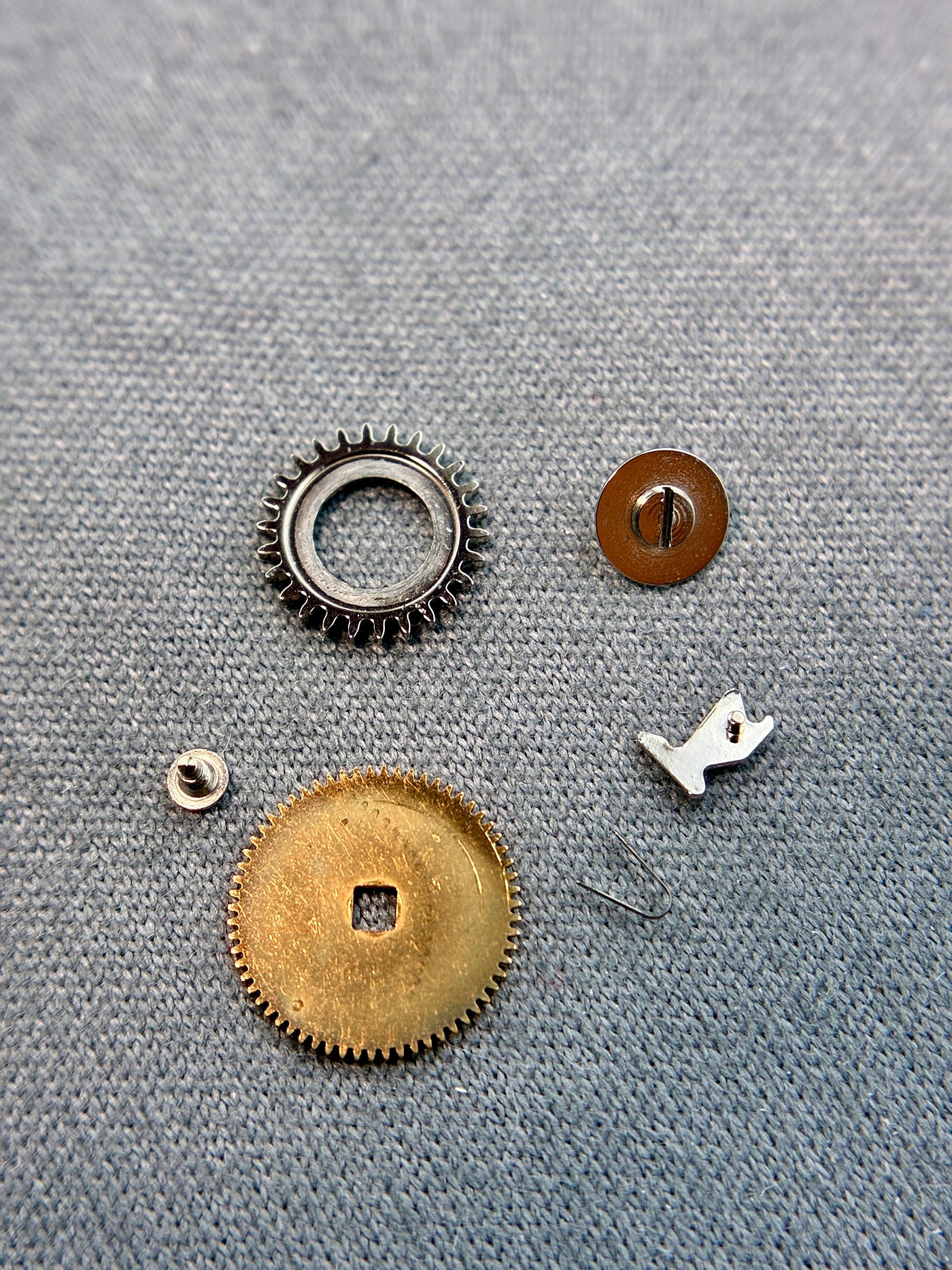
Remove the barrel bridge.
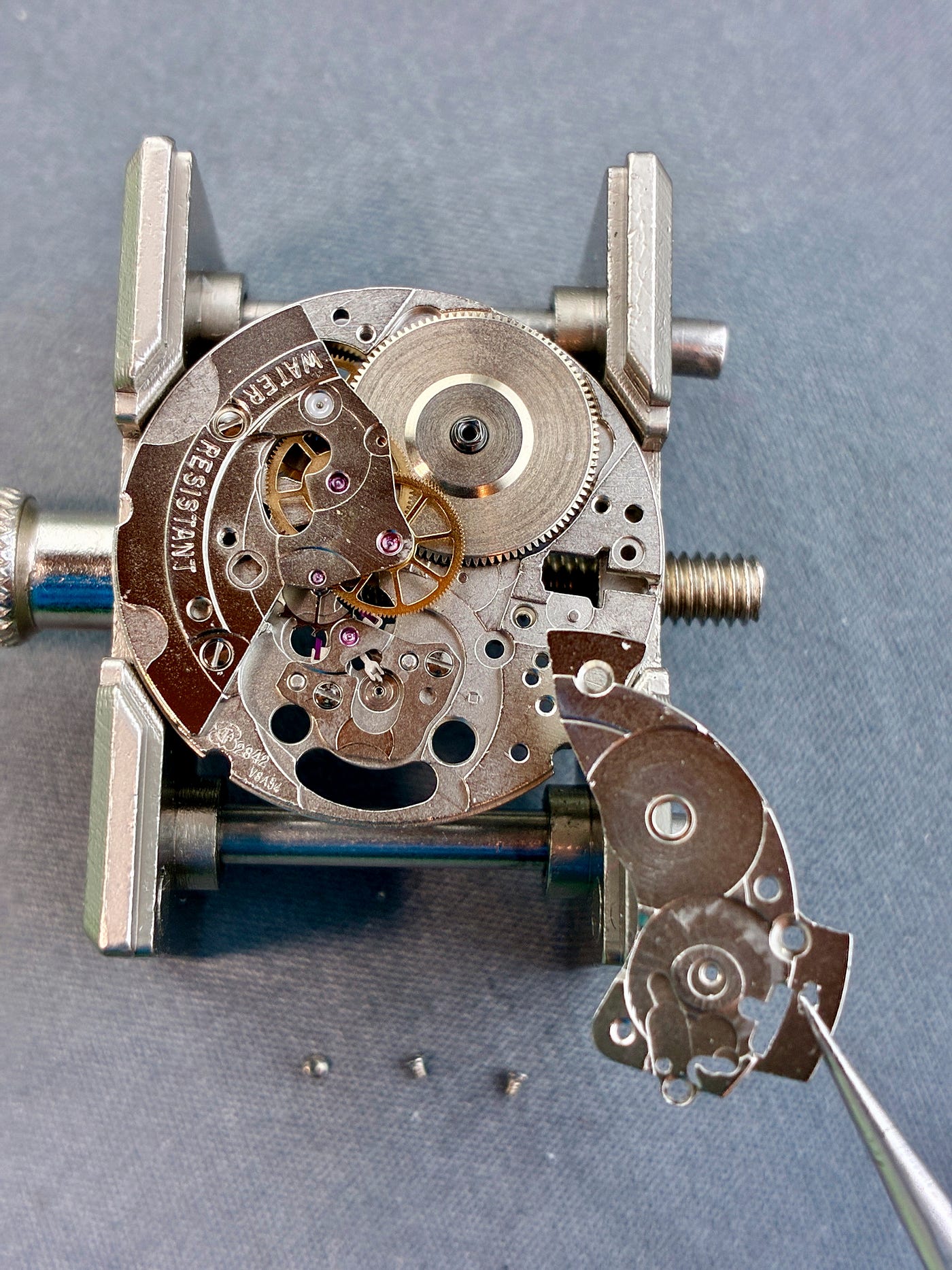
Remove the gear train bridge.
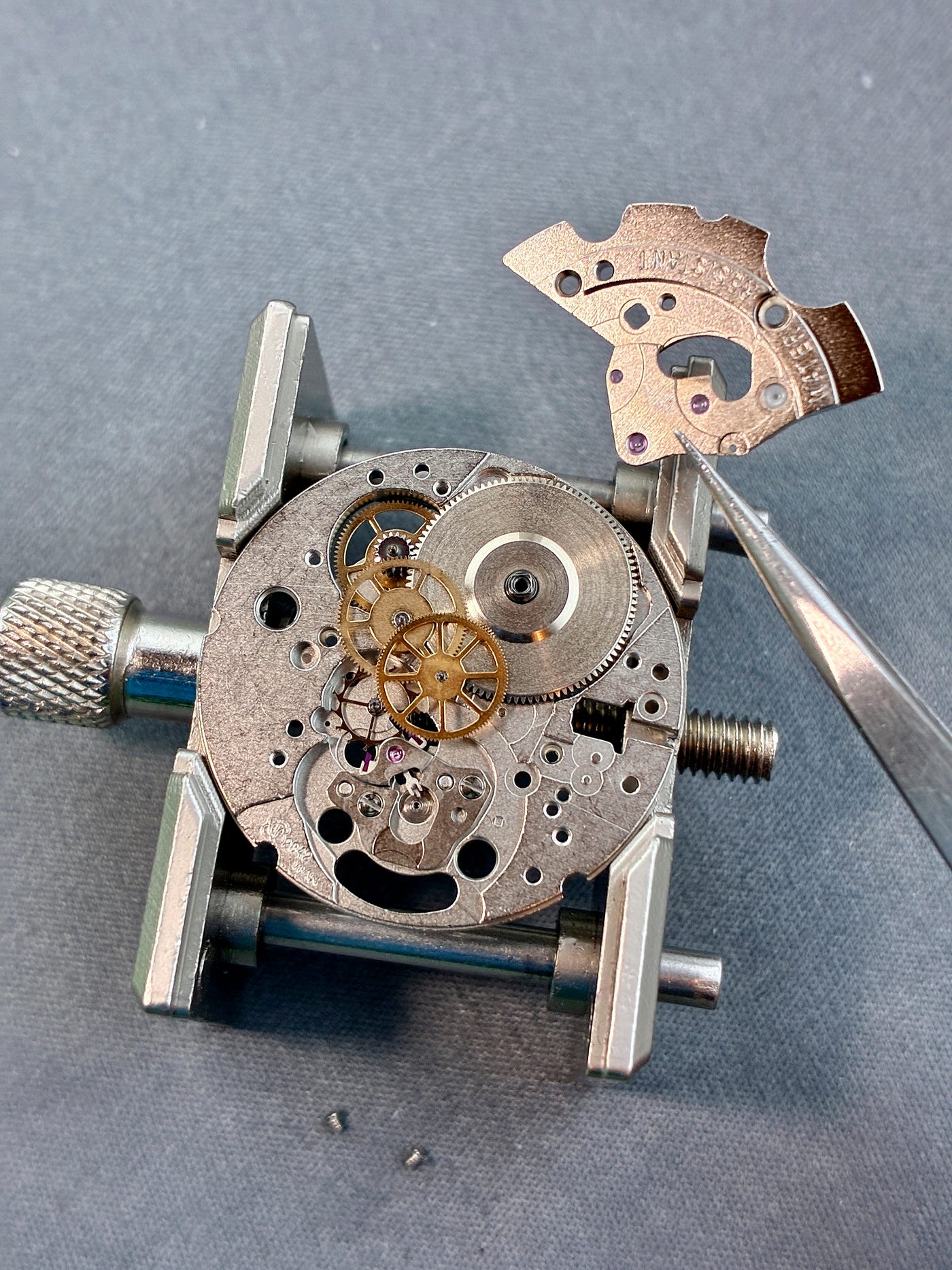
Note that the 2nd wheel (immediate wheel) bearing on this side is also made of plastic.
Remove the pallet fork bridge. You can see how the “System ETA”-styled gear train (sans balance wheel) lined up.
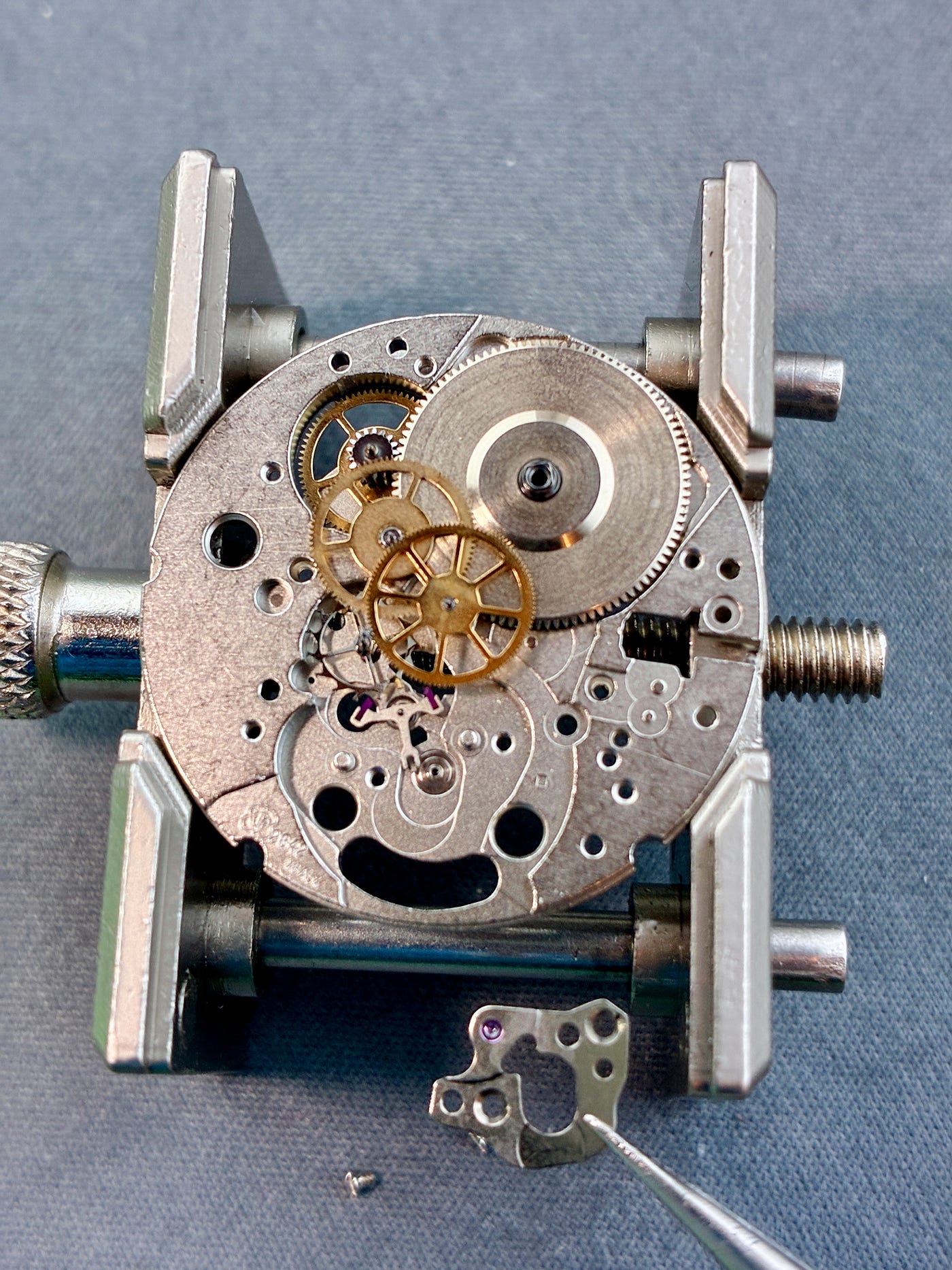
The barrel drives the 2nd wheel (immediate wheel), which is placed very close to the dial side. Then the 2nd wheel drives the third wheel via the smaller pinion. The same pinion drives the cannon pinion on the dial side, while the large pinion drives the fourth wheel, which is at the center of the movement.
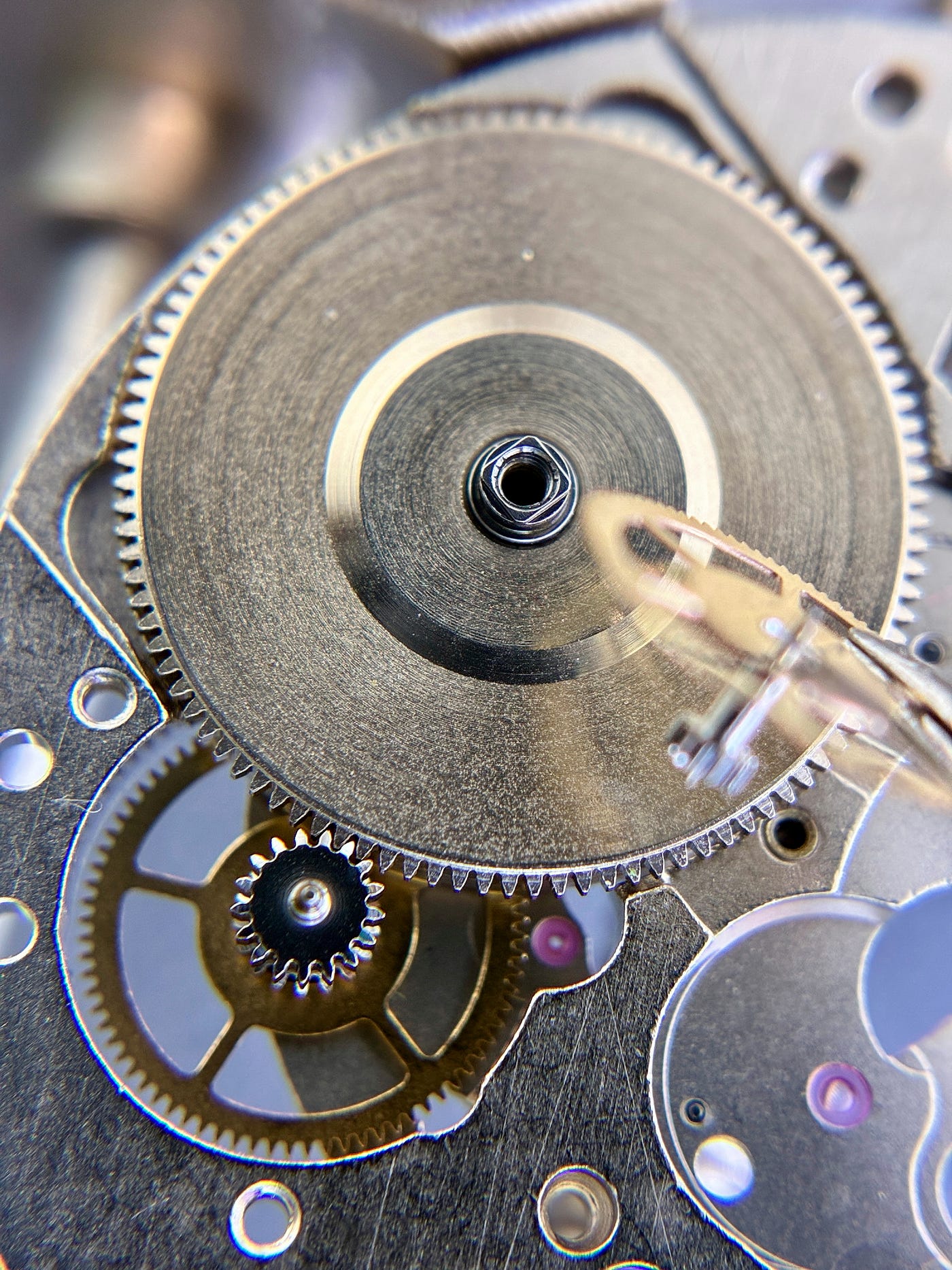
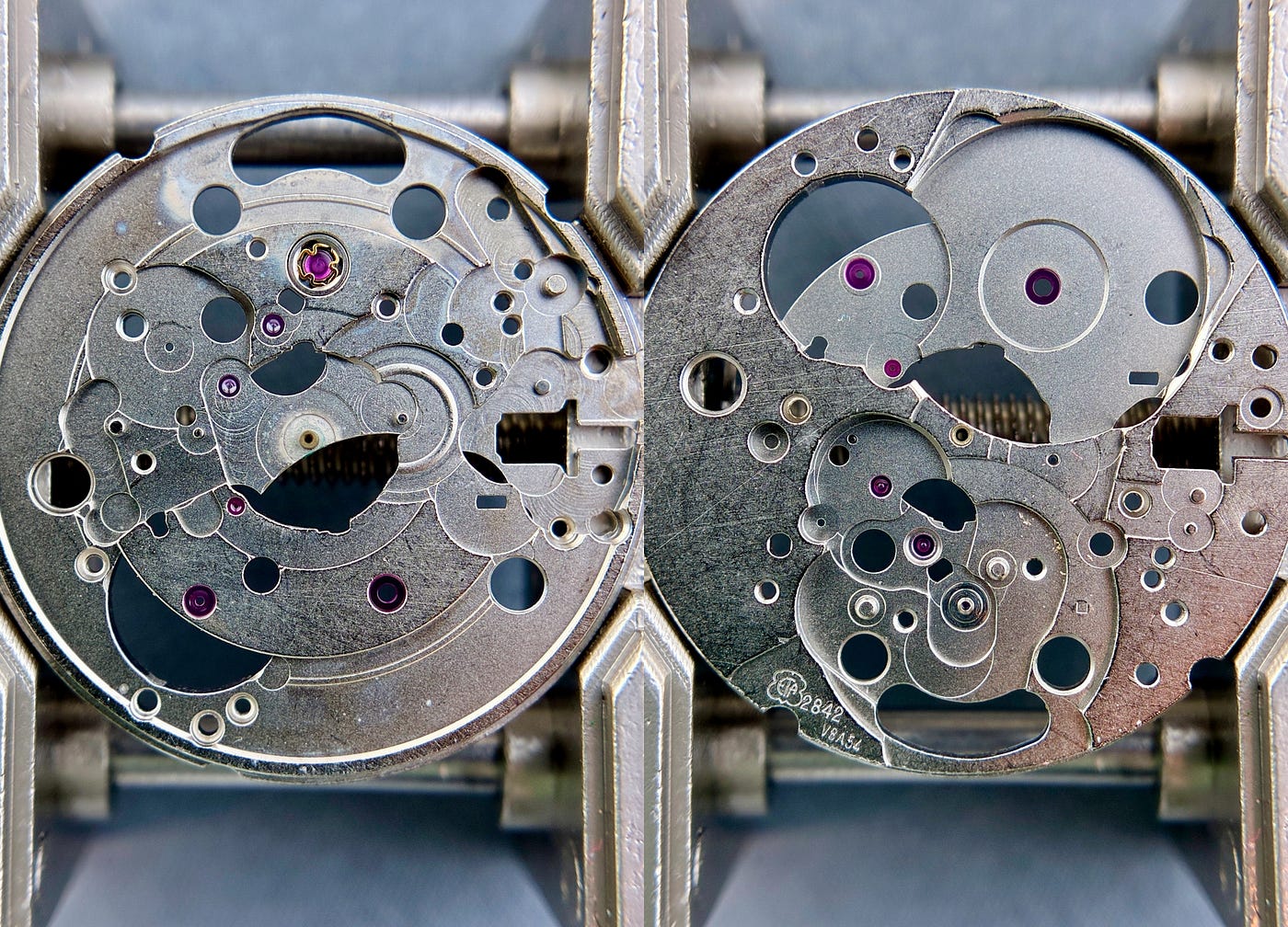
After removing the gear train parts, we have completed the strip down.
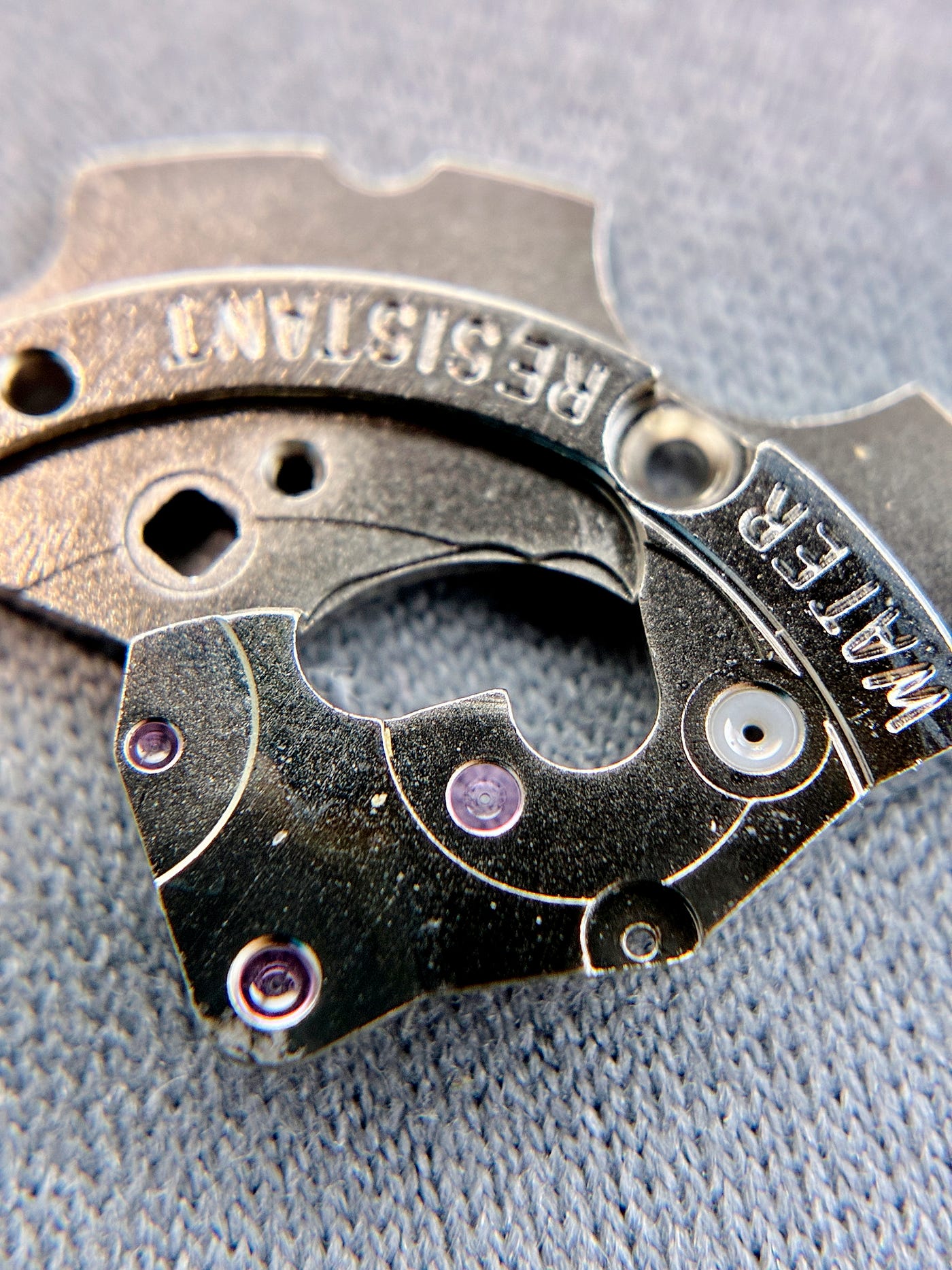
Of course, we need to remove the Novodiac anti-shock as well. Novodiac is made by Incabloc and is easier to made (hence cheaper) than Incabloc shock absorbers, although you can find them in modern models like ETA’s Powermatic 80.
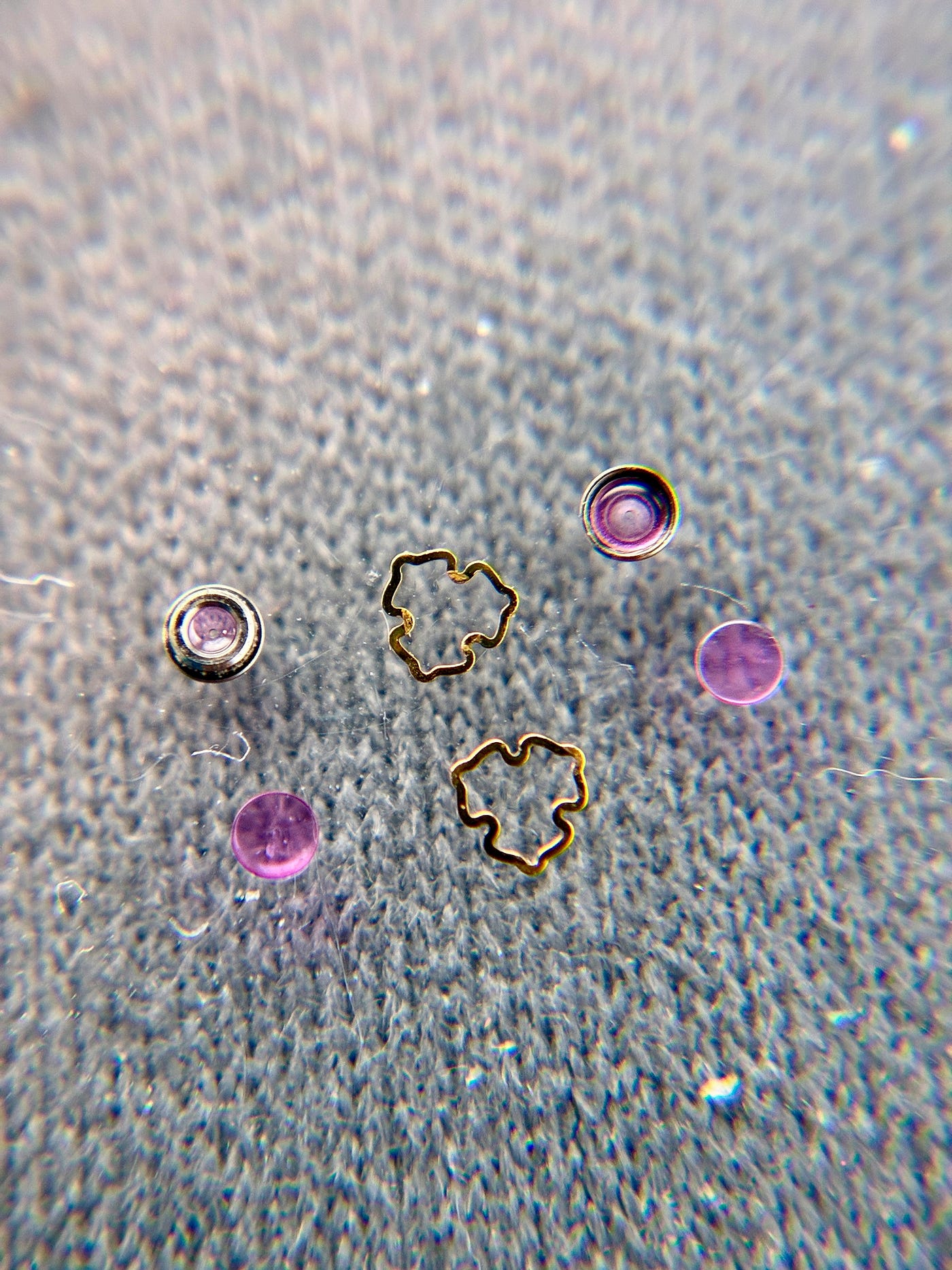
Jewels count:
- Balance wheel — 5 (1 roller jewel and 4 in Novodiac)
- Pallet fork — 2
- Pallet fork pivots — 2
- Escapement wheel pivots — 2
- Fourth wheel pivot — 1 (gear train bridge)
- Third wheel pivots — 2
- Immediate wheel pivots — 2 (the one on gear train bridge is plastic)
- Barrel pivot — 1 (base plate)
- Automatic winding wheels — 6 (3 on lower plate are plastic)
That’s 23, although 4 of them are in fact plastic.
As mentioned before, the regular ETA 2824 has two more jewels in the first reversing wheel. The Sellita SW200 has 26, with one extra for the barrel pivot (barrel bridge side).
The base version of Swatch Group’s Powermatic 80 (ETA C07.111), which use Delrin 500 for the escapement wheel and pallet fork, has 23 jewels. The other versions (C07.6xx and C07.8xx) are 25 jewels with metal pallet forks.
Servicing and Assembly
The movement was in working condition and not particular dirty (which is a surprise considering it was in a plastic case for two decades). The keyless work was a bit sticky from old oil — an issue easily solved by cleaning the parts.
Of course, I had to be careful dealing with the plastic bearings on two of the bridges. I decided to rinse them very quickly in IPA, and try to wash the non-plastic jewels by dipping it halfway into the solvent and brush them.
For the reversing wheels, the modern ETA 2824 manual advised that you do not wash them — adding a drop of Moebius 9010 on the internal springs will do. I still hand-watch the parts anyway, as they may not be cleaned for over 20 years, and the only reason to jam the wheels are old sticking oils.
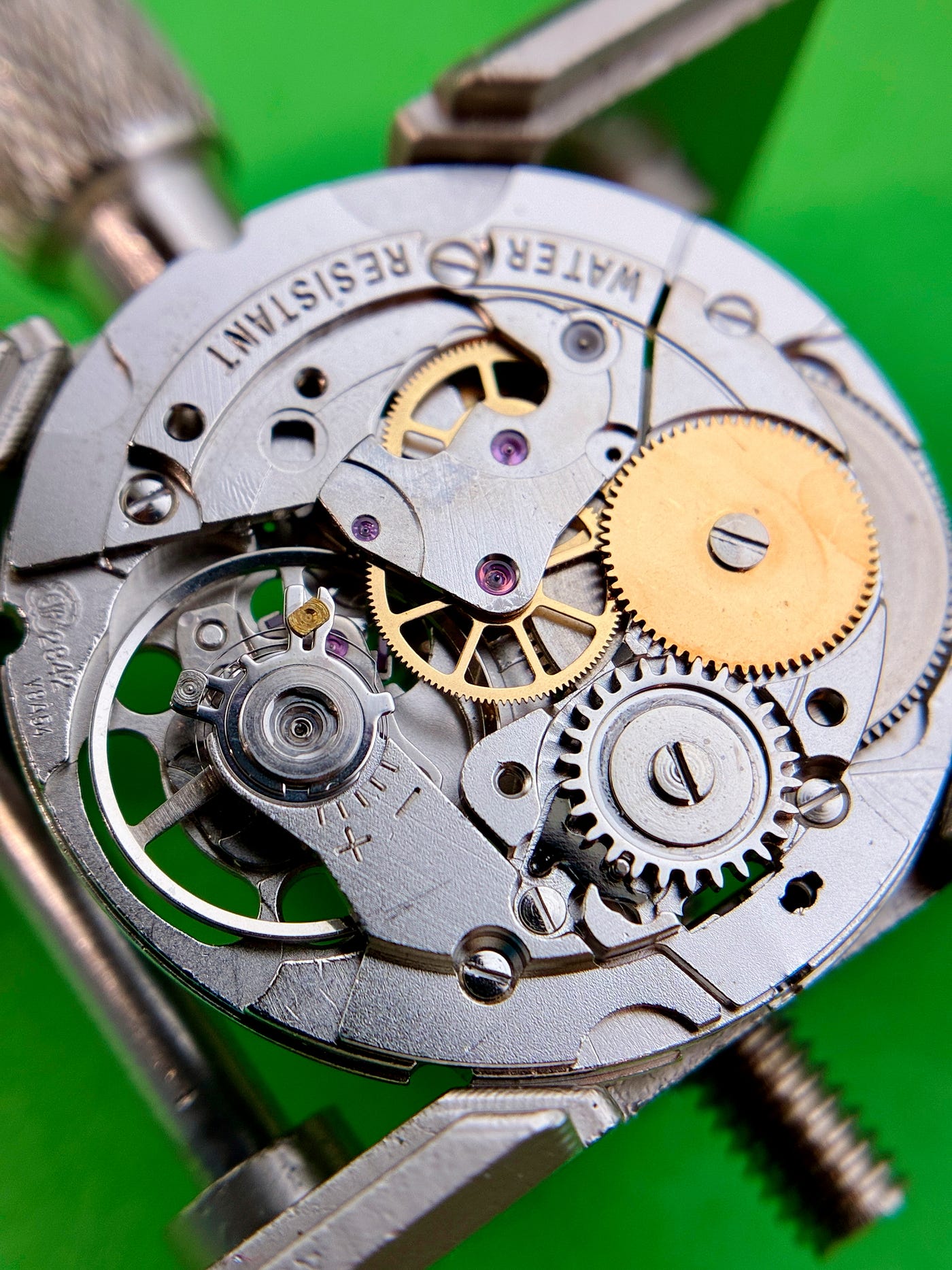
On the dial side, there are some water marks (?) around the balance wheel where the dial has an opening. The IPA did not remove much of it, but wiping it with a dial cleaner seems to work.
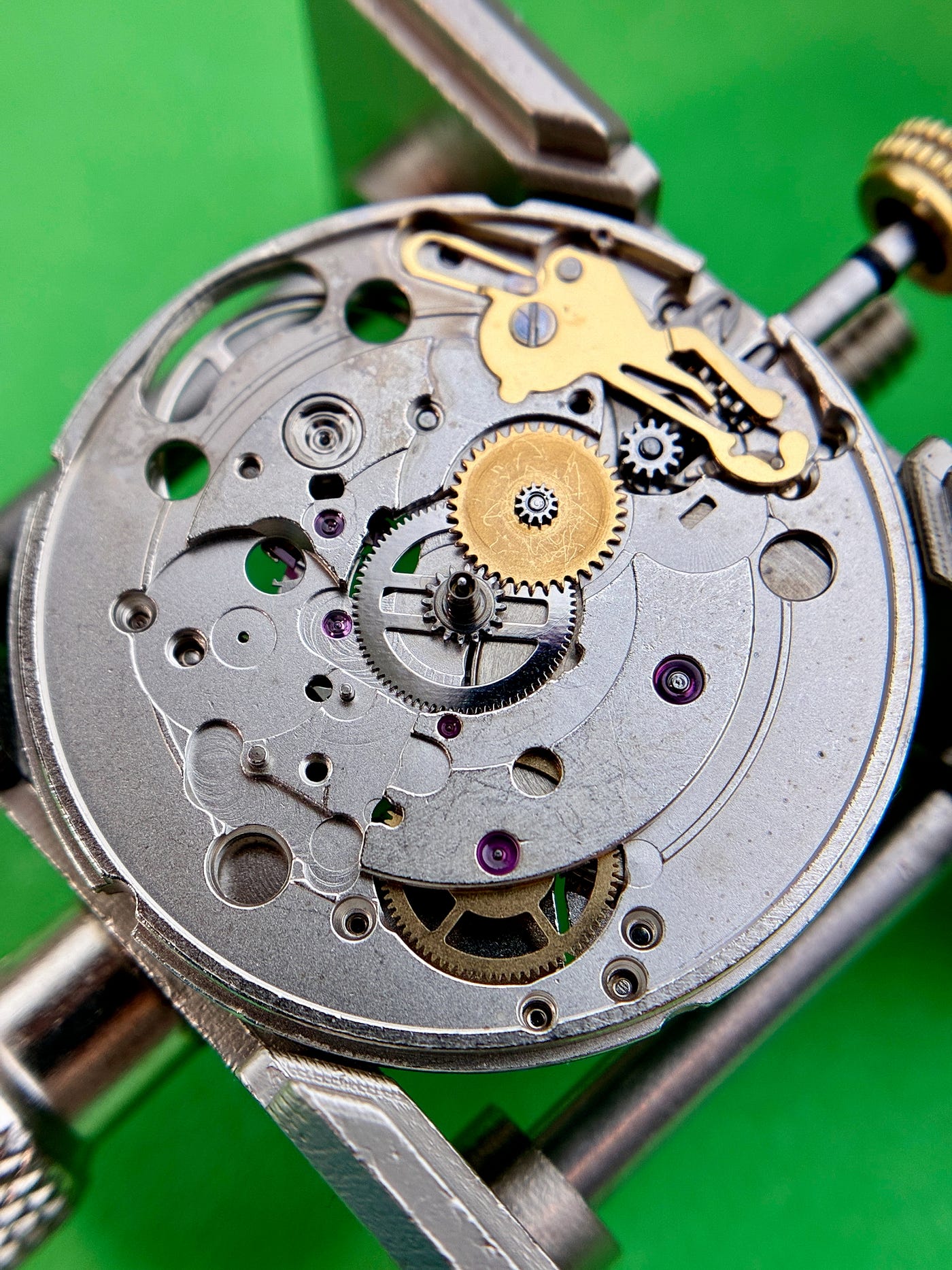
The cover plate of the time setting wheel has two legs to hold it around the hour wheel.
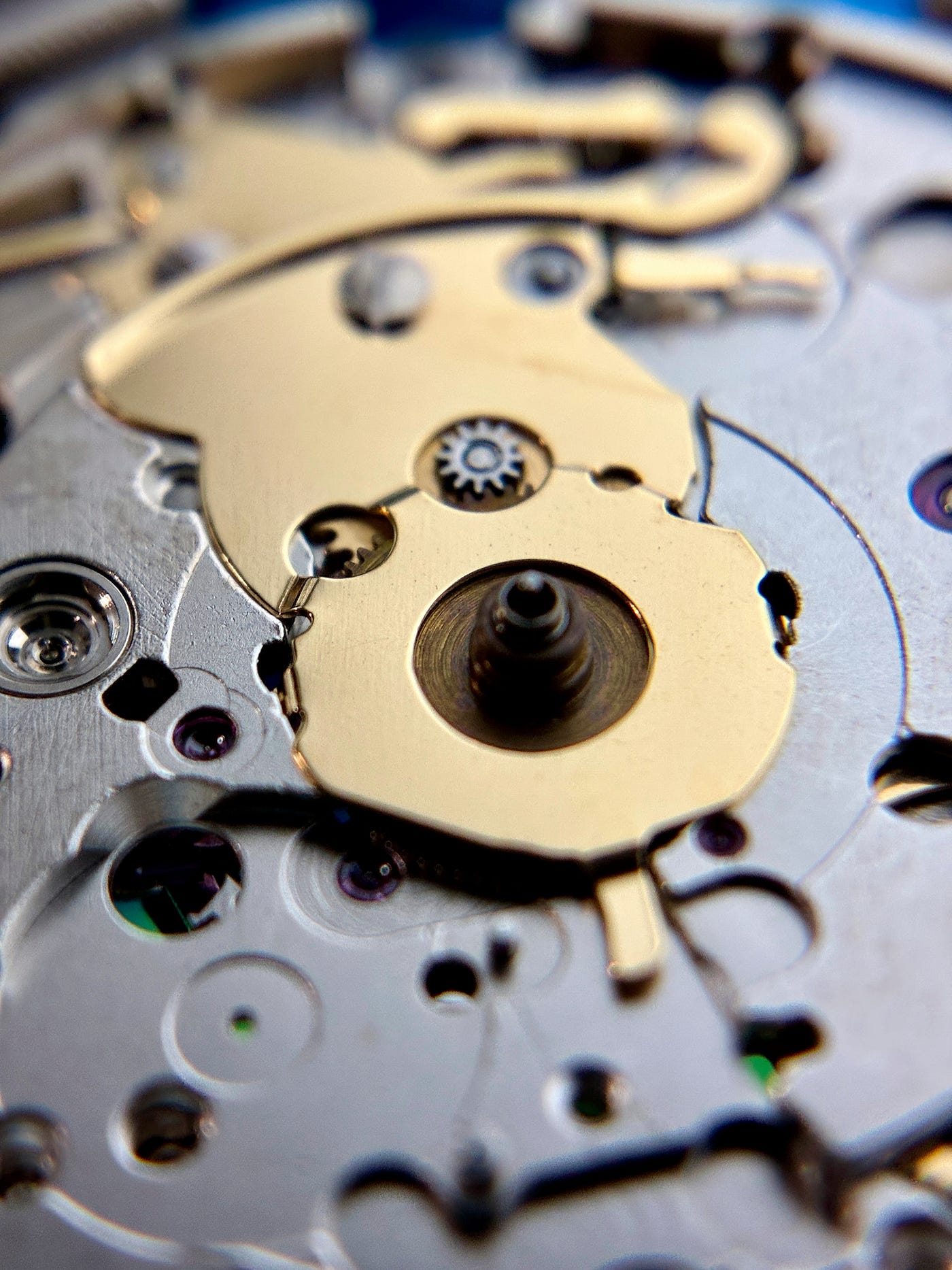
Install the Novodiac anti-shock. I did it with two tweezers to hold down and turn the three sides; later someone told me a small plastic tube roughly the same size would do the trick with ease.
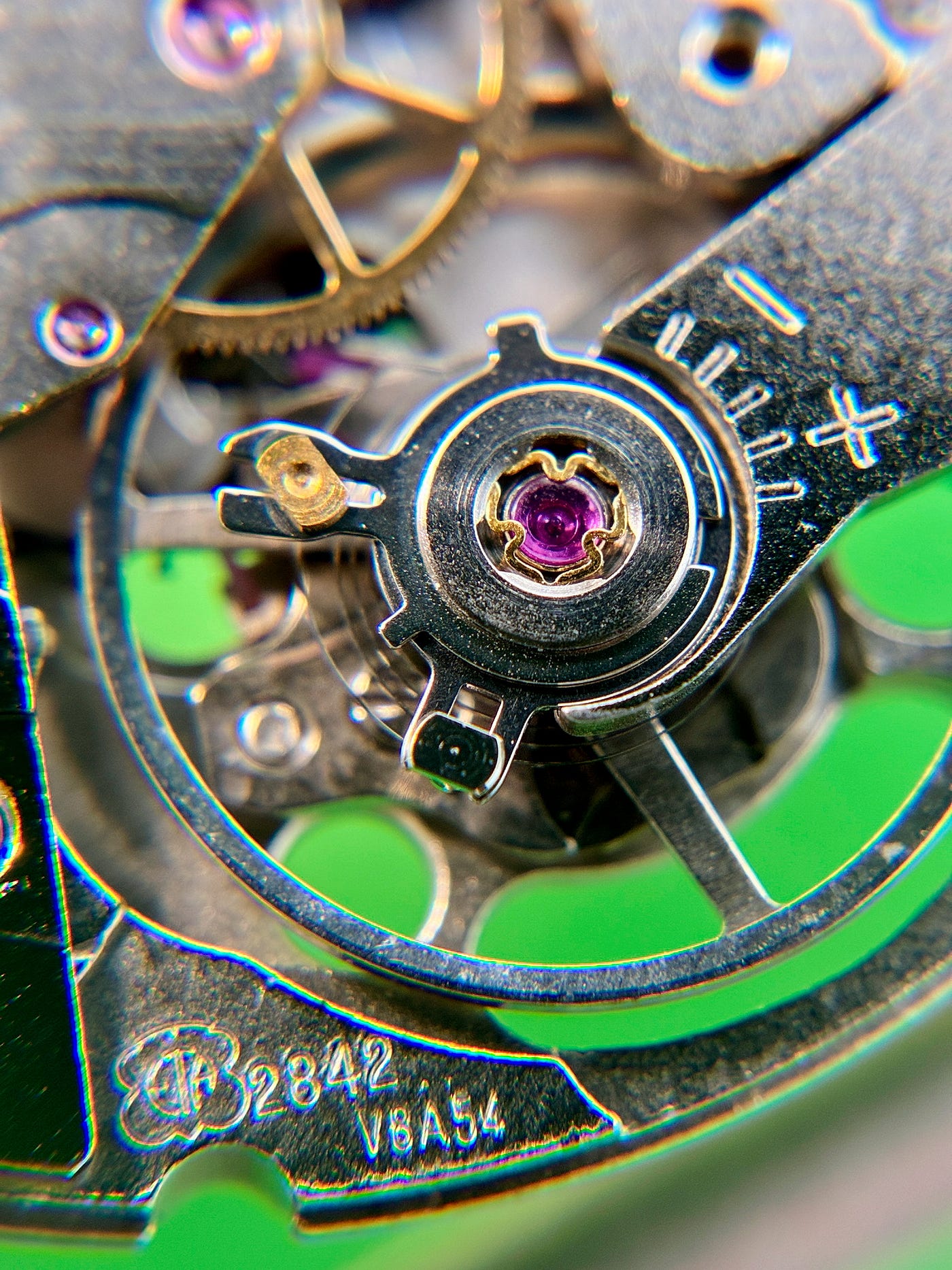
Here’s a comparison between ETA 2842 and my PT5000 (ETA 2824 clone). The balance wheels are the same size, although the 2842’s seem to be slightly thicker. The escapement wheels are also different due to the different operating frequency.
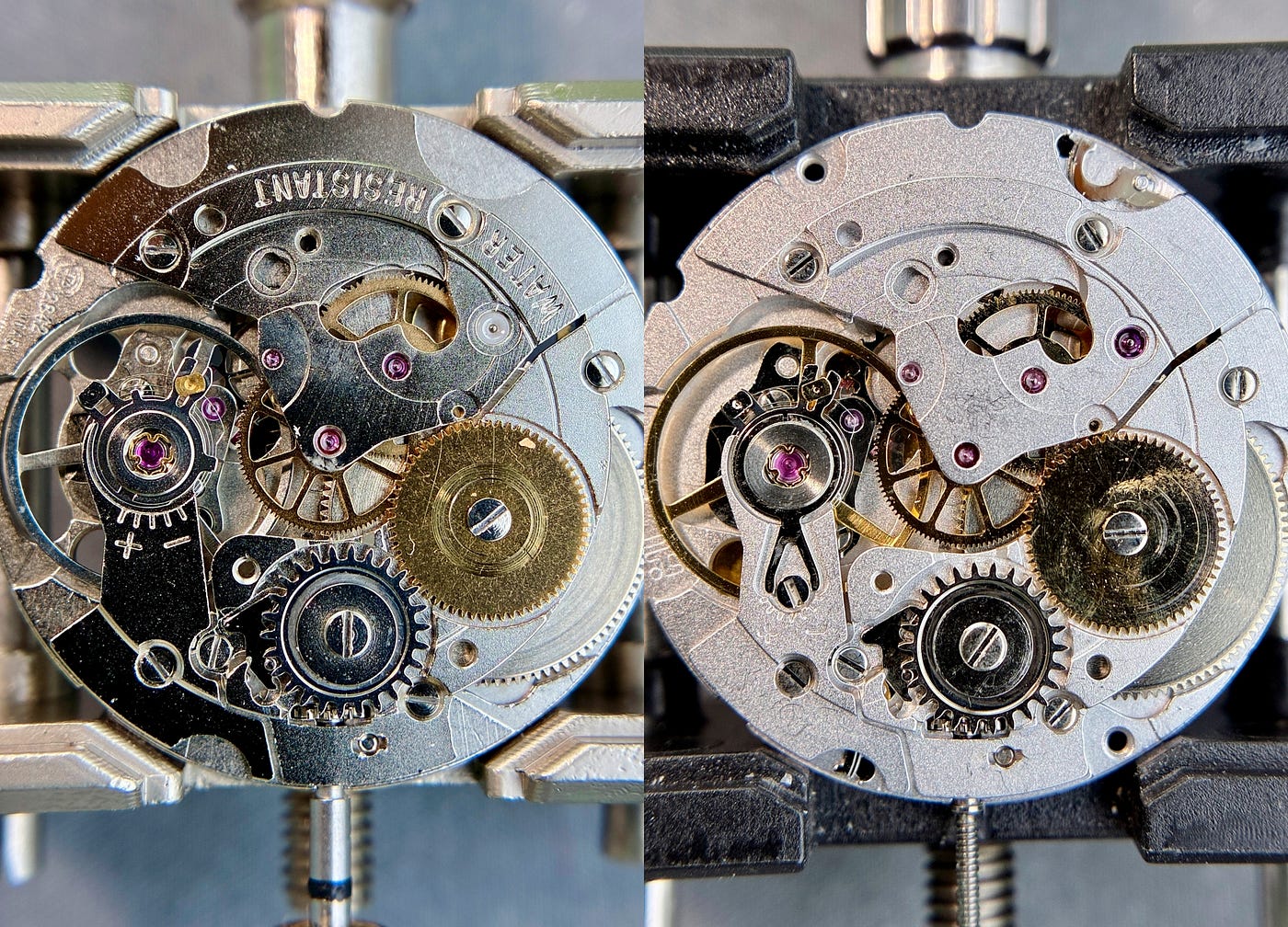
ETA 2842 (left) and PT5000 (ETA 2824 clone, right)
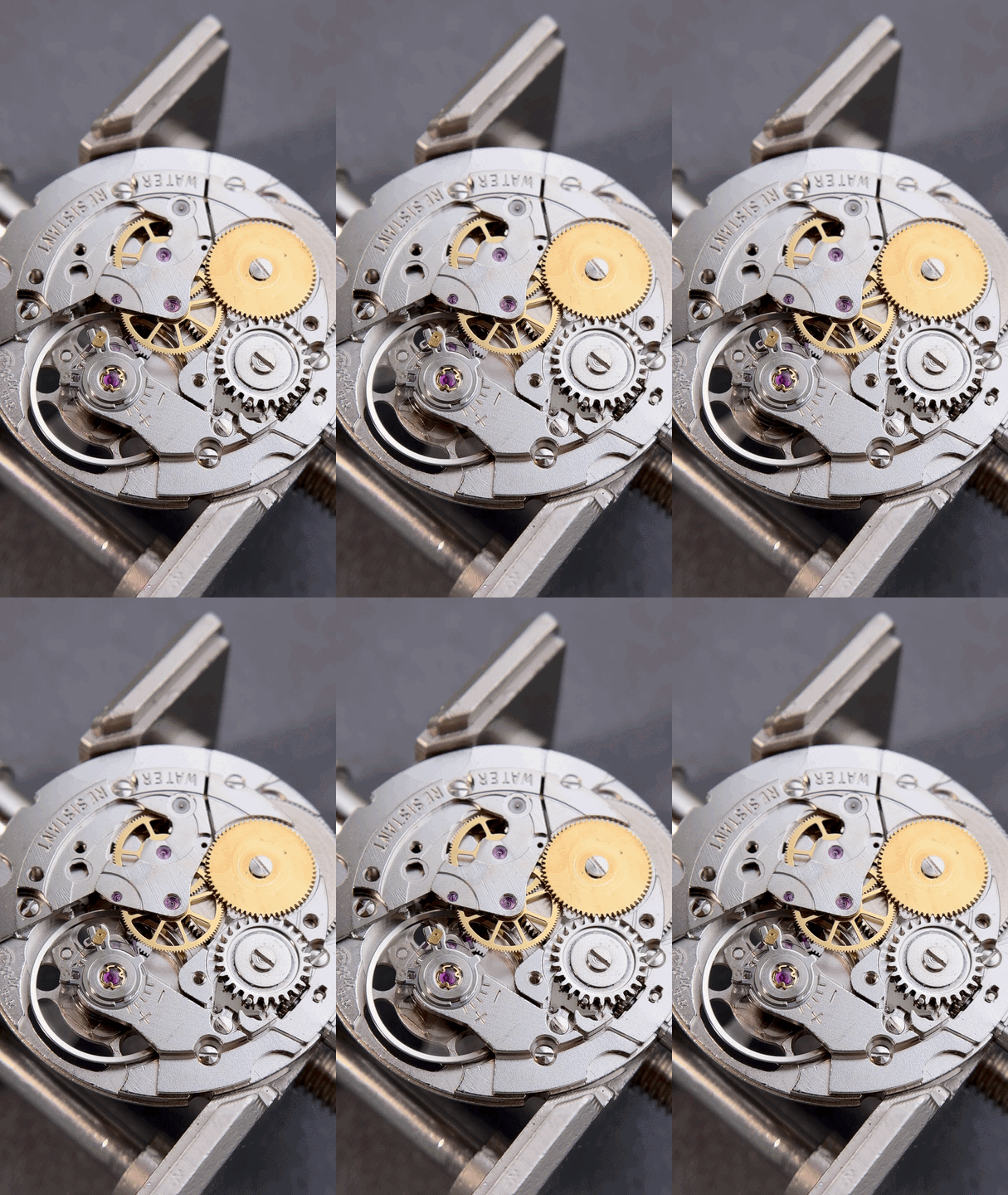
We also need to regulate the movement at this stage, as the automatic framework would cover the regulator arm from above.
Put on the plastic holder, dial and hands. (Again, remember to pull the crown out before removing the stem.)
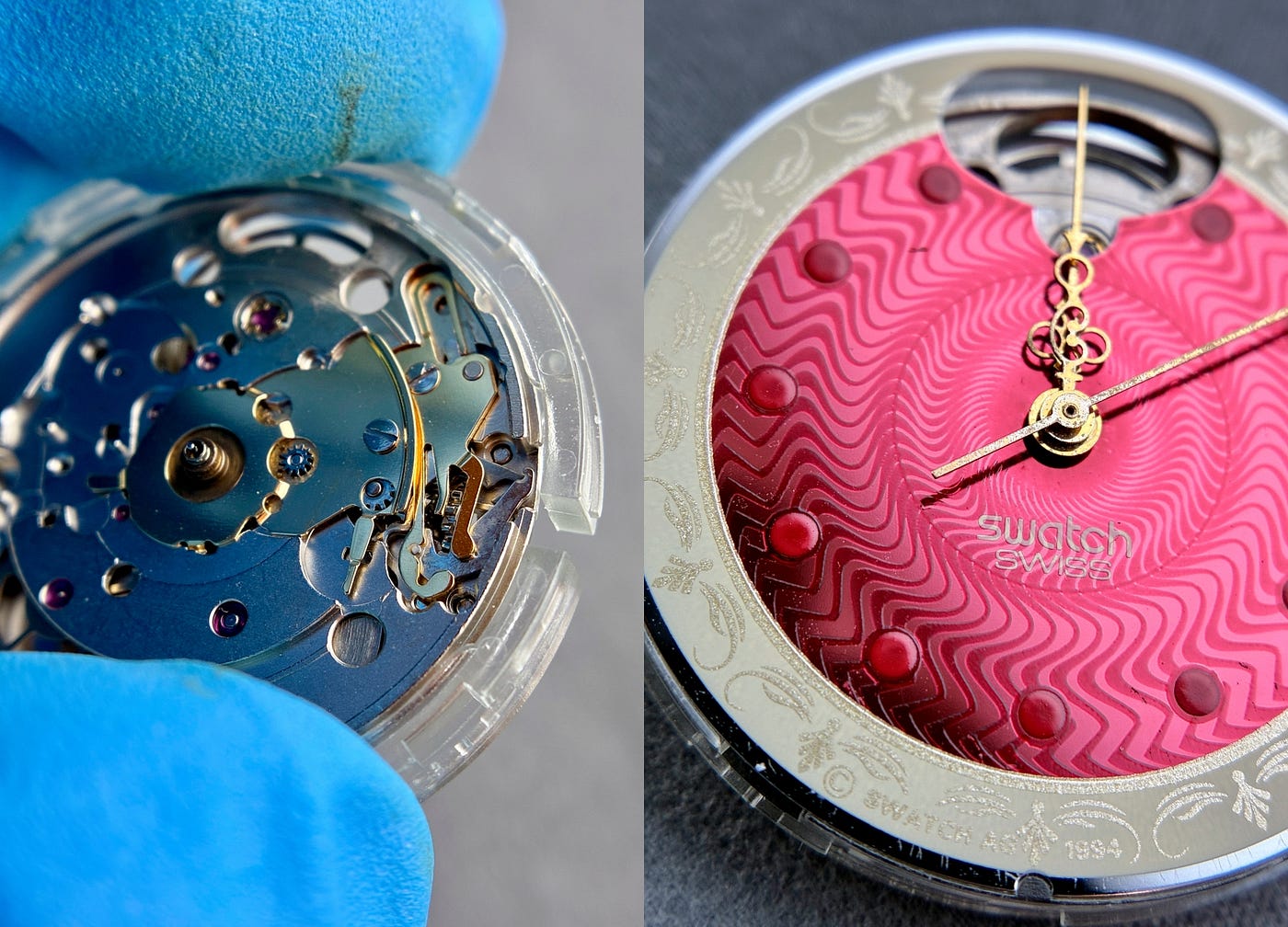
I also insert a gasket with more or less the same size around the slit of the back cover, to add a bit of extra water resistance.
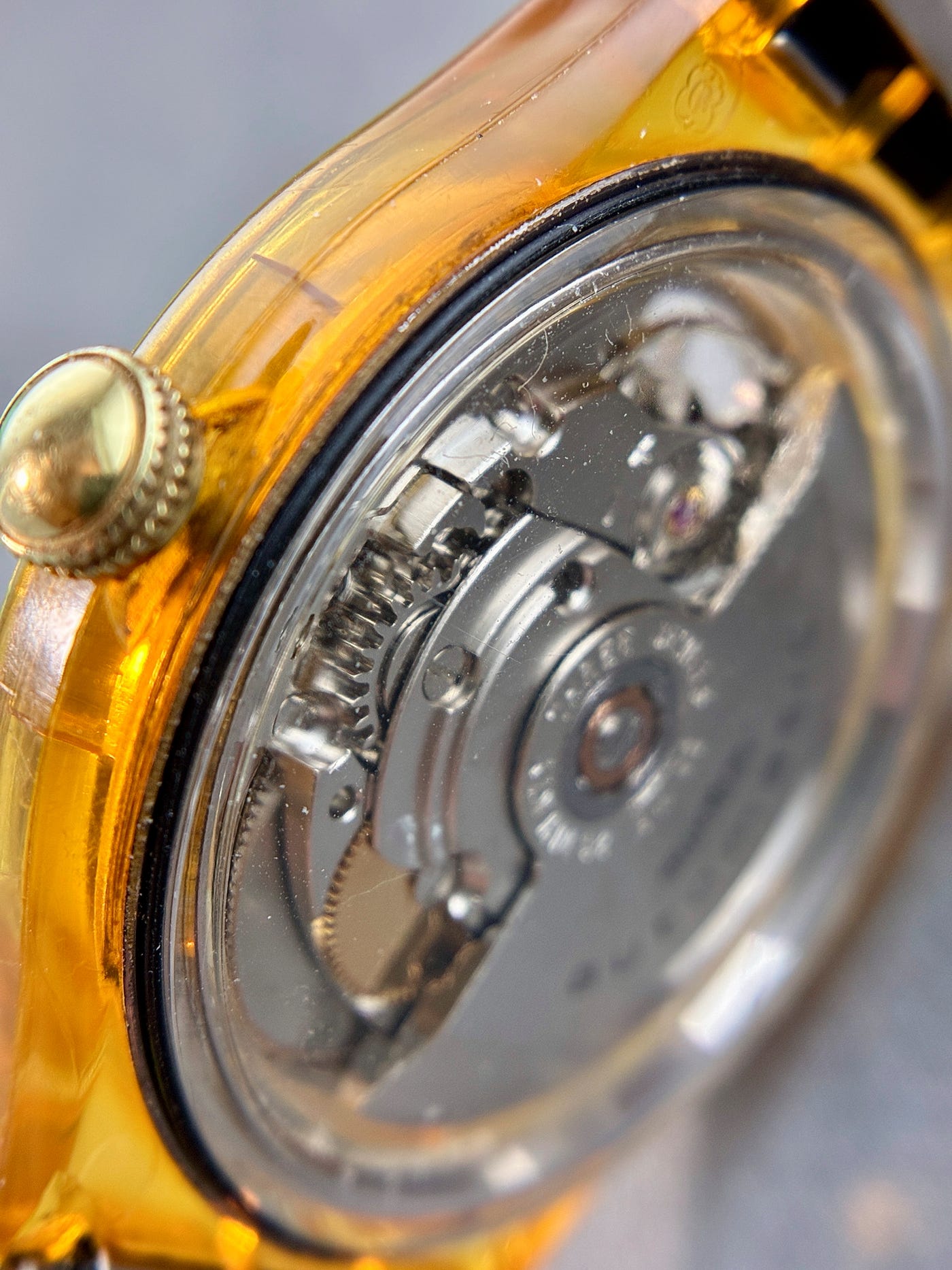
With the wacky colors and cheap plastic vibe, it’s hard to imagine this watch actually has some real deal inside. I am not saying Sistem51 is bad (it’s pretty cool actually; with a brand new gear train design and 90 hours of power reserve), but you will never be able to pull it out and service it.
메타데이터
- post_id
- f835fc07013e
- slug
- servicing-a-1990s-swatch-automatic-eta-2842-eta-2824s-inconspicuous-but-serviceable-little-f835fc07013e
- url
- https://medium.com/@alankrantas/servicing-a-1990s-swatch-automatic-eta-2842-eta-2824s-inconspicuous-but-serviceable-little-f835fc07013e
- canonical_url
- https://medium.com/@alankrantas/servicing-a-1990s-swatch-automatic-eta-2842-eta-2824s-inconspicuous-but-serviceable-little-f835fc07013e
- author_url
- https://medium.com/@alankrantas
- status
- ok
- fetched_at
- 2026-07-14 14:50:05