How to Think Like a Programmer: 3 Mental Shifts That Changed Everything
Learn how to think like a programmer with 3 essential mindset shifts. Master problem-solving, decomposition, and planning to code better.
How to Think Like a Programmer: 3 Mental Shifts That Changed Everything
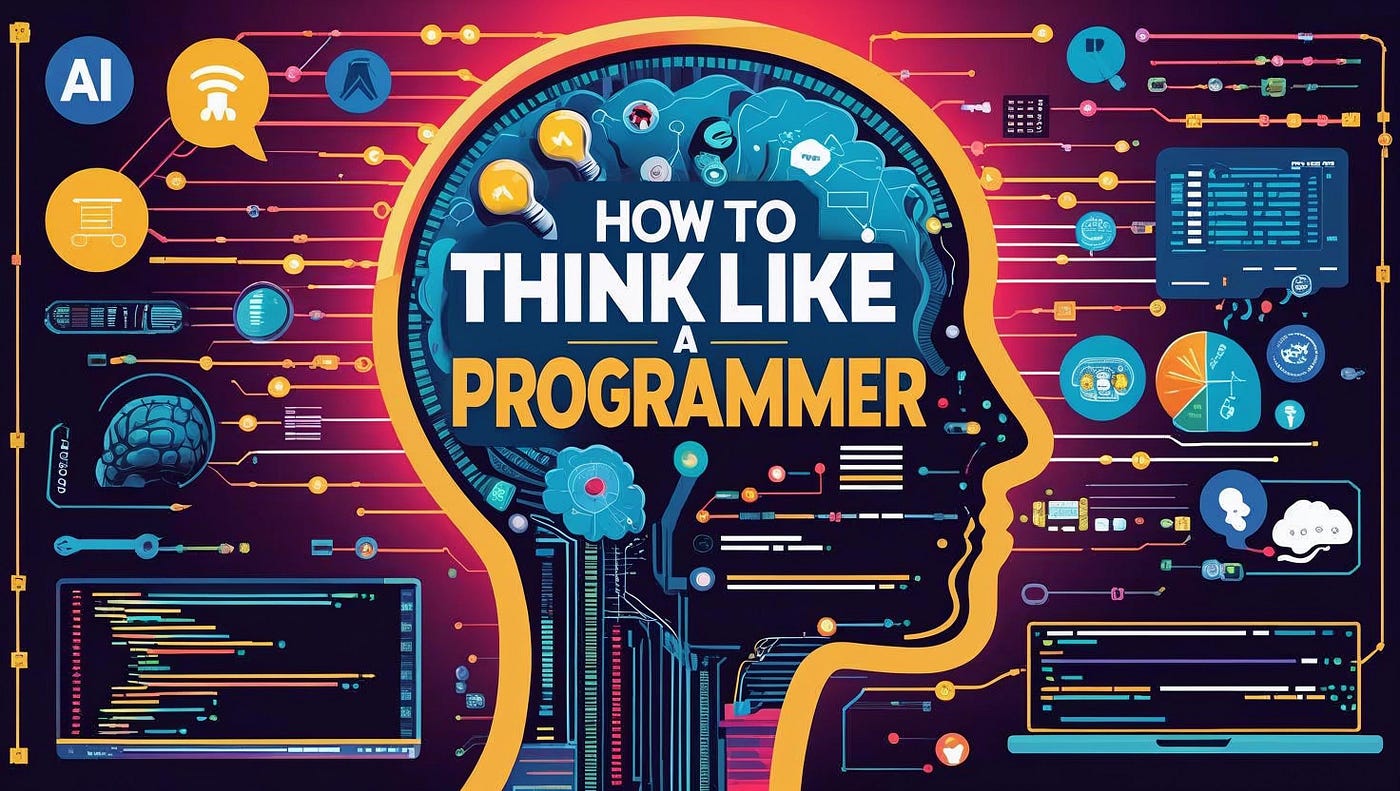
How to Think Like a Programmer (Create By Canva)
I remember staring at my screen for hours. The code wasn’t working. I felt completely lost.
Sound familiar? You’re not alone in this struggle.
After teaching coding to thousands of students, I’ve noticed something. The biggest barrier isn’t learning syntax. It’s not memorizing functions or frameworks either.
The real challenge? Learning to think like a programmer.
Today I’ll share three mental shifts that transformed my approach. These same strategies helped my students go from confused beginners to confident developers.
🧠 What Programming Really Is
Let me start with a truth bomb. Programming isn’t about writing code all day.
You’re actually a professional problem solver.
Think about Facebook. Mark Zuckerberg saw a problem in his dorm room. People needed better ways to connect online. He solved that problem with code.
Google noticed email clients weren’t great. They created Gmail to fix that issue.
Every successful application solves a real problem. Code is just your tool for building solutions.
This mindset shift changes everything. You stop thinking “I need to learn Python.” Instead, you think, “I need to solve this problem.”
3 Mental Shifts That Changed Everything:
- Adopt a Scientist’s Mindset 🔬
- Master the Art of Decomposition ✂️
- Plan Before You Code 📋

3 Mental Shifts That Changed Everything
🔬 Adopt a Scientist’s Mindset
Remember high school chemistry class? You mixed elements in specific amounts. You recorded every result carefully.
This is exactly how programmers should think.
Scientists don’t get frustrated when experiments fail. They examine what went wrong. They form new hypotheses. They try different approaches systematically.
Most coding beginners do the opposite. They write random code, hoping something works. They get overwhelmed when things break.
Professional programmers think methodically instead. They approach problems with structure and order.
The Scientific Method for Coding:
- Observe the problem clearly
- Form hypotheses about potential solutions
- Test your code systematically
- Analyze what works and what doesn’t
- Refine your approach based on results
This methodical thinking separates amateurs from professionals.

The Scientific Method for Coding
✂️ Master the Art of Decomposition
Here’s mistake number one I see constantly. People try solving huge problems all at once.
A student recently told me, “I can follow tutorials fine. But when I build something alone, I freeze up.”
The issue? They see projects as massive, overwhelming tasks.
Let me give you an example. Imagine building a Twitter clone from scratch. That sounds impossible, right?
But what if I break it down?
Twitter Clone Components:
- User registration system
- Login functionality
- Post creation feature
- News feed display
- User profiles
- Follow/unfollow system
Still overwhelming? Let’s go deeper.
News Feed Breakdown:
- Display posts in chronological order
- Show user avatars
- Include timestamps
- Add like buttons
- Enable comment sections
- Implement infinite scrolling
Now we’re getting somewhere! Each piece becomes manageable.
Professional programmers excel at decomposition. They break massive projects into tiny, solvable pieces.
Think of it like eating an elephant. You do it one bite at a time.
🍳 Think Like a Recipe Developer
This brings me to algorithmic thinking. It’s fancy talk for something simple.
You’re creating recipes for computers to follow.
When I make chili, I follow specific steps:
- Heat oil in a large pot
- Add chopped onions, cook 5 minutes
- Add ground beef, brown completely
- Stir in tomatoes and spices
- Simmer for 30 minutes
Each step must happen in order. Miss one step? The result changes completely.
Computers work the same way. They need precise, step-by-step instructions.

3 Mental Shifts That Changed Everything (Create By Canva)
Common Beginner Mistake:
New programmers often assume that computers can read their minds. They write:
button.click → show item on screenBut computers need explicit instructions:
- Listen for the button click event
- Access the DOM element
- Create a new list item element
- Add text content to the element
- Append element to existing list
- Update screen display
Computers are incredibly powerful but completely literal. They do exactly what you tell them. Nothing more, nothing less.
🎯 Think Generally, Not Specifically
Here’s mistake number two that kills progress. People solve individual cases instead of general problems.
I often give this exercise: “Get the user’s name and greet them.”
Many students write:
name = input("What's your name?")
print("Hello Tim!")
See the problem? This only works for people named Tim!
Professional programmers think generally. They create solutions that work for every possible case.
The correct approach:
name = input("What's your name?")
print(f"Hello {name}!")
Now it works for Tim, Sarah, John, or anyone else.
Ask Yourself:
- What if the user enters nothing?
- What about special characters in names?
- How do I handle extra-long names?
- What if someone enters numbers?
Always consider edge cases. Your solution should also work in unusual situations.
📋 Plan Before You Code
Mistake number three? Jumping straight into coding without planning.
I used to do this constantly. I’d start typing immediately. Twenty versions later, I’d finally stumble onto a solution.
This approach is frustrating and inefficient.
Now I spend hours planning before touching my keyboard. I sketch solutions on paper. I diagram the logic flow. I think through potential problems.
My Planning Process:
- Understand the problem completely
- Break it into smaller sub-problems
- Sketch out the solution approach
- Consider different input scenarios
- Plan the step-by-step algorithm
- Only then start coding
The coding becomes the easy part. I’m just translating my plan into syntax.
Professional developers think first, code second.
🚀 Your Next Steps
These three mindset shifts changed everything for me:
→ Think like a scientist — approach problems methodically
→ Master decomposition — break big problems into small pieces
→ Plan before coding — think first, type second
Start applying these concepts to your next project. Don’t expect an overnight transformation. These thinking patterns take practice to develop.
But stick with it. The payoff is incredible.
I’ve watched countless students make these mental shifts. They go from struggling with tutorials to building impressive applications.
The difference isn’t talent or secret knowledge. It’s simply learning to think like a programmer.
Your coding journey just got a whole lot clearer.
A message from our Founder
Hey, Sunil here. I wanted to take a moment to thank you for reading until the end and for being a part of this community.
Did you know that our team run these publications as a volunteer effort to over 3.5m monthly readers? We don’t receive any funding, we do this to support the community. ❤️
If you want to show some love, please take a moment to follow me on LinkedIn, TikTok, **Instagram. You can also subscribe to our [weekly newsletter](https://newsletter.plainenglish.io/)**.
And before you go, don’t forget to clap and follow the writer️!
메타데이터
- post_id
- f842b3e4e432
- slug
- how-to-think-like-a-programmer-3-mental-shifts-that-changed-everything-f842b3e4e432
- url
- https://blog.stackademic.com/how-to-think-like-a-programmer-3-mental-shifts-that-changed-everything-f842b3e4e432
- canonical_url
- https://blog.stackademic.com/how-to-think-like-a-programmer-3-mental-shifts-that-changed-everything-f842b3e4e432
- author_url
- https://medium.com/@blendvisions
- status
- ok
- fetched_at
- 2026-08-22 20:44:26