Europe is protecting the past while Xiaomi builds the future in 76 seconds
Thanks to 91% automation, Xiaomi takes 76 seconds to make a car. What’s more, it does this so well that demand exceeds its production…
Europe is protecting the past while Xiaomi builds the future in 76 seconds
Thanks to 91% automation, Xiaomi takes 76 seconds to make a car. What’s more, it does this so well that demand exceeds its production capacity. The problem for Europe is not the arrival of Xiaomi, it’s that it highlights everything that is failing about European car production.
To read the specialist media, it’s clear that this isn’t so much a company, as the symbol of a new era. Take this piece in the Financial Times: “China’s smartphone king takes on Elon Musk in Europe with premium EVs”: it tells how a company that just a few years ago was seen in Europe as a smartphone brand competing on price has been able to enter the EV market with a speed that has blindsided the traditional industry.
In a very short time, Xiaomi has managed to produce, from scratch, models such as the SU7 and YU7, turning them into status symbols, with demand outstripping production capacity at its highly automated factory, where the focus is not just battery and motor, but also on software, integration and a friendly ecosystem. And that’s precisely what’s important: Xiaomi isn’t trying to make “a cheap Chinese car.” It is trying to redefine what a car should be in the digital age.
If left to act without protectionist crutches in favor of established manufacturers, Xiaomi could soon establish itself globally in the same way it has with consumer electronics: an agent of creative destruction. Not because it sells cheaper without further ado, but because it competes on different terms. It’s not looking to make the traditional industrial car, and instead is all about connected electronics: fast cycles, constant iteration, user-oriented design, integration between devices and a much more ambitious understanding of software as a central element of the product. According to the Financial Times, the company has also created an R+D center in Munich to adapt and develop vehicles with European talent. This is not some opportunistic experiment, but a commitment to a new way of doing things.
Over the last two decades, China has concentrated scale, incentives, industrial policy, electrification support, infrastructure, an extraordinarily dense supply chain, and brutal competitive pressure among dozens of actors. With government support? Yes. And why not? What better use is there for public money than to create a globally competitive industry from scratch? The result? According to the IEA, China made some 12.4 million electric cars in 2024, more than 70% of global production, while the EU’s output stagnated at 2.4 million. The IEA also highlights how Chinese EV makers are now keen to find overseas markets, as capacity now exceeds demand at home. In other words, China has not only innovated: it has learned to innovate on an industrial scale.
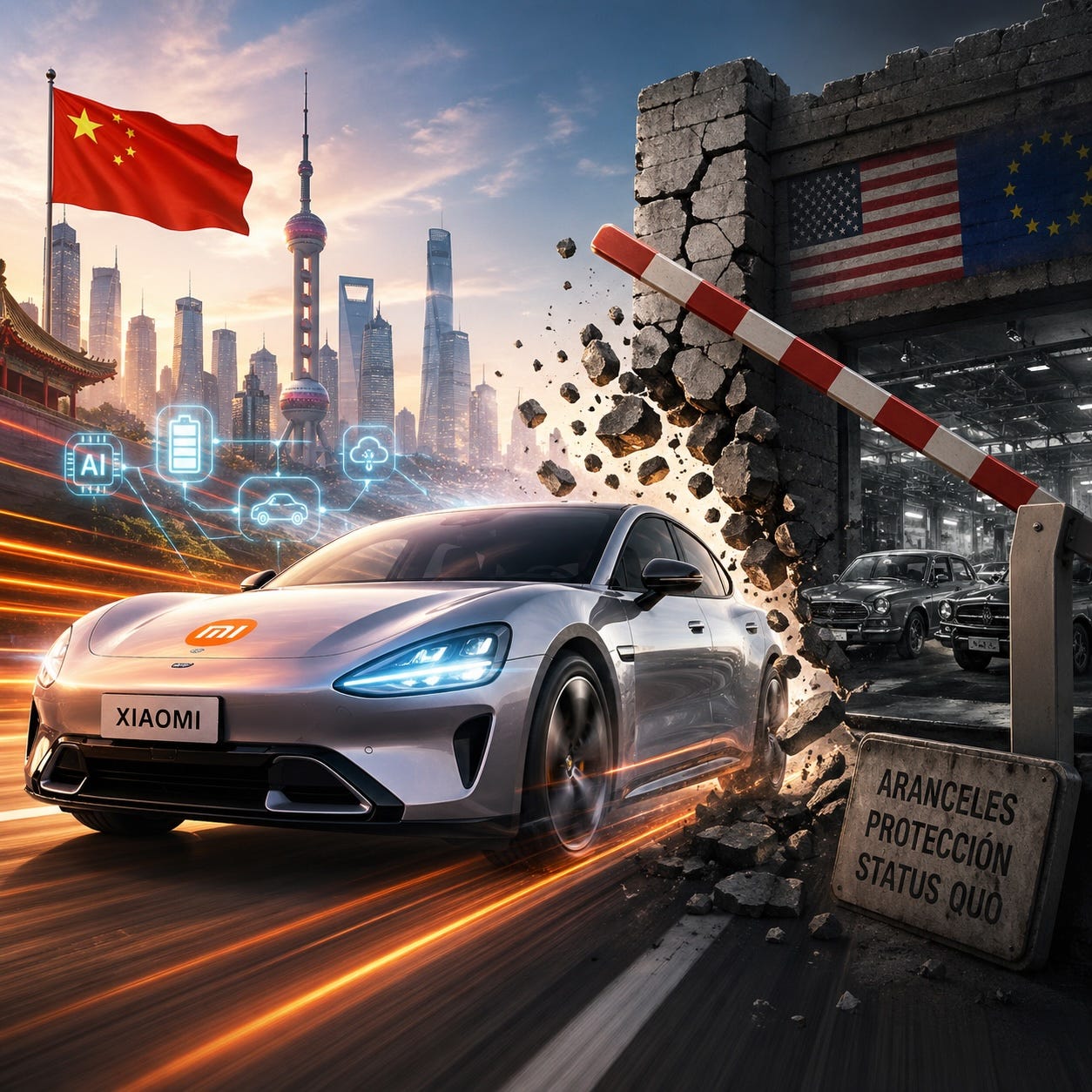
Meanwhile, the West has too often opted for a much more politically comfortable strategy: protect the incumbent, delay the market’s verdict, and present fear of competition as defending a failing European industry. The European Union imposed import duties of up to 35% on Chinese EVs, in addition to the base tariff of 10%, valid for five years. The United States, for its part, slapped 100% tariffs on Chinese EVS in 2024. The geopolitical, commercial or strategic justification of both measures is debatable, but what should not be lost is their practical meaning: instead of responding to a technologically more aggressive rival by innovating faster, these two enormous blocs have erected trade barriers in a desperate bid to buy time.
The problem is, that they’ve set themselves a trap. Economic history is full of sectors that used protection not to transform themselves, but to delay transformation. And the difference between the two is enormous. If the time bought with tariffs is invested in redesigning processes, making platforms cheaper, improving batteries, prioritizing software, rethinking the relationship with the customer and assuming that a car no longer competes only in horsepower, chassis and finish, then perhaps it makes sense. But if that time is spent continuing to sell a cosmetic version of the past, the result will be worse: in the end, the wall will fall or be surrounded, and the technology gap greater.
Xiaomi is a sore point for European carmakers its advantage is just about cost, but the product concept itself. Its management has insisted that the European automobile still has obvious engineering strengths, but lacks the smartness of the vehicle part of a broader digital ecosystem. That ties in with something we’ve been seeing for too long: many European and US manufacturers still treat software as an accessory, an added layer, or a department, when in reality it should be the core architecture of the vehicle. The most advanced Chinese car is not limited to getting around: it learns, it updates, it talks with your mobile phone, with your connected home, with your digital services and knows your habits. In short, Europe is competing with a whole different ecosystem.
The question we have to ask is how would Xiaomi fare in a truly open market. In Europe, it would probably force the big carmakers to speed up the transition to EVs, especially those based on high margins and slow product evolution. Even the IEA notes that Europe remains the main export destination for Chinese EVs, although Europe’s weight in the total value of these exports has fallen due to weak demand and new restrictions. If these restrictions did not exist, the adjustment would be brutal: falling prices, more pressure on development deadlines, more software and a consumer much less willing to accept that innovation must be expensive.
In the United States, the case would be even more revealing. The US market continues to be dominated by large vehicles, and the IEA pointed out that in 2024, among the 110 electric models available there, only two were economy. US consumers are not protected from Chinese cars: they are protected from having options. When a market is closed to certain product standards, it ends up confusing protection with isolation. And isolation, in technology, is often the path to irrelevance.
The rest of the world may become the laboratory where this story is resolved first. The IEA already describes how, in the face of increasing barriers in large markets, Chinese manufacturers are redirecting exports and capacity to emerging markets, from Southeast Asia to Latin America, and how they are also speeding this up by building factories outside China to dodge restrictions. If Europe and the United States insist on closing the door, Xiaomi and other companies will not disappear: they will learn to grow elsewhere, build a global brand, further develop their technology and return even stronger, perhaps not only as exporters, but as local producers in third countries.
All of this raises an uncomfortable question: what exactly is being protected? Because it is one thing to defend strategic capabilities, jobs or technological autonomy, and quite another to protect, as is being done, slowness, complacency and backwardness. If China has managed to make its cars better, more developed, more digital and, in many cases, more attractive to the user, the answer should not be to prohibit the consumer from buying them. The answer should be to ask why our manufacturers haven’t been able to get there sooner. Turning protection against innovation into industrial policy is a very dangerous idea.
Xiaomi is not a threat because it is Chinese. It’s a threat because it represents a form of competition that many in the West have stopped practicing. A way of competing that mixes ambition, speed, obsession with the product, mastery of software and brutal vertical and ecosystem integration. If it were left to compete tariff-free, it would probably force the Western car industry to do what it has been avoiding for too long: stop asking for protection and start listening to the market.
(En español, aquí)
메타데이터
- post_id
- f846705a049d
- slug
- europe-is-protecting-the-past-while-xiaomi-builds-the-future-in-76-seconds-f846705a049d
- url
- https://medium.com/enrique-dans/europe-is-protecting-the-past-while-xiaomi-builds-the-future-in-76-seconds-f846705a049d
- canonical_url
- https://medium.com/enrique-dans/europe-is-protecting-the-past-while-xiaomi-builds-the-future-in-76-seconds-f846705a049d
- author_url
- https://medium.com/@edans
- status
- ok
- fetched_at
- 2026-06-09 15:37:30