Stochastic calculus and Discrete-Markov chains Examples : Bonus-Malus System in Automobile…
A stochastic process is a collection of random variables indexed by time. It is commonly denoted as { X(t), t belong to I}, where:
Stochastic calculus and Discrete-Markov chains Examples : Bonus-Malus System in Automobile Insurance(3)
A stochastic process is a collection of random variables indexed by time. It is commonly denoted as { X(t), t belong to I}, where:
- I represents the time interval.
- X(t) is the random variable at time t.
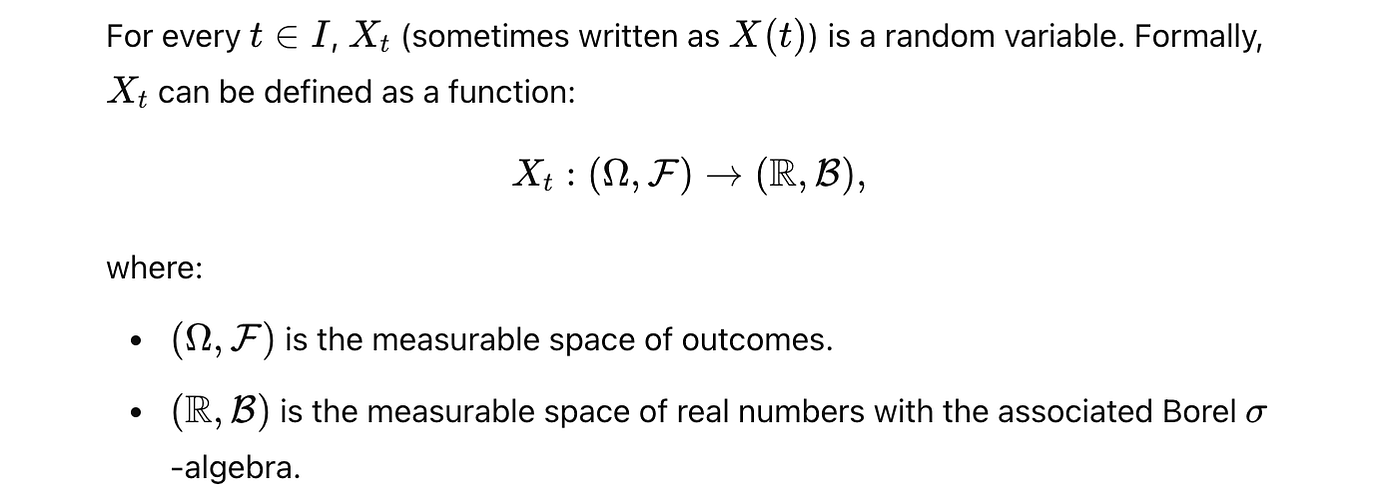
In the study of stochastic processes, there are distinctions to be made depending on the relationship between variables:
- Independent Sequences of Variables: In certain stochastic processes, the random variables Xt (X(t)) are independent of each other. This means that no value in the sequence affects any other, leading to complete independence between all elements of the process.
- Dependent sequences of variables: An example is when the future state of the process depends only the present state and not in the entire history of the process. This is called the Markov property. When a stochastic satisfies this property, it is referred to as Markovian.
Markov chains will be studied in this paper. Markov chains can be discrete-time or continuous-time, depending on whether the transitions happen at distinct steps or continuously over time.
The most important result regarding Markov chains is the ergodic theorem. The ergodic theorem explains what happens in the long term, depending on the initial state of the chain. Let’s start with discrete-Markov chains.
1. Definition of discrete-Markov chains


2. Bonus-Malus System in Automobile Insurance
In automobile insurance, the premium of an insurer can decrease if there are no claims during certain period. Conversely, it can increase if one or more claims are submitted during that time. Claims arise from accidents road, which occur randomly over time.
The random events that occur over time are modeled using a Poisson process and is independent of the number of events in any other disjoint time interval.
It is assumed that the class of an insurer is updated after each year of driving. The class increases by the number of claim made during the year if any occurred, but decreases by if there were no claims. The initial class is 0 and cannot decrease further. The class of an insurer after n≥ 0 years of driving is denoted by Xn. Xn is a discrete Markov chain. This is the characteristic of poisson distribution.
Transition matrix

So we have :


References:
- Andrey Markov, whose work laid the foundation for these processes, has inspired the terminology used in modern probability theory, including the Markov property and Markov chains.
- Lessard, S. (2014). Processus stochastiques: Cours et exercices corrigés. Paris, France: Dunod. ISBN: 9782340–002142.
메타데이터
- post_id
- f860e6a3baeb
- slug
- stochastic-calculus-and-discrete-markov-chains-examples-bonus-malus-system-in-automobile-f860e6a3baeb
- url
- https://medium.com/@jumbongjunior/stochastic-calculus-and-discrete-markov-chains-examples-bonus-malus-system-in-automobile-f860e6a3baeb
- canonical_url
- https://medium.com/@jumbongjunior/stochastic-calculus-and-discrete-markov-chains-examples-bonus-malus-system-in-automobile-f860e6a3baeb
- author_url
- https://medium.com/@jumbongjunior
- status
- ok
- fetched_at
- 2026-06-09 15:37:30