How I Got My Site Visible On Google And AI Search
After 11 months of dead traffic, one overlooked tool changed everything I thought I knew about SEO.
How I Got My Site Visible On Google And AI Search
After 11 months of dead traffic, one overlooked tool changed everything I thought I knew about SEO.
My site had been invisible for eleven months.
Not slipping. Not stagnant. Just — gone. Traffic at zero. Revenue at zero. I’d wake up at 3 a.m. and refresh Google Search Console like some kind of ritual. The same flat line staring back at me. Every single morning.
The Year I Watched Everything I Built Go Quiet
I’d started my blog the way everyone does — full of stupid, beautiful hope. I wrote constantly. Two posts a week, sometimes three. I optimized titles, stuffed meta descriptions, built internal links like I was laying bricks for a cathedral.
And for a while? It worked. I had a small but real audience. Affiliate income that covered my phone bill, then my rent.
Then the algorithm shifted. Or AI search happened. Or both. Honestly, I still don’t know exactly what broke. I just know that one quarter I was , and the next I was watching the dashboard bleed out.
- Lost 68% of organic traffic in under four months
- Google started pulling AI-generated answers instead of linking to my articles
- ChatGPT, Perplexity — they weren’t citing me anymore. They were citing everyone but me
- I didn’t even know what “AI visibility” meant, let alone how to track it
The worst part wasn’t the money, though. It was the feeling that the rules had changed mid-game and nobody told me.
Every Fix I Tried Made Me Feel Stupider
I’m not someone who gives up easily. I want to be clear about that. I went down every rabbit hole there was.
- I tried Ahrefs — useful data, but it cost more than my car insurance and told me what was wrong without telling me how to fix it
- I tried Jasper for content — the articles read like a press release written by a very confident robot
- I tried posting consistently on LinkedIn to drive traffic — lasted six weeks before I ran out of things to say
- I hired a freelance SEO consultant — she had a beautiful deck and zero results at the end of three months
- I watched YouTube tutorials until my eyes dried out, each one contradicting the last
The SEO world had split in two. Half the advice was about Google. The other half was about “GEO” — Generative Engine Optimization — and how to get AI platforms to mention your brand. And nobody was teaching both. Nobody had a tool that did both.
I was exhausted. The kind of tired that doesn’t go away with sleep.
The Comment I Almost Scrolled Past
I was in an AppSumo forum thread at some ungodly hour — one of those nights where I’d convinced myself I was “doing research” but I was really just doom-scrolling deal pages hoping something would feel like an answer.
Someone in the comments mentioned they’d replaced three separate tools — their rank tracker, their content writer, and something called an AI visibility monitor — with a single platform. They weren’t selling anything. It was just a casual observation buried under forty other replies.
I almost kept scrolling.
But something about the phrase “AI visibility monitor” made me stop. Because that was the part I had no solution for. I didn’t even know how to measure whether ChatGPT was mentioning me. I didn’t know if the problem was my content, my structure, or just my obscurity.
The link they dropped was **this one**. No explanation. Just the URL.
I sat with my cursor hovering over it for a solid minute.
Then I clicked. And what I found made almost no sense to me at first — because it was too simple. One platform. One dashboard. Everything.
The Method That Finally Matched How Search Actually Works Now
I want to explain this carefully because I think most people are still fighting the last war. Google and AI search are now one battlefield, not two. And the tools most of us are using were built before that was true.
Here’s what changed when I started using the framework inside that platform:
Step 1: I stopped guessing at keywords. The research tool pulled high-volume, low-difficulty opportunities across both search engines and AI platforms simultaneously. I could see where competitors ranked and I didn’t — immediately. That gap alone was worth everything.
Step 2: I let the AI write first drafts in my voice. Not generic content. I’d been burned by AI content before and was braced for garbage. Instead I got structured, image-included, link-rich articles that actually sounded like a person had an opinion. I published one. Then two. The SEO score showed green before I even hit publish.
Step 3: I connected it to my CMS and stopped copying and pasting my life away. One click to WordPress. Done. What used to take me a full afternoon took forty minutes, including the edits.
Step 4: I tracked my AI visibility for the first time ever. ChatGPT. Perplexity. Claude. Gemini. I could see my brand’s “share of voice” across all of them. I could see sentiment. I could see how often I was being cited versus my competitors.
That last part made me sit back in my chair and just — stare. I had never seen that data before. I didn’t know I could.
The Morning the Numbers Stopped Lying
About six weeks in, I opened my dashboard on a Tuesday before coffee.
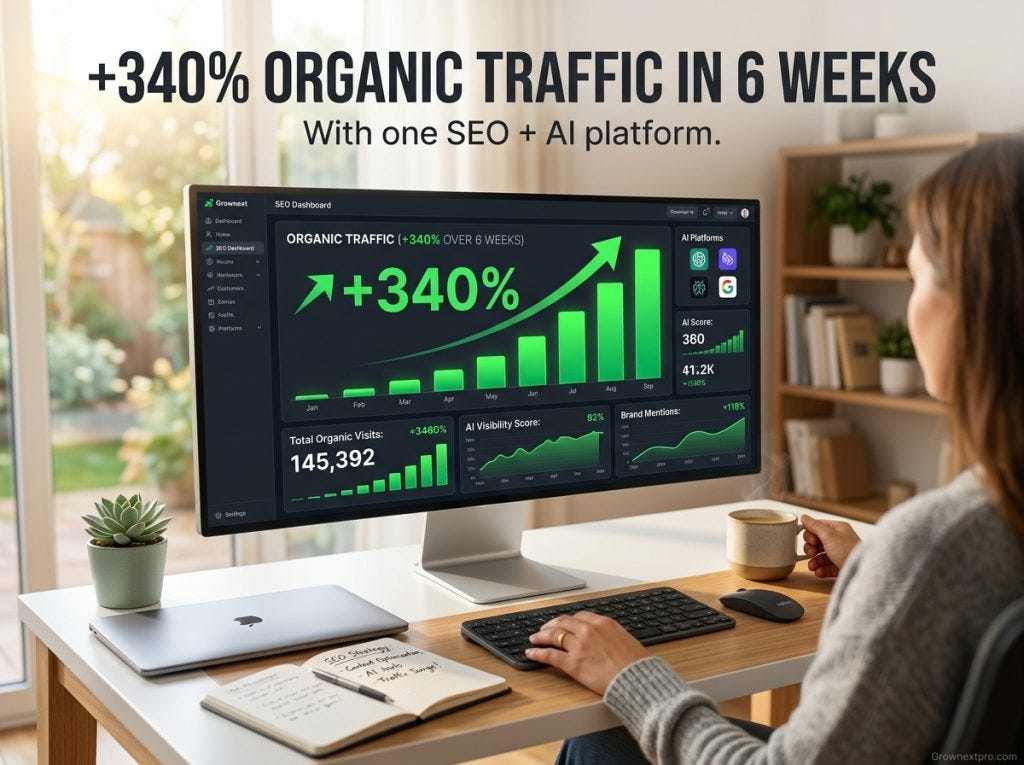
I refreshed it. Then I refreshed it again because I thought it was a display error.
My AI visibility score had climbed from effectively nonexistent to measurable — with citations showing up across four different AI platforms. Google traffic was ticking upward. Not viral, not overnight. But the flat line had a slope now.
- Organic impressions up 340% over the prior period
- Three articles ranking on page one for terms I’d targeted deliberately, not accidentally
- Two unprompted mentions in Perplexity answers — my brand name, my URL, cited without me even knowing it had happened
- One piece generated more traffic in two weeks than my previous top post had in six months
I sat there in the quiet of my kitchen and I felt something I hadn’t felt in almost a year. Relief. Just that. Simple, stupid, profound relief.
Why I’m Even Telling You This
I’m not a tech person. I’m not an agency. I’m someone who had a small site that mattered to me, and I watched it disappear, and I couldn’t figure out why the tools I had weren’t enough anymore.
If you’re in that place — you are not behind because you’re bad at this. You’re behind because the landscape shifted and most tools didn’t. The problem isn’t your effort. The problem is the map is wrong.
If any of this sounds familiar, **this is the same platform I’m still using. **It’s on AppSumo right now, which means the price is honest and the money-back window is real. No performance required. No lock-in.
I’m not here with a flashy promise. I’m just someone who spent a year in the dark and finally found a light switch. What you do with that is up to you.
I still check my dashboard every morning. But it doesn’t feel like a punishment anymore.
It feels like watching something come back to life.
And I didn’t know how badly I needed to see that until I finally did.
Originally published at https://grownextpro.com on June 26, 2026.
메타데이터
- post_id
- f87af6e2eebb
- slug
- how-i-got-my-site-visible-on-google-and-ai-search-f87af6e2eebb
- url
- https://medium.com/@shakibb/how-i-got-my-site-visible-on-google-and-ai-search-f87af6e2eebb
- canonical_url
- https://medium.com/@shakibb/how-i-got-my-site-visible-on-google-and-ai-search-f87af6e2eebb
- author_url
- https://medium.com/@shakibb
- status
- ok
- fetched_at
- 2026-09-03 12:43:36