Precarious Bridges
Death Stranding (2019) as a Critique of Neoliberal Individualism
Precarious Bridges
Death Stranding (2019) as a Critique of Neoliberal Individualism
Sam as a freelance porter on his reverse trike. (DS Wiki)
The vague silhouette of what looks to be a hooded porter on the back of a reverse trike on the horizon seems to be getting closer and closer as you watch on your prepper shelter displays; it was about time, you smile and think to yourself in exuberation, having to wait for as long as you did for your new Homo Ludens figure set. But then your eyes start to widen as you realize the skies are starting to rapidly darken through your screens. Timefall storm alarms begin going off and you simply sit there in silence, sulking to yourself wondering why nothing ever goes your way.
Even so, you find the courage to sneak a peek back up at the lionhearted porter — and find that they are riding at an even higher speed than before. You subconsciously tighten your grip on the armrests of your chair in anticipation as the front tires of the trike suddenly seem to catch onto something dark and indiscernible. The porter goes flying into the acrid air with your package rigged securely on their back, and so does your hope of having a good rest of your night. But in yet another act of gallantry, the porter torques themselves mid-air before landing, cushioning their collision with the crags right below the anti-chiral barriers of your shelter with their body instead. They pull themselves up with urgency, hobbling up towards your shelter as you realize through the rips and tears at their pants that there was more than simply timefall endangering them.
You sprint up the shelter stairs to the cargo dumbwaiter, as you hear the porter keying in the order confirmation on your terminal. Seeing the bright brass shine of the cargo container before your eyes almost has them pop out of their sockets as you scramble to open it. And open it you did: revealing a tiny crack in the Ludens’ helmet visor. Without even thinking, you stand up straight and tap in the porter’s ratings without a single hesitation. Outside, just barely sheltered by the pouring timefall, the porter stands ravaged, their pale grey uniform now tattered, soaked and stained with the crimson streaks of their own blood. But the real kicker comes as their performance report flashes up before them — a large impenitent “C” stares back at them as they collapse to the floor in disbelief; the unfeeling dark blue hue of five likes washing over them in a blanket of learned helplessness, consuming them.
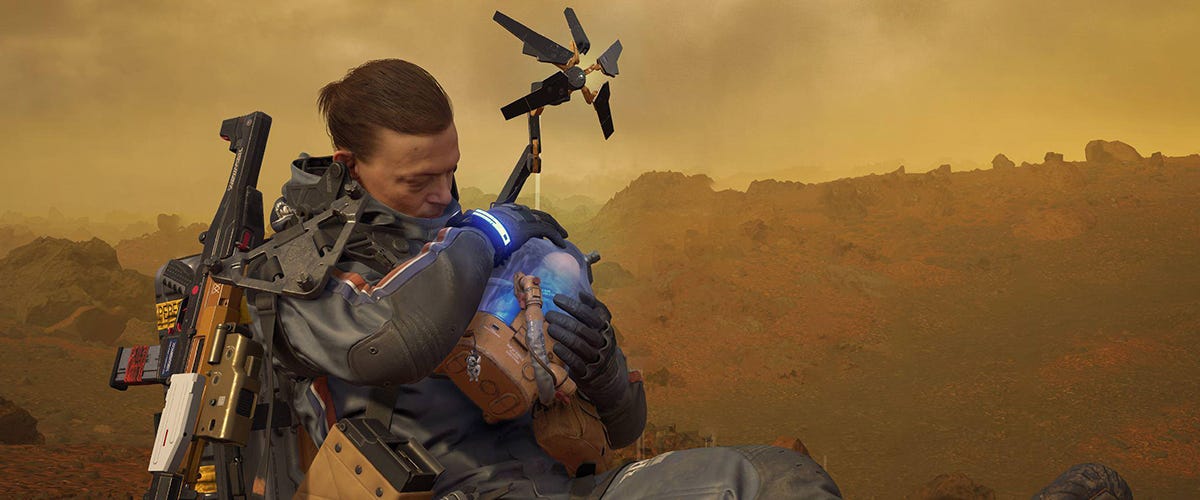
Sam checks on Lou in a moment of respite. (Geek Culture)
An Insurgent Masterpiece
The celebrated Japanese auteur Hideo Kojima’s masterpiece Death Stranding (2019) broke not only the internet and video game industry but also sent massive shockwaves across mainstream media, and continues to maintain a commanding presence within cultural discourse and analysis (Bostan & Şengün, 2023), with a sequel released earlier this year. It won the most Game of The Year awards in the year of its release, and even won a BAFTA a year after that for its troubles (IMDb, 2025). However, many of these awards were clinched for technical achievement, despite there existing so much more within Kojima Productions’ masterful execution of meta-narrative interwoven with intentionality hidden within the inner workings of the game itself. There exists many interpretations of the game’s Daedalian story, picking apart differing narrative themes the game proffers, like a critique of American Exceptionalism and its fundamental political frustrations (Kurasov, 2022) or even fatherhood and emotive masculinity (Leslie, 2021).
The ensuing essay, however, will specifically serve to argue that through the procedural rhetoric of traversal, delivery labour and asynchronous sociality, Death Stranding ratifies a critique of neoliberal individualism, revealing the way in which game mechanics can propagate the actual pressures of self-optimization, isolation, and gig-economy precarity under a veiled ideological façade of “connection.”
This argument will be explored through the principles and manifestations of neoliberal selfhood embedded with the game’s systems, the prevalence of gamified labour or “playbour,” as well as pseudo-social networks and how they simulate a sense of community whilst reinforcing individual burden, mirroring our own world’s growing inclination towards precarious labour infrastructure. This inquiry will serve to holistically analyze the potential in Death Stranding, within and beyond the boundaries of its medium, for expressing political critique by dint of its mechanics in conjunction with its written narrative.
Neoliberal Subjectivity Embedded in Procedural Rhetoric
We begin with the case of the game’s lifeblood: its mechanics and gameplay systems. Academic and video game designer Ian Bogost coined the term “procedural rhetoric” to elucidate the ability of games to make arguments by means of rules, systems, and mechanics, rather than through narrative and dialogue (Bogost, 2007). Death Stranding’s systems can be observed mirroring these concepts when applying Bogost’s framework, affectively performing neoliberal capitalist ideology through modelling neoliberal forms of selfhood; much like the tale prefacing the essay, much of the game’s central gameplay loop enacts a sort of system-guided self-regulation, fostering an approach of “min-maxing” the self through strategic reworking of the player’s habitus — mirroring the practice of everyday reworking and resilience in remote gig workers (Anwar & Graham, 2022).

A player’s post-delivery performance report. (Reddit)
Author Alexander R. Galloway’s concept of games as “algorithmic cultural machines” is especially instrumental in helping us envisage this phenomenon. He posits that through a game’s code and by extension, game mechanics, enact control and thus, ideological structures by means of governing player behaviour (Galloway, 2006). By consequence of the quantitative performance rating the player receives as a definitive “score,” variables of player agency like route planning, weight management, delivery timing and the overall logic of rapid optimization serves to discipline and ultimately frame the player as neoliberal enterprise. These incarnations of algorithmic governance, again, uncannily reflect neoliberal capitalist methodology we see in action today in gig platforms or logistics industries, embodying service at the expense of self by commodifying behaviour and choice. The player’s identity is hence, shaped more so through narrative-informed mechanics and not simply just with conventional narrative devices like cutscenes or lore entries to build player ontology.

The game’s Cargo Management interface. (Millenium)
By virtue of this, Sam Bridges is no hero. Rather, he serves to exist as Bridges’ procedural instantiation of “homo oeconomicus,” a role thrust upon him that he unwillingly concretizes out of necessity: driven by the lives under his direct responsibility as a consequence of his, unfortunately, extraordinary circumstances (Brown, 2015). The player, by assuming the being that is Sam, also thereby assumes his role in Death Stranding’s world as the foremost mascot of neoliberal enterprise — his freedom of mobility really just a proxy for forced self-management, enforcing an infrastructure of “network logic” of individualized responsibility across a space.
“Playbour” and Precarious Play
These ideas are by no means new, however, and have been explored in length within the video game realm, no less. According to media theorist Julian Kücklich, digital play can evolve to mimic or even become forms of labour itself: often then manifesting in circumstances that are unpaid and thus potentially precarious or exploitative (Kücklich, 2005). He illustrated this concept specifically through the act and process of modding, bringing to mind the vast modding communities of Doom or Skyrim, or even games that were initially born as mods themselves, like Counter-Strike or Team Fortress 2 (Sotamaa, 2007). Nonetheless, Kücklich’s notion of “playbour” foregrounds the ways in which — like most things else in the neoliberal capitalist reality we live in today — play has been commodified, ultimately serving as beneficial unpaid labour for corporations and other capital-accumulative purposes. This very directly maps onto Death Stranding, where labour is very literally embedded within the gameplay loop, merging fun and work via intentional design.

A player’s screenshot of a segment of trans-regional chiral highway they built. (Reddit)
The precarity of Kojima’s playbour here should go unacknowledged either: Sam’s unpaid and, at times, even obligatory acts of infrastructure-building á la ladders, ziplines, bridges and other traversal tools to complete deliveries is ingenuously forced upon the player should the player wish to secure the maximal, or rather, “satisfactory” mission outcome. The unpaid building of infrastructure, which as you progress further through the game even expands to include trans-regional roadwork if you can believe it, is not ideologically neutral and should not be mistaken as such (Dyer-Witheford & de Peuter, 2009). Masquerading as just another fun gameplay feature to engage with, it serves to metanarratively reproduce global capitalist power structures and this case, manifests as a critique of such proliferation.
Sam stalked by BTs. (IGN)
The risk, reward and physical strain generated by the austere environments that Sam risks life and limb to traverse through are designed with intention to be intimately felt through haptics and balance systems (Jaramillo-Dent, 2021). There are a multitude of cutscenes and animations in rest areas that serve no other gameplay or narrative purpose than to illustrate to the player how exhausted or physically hurt Sam is and the ways in which you can help him heal or unwind (Backe, 2021). And this is without even considering the fact that Sam also faces threats with self-agency like BTs (Beached Things), MULEs and Homo Demens whilst powering through the cliffs, crevasses, rapids, snowy mountaintops and timefall. But despite all the hazards and hardship Sam faces, the gameplay loop and metanarrative labour structure is, well, gamified. Star-rating and the metrics of likes as literal social capital through the post-delivery evaluation screen create positive feedback loops that serve as labour-disciplining mechanisms, whilst also utilizing a multitude of progression systems as a means of behavioural nudging (Woodcock & Johnson, 2018).
A multitude of cutscenes where Sam is showering. (Youtube)
The “Network Imaginary” and Pseudo-social Community
Finally, we come to the case of Death Stranding’s asynchronous multiplayer. Despite being networked, it expertly constructs a medium for affective connection whilst also actively reinforcing solitary labour: not allowing players to physically meet in the gameworld, but only the visual and auditory ghosts of each other. This social infrastructure is intentionally designed to selectively curate community and shape player networks, ensuring that loneliness persists (Consalvo, 2007). Through the Chiral Network, other players’ built infrastructure feel communal but are really procedurally selected, enforcing an illusion of social intimacy whilst actually heightening isolation amongst individual players in a sort of digital pseudo-social system (Turkle, 2011). This is intimately felt through the act of being able to hear one another’s disembodied voices as players attempt to call out to one another — both players could be no further than two feet apart in the game world, but are separated by the borders of their own instances, unable to see one another but able to hear the vast distance between the two, each Sam’s voice echoing and bouncing off these invisible walls that carry on into infinity.
A player’s screenshot of player-placed infrastructure. (Eurogamer)
Kojima skillfully crafts somewhat of a “network imaginary,” serving to critique the neoliberal framework of fragmented digital connectivity. Bridge Links mimic contemporary social media platforms, prompting players to engage in algorithmic affirmation through “likes” that, much like in the real world, enkindles affective but ultimately hollow connection; players engage in habitual network use as ritual and proliferate the individual burdens of shallow and “ambient” social relations (Chun, 2016). And finally, these design choices once again metanarratively underscore the multi-natured precarity of gig workers: mirroring the means in which these fractured social systems strip power away from the worker by weakening worker-employer and worker-worker relations, averting attempts to unionize, and also prevents legal culpability for traditional security nets, making it doubly as precarious for already marginalized groups and individuals (Glavin, Bierman & Schieman, 2019).
A player’s Bridge Links menu, displaying their likes amongst other statistics. (Polygon)
In closing
Kojima has outdone himself yet again with Death Stranding, and I say that with no shame of the boundless degree of bias I possess as a Kojima fanboy, but I digress. Death Stranding not only exists as a challenge to the game industry — and his former employers — through its subversive gameplay loop and mechanics, but also as an ideological critique of the contemporary world at large with those very same mechanics. The horrors and dangers of neoliberal capitalist individuality is intimately and affectively felt and experienced through its traversal, labour, and network systems, adroitly employing procedural rhetoric to elucidate the urgent tensions of contention between “connection” and exploitation. Kojima has utilized the craft of game design itself as a vehicle for sociopolitical commentary, rather than relying on traditional narrative instruments. As a final note, it is imperative to note that as Death Stranding exists as a stark critique of neoliberal capitalism, it does also proposes an apt and bright, albeit ambiguous ideal of hope. Seeking out, without sparing any effort, true and sincere connection to form authentic and genuinely collectivistic communities is the only way forward, as it always has been.
Death Stranding is many things, but perhaps above all, stands out as a present-day “allegorithm” for the seemingly endless struggle of class and inequality: but today presenting an emergent, new form of insecurity through the ever-precarious gig economy and the precariat immobilized by its imperceptible iron grip (House, 2020). Sam Bridges stands enervated as yet another power-stricken and identity-displaced labourer of the precariat, braving by his lonesome the unrelenting environment made austere by our own capital-driven trespasses, sacrificing his body and hollowing his soul to provide for others the unpaid deliveries and infrastructure development.

Sam feeds an older Lou in the sequel. (Push Square)
He keeps on keeping on, as it is the only way that he may provide — in the hopes that his child may enjoy yet another day on this Earth.
References
Anwar, M. A., & Graham, M. (2022). Resilience, Reworking, and Resistance: Hidden Transcripts of the Gig Economy. In M. Amir Anwar & M. Graham (Eds.), The Digital Continent: Placing Africa in Planetary Networks of Work (p. 164). Oxford University Press. https://doi.org/10.1093/oso/9780198840800.003.0006
Arif, L. (2024, January 5). Death Stranding 2: Is Lou dead? Push Square. https://www.pushsquare.com/guides/death-stranding-2-is-lou-dead
Backe, H.-J. (2021). Compromised bodies in Death Stranding. Game Studies, 21(4). https://gamestudies.org/2104/articles/backe
Bierman, A., Glavin, P., & Schieman, S. (2019, November 20). Workers in the gig economy feel lonely and powerless. The Conversation. https://doi.org/10.64628/AAM.jjd4wsnrp
Bogost, I. (2007). Persuasive games: The expressive power of videogames. MIT Press.
Bostan, B., & Şengün, S. (2023). Forging Connections: The Social Dynamics of “Death Stranding” as a Paradigm Shift in Gaming. New Trends in Computer Sciences, 1(2), 97–112. https://doi.org/10.3846/ntcs.2023.19412
Brown, W. (2015). Undoing the demos: Neoliberalism’s stealth revolution. Zone Books.
Chun, W. H. K. (2016). Updating to remain the same: Habitual new media. MIT Press.
Consalvo, M. (2007). Cheating: Gaining advantage in videogames. MIT Press.
Death Stranding (Video Game 2019) — Awards — IMDb. (n.d.). Retrieved November 24, 2025, from https://www.imdb.com/title/tt5807606/awards/
Dyer-Witheford, N., & de Peuter, G. (2009). Games of empire: Global capitalism and video games. University of Minnesota Press. https://doi.org/10.5749/minnesota/9780816654849.001.0001
Fandom Contributors. (n.d.). Reverse trike. Death Stranding Wiki. https://deathstranding.fandom.com/wiki/Reverse_Trike
Frank, A. (2019, November 7). Death Stranding Bridge Links, strand contracts, likes, friends, structures, cargo explained. Polygon. https://www.polygon.com/death-stranding-guide/2019/11/7/20939925/bridge-links-strand-contracts-likes-friends-structures-cargo/
Galloway, A. R. (2006). Gaming: Essays on algorithmic culture. University of Minnesota Press. https://doi.org/10.5749/minnesota/9780816648510.001.0001
GameCompareCentral. (2025, August 24). Death Stranding All Sam Shower Animations [Video]. YouTube. https://www.youtube.com/watch?v=pJ0IZdGgzCk
House, R. (2020). “‘Likers Get Liked’: Platform Capitalism and the Precariat in Death Stranding.” Gamevironments. https://doi.org/10.26092/ELIB/408
IGN Staff. (2024, November 7). How to kill or avoid BTs — Death Stranding guide. IGN. https://www.ign.com/wikis/death-stranding/How_to_Kill_or_Avoid_BTs
Intricate Rituals and the Ties that Bind: Emotive Masculinity in Death Stranding — Haywire Magazine. (2021). Retrieved November 24, 2025, from https://haywiremag.com/features/intricate-rituals-and-the-ties-that-bind-emotive-masculinity-in-death-stranding/
Jaramillo-Dent, D. (2021). Playing delivery: Bodies and precarity in Death Stranding. Journal of Gaming & Virtual Worlds, 13(3), 271–288. https://doi.org/10.1386/jgvw_00045_1
Koh, I. (2019, November 20). Death Stranding leads The Game Awards 2019 with most nominations. Geek Culture. https://geekculture.co/death-stranding-leads-the-game-awards-2019-with-most-nominations/
Kücklich, J. (2005). Precarious playbour: Modders and the digital games industry. Fibreculture Journal, 5. http://five.fibreculturejournal.org/fcj-025-precarious-playbour-modders-and-the-digital-games-industry/
Millenium Editorial Staff. (2019). Death Stranding: Gameplay guide. Millenium.gg. https://us.millenium.gg/guide/8469.html
Parkin, J. (2019, November 7). Death Stranding Bridge Links, strand contracts, likes, friends, structures, cargo explained. Polygon. https://www.polygon.com/death-stranding-guide/2019/11/7/20939925/bridge-links-strand-contracts-likes-friends-structures-cargo/
Reynolds, M. (2021, September 4). Death Stranding multiplayer explained. Eurogamer.https://www.eurogamer.net/death-stranding-multiplayer-6027
Sotamaa, O. (2007). On modder labour, commodification of play, and mod competitions. First Monday, 12(9). https://doi.org/10.5210/fm.v12i9.2006
Turkle, S. (2011). Alone together: Why we expect more from technology and less from each other. Basic Books.
u/ColorfulBear. (2019, November 14). Just finished the road — 40 sections, 84k of materials. Reddit. https://www.reddit.com/r/DeathStranding/comments/dx6yt4/just_finished_the_road_40_sections_84k_of/
u/PatrickBrutal. (2023, June 29). Can someone please explain why this was a B no? Reddit. https://www.reddit.com/r/DeathStranding/comments/14mlnpu/can_someone_please_explain_why_this_was_a_b_no/
Woodcock, J., & Johnson, M. R. (2018). Gamification: What it is, and how to fight it. The Sociological Review, 66(3), 542–558. https://doi.org/10.1177/0038026117728620
Acknowledgement
ChatGPT 5.1 was used in this paper to assist in the structuring of the bibliography, as well as to search for relevant sources.
Prompts include:
“I’m looking to write an essay on the video game Death Stranding and its potential as critique of neoliberal capitalism, could you help find some relevant sources to expand on this”
“Okay those were great please help me create an APA 7th bibliography from the sources you had linked”
The software was immensely helpful in cutting down the time needed to scour the web for relevant sources, as well as the initial formation of the bibliography, so that I could just worry about the finishing touches and ensuring it was organized properly, and most importantly, accurately.
메타데이터
- post_id
- f88f183e9390
- slug
- precarious-bridges-death-stranding-as-a-critique-of-neoliberal-individualism-f88f183e9390
- url
- https://medium.com/@nijoules/precarious-bridges-death-stranding-as-a-critique-of-neoliberal-individualism-f88f183e9390
- canonical_url
- https://medium.com/@nijoules/precarious-bridges-death-stranding-as-a-critique-of-neoliberal-individualism-f88f183e9390
- author_url
- https://medium.com/@nijoules
- status
- ok
- fetched_at
- 2026-06-24 04:09:36