Designing AI Guardrails: Building Reliable and Responsible Intelligent Document Processing Systems
In the race to automate business processes, Intelligent Document Processing (IDP) often takes center stage. It promises to digitize…
Designing AI Guardrails: Building Reliable and Responsible Intelligent Document Processing Systems
In the race to automate business processes, Intelligent Document Processing (IDP) often takes center stage. It promises to digitize invoices, contracts, forms, and reports with near-human precision. Yet, as many enterprises have learned, pure automation without guardrails is a recipe for risk.
Guardrails aren’t just code — they’re confidence. They determine when AI acts, when it pauses, and when humans step in.
Recent examples, like DoorDash’s AI-powered menu digitization system, reveal how carefully designed guardrails can turn fragile prototypes into production-ready systems. Let’s unpack what that means for enterprises implementing IDP today.
The Missing Piece in Most IDP Pipelines
Typical document automation pipelines follow a familiar structure:
- OCR (Optical Character Recognition): Extract text from scans or photos.
- LLM (Large Language Model): Interpret and structure the extracted text.
- Output: Deliver structured, searchable data.
It works beautifully — until it doesn’t. Real-world documents are messy: missing pages, inconsistent formatting, poor lighting, or handwriting that baffles machines. When AI encounters these imperfections, it doesn’t always fail gracefully. It guesses.
That’s where AI guardrails come in.
What Are AI Guardrails?
AI guardrails are control mechanisms that monitor, evaluate, and filter outputs from automated systems before they’re trusted downstream. They don’t replace models; they govern them.
Three essential layers define effective IDP guardrails:
1. Input Quality Guardrails
- Assess image clarity, orientation, and completeness.
- Detect issues like glare or missing pages before OCR begins.
2. Confidence-Based Guardrails
- Use confidence scores from OCR and LLM models to decide whether results are reliable.
- Route low-confidence documents for human review.
3. Semantic Validation Guardrails
- Check logical consistency: does the total match the line items?
- Are key fields (invoice number, date, or amount) coherent with known patterns?
Each layer acts as a safety net. Combined, they form a governance architecture that enforces accountability within automation pipelines.
Why Guardrail Design Matters
Enterprises implementing AI often underestimate one critical truth: Bad automation scales faster than good automation.
Guardrails prevent small errors from propagating across entire systems. They also introduce an ethical layer, ensuring automation aligns with business policy, data governance, and compliance standards.
In regulated industries, guardrails aren’t optional — they’re your license to automate.
Well-designed guardrails make automation both responsible and resilient, reducing rework costs and improving auditability.
Design Patterns for Guardrail Implementation
When creating guardrails for IDP systems, consider these proven design patterns:
- Classifier Gate: Use models like LightGBM to predict if outputs are reliable.
- Multi-View Validation: Combine signals from image, text, and semantic layers.
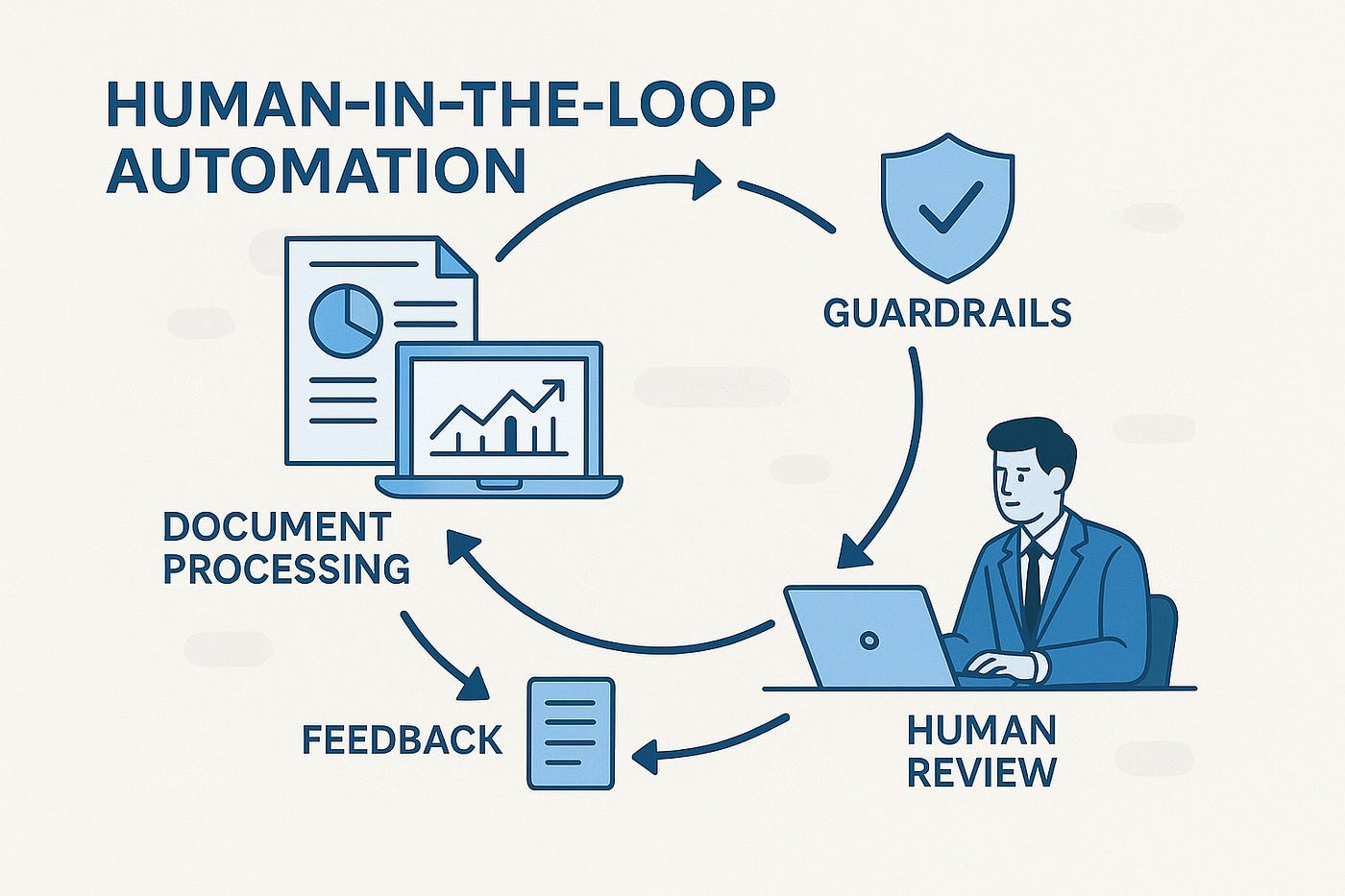
- Human-in-the-Loop Escalation: Route uncertain cases to reviewers.
- Feedback Loop Integration: Incorporate human corrections back into training data.
- Fail-Safe Defaults: When confidence drops, the system defers to manual review, not automation.
These patterns balance efficiency with control — and are already supported within the Microsoft AI ecosystem through tools like ML.NET, Azure AI Document Intelligence, and Semantic Kernel.
Applying Guardrails in the Microsoft/.NET Environment
Microsoft’s technology stack makes it straightforward to integrate guardrails into enterprise workflows:
- ML.NET: Build lightweight classifiers to evaluate document quality or confidence.
- Azure AI Document Intelligence: Automate extraction and layout understanding at scale.
- Semantic Kernel: Coordinate AI agents, guardrail models, and human feedback loops in production environments.
This approach mirrors the DoorDash framework, proving that robustness, not raw power, defines sustainable automation.
For a deeper look at these enterprise integrations, explore 👉 **Intelligent Document Processing & AI-Powered RPA**
Guardrails as an AI Philosophy
Beyond engineering, guardrails represent a mindset. They embody Stoic restraint in automation — a recognition that even powerful AI systems must know when not to act.
“Wisdom is knowing what to overlook.” — William James Guardrails operationalize that wisdom inside our machines.
By embracing this philosophy, enterprises can build IDP systems that aren’t just fast — they’re trustworthy, interpretable, and aligned with human judgment.
For real-world inspiration on how this principle plays out at scale, see 👉 **Intelligent Document Processing in Action: Lessons from DoorDash’s AI-Powered Menu System**
The Future: From Guardrails to Governance
As multimodal models and autonomous agents evolve, the need for guardrails will only increase. Tomorrow’s enterprises will extend them into policy-driven AI governance, linking model behavior to compliance frameworks and business risk thresholds.
Guardrails aren’t barriers. They’re the architecture of trust — ensuring every automated decision reinforces, rather than undermines, your organization’s integrity.
AI guardrails, Intelligent Document Processing, Enterprise AI, Automation Governance, Microsoft AI
메타데이터
- post_id
- f894e20ba4e1
- slug
- designing-ai-guardrails-building-reliable-and-responsible-intelligent-document-processing-systems-f894e20ba4e1
- url
- https://medium.com/@ai_92969/designing-ai-guardrails-building-reliable-and-responsible-intelligent-document-processing-systems-f894e20ba4e1
- canonical_url
- https://medium.com/@ai_92969/designing-ai-guardrails-building-reliable-and-responsible-intelligent-document-processing-systems-f894e20ba4e1
- author_url
- https://medium.com/@ai_92969
- status
- ok
- fetched_at
- 2026-06-17 08:20:12