A History Lesson in Reporting — It’s All About Change Management
The evolution of reporting has been a wild ride over my career. I want to share some thoughts to prepare you for what is going on today in…
A History Lesson in Reporting — It’s All About Change Management
The evolution of reporting has been a wild ride over my career. I want to share some thoughts to prepare you for what is going on today in AI learning, drawing on lessons from the past.

Don’t You Take Away My Greenbar Reports
It was in the 1990’s, and I was working at a company where reports were constantly being printed. I remember one day watching a person take a huge report, flip it over, remove the last page, and throw the rest away.
I was surprised by how much paper was used and was curious why this person was taking the last page. I asked them, and they responded, “I only need the totals, not the details.” Management soon found a software application to view reports, eliminating paper waste. This was completed quickly with limited communication.
It wasn’t long after the greenbar printers were removed that people started complaining, “How am I going to do my job now without my hardcopy reports?” The change invoked human nature, which hates change unless we are prepared for it. In this example, employees were not prepared, and acceptance took a long time.
Another lesson would emerge with the next evolution of reporting and dashboards that I didn’t envision.
All I Need is My Dashboard and Reports
Since 2000, the focus on delivering data has been on dashboards and reports. I will admit this was a major focus of mine for several years to deliver these data assets. I was also an avid user, opening up my enterprise dashboard to see how the business was doing.
From a developer perspective, I would build something, but there was always one more change or a new report, often very similar to other reports that the business users required. It provided job security, but it seemed like you could never get ahead.
The concept of self-service has always been a dream, but ever so elusive. The tools, at their core, still required technical skills. I remember trying to work with some business analysts using Power BI. Still, the combination of understanding the data grain and using DAX was a steep learning curve that was a roadblock.
Making the change to self-service didn’t mean a better experience for your business users at this time. It was still too early, and no matter how much change management and training there was, the positive business results weren’t there. I think many organizations underestimated the investment required to acquire the necessary skills.
The status quo would remain, with business users waiting for IT to build and maintain the dashboards and reports they needed. Waiting for the next evolution would keep business users working with data the same way until AI arrived.
Here’s A Personal Agent for You
Leaping forward to today, it feels like another crossroads. AI technology has brought the promise of self-service and better insights for business users. Data and Business Intelligence engineers can now focus on creating high-quality data solutions with semantic models in collaboration with business SMEs, rather than creating dashboards and reports.
Data teams are very excited about the possibilities that this opens up for the business. AI Agents are being created to enable business users to ask questions about their data within their organizations. New insights and actions are now possible without the technical skills to write SQL!
So why is adoption so low for some companies?
Has the data team’s enthusiasm for true self-service not reached business users? Why? When this happens, there is very little from a change management perspective. Let’s dig into what change management is and why it is important.
Change management helps us, as humans, understand the “why” as much as the “how” of business process changes. I have used the ADKAR model in the past. It is a framework for managing change by focusing on individual milestones: Awareness, Desire, Knowledge, Ability, and Reinforcement.
What can I do to help my business users?
Let’s put this into perspective using Snowflake CoWork (formerly Snowflake Intelligence) as the example of the AI Agentic systems and how to apply ADKAR.
Awareness
The first step is to develop a communication plan explaining the need for the change. The example I will use is having a new method for working with data that helps you ask questions and get answers that drive new actionable insights. In addition, describing the ability to go beyond understanding what is happening with dashboard data to understanding the “why.”
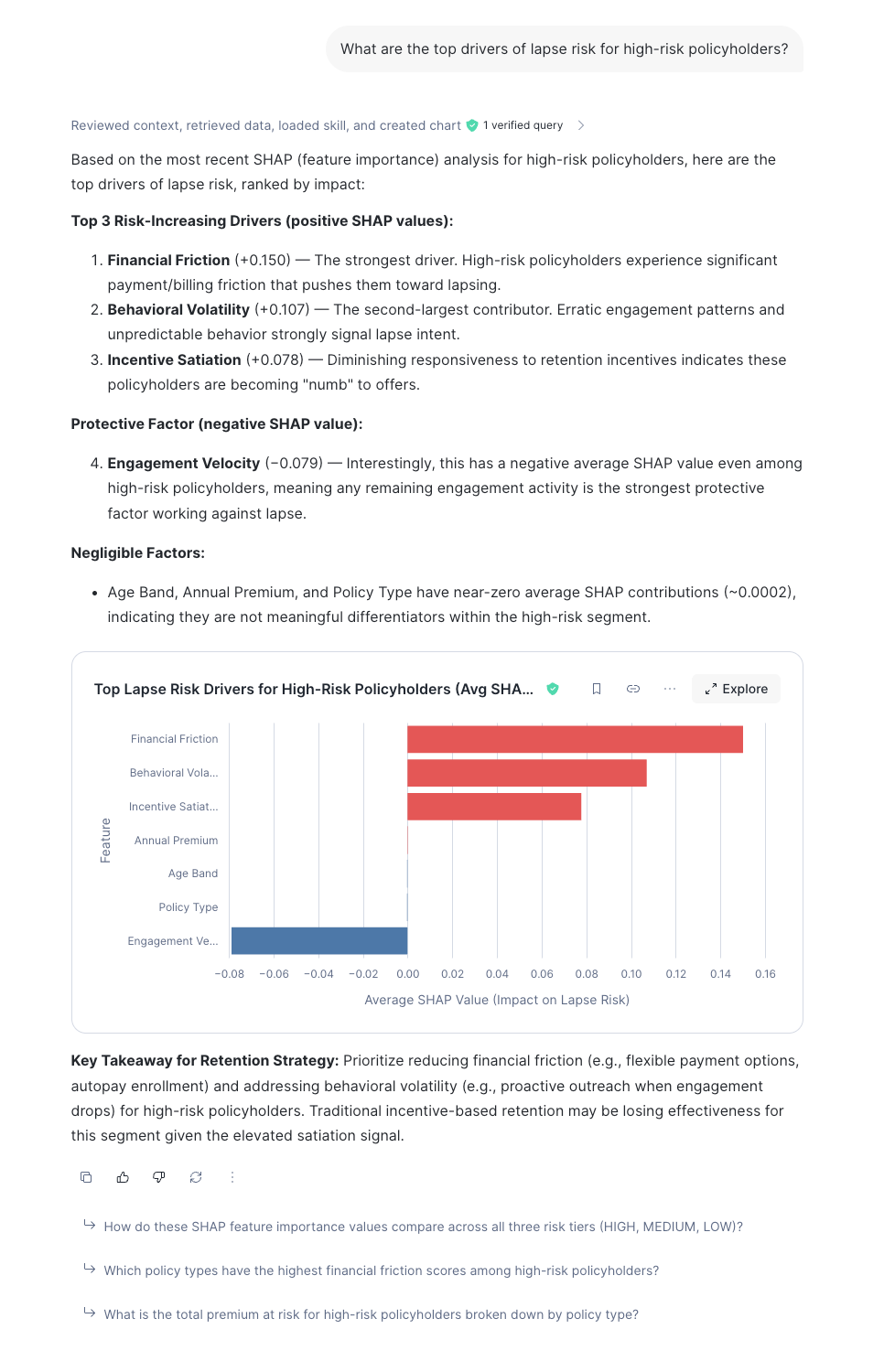
Example showing business users the level of analysis well beyond a static dashboard
Beyond communicating the benefits of Snowflake CoWork, the next step is to drive awareness through demonstrations so business users can see it in action.
Desire
The desire phase is to show individual business users what’s in it for them. You’ll likely hear from business users, “I have used my dashboards and reports for years, why would I change?” Please show them the benefits to them individually to get buy-in for supporting and participating in the use of CoWork.
One key feature that helps business users want to make the change is the use of artifacts. Artifacts in Snowflake CoWork are saved, persistent charts or tables generated from a question, so you can revisit, refresh, share, and collaborate on an insight without regenerating it.
Artifacts provide a great way to show business users they can still access a dashboard view of what matters to them whenever they want, while also diving into the data and continuing to ask questions about it in a given artifact.
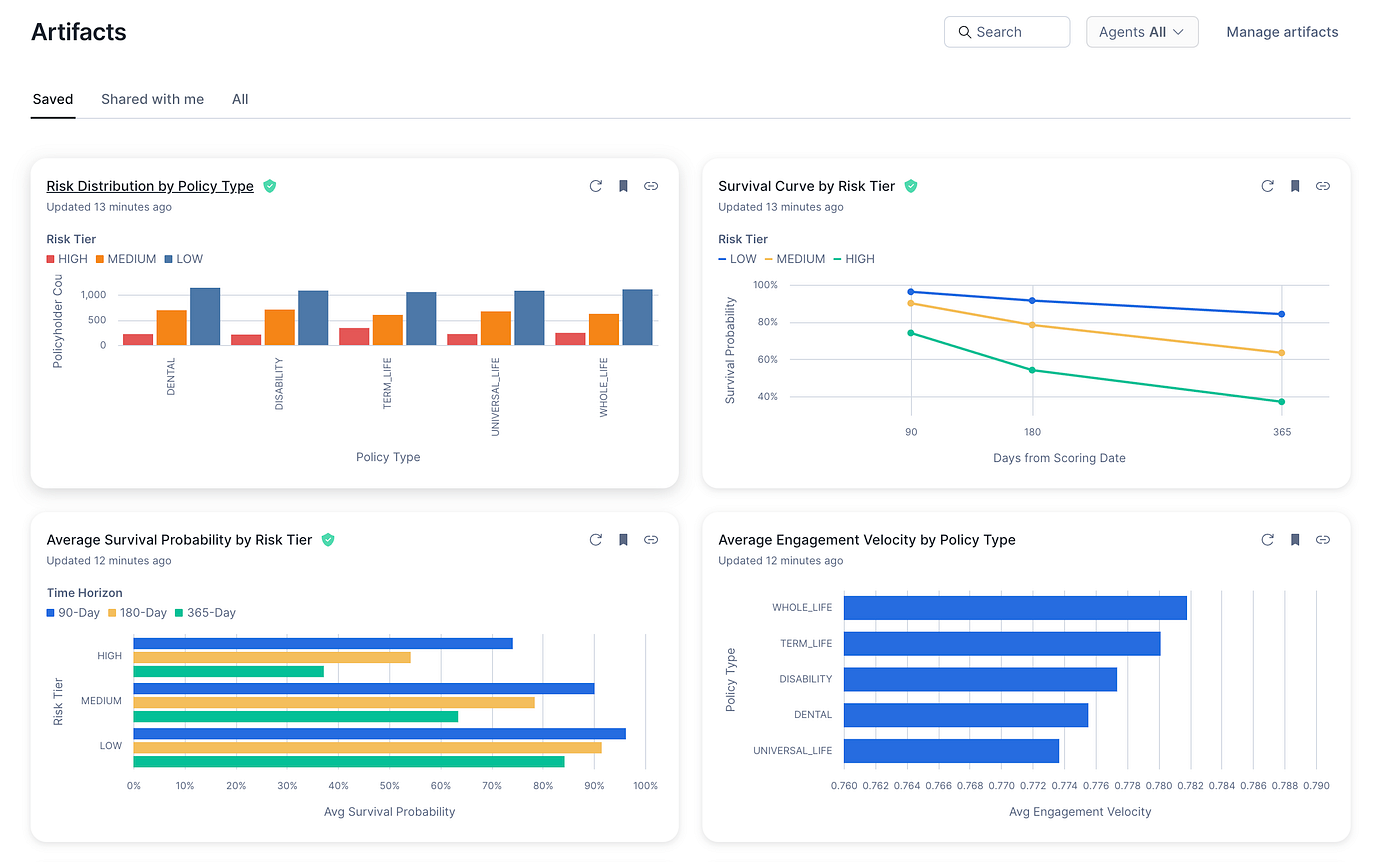
Artifacts provide a great way to create a personalized dashboard
Knowledge
Training and education are key components in increasing knowledge about the change to using Snowflake CoWork. The key is to start training on the basic data features, then move on to additional collaborative features such as deep research, skills, and connectors.
- Deep Research: Multi-source investigation across structured + unstructured data with multi-step reasoning, fully cited, and built for complex strategic ‘why’ questions.
- Skills: Create repeatable workflows as a one-line skill. Example — “pull my pipeline recap”. Skills can be more complex when they involve multiple steps.
- Connectors: Are MCP connectors authenticated connections to external systems that let CoWork discover and use tools from those systems, so it can not just answer questions but also take actions across apps like Jira, Salesforce, Slack, Gmail, and Google Drive.
In addition, show users the work that goes into the semantic models so they can trust the accuracy of the information they receive from Snowflake CoWork. This is a very important step — trust is everything!
Ability
Now that training has been completed, it is time for business users to incorporate Snowflake CoWork into their daily routines. During this phase, the data teams supporting the agents should see an uptick in usage. They will probably also have an increase in questions, which is a good thing. Whenever a group of people starts using a new technology like CoWork, there will be lots of ideas for expanding its use!
If you are still not seeing an uptick in use, then refer back to the first three phases to determine which phase needs adjustment. For example, does the training need a little extra work? No need for panic, just some minor adjustments to keep things moving along.
Reinforcement
I believe I read somewhere that changing a habit takes at least 3 weeks. Our data teams will continue to share updates on their work, communicate new features, and highlight the successes of their business users. Having business user stories about how Snowflake CoWork has impacted them personally is not only exciting but also a great source of reinforcement!
Ultimately, you are trying to prevent business users from reverting to their old dashboards and reports.
Conclusion
As technology professionals, we get excited about innovations that can make our business users and organization more successful. This article shows that even the best tech doesn’t guarantee adoption without change management. Combine the two and watch your creative work become the talk of the organization!
메타데이터
- post_id
- f894f632c6b6
- slug
- a-history-lesson-in-reporting-its-all-about-change-management-f894f632c6b6
- url
- https://medium.com/@michael.meyer_34371/a-history-lesson-in-reporting-its-all-about-change-management-f894f632c6b6
- canonical_url
- https://medium.com/@michael.meyer_34371/a-history-lesson-in-reporting-its-all-about-change-management-f894f632c6b6
- author_url
- https://medium.com/@michael.meyer_34371
- status
- ok
- fetched_at
- 2026-07-09 16:18:44