RAG vs Fine-Tuning in AI: Choosing the Right Strategy for Smarter Models
The rapid evolution of AI systems has transformed how businesses build intelligent solutions. From dynamic chatbots to advanced knowledge…
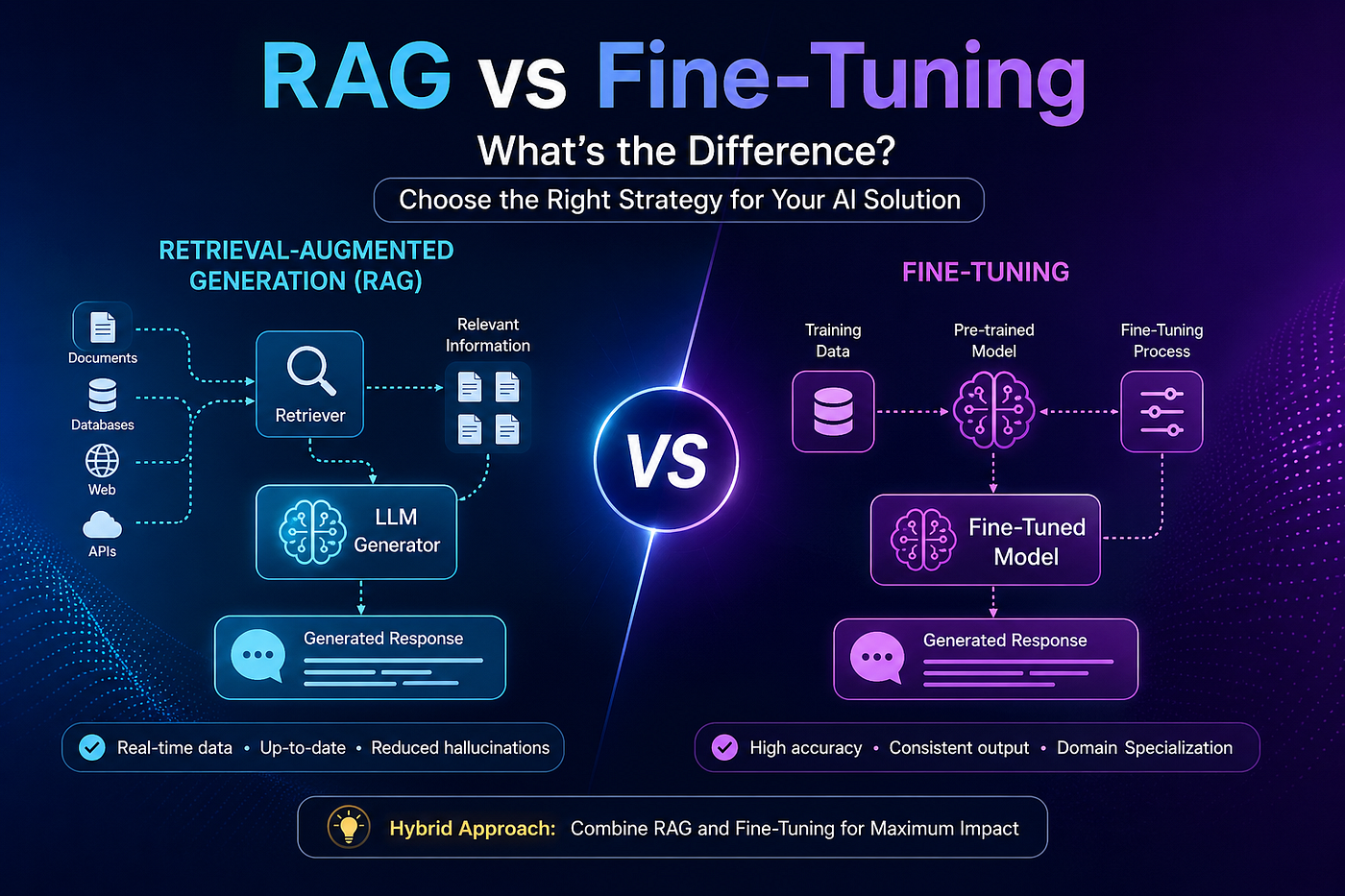
Modern AI comparison infographic showing Retrieval-Augmented Generation (RAG) vs Fine-Tuning with a hybrid approach concept, highlighting how both strategies power next-gen intelligent systems
RAG vs Fine-Tuning in AI: Choosing the Right Strategy for Smarter Models
The rapid evolution of AI systems has transformed how businesses build intelligent solutions. From dynamic chatbots to advanced knowledge assistants, organizations are now exploring more efficient ways to improve model accuracy, relevance, and adaptability. Two powerful approaches Retrieval-Augmented Generation (RAG) and fine-tuning have emerged as leading strategies, each offering unique advantages depending on the use case.
This article breaks down the key differences, benefits, and future potential of both approaches to help you make the right decision.
Understanding the Foundations of Modern AI Systems
Modern AI applications rely heavily on data-driven intelligence to deliver contextual, accurate, and real-time outputs. At the core of these systems are large language models (LLMs) that process and generate human-like text.
However, raw models are not always sufficient. Businesses often need customization strategies to:
- Improve domain-specific accuracy
- Reduce hallucinations
- Enable real-time data integration
- Enhance user experience
This is where RAG and fine-tuning come into play.
What is Retrieval-Augmented Generation (RAG)?
Retrieval-Augmented Generation is a hybrid approach that combines:
- A retrieval system (searching external or internal data sources)
- A generative model (producing responses)
How RAG Works
- User inputs a query
- System retrieves relevant data from a knowledge base
- Retrieved data is passed to the model
- Model generates a context-aware response
Key Benefits of RAG
- Real-time data access: No need to retrain models for new information
- Reduced hallucination: Responses are grounded in actual data
- Scalable knowledge integration: Easily connects with APIs, databases, and documents
- Cost-efficient updates: No repeated training cycles
Best Use Cases
- Enterprise knowledge assistants
- Customer support automation
- Document search systems
- Dynamic recommendation engines
What is Fine-Tuning?
Fine-tuning is the process of training a pre-trained model on a specific dataset to improve its performance for a particular task.
How Fine-Tuning Works
- Start with a pre-trained model
- Train it further on domain-specific data
- Adjust weights to align with desired outputs
Key Benefits of Fine-Tuning
- High accuracy for niche domains
- Consistent tone and style control
- Better task-specific performance
- Reduced dependency on external retrieval systems
Best Use Cases
- Industry-specific chatbots (legal, medical, finance)
- Brand voice customization
- Predictive analytics systems
- Structured data generation
RAG vs Fine-Tuning: Core Differences
1. Data Handling
- RAG: Uses external data sources dynamically
- Fine-tuning: Embeds knowledge directly into the model
2. Flexibility
- RAG: Highly flexible, updates instantly with new data
- Fine-tuning: Requires retraining for updates
3. Cost Efficiency
- RAG: Lower long-term cost for dynamic environments
- Fine-tuning: Higher cost due to training cycles
4. Accuracy & Control
- RAG: Context-aware but depends on retrieval quality
- Fine-tuning: More controlled and consistent outputs
5. Scalability
- RAG: Easily scalable across multiple data sources
- Fine-tuning: Scaling requires more compute resources
When Should You Choose RAG?
RAG is ideal if your system:
- Needs real-time information updates
- Works with large, frequently changing datasets
- Requires integration with enterprise tools
- Focuses on search-driven responses
Future-Ready Insight
RAG is increasingly being combined with vector databases and semantic search tools, enabling highly intelligent, context-rich systems that evolve continuously.
When Should You Choose Fine-Tuning?
Fine-tuning is better suited if your goal is:
- Deep domain specialization
- Strong output consistency
- Controlled model behavior
- High accuracy in repetitive tasks
Future-Ready Insight
Advancements in parameter-efficient fine-tuning methods (like LoRA and adapters) are making this approach more accessible and cost-effective.
Hybrid Approach: The Best of Both Worlds
Forward-thinking businesses are now combining RAG and fine-tuning to build next-gen AI systems.
Why Hybrid Models Work
- Fine-tuning ensures baseline intelligence and tone
- RAG injects real-time, up-to-date knowledge
Example Architecture
- Fine-tuned model for domain expertise
- RAG layer for dynamic data retrieval
- Vector database for semantic search
- AI orchestration tools for workflow automation
This hybrid approach is becoming the foundation of future-ready AI ecosystems.
Role of an Expert Development Partner
Implementing these advanced AI strategies requires deep technical expertise. A reliable LLM development company can help:
- Design scalable RAG pipelines
- Optimize model fine-tuning workflows
- Integrate AI into existing systems
- Ensure security, compliance, and performance
Conclusion: Choosing the Right Strategy
Both RAG and fine-tuning offer powerful capabilities, but the right choice depends on your business needs.
- Choose RAG for flexibility, scalability, and real-time intelligence
- Choose fine-tuning for precision, control, and domain expertise
- Combine both for a future-proof AI architecture
As AI continues to evolve, organizations that adopt the right strategy today will be better positioned to build intelligent, adaptive, and high-performing systems tomorrow.
메타데이터
- post_id
- f8a2e4b8cbb8
- slug
- rag-vs-fine-tuning-in-ai-choosing-the-right-strategy-for-smarter-models-f8a2e4b8cbb8
- url
- https://medium.com/@david.wilson.digital/rag-vs-fine-tuning-in-ai-choosing-the-right-strategy-for-smarter-models-f8a2e4b8cbb8
- canonical_url
- https://medium.com/@david.wilson.digital/rag-vs-fine-tuning-in-ai-choosing-the-right-strategy-for-smarter-models-f8a2e4b8cbb8
- author_url
- https://medium.com/@david.wilson.digital
- status
- ok
- fetched_at
- 2026-07-09 09:01:30