Does Playing a Musical Instrument Give Kids a Cognitive “Boost”?
Throughout my life, I have always been involved with music. From high school orchestras, marching bands, and even performing alongside…
Does Playing a Musical Instrument Give Kids a Cognitive “Boost”?
Image made with elements from Canva.
Throughout my life, I have always been involved with music. From high school orchestras, marching bands, and even performing alongside professional musicians in side-by-side concerts. Most of us have some memory of a music class, even if that’s limited to exploratory music in elementary school, but for many people it is just a part of life. However, some research may suggest that music may serve more than just the music.
In a recent study published in the Annals of the New York Academy of Sciences, researchers utilized data from the Adolescent Cognitive Brain Development study (ABCD Study). It is the largest long-term study of brain development across the United States, tracking approximately 12,000 children into adolescence. In this study they hoped to see how continuous musical engagement can ‘shape’ the brain of a child through various capacities over years.
In the study, musicians were defined as those receiving consistent musical training over the course of a few years, and non-musicians were defined as those participating in other activities. To include a more effective comparison group, musicians were compared to soccer players, who served as an active control. Unlike a passive control group that has no lifestyle change, an active control group engages in a structured activity. This comparison helped in seeing if the observed benefits resulted from musical engagement specifically, or more generally from involvement in a structured activity.
Musicians and non-musicians were given a variety of tasks that measure cognitive development and executive function. A specific one that they used is the Picture Vocabulary Test where participants heard spoken words and are asked to choose an image that best represents said word. In addition to comparing scores on individual tasks, the researchers wanted to see if the overall patterns of cognitive performance could distinguish the groups. The researchers used a machine learning tool (called a SVM) to see if the music-training group and the sports-training group could be identified through their scores on the cognitive tests.
Following two years of continuous practice in the programs, comparisons showed that the music-training group outperformed the sports-training group on various cognitive and language tasks. To ensure that the differences in cognitive performance were not solely due to socioeconomic advantage but also musical training the study used the Area Deprivation Index (ADI) to look at access to neighborhood resources. Their findings suggested that musical training served kids in high-deprivation areas by preventing a ‘vocabulary gap’ that often develops over time. The music-training group from both spectrums of the area deprivation index had similar improvements in performance in the picture vocabulary task as they developed and gained more experience with language. While the active control group from high-deprivation areas experienced significantly less vocabulary growth than their peers from low-deprivation areas, the music-training group showed no such deficit. The children in the music-training group achieved similar performance gains regardless of socioeconomic status.
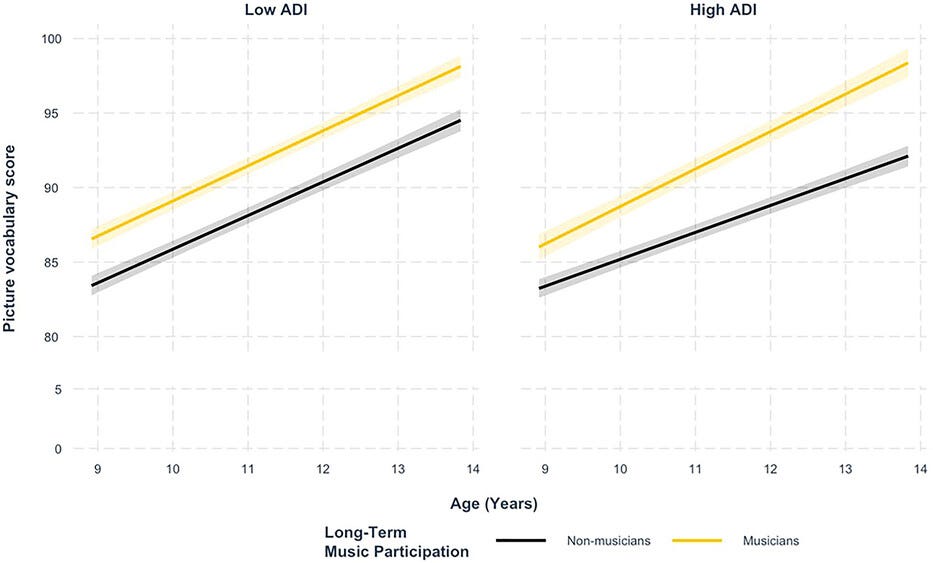
Table comparing non-musicians and musicians in picture vocabulary test scores. Source
Musical training may serve as a supplementary tool for supporting cognitive and language development due to its help in higher vocabulary scores. Although, this does not make it unique in comparison to other highly demanding cognitively enriching tasks. While the study accounts for socioeconomic status and other important factors, it may not be enough to claim music as the only or best way to get these benefits.
However, even if music isn’t unique in its ability to improve language and other cognitive skills, that doesn’t take away from its importance. Even if musical training offered no cognitive advantages at all, it would still be very valuable in other ways. From my own perspective, music has changed the trajectory of my life and has given me the best friendships, a sense of community, and a different way of seeing the world. Whether or not music gives you a ‘cognitive boost’, there will always be value in picking up an instrument.
Reference:
Habibi, A., Hsu, E., Villanueva, J., & Luo, S. (2025). Longitudinal Effects of Continuous Music Training on Cognitive Development: Evidence From the Adolescent Brain Cognitive Development (ABCD) Study. Annals of the New York Academy of Sciences. https://doi.org/10.1111/nyas.70086
메타데이터
- post_id
- f8a5e8db90f5
- slug
- does-playing-a-musical-instrument-give-kids-a-cognitive-boost-f8a5e8db90f5
- url
- https://medium.com/langmuscoglab/does-playing-a-musical-instrument-give-kids-a-cognitive-boost-f8a5e8db90f5
- canonical_url
- https://medium.com/langmuscoglab/does-playing-a-musical-instrument-give-kids-a-cognitive-boost-f8a5e8db90f5
- author_url
- https://medium.com/@erivas06
- status
- ok
- fetched_at
- 2026-07-07 12:54:49