The Future of Work: Why Adaptability Is the Real Flex
The Future of Work: Why Adaptability Is the Real Flex
The Future of Work: Why Adaptability Is the Real Flex
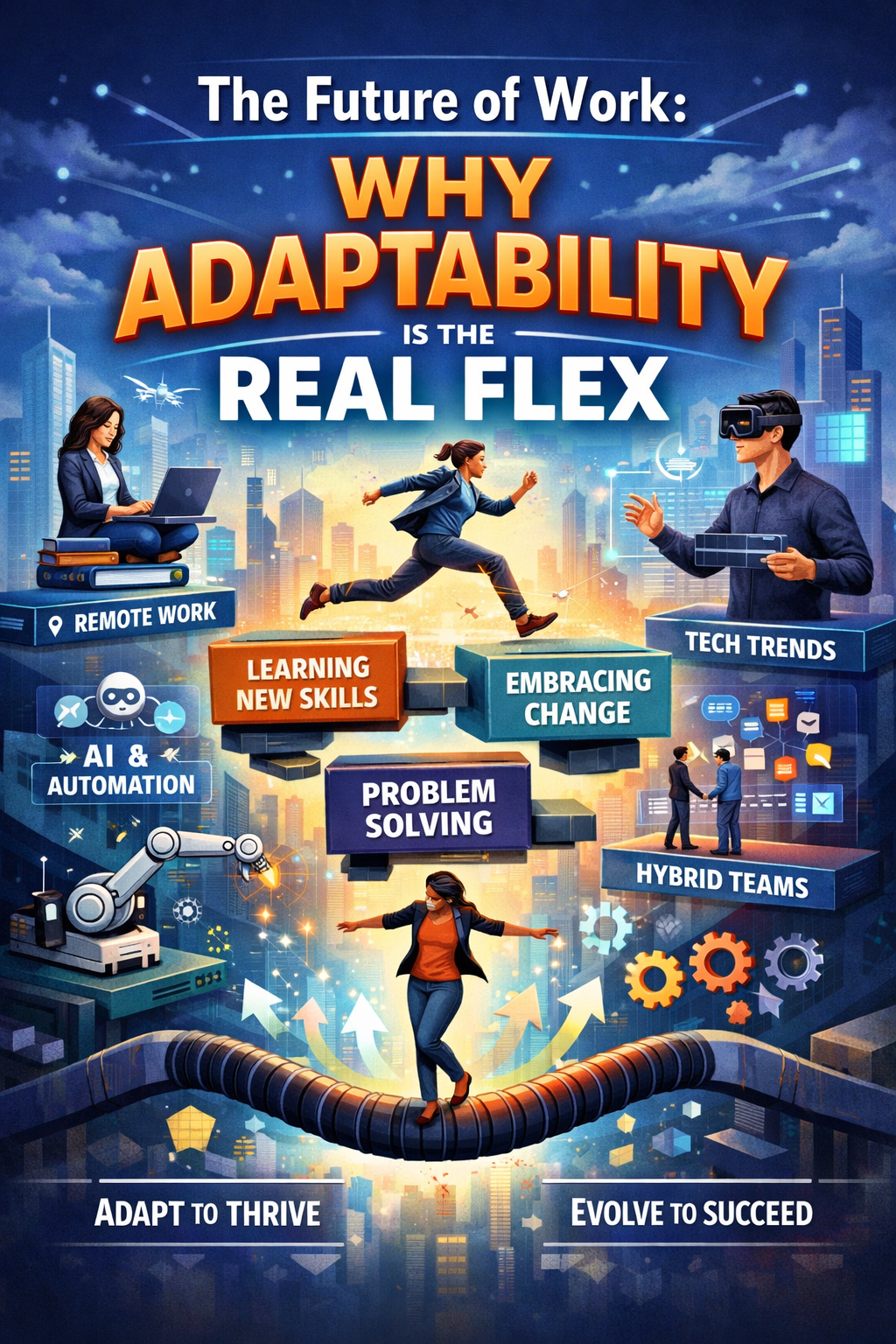
The future doesn’t belong to the strongest or the smartest — it belongs to those who can change, learn, and rise again. In a world of AI, remote work, and constant disruption, adaptability is no longer a soft skill; it’s the ultimate power move. Evolve your mindset, upgrade your skills, and turn change into your greatest advantage. 🚀
The Future of Work: Why Adaptability Is the Real Flex
Introduction: Standing at the Crossroads of Change
We are living through one of the most defining transitions in the history of Work. The familiar structures that once shaped stable Careers are dissolving, replaced by a fast-moving ecosystem powered by AI, evolving Skills, and constant reinvention. The future no longer rewards those who cling to certainty. It belongs to those who move with change. In this new era, Adaptability is not a soft trait — it is the real flex.
We are not preparing for a distant tomorrow. The future of work is already here, reshaping how we learn, earn, and grow. Those who understand this shift are not just surviving; they are building careers that thrive under pressure, complexity, and uncertainty.
The Evolution of Work in an AI-Driven World
The definition of **Work has changed dramatically. Once rooted in routine and repetition, work is now fluid, digital, and increasingly intelligent. AI** has moved beyond automation into augmentation, transforming how decisions are made, how productivity is measured, and how value is created.
We are witnessing a transition where machines handle predictability while humans focus on creativity, judgment, and emotional intelligence. This does not signal the end of human relevance — it marks the beginning of a higher standard. To remain competitive, we must learn how to collaborate with intelligent systems rather than compete against them.
AI is not replacing ambition; it is reshaping it. Those who adapt to AI-enhanced workflows are redefining excellence in modern careers.
Why Skills Matter More Than Job Titles
In the future of work, Skills matter more than credentials, titles, or tenure. Static roles are fading. Dynamic skill portfolios are taking their place. Organisations no longer hire for what we were trained to do once; they invest in what we can learn repeatedly.
Technical skills may open doors, but human skills sustain careers. Critical thinking, problem-solving, communication, and adaptability are becoming the foundation of long-term relevance. The ability to learn fast, unlearn outdated methods, and relearn new approaches defines professional resilience.
We are moving from a degree-based economy to a skills-based economy, where continuous learning is not optional — it is survival.
Adaptability: The Most Valuable Career Currency
Adaptability is the ability to respond intelligently to change, not with fear, but with confidence. It is the mindset that allows us to pivot when industries shift, tools evolve, and expectations rise.
In a world where roles are constantly redefined, adaptability determines who leads and who lags. It empowers us to take ownership of our careers, rather than outsourcing our future to outdated job descriptions.
Adaptable professionals do not wait for disruption; they anticipate it. They build transferable skills, embrace feedback, and stay curious even when certainty disappears. This is not a weakness — it is a strategic strength.
AI and the Redefinition of Career Growth
Traditional career ladders are being replaced by career lattices. AI enables faster experimentation, smarter decisions, and personalised learning paths. Growth is no longer linear — it is exponential for those willing to evolve.
We are no longer defined by a single profession for life. The future favours multi-skilled individuals who can move across domains, combining technology with human insight. Careers are becoming living systems that grow through adaptation.
AI accelerates this shift by providing real-time insights, automating low-value tasks, and freeing us to focus on meaningful, high-impact work.
The Emotional Reality of Career Transformation
Change is not just technical — it is deeply emotional. The future of work challenges identity, security, and confidence. Many fear becoming irrelevant. Others fear starting over. These emotions are real, and ignoring them weakens adaptability.
We grow stronger when we acknowledge uncertainty and still move forward. Adaptability is not the absence of fear; it is action despite it. Emotional intelligence becomes a core skill, enabling us to navigate transitions with clarity and purpose.
The careers that endure are built not on comfort, but on courage.
Learning as a Lifelong Professional Strategy
In the future of work, learning never ends. Continuous upskilling is no longer a bonus — it is a baseline expectation. Those who treat learning as a habit rather than a phase remain competitive across decades.
Microlearning, digital platforms, and AI-powered education are democratizing access to skills. We must take responsibility for our growth, actively seeking knowledge rather than waiting for permission.
Learning agility is the bridge between today’s expertise and tomorrow’s opportunity.
Organisations That Reward Adaptability Win the Future
The future of work is not just about individuals. Organizations that value Adaptability build cultures of innovation, resilience, and trust. They reward experimentation, encourage cross-functional collaboration, and invest in skill development.
Rigid hierarchies give way to flexible teams. Performance is measured by impact, not hours. Work becomes more human, more creative, and more meaningful when adaptability is embedded into organisational DNA.
Companies that fail to evolve lose relevance. Those who adapt shape the future.
Redefining Success in the Modern Career
Success is no longer defined by stability alone. It is defined by growth, relevance, and alignment with purpose. A successful Career evolves with the world, not against it.
We must redefine ambition — not as climbing a fixed ladder, but as building a flexible foundation. Adaptability allows us to pursue opportunity wherever it emerges, without fear of reinvention.
The future rewards those who are ready to change before they are forced to.
The Real Flex Is Staying Relevant
In a world obsessed with speed, technology, and disruption, the real flex is not knowing everything — it is learning anything. Adaptability is the skill that unlocks all other skills. It is the power to stay relevant, resilient, and respected in the future of work.
We do not need to predict every change. We need to prepare ourselves to handle any change. That is the mindset that builds unstoppable careers.
The future of work belongs to those who move with it.
메타데이터
- post_id
- f8dc916bf5bc
- slug
- the-future-of-work-why-adaptability-is-the-real-flex-f8dc916bf5bc
- url
- https://medium.com/@Anemania/the-future-of-work-why-adaptability-is-the-real-flex-f8dc916bf5bc
- canonical_url
- https://medium.com/@Anemania/the-future-of-work-why-adaptability-is-the-real-flex-f8dc916bf5bc
- author_url
- https://medium.com/@Anemania
- status
- ok
- fetched_at
- 2026-06-17 08:20:12






