The One-Click DeFi Economy
DeFi was originally built around a simple promise: open access to financial systems without intermediaries. But as the ecosystem has…
The One-Click DeFi Economy
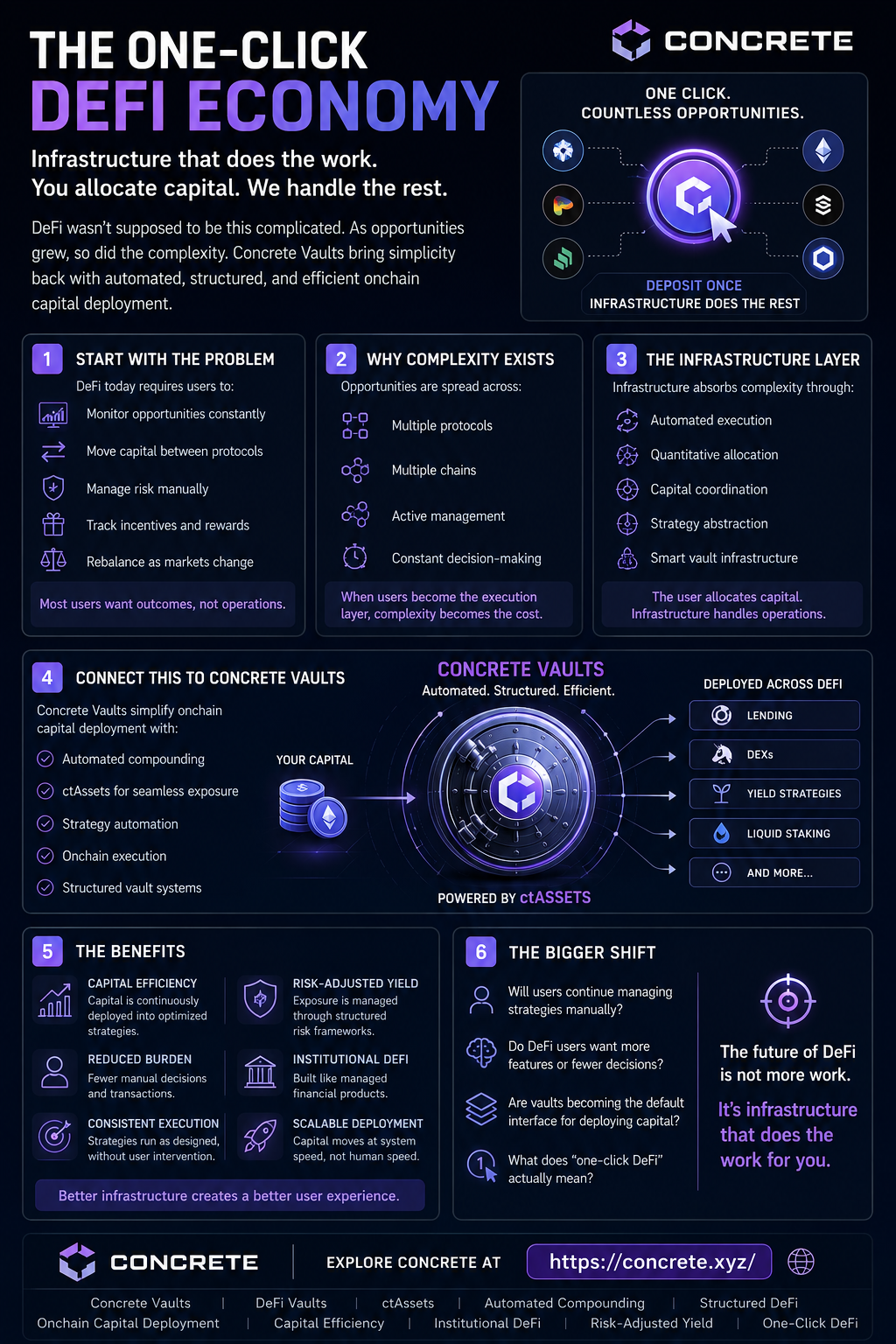
DeFi was originally built around a simple promise: open access to financial systems without intermediaries. But as the ecosystem has expanded, that simplicity has quietly shifted into something far more demanding.
Today, participating in DeFi often feels less like using a product — and more like managing a full-time strategy desk.
The next evolution of DeFi is not more tools.
It’s fewer decisions.
It’s one-click capital deployment.
1️⃣ Start With the Problem: DeFi Today Is Operationally Heavy
Most users entering DeFi quickly run into a familiar reality:
They aren’t just investing.
They are constantly operating.
To stay competitive, users often need to:
- monitor yield opportunities across protocols
- move capital between chains and ecosystems
- manage liquidation and smart contract risk
- track incentive programs and reward cycles
- rebalance positions as market conditions shift
Even basic yield strategies can require ongoing attention.
This creates a structural friction point:
Most users want outcomes, not operations.
Yet DeFi today asks them to be their own portfolio manager, execution engine, and risk officer — all at once.
2️⃣ Why Complexity Exists in the First Place
DeFi isn’t complicated by accident. The complexity is a byproduct of composability and fragmentation.
Yield opportunities are spread across:
- multiple protocols
- multiple chains
- rapidly changing incentive systems
- heterogeneous risk models
To extract value, users must coordinate across all of them.
That means every participant effectively becomes:
- a strategist deciding where capital should go
- an operator executing transactions
- a risk manager monitoring exposure
In practice, users become the execution layer of DeFi itself.
This is powerful — but not scalable for most participants.
3️⃣ Introducing the Infrastructure Layer
The next phase of DeFi is about abstraction.
Instead of users managing every operational decision, infrastructure absorbs that complexity.
This is where structured systems emerge:
- automated execution
- quantitative allocation models
- capital coordination across protocols
- strategy abstraction layers
- smart vault infrastructure
In this model:
The user allocates capital. Infrastructure handles operations.
This shift turns DeFi from an active job into a passive system.
4️⃣ Concrete Vaults and the Abstraction of Complexity
A clear example of this infrastructure shift is the rise of Concrete Vaults.
Concrete is building structured DeFi systems designed to simplify onchain capital deployment through automated vault strategies.
Instead of users manually managing positions, Concrete Vaults enable:
- automated compounding of yield
- deployment through ctAssets
- strategy automation across protocols
- structured onchain execution
- coordinated capital allocation
The result is a shift in how users interact with DeFi:
They no longer need to chase yield opportunities.
They gain exposure to them through structured vaults that manage execution in the background.
This is what “one-click DeFi” begins to look like in practice.
5️⃣ Why This Model Matters
As DeFi scales, the primary constraint is no longer access — it’s attention.
Infrastructure like vault systems introduces meaningful improvements:
- Capital efficiency: capital is continuously deployed into optimized strategies
- Reduced operational burden: fewer manual decisions and transactions
- Consistent execution: strategies run as designed without user intervention
- Risk-adjusted yield: exposure is managed through structured frameworks
- Institutional-grade design: systems resemble managed financial products
- Scalable deployment: capital can move at system speed, not human speed
This fundamentally changes who DeFi is built for.
It expands from active power users to passive capital allocators.
6️⃣ The Bigger Shift: From Active Management to Passive Allocation
The long-term question is not whether DeFi becomes more advanced.
It already has.
The real question is:
- Will users continue managing strategies manually in five years?
- Or will they simply allocate capital into systems that do it for them?
- Are DeFi vaults becoming the default interface for onchain investing?
- And what does “one-click DeFi” truly mean when fully realized?
The trajectory suggests a clear answer:
The future of DeFi is not more dashboards, more decisions, or more complexity.
It is infrastructure that removes the need for them altogether.
A system where users don’t manage strategies —
they simply choose exposure.
Explore Concrete at https://concrete.xyz/
메타데이터
- post_id
- f8de261b522f
- slug
- the-one-click-defi-economy-f8de261b522f
- url
- https://medium.com/@shepushohel/the-one-click-defi-economy-f8de261b522f
- canonical_url
- https://medium.com/@shepushohel/the-one-click-defi-economy-f8de261b522f
- author_url
- https://medium.com/@shepushohel
- status
- ok
- fetched_at
- 2026-07-11 19:05:18



