Edvard Munch’s Sun
“What is art? Art grows from joy and sorrow, but mostly from sorrow. It grows from human lives.” Edvard Munch
Edvard Munch’s Sun
“What is art? Art grows from joy and sorrow, but mostly from sorrow. It grows from human lives.” *Edvard Munch*

Edvard Munch’s “Sun” (1910–1911) sourced from Wikipedia Commons
The name Munch resonates with me. Naturally, flashes of his iconic Scream come to mind. The name and picture have penetrated our collective psyche (Viking TV., 2025), and we think of devastation, dread, sickness, and deep despair. The Scream or the Cry is a representation of “spiritual anguish” (Watson, 2026).
So, reader, you can imagine, when my eyes alighted on his mural depiction of the Sun, I became entranced. This striking scene is so far removed from what I know of Edvard Munch.
It’s a blazing testimony of the happiness a day can usher in. In sophisticated strokes that capture a childlike inventiveness, this depiction beams at us, spectators.
What I most enjoy is Munch’s clear intent. His piece maintains a truth about the brilliance of nature, an unspoken sentiment Munch held dear.
Edvard Munch: A Brief Biography
“Illness, insanity, and death were the black angels that kept watch over my cradle and accompanied me all my life.” Edvard Munch (Watson, 2026)
Born in 1863 in Löten, Norway, and raised in Oslo (then called Christiania), Munch’s early life was marked by severe loss, illness, and insanity (edvardmunch, n.d). Edvard had a challenging childhood. He lost his mother when he was five and his sister at the age of 14, both to tuberculosis (Watson, 2026; Hamilton, 1972). His young life was also upstaged by the constant resurgence of disease.
Edvard’s other sister had a debilitating mental illness. Apparently, he was plagued by a fear of this disorder expressing itself in his life (“Edvard Munch,” 2026).
His father, a doctor in the army, was deeply religious, strict and emotionally withdrawn (Hamilton, 1972). He was also mentally ill (edvardmunch, n.d.). He joined his wife and daughter, passing away when Edvard was 25 years old. This immense toll cast over Munch stained his worldview.
During his teen years, Edvard excelled academically, although he favoured technical drawing (edvardmunch, n.d.). In 1889, Munch was awarded a government scholarship to study in Paris.
He studied art for a handful of months in Léon Bonnat’s studio (Hamilton, 1972). Yet, this brief time was insignificant compared to the overwhelming impact of the collective French cultural experience and the Kristiania Bohème on his art.
The Kristiania Bohème
The Kristiania Bohème was a revisionist art and literary movement. They intended to disrupt the culture and politics of the bourgeoisie (Watson, 2026).
Founded in Oslo, Norway (formerly Kristiania/Christiania), and led by Hans Jæger (“The Kristiania Bohemians,” 2026). The Kristiania Bohème advocated freedom from class hierarchy, individualism, and the expression of love in all their work (Watson, 2026). Apparently, Munch was drawn to the group after reading a controversial novel written by Hans Jæger (Hamilton, 1972).
The group followed a doctrine outlined in their Nine Bohemian Commandments. Their core philosophy had an underlying system of anarchism (“Kristiania Bohemians,” 2026).
The Bohemes was a precursor to the expressionist movement. Their impact on Munch was significant. He adopted their bohemian philosophy with vigour (Hamilton, 1972). Artists like Christian Krohg and Oda Krohg belonged to the Kristiania Bohème and inspired Munch (Watson, 2026).
This group, along with other modernist movements and their challenge of artistic dogma, was instrumental in forwarding the artist’s narrative. The Expressionist style evoked by Munch evolved from this anarchist philosophy.
The Expressionist Style
“A series of powers are at work within the great stream of Expressionism who have no outward similarity to one another but a common direction of thrust, namely the intention to give expression to things of the psyche (seelisches) through form alone.” *Max Ernst*
Expressionism was revolutionary. It was a breakaway of Impressionism and a darker cousin to Fauvism. Generally, Expressionism, like Fauvism, relied on bold tones, hues, and shades to express emotion. However, the depictions were more dismal, darker sentiments. In Munch’s case, paintings conveyed a forboding.

Edvard Munch “Morning” 1884, Sourced from Wikiart
Expressionism is evident in the provocative quality of Munch’s Morning. Munch captures so much more than the women peering beyond the spectator's view. There is emotion here. Personally, I feel a longing, a melancholic yearning. Her eyes crease at the edges, hinting towards a smile, inviting the new day. There is a quiet striving, a numinous connection between subject, painter, and audience.
Compare Morning to Ernst Kirchner’s Die Artistin — Marcella. Note how Kirtchner's use of prominent colours and bold lines still conveys an emotional suggestion to the viewers. The female subject appears bored. Yet the black horizontal lines draw you in. Looking deeper, there is, I believe, a quiet malaise stirring within this subject- an ennui.
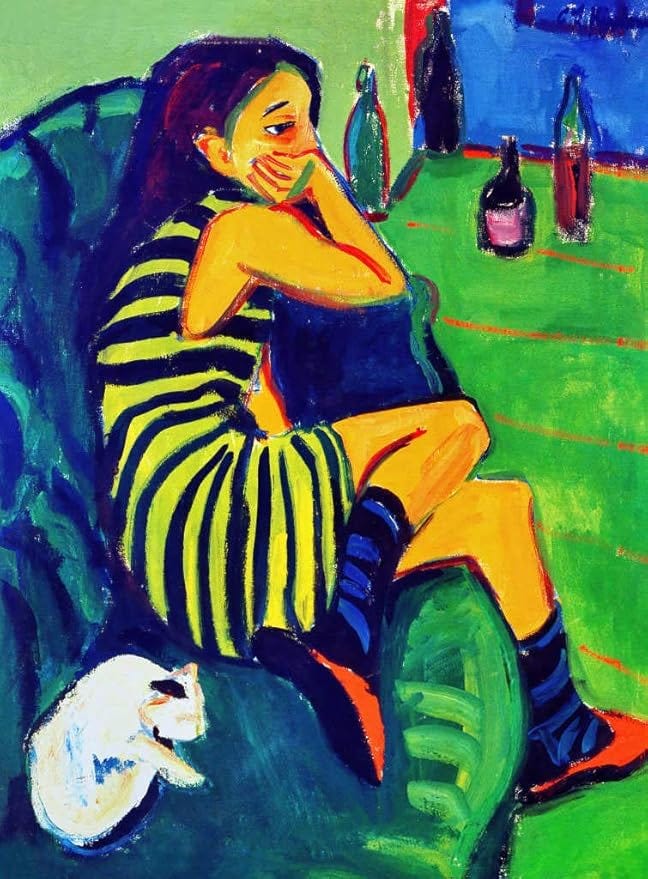
Ernst Kirchner, ‘The Female Artist ( Die Artistin- Marcella)’ 1910, Sourced from Wikiart
True to the Expressionist style, Kirchner's pieces typically render suggestions of severe sadness. Importantly, the Expressionist pieces are meant for an audience. They dance in colour and movement, the underlying sorrow clear in subtle gestures or dramatic poses.
The desire to express the emotional in landscape, portraits, and various scenes is what makes these men outstanding figures within the art world. Any realist portrayal is overlaid with the deeper, largely unexplored realities of the psyche.

Ernst Kirchner, ‘Double Self-Portrait,’ (date unknown), sourced from Wikiart
Expressionism frequently distorted or exaggerated the shape and form of its subjects (“Expressionism,” 2026). It gave room to each artist to stay true to their distinct style. Consequently, the individual artists of the Expressionist era developed and evolved.
Often, Expressionists used dark greens, blues, and blacks to reveal the scene’s despair, the subject’s state of suffering. They induced a sense of empathy and strove for compassion. They attempted to get the audience thinking and feeling for those under the blanket of bleakness. Those people with whom society doesn’t think after, bother, or care for.

Edvard Munch, ‘The sick Child,’ 1885–1886, sourced from Wikiart
The Expressionist era lasted approximately 30 years. It came to a rapid halt in the 1930s, during the rise of Nazism. The movement was seen as degenerative art. The Nazi’s used expressionist art as an example of degenerative art in their propaganda campaign. Many artists fled Germany, as World War 2 approached, in terror for their lives.
Edvard Munch: Expressing the inner mirror of the soul
“He did not close his eyes to the modern Inferno…. and so was able to diagnose the panic and universal anxiety.” *Oskar Kokoschka’s observation on Munch as a young man. (Hamilton, 1972, p. 122)*

Edvard Munch, “The Scream/Skrik ” 1893, Sourced from Amazon
The Expressionist style followed on from the Fauvist rebellion and the romance of Impressionist musings. It spoke to the psychological realities and how the individual perceives their surroundings. Munch, highly invested in the psychological, felt an inner compulsion to portray these realities.
He was profoundly influential within the Expressionist era. Hamilton (1972) compares Munch’s impact on the Expressionist era with Van Gogh. He does this as each man refused to comply with social standards. Also, both artists strove to capture visually “symbols for psychic maladjusted” (Hamilton, 1972, p. 122). Munch used Expressionist themes to develop some of the principles that informed the Symbolist art movement (Watson, 2026)

Vincent Van Gogh, ‘Self Portrait,’ 1889, sourced from Wikiart
The subject matter of Munch’s work was deeply personal. Despite the vivacious colors and energetic sweeps of paint, they were sombre, gloomy, and dismal. Always revelatory, his pieces manage to shed insights into the inner dimension of the human experience- the torments of the mind.

Edvard Munch, ‘Melancholy,’ 1892, sourced from Wikiart
Expressing the interior landscape of the mind came naturally to both Munch and Van Gogh. Both men were obsessively occupied with their clinical state and mental suffering.

Vincent Van Gogh, ‘Sower with Setting Sun,’ 1888, sourced from Wikiart
Munch’s youth was rife with one dismal event after another. Each event locked Munch in the certainty that despair haunts a person’s life. His adult life was also plagued by emotional crisis and mental strain.
It’s interesting how, in the shadow of expressionism and the famous Scream, Munch could find inspiration from the guiding force of the sun. His mural is a gentle, almost kinder exploration of the psychological. It possesses redemptive powers like the newness of the day.
Edvard Munch’s Sun
“I saw the sun rise up above the cliffs — I painted the sun.” *Edvard Munch*
The Sun is a part of the University of Oslo’s ceremonial hall (Aula) in Norway (Viking TV., 2025). Edvard Munch won a competition to decorate the Aula (Viking TV., 2020). The competition was to commemorate the university’s centenary in 1911 (Munch, n.d.).
Announced in 1909, the competition gathered Norway’s more renowned artists to participate in designing and painting a mural. Munch wasn’t invited. Nonetheless, he wrote a letter to the committee stating his wish to join (Munch, n.d.).
Munch painted several versions of The Sun after experiencing an emotional and mental upheaval. He returned to Norway following a brief stay in a mental institution in Copenhagen. Before that, he was constantly traveling, living as a foreigner. He sought refuge, desiring a breakaway from urban life and its temptations (Viking TV., 2020).
He received treatment at the clinic and cleansed his system. Back home, he managed to regain equanimity and reconnect with himself. In Norway, he had a fresh, albeit tentative sense of renewed wonder.
With his friend Christian Gierløff (Munch, n.d.) and cousin Ludvig Ravensberg (Viking TV., 2020), he moved along the South coast of Norway. Eventually, he settled in Kragerø, where he sketched and drafted hundreds of versions of his concept- The sun rising over the rocky archipelago off Kragerø (Munch, n.d.).

View of coastal Kragerø, sourced from Visit Kragerø
It was a close competition, with it ending in a stalemate between Munch and Emmanuel Vigeland. The jury decided to call a halt to the proceedings. Edvard kept striving and created a smaller rendering, which he showcased in Germany with resounding success. He was permitted a temporary exhibition in the Aula. Eventually, his friends collected enough money to buy the productions and donated them directly to the university (Munch, n.d.).

Edvard Munch, ‘Friedrich Nietzsche,’ Sourced from Munch
Munch was inspired by notions of vitality, a divine energy. He found this in the works of Frederick Nietzsche, whom he painted posthumously in 1906 (Munch, n.d.). This portrait is a precursor of the Sun. It gives us fresh insights into how Munch felt about the existential philosophies discussed and adopted within European culture.
This is so far removed from the existential dread we frequently associate with him.
The Sun, with its reaching rays, is provider, nurturer; it gifts man light to see, and energizes as it illuminates. “Inhuman itself, it is the source of all life” (edvardmunch, n.d.). The mural occupies the width and height of the university’s wall almost in its entirety, inviting an emotional experience- a cleansing, an offering.
Conclusion
Edvard Munch’s early life was marred by incredible sadness and despair. A prodigious artistic talent, Munch transcended his overwhelming obstacles and found his voice as a leading member of the expressionist movement. The Scream is universally known and speaks to a sense of inescapable angst. The Sun, on the other hand, speaks to renewal, hope, and a softening of the cruelties of the previous day. Enlightenment and vitality, the Sun dispels darkness and gifts us all.
Reference List
Edvard Munch. (n.d.). Home. In EdvardMunch. https://www.edvardmunch.org/
Edvard Munch. (2026, Februrary 11). Edvard Munch. In Wikipedia. https://en.wikipedia.org/wiki/Edvard_Munch
Expressionism. (2026) Expressionism. In Britannica. https://www.britannica.com/art/Expressionism
Hamilton, G. H. (1972). Painting and Sculpture in Europe 1880–1940. Penguin Books.
Munch. (n.d.) Between Us and the Sun. In Munch. https://www.munch.no/en/our-collection/between-us-and-the-sun/
Munch. (n.d.). A Monumental Battle. In Munch. https://www.munch.no/en/our-collection/munch-paintings-the-world-rejected/
The Kristiania Bohemians. (2024, November 10). Kristiania Bohemians. In Wikipedia. https://en.wikipedia.org/wiki/Kristiania_Bohemians
The Sun, 1909. (n.d.). The Sun, 1909. In EdvardMunch.org. https://www.edvardmunch.org/the-sun.jsp#google_vignette
The Sun. (n.d.). The Sun. In The University of Oslo. https://www.uio.no/english/about/culture/collection/aula/the-sun.html
Viking. TV. (2020, May 18). Exploring the Sun: Edvard Munch’s Masterpiece with Curator Kari J. Brandtzæg. YouTube. https://www.youtube.com/watch?v=jdd12mW-U3w
Viking. TV. (2025, July 28). Exploring the universe of Norway’s master of expressionism, Edvard Munch. YouTube. https://www.youtube.com/watch?v=TYf4-3-vQps
Watson, G. F. (2026, January 23). Edvard Munch. In Britannica. https://www.britannica.com/biography/Edvard-Munch
Watson, G. F. (2026, January 23). Kristiania Bohème. In Britannica. https://www.britannica.com/topic/Kristiania-Boheme
메타데이터
- post_id
- f8f3f72db920
- slug
- edvard-munchs-sun-f8f3f72db920
- url
- https://medium.com/@kerryannesearle/edvard-munchs-sun-f8f3f72db920
- canonical_url
- https://medium.com/@kerryannesearle/edvard-munchs-sun-f8f3f72db920
- author_url
- https://medium.com/@kerryannesearle
- status
- ok
- fetched_at
- 2026-08-05 22:16:30