Nataraja- The cosmic dancer
“Angikam Bhuvanam Yasya
Nataraja- The cosmic dancer
“Angikam Bhuvanam Yasya
Vachikam Sarva vangmayam
Ahaaryam Chandra taaradi
Tam Numaha Satvikam shivam”
The Namaskriya Shloka that every classical dancer learns at the very first dance class in her/his life and says every time she/he commences and ends her dance. The Indian tradition of doing puja i.e. worshipping the almighty, a way to exhibit your gratitude towards God for giving this life-changing opportunity of being blessed to learn this divine art form. A dancer on the very first day is taught to worship the God of dance Nataraja.
This is the form of Lord Shiva as the cosmic dancer with its mention in various dance literature. This form of Shiva is found at the Chidambaram temple, Tamil Nadu, India. Chidambaram is said to be the center of the universe. This form of Lord Shiva is found here and is worshipped by all Shaivites and Indian classical dancers alike.
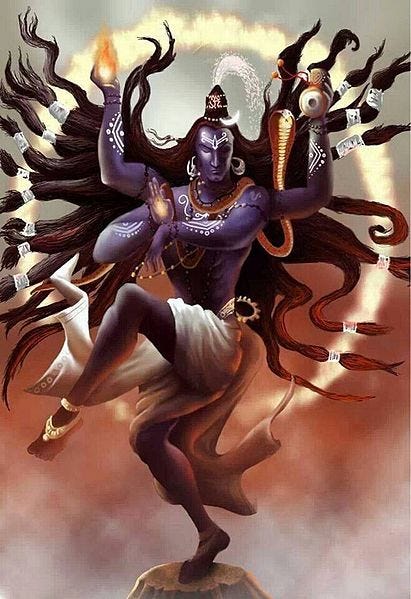
Image Source:wikipedia.org
Lord Shiva is said to have performed the ‘Ananda Tandava’ here. There is a forest adjoining this temple known as the Thillai forest were centuries ago resided a group of saints who believed that through chants and magic words they can control the supreme power. Lord Shiva then took the form of a ‘Pitchatanadar’, a simple mendicant seeking alms and Lord Vishnu accompanied him in the form of ‘Mohini’. The rishis and their wives are enchanted on seeing them. Seeing their consorts enchanted, the rishis got furious and started attacking the mendicant. They first attacked with scores of serpents using magic words. Lord Shiva took them and wrapped it around his neck, waist, and hair locks. They then invoke a ferocious tiger, Lord Shiva skinned it and tied it around his waist. Then the angry rishis used all their powers to create a terrifying demon ‘muyalakan’, Lord Shiva with a gentle smile then stepped on the back of the demon and performed the ‘Ananda Tandava’ and revealed his true form.
This epitome of beauty is adorned by numerous multi-faceted jewels all over the body. At the very top sits the life-giving river Ganga symbolizing prosperity. Besides her is the crescent moon depicting benevolence.
The right ear bears man’s jewel whereas the left ear bears woman’s jewel together telling us the tales of the union of Shiva and Shakti. The sun and the moon are the two eyes whereas the third eye in between the brows used to kill the Lord of love ‘Manmata’ symbolizes knowledge.
Coming down the snake at the neck is a symbol of Kundalini shakti i.e. each individual’s spiritual director, who strives to lead us to constant awareness of the Source. The thread across the body signifies purity.
In this form, Lord Shiva has 4 hands each carrying tales of creation. The upper right-hand carries ‘damaru’, a small two-headed drum. The upper left-hand holds fire. The lower right hand is uplifted in ‘Abhaya hasta’. The lower left hand pointing downward in ‘dola hasta’.
Lord Shiva’s right foot is placed on the demon crushing the demon. The left foot is raised in kunchita pada. There is a ring of flames around this idol known as ‘Prabhamandala’. The face holds a tranquil expression.
Lord Shiva in this form depicts the ‘Panchakritya’- ‘Shrishti’ that is the creation or origin of life,
‘stithi’ that is protection and preservation,
‘samhara’ that is destruction,
‘tirobhava’ that is ignorance and
‘moksha’ is salvation.
“Life is a succession of lessons which must be lived to be understood.”
— Helen Keller
This single idol in it depicts the entire cycle of life, tells the story of the creation, speaks volumes about the greatness of Indian culture but more does this idol has to say?

Image Source:pixabay.com
As 21 century is exploring new ways to attain mental peace and experience bliss this idol has something more to tell us. Change is the only thing constant. Change is what happens outside of us but it is what affects inside of us. Numerous changes take place in and around us and we are always ready to put our hands down and give in our self-confidence into the hands of these changes. We are always ready to surrender our self worth in front of these changes. Psychologically there is nothing wrong with this behavior of ours owing to the human mind. A human mind is programmed in that manner to give in to any petty change happening. However, if life was so simple and predictive what were we then supposed to learn through this journey?
“We may get knocked down on the outside, but the key to living in victory is to learn how to get up on the inside.”
― Joel Osteen
This idol is complete in all senses. In its very posture, it gives us a principal message i.e. the everything lies within you. The power to create and the power to destroy is in your hands. No change be it a small change or a great change doesn’t hold any ability to take away your peace of mind. You are the creator and the destructor of your beautiful life.
Indian classical dances teach the dancers this valuable life skill. A dancer holds the power to beautify the performance irrespective of the circumstances around or simply give in and spoil the performance.
A dancer throughout his/her journey learns the key skills of patience and determination. They very well imbibe the masterstroke to take charge of their well being and to establish stability within them irrespective of surrounding circumstances. Through the rigorous training that a dancer undergoes it teaches them the value of hard work and gives them a chance to taste the result of their efforts.
A dancer while learning various compositions by great saints and poets learns about the glorious past of India. The past that speaks about the stories of God in the innumerable forms, and also heroic deeds of our distinguished leaders. These stories under wraps give away a valuable message which the dancer understands while portraying the story. Although this message doesn’t just stay with the dancer only until they perform but stay with him/her as a life lesson.
A dancer creates a space around him/ her. This space is where the dancer spreads his wings and creates a mark. This space is the small world which the dancer knows is his and he is the king of that space which also gives a sense of understanding as the self is ours and we have to look after it.
Classical dance teaches us to be strong and makes us aware of the fact that we are responsible for our inner stability.
메타데이터
- post_id
- f8fe0574122e
- slug
- nataraja-the-cosmic-dancer-f8fe0574122e
- url
- https://medium.com/@shruti-vs19/nataraja-the-cosmic-dancer-f8fe0574122e
- canonical_url
- https://medium.com/@shruti-vs19/nataraja-the-cosmic-dancer-f8fe0574122e
- author_url
- https://medium.com/@shruti-vs19
- status
- ok
- fetched_at
- 2026-07-28 18:25:08